
Contact Us
  Search
The Business Research Company Logo
Women’s Digital Health Global Market Opportunities And Strategies To 2035
Published :May 2026
Pages :356
Format :PDF
Delivery Time :2-3 Business Days
Why 2-3 days? We update the report with the latest data and news before delivery. Let us know if you need us to expedite.
Report Price :$4,490.00

Women’s Digital Health Global Market Opportunities And Strategies To 2035

By Type (Mobile App, Wearable Devices, Diagnostic Tools, Other Types), By Component (Software, Services, Hardware), By Application (Reproductive Health, Pregnancy, Nursing Care, Pelvic Care, General Healthcare And Wellness), And By Region, Opportunities And Strategies – Global Forecast To 2035

Women’s Digital Health Market Definition

Women’s digital health refers to the use of digital technologies and services specifically designed to address the unique healthcare needs of women across various life stages, including menstruation, fertility, pregnancy, postpartum care, menopause and overall wellness. The market comprises mobile applications, wearable devices, diagnostic tools, connected hardware and software platforms, as well as digital services such as teleconsultations and personalized health coaching. The women’s digital health market consists of sales, by entities (organizations, sole traders, or partnerships) of women’s digital health products and services that are used by women to manage their health issues. There are many mobile applications available that are only made for helping women to manage their health such as reproductive related mobile application that track their menstrual cycles, ovulation and fertility.
Research Expert

Book your 30 minutes free consultation with our research experts

Women’s Digital Health Global Market Opportunities And Strategies To 2035 Market Size and growth rate 2025 to 2030: Graph

Women’s Digital Health Market Size

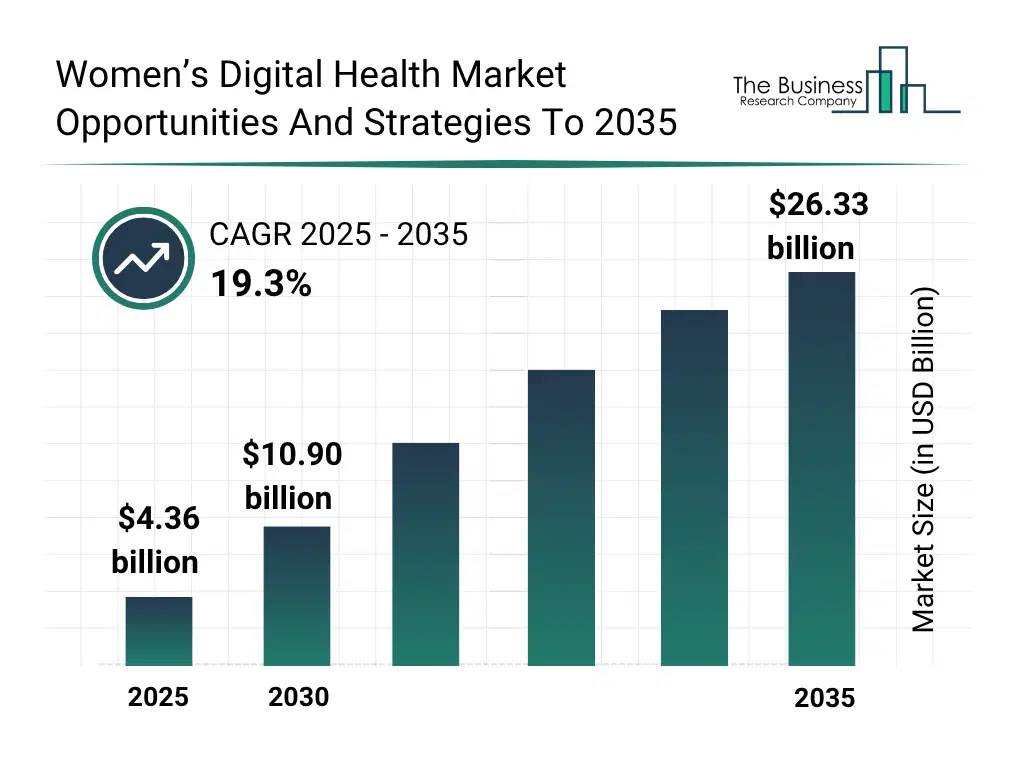
The global women’s digital health market reached a value of nearly $4,364.2 million in 2025, having grown at a compound annual growth rate (CAGR) of 20.6% since 2020. The market is expected to grow from $4,364.2 million in 2025 to $10,903.8 million in 2030 at a rate of 20.1%. The market is then expected to grow at a CAGR of 19.3% from 2030 and reach $26,327.2 million in 2035. Growth in the historic period resulted from increasing number of working women, growing focus on postpartum care and mental health support, rising maternal morbidity and high-risk pregnancies and rising infertility rates. Factors that negatively affected growth in the historic period were limited reimbursement coverage and data privacy and security concerns. Going forward, rising smartphone penetration, growing burden of chronic and women-specific health conditions, expansion of digital health infrastructure and increasing focus on maternal and neonatal health outcomes will drive growth. Factors that could hinder the growth of the women’s digital health market in the future include physician skepticism and resistance to digital tools, low health literacy and limited Awareness and impact of trade war and tariff.

Women’s Digital Health Market Segmentation

The women’s digital health market is segmented by type, by component and by application.

By Type –
The women’s digital health market is segmented by type into:
    • a) Mobile Apps
    • b) Wearable Devices
    • c) Diagnostic Tools
    • D) Other Types Consumable
The mobile apps market was the largest segment of the women’s digital health market segmented by type, accounting for 65.7% or $2,865.2 million of the total in 2025. Going forward, the wearable devices segment is expected to be the fastest growing segment in the women’s digital health market segmented by type, at a CAGR of 20.7% during 2025-2030.

By Component –
The women’s digital health market is segmented by component into:
    • a) Software
    • b) Service
    • c) Hardware
The software market was the largest segment of the women’s digital health market segmented by component, accounting for 46.5% or $2,027.7 million of the total in 2025. Going forward, the software segment is expected to be the fastest growing segment in the women’s digital health market segmented by component, at a CAGR of 21.6% during 2025-2030.

By Application –
The women’s digital health market is segmented by application into:
  1. a) Reproductive Health
  2. b) Pregnancy And Nursing Care
  3. c) Pelvic Care
  4. D) General Healthcare And Wellness
The reproductive health market was the largest segment of the women’s digital health market segmented by application, accounting for 41.0% or $1,789.7 million of the total in 2025. Going forward, the general healthcare and wellness segment is expected to be the fastest growing segment in the women’s digital health market segmented by application, at a CAGR of 22.1% during 2025-2030.

By Geography - The women’s digital health market is segmented by geography into:
      o Asia Pacific
      • • China
      • • India
      • • Japan
      • • Australia
      • • Indonesia
      • • South Korea
      o North America
      • • USA
      • • Canada
      o South America
      • • Brazil
      o Western Europe
      • • France
      • • Germany
      • • UK
      • • Italy
      • • Spain
      o Eastern Europe
      • • Russia
      o Middle East
      o Africa
North America was the largest region in the women’s digital health market, accounting for 37.8% or $1,649.8 million of the total in 2025. It was followed by Asia Pacific, Western Europe and then the other regions. Going forward, the fastest-growing regions in the women’s digital health market will be Asia Pacific and South America where growth will be at CAGRs of 25.3% and 21.9% respectively. These will be followed by Middle East and Africa where the markets are expected to grow at CAGRs of 21.3% and 20.9% respectively.

Women’s Digital Health Market Drivers

The key drivers of the women’s digital health market include: Expansion Of Digital Health Infrastructure Expansion of digital health infrastructure is expected to be a key driver of the growth of the women’s digital health market in the forecast period. Broader availability of secure cloud platforms, telehealth frameworks, electronic health records and digital payment systems enables seamless deployment of women-centric apps, connected devices and remote care services. Strengthened infrastructure supports data sharing, analytics and personalized care delivery, allowing women’s digital health platforms to offer more advanced features such as remote monitoring, AI-driven insights and integrated care coordination. As digital infrastructure matures, it reduces barriers to implementation and enhances the scalability and reliability of women’s digital health services. The expansion of digital health infrastructure during the forecast period in 2025 is 1.3%.

Women’s Digital Health Market Restraints

The key restraints on the women’s digital health market include: Physician Skepticism And Resistance To Digital Tools Physician skepticism and resistance to digital tools is restricting the growth of the women’s digital health market during the forecast period. Some healthcare professionals remain cautious about the clinical validity, accuracy and reliability of digital women’s health platforms, particularly in areas such as fertility tracking, remote monitoring and AI-driven insights. Concerns around increased workload, data interpretation responsibility and disruption to established workflows further limit clinician engagement. Without strong physician endorsement, digital women’s health solutions face barriers to trust, referral and long-term utilization within formal healthcare settings. Growth affected by physician skepticism and resistance during the forecast period in 2025 is -1.5%.

Women’s Digital Health Market Competitive Landscape

Major Competitors are:

  • Flo Health Inc.
  • Garmin Ltd.
  • Advantia Health
  • Syntegon Technology
  • NURX Pharmaceuticals Inc.
  • Other Competitors Include:

  • Hims & Hers Health Inc.
  • Bellabeat
  • Pristyn Care
  • Elvie
  • Nuvo Group Ltd.
  • Sirona Hygiene Pvt. Ltd.
  • twoplus Fertility SG
  • Zora Healthcare Pte. Ltd.
  • Ovum
  • Laiqa
  • ByteDance Ltd.
  • Panasonic Holdings Corporation
  • Chiral Corporation
  • Femtech Japan
  • SugenTech Inc.
  • Samsung Electronics Co. Ltd.
  • Dayima
  • Meiyou
  • Babytree
  • Medita Co
  • Kayanee
  • Smart Health Medical
  • FamCare
  • Labayh
  • iLean
  • Nabta Health
  • Ovasave
  • Diva'Me
  • MyLily
  • PeriCare
  • Mina Roe
  • Bonzun
  • Vira Health
  • VediamociChiara
  • Ava AG
  • Biowink GmbH
  • Clue (by BioWink)
  • Nuvo Group
  • Reya Health
  • My Normative
  • Fecundis Lab
  • Hygia Health
  • Huna
  • Bellamaterna
  • Maven Clinic
  • Hims & Hers Health, Inc.
  • The Women's Wellness Centre
  • myGynaeDoc
  • Elara Health
  • June Health
  • OOVA
  • Kindbody
  • Glow
  • Allara Health
  • Tia
  • Oula
  • Mino Care
  • Afynia
  • Cosm Medical
  • Choiz
  • Bloom Care
  • Blessed Mothers
  • RadarFit
  • Zoie Health
  • Viya Health
  • CapeRay
  • Coral
  • HeraMED Ltd.
  • MomConnect
  • My Pregnancy Journey
  • FemConnect
  • Need data on a specific region in this market?

    Opportunities And Recommendations In The Women’s Digital Health Market

    Opportunities – The top opportunities in the women’s digital health market segmented by type will arise in the mobile apps segment, which will gain $4,374.7 million of global annual sales by 2030. The top opportunities in the women’s digital health market segmented by component will arise in the software segment, which will gain $3,354.8 million of global annual sales by 2030. The top opportunities in the women’s digital health market segmented by application will arise in the reproductive health segment, which will gain $2,710.7 million of global annual sales by 2030. The women’s digital health market size will gain the most in the USA at $1,818.8 million. Recommendations- To take advantage of the opportunities, The Business Research Company recommends the women’s digital health companies to focus on connected consumable innovation, focus on AI-enabled personalized mobile platforms, focus on connected, women-centric diagnostic platforms, focus on scaling connected smart medical instruments, focus on women-specific wearable biometric integration, focus on wearable devices for continuous women-centric health monitoring, focus on software-led women’s digital health platforms, focus on integrated healthcare distribution partnerships, focus on value-based and tiered pricing discipline, focus on evidence-led education and trust building, focus on lifecycle-based targeting and channel precision, focus on building trusted care teams and wellness support.
    Chat with us