

Visual Odometry Cameras Market Report 2026
Global Outlook – By Product Type (Monocular Cameras, Stereo Cameras, Red, Green, Blue-Depth (RGB-D) Cameras, Other Product Types ), By Technology (Two-Dimensional (2D) Visual Odometry, Three-Dimensional (3D) Visual Odometry, Simultaneous Localization And Mapping (SLAM)-Based Visual Odometry, Other Technologies ), By Distribution Channel (Online, Offline ), By Application (Robotics, Autonomous Vehicles, Drones, Augmented Reality, Industrial Automation ), By End-User (Automotive, Aerospace And Defense, Consumer Electronics, Industrial, Healthcare, Other End-Users ) – Market Size, Trends, Strategies, and Forecast to 2035
Visual Odometry Cameras Market Overview
• Visual Odometry Cameras market size has reached to $1.73 billion in 2025 • Expected to grow to $3.38 billion in 2030 at a compound annual growth rate (CAGR) of 14.5% • Growth Driver: Increasing Adoption Of Autonomous Vehicles Fueling The Growth Of The Market Due To Rising Demand For Safe And Efficient Transportation • Market Trend: Technology Advancements In Visual-Inertial Odometry Enhance Navigation Accuracy And Autonomous System Performance • North America was the largest region in 2025 and Asia-Pacific is the fastest growing region.
What Is Covered Under Visual Odometry Cameras Market?
Visual odometry cameras are specialized imaging systems that capture continuous visual data to estimate the motion and position of a robot, vehicle, or device relative to its surroundings. It combines computer vision algorithms, simultaneous localization and mapping (SLAM), and sensor fusion, and enables accurate real-time navigation and mapping without relying solely on GPS. Visual odometry cameras enhance autonomous capabilities such as path planning, obstacle detection, and environmental awareness in robotics, drones, and autonomous vehicles. The main product types of visual odometry cameras include monocular cameras, stereo cameras, RGB-D (red, green, blue-depth) cameras, and other product types. Monocular cameras use a single lens to capture image sequences and estimate motion by analyzing changes between frames. The key technologies include two-dimensional (2D) visual odometry, three-dimensional (3D) visual odometry, simultaneous localization and mapping (SLAM)-based visual odometry, and other technologies and are distributed through online and offline modes. The various applications of robotics, autonomous vehicles, drones, augmented reality, and industrial automation, while the end-use includes automotive, aerospace and defense, consumer electronics, industrial, healthcare, and other end-users.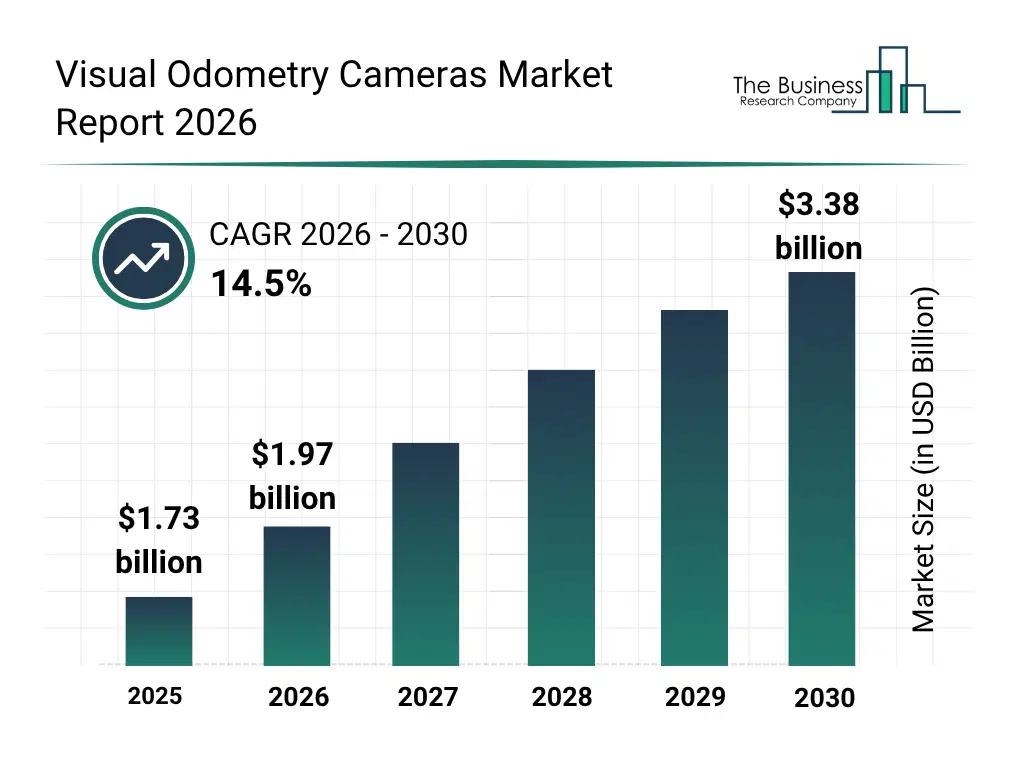
What Is The Visual Odometry Cameras Market Size and Share 2026?
The visual odometry cameras market size has grown rapidly in recent years. It will grow from $1.73 billion in 2025 to $1.97 billion in 2026 at a compound annual growth rate (CAGR) of 14.2%. The growth in the historic period can be attributed to increasing deployment of autonomous vehicles, rising robotics and drone adoption, technological advances in monocular and stereo cameras, growth in industrial automation applications, demand for enhanced navigation accuracy.What Is The Visual Odometry Cameras Market Growth Forecast?
The visual odometry cameras market size is expected to see rapid growth in the next few years. It will grow to $3.38 billion by 2030 at a compound annual growth rate (CAGR) of 14.5%. The growth in the forecast period can be attributed to growing adoption of slam-based visual odometry, increasing integration with ai-driven sensor fusion, expansion of ar/vr applications, rising use in aerospace and defense sectors, development of compact and high-resolution camera modules. Major trends in the forecast period include increasing adoption of stereo and rgb-d visual odometry cameras, rising demand for slam-based navigation solutions, growing integration of low-light and high frame rate cameras, expansion of drone and robotics applications, rising focus on real-time environmental mapping and obstacle detection.Global Visual Odometry Cameras Market Segmentation
1) By Product Type: Monocular Cameras, Stereo Cameras, Red, Green, Blue-Depth (RGB-D) Cameras, Other Product Types 2) By Technology: Two-Dimensional (2D) Visual Odometry, Three-Dimensional (3D) Visual Odometry, Simultaneous Localization And Mapping (SLAM)-Based Visual Odometry, Other Technologies 3) By Distribution Channel: Online, Offline 4) By Application: Robotics, Autonomous Vehicles, Drones, Augmented Reality, Industrial Automation 5) By End-User: Automotive, Aerospace And Defense, Consumer Electronics, Industrial, Healthcare, Other End-Users Subsegments: 1) By Monocular Cameras: Global Shutter Camera, Rolling Shutter Camera, High Frame Rate Camera, Low Light Camera, Wide Angle Camera 2) By Stereo Cameras: Long Baseline Stereo Camera, Short Baseline Stereo Camera, High Resolution Stereo Camera, Compact Stereo Camera, Industrial Stereo Camera 3) By Red, Green, Blue-Depth (RGB-D) Cameras: Time of Flight Camera, Structured Light Camera, Active Stereo Depth Camera, Multi-Depth Sensor Camera, Indoor RGB-D Camera 4) By Other Product Types: Omnidirectional Camera, Fisheye Camera, Event-Based Camera, Hybrid Sensor Camera, Multi-Camera ModuleWhat Are The Drivers Of The Visual Odometry Cameras Market?
The increasing adoption of autonomous vehicles is expected to propel the growth of the visual odometry cameras market going forward. Autonomous vehicles are self-driving vehicles equipped with advanced sensors, cameras, radar, LiDAR, artificial intelligence, and control systems that enable them to navigate and operate without human intervention. Autonomous vehicles are increasing primarily due to rapid advancements in artificial intelligence and sensor technologies, which significantly improve vehicle perception, decision-making, and safety performance. Visual odometry cameras support autonomous vehicles by enabling accurate motion estimation, obstacle detection, and real-time navigation for both ground and aerial autonomous systems. For instance, in October 2023, according to GOV.UK, a UK-based government website, by 2035, around 40% of vehicles in the UK are expected to feature self-driving capabilities. The UK’s autonomous vehicle market could reach approximately £42 billion (about $55.9 billion) by 2035, potentially generating up to 38,000 new jobs. Therefore, the rising adoption of autonomous vehicles is driving the growth of the visual odometry cameras industry. The increasing deployment of drones is expected to propel the growth of the visual odometry cameras market going forward. Drone deployment refers to the expanding use of unmanned aerial vehicles (UAVs) across commercial, industrial, and government sectors for tasks such as surveillance, delivery, and inspection. The rising adoption of drones is largely driven by rapid advancements in automation and expanding commercial applications, as industries increasingly rely on UAVs to perform complex operations in GPS-denied and remote environments. The growing use of drones creates a strong demand for visual odometry cameras, as these cameras serve as the primary tool enabling drones to determine their position and navigate precisely by processing real-time visual data from their surroundings. For instance, in August 2025, according to the House of Commons, a UK-based governing body, as of July 2025, the UK had supplied Ukraine with more than 70,000 uncrewed systems, including long-range attack drones, FPV and loitering munitions, intelligence, surveillance, and reconnaissance drones, and maritime drones. Therefore, the increasing deployment of drones is driving the growth of the visual odometry cameras industry.Key Players In The Global Visual Odometry Cameras Market
Major companies operating in the visual odometry cameras market are Microsoft Corporation, Samsung Electronics Co. Ltd., Facebook Technologies LLC, Huawei Technologies Co. Ltd., Sony Corporation, Intel Corporation, Continental AG, Qualcomm Technologies Inc., Canon Inc., STMicroelectronics N.V., Hexagon AB, Nikon Corporation, SZ DJI Technology Co. Ltd., Trimble Inc., Xiaomi Corporation, Basler Aktiengesellschaft, Skydio Inc., NavVis GmbH, SLAMcore Limited, Fixposition AG.Global Visual Odometry Cameras Market Trends and Insights
Major companies operating in the visual odometry cameras market are focusing on developing technology advancements in visual-inertial odometry, such as the Visual Inertial Navigation Camera, to enhance real-time positioning accuracy, motion tracking stability, and autonomous navigation performance in robotics, drones, and automotive systems. A Visual Inertial Navigation Camera is an advanced sensing system that combines a vision camera with an Inertial Measurement Unit to estimate position, orientation, and motion in real time. For instance, in July 2025, oToBrite Electronics, Inc., a Taiwan-based provider of automotive and robotics vision-AI solutions, launched its Automotive VIO Camera to enhance high-precision localization, real-time motion tracking, and stable navigation performance in autonomous vehicles and robotic platforms through integrated visual-inertial odometry technology. oToBrite’s Automotive VIO Camera integrates a high-performance vision sensor with an embedded Inertial Measurement Unit to deliver robust visual-inertial fusion, ensuring accurate localization even in low-texture or dynamic environments.Regional Insights
North America was the largest region in the visual odometry cameras market in 2025. Asia-Pacific is expected to be the fastest-growing region in the forecast period. The regions covered in this market report are Asia-Pacific, South East Asia, Western Europe, Eastern Europe, North America, South America, Middle East, Africa. The countries covered in this market report are Australia, Brazil, China, France, Germany, India, Indonesia, Japan, Taiwan, Russia, South Korea, UK, USA, Canada, Italy, Spain.What Defines the Visual Odometry Cameras Market?
The visual odometry cameras market consists of revenues earned by entities by providing services such as motion trajectory estimation, depth and distance measurement, visual-inertial data processing, and real-time environment tracking. The market value includes the value of related goods sold by the service provider or included within the service offering. The visual odometry cameras market also includes sales of complementary sensors, computing modules, industrial-grade lenses, ruggedized housings, mounting accessories, and edge processing devices. Values in this market are ‘factory gate’ values, that is, the value of goods sold by the manufacturers or creators of the goods, whether to other entities (including downstream manufacturers, wholesalers, distributors, and retailers) or directly to end customers. The value of goods in this market includes related services sold by the creators of the goods.How is Market Value Defined and Measured?
The market value is defined as the revenues that enterprises gain from the sale of goods and/or services within the specified market and geography through sales, grants, or donations in terms of the currency (in USD unless otherwise specified). The revenues for a specified geography are consumption values that are revenues generated by organizations in the specified geography within the market, irrespective of where they are produced. It does not include revenues from resales along the supply chain, either further along the supply chain or as part of other products.What Key Data and Analysis Are Included in the Visual Odometry Cameras Market Report 2026?
The visual odometry cameras market research report is one of a series of new reports from The Business Research Company that provides market statistics, including industry global market size, regional shares, competitors with the market share, detailed market segments, market trends and opportunities, and any further data you may need to thrive in the visual odometry cameras industry. The market research report delivers a complete perspective of everything you need, with an in-depth analysis of the current and future state of the industry.Visual Odometry Cameras Market Report Forecast Analysis
| Report Attribute | Details |
|---|---|
| Market Size Value In 2026 | $1.97 billion |
| Revenue Forecast In 2035 | $3.38 billion |
| Growth Rate | CAGR of 14.2% from 2026 to 2035 |
| Base Year For Estimation | 2025 |
| Actual Estimates/Historical Data | 2020-2025 |
| Forecast Period | 2026 - 2030 - 2035 |
| Market Representation | Revenue in USD Billion and CAGR from 2026 to 2035 |
| Segments Covered | Product Type, Technology, Distribution Channel, Application, End-User |
| Regional Scope | Asia-Pacific, Western Europe, Eastern Europe, North America, South America, Middle East, Africa |
| Country Scope | The countries covered in the report are Australia, Brazil, China, France, Germany, India, ... |
| Key Companies Profiled | Microsoft Corporation, Samsung Electronics Co. Ltd., Facebook Technologies LLC, Huawei Technologies Co. Ltd., Sony Corporation, Intel Corporation, Continental AG, Qualcomm Technologies Inc., Canon Inc., STMicroelectronics N.V., Hexagon AB, Nikon Corporation, SZ DJI Technology Co. Ltd., Trimble Inc., Xiaomi Corporation, Basler Aktiengesellschaft, Skydio Inc., NavVis GmbH, SLAMcore Limited, Fixposition AG. |
| Customization Scope | Request for Customization |
| Pricing And Purchase Options | Explore Purchase Options |