
Virtual Reality In Education Global Market Opportunities And Strategies To 2035
By Component (Hardware, Solutions, Software), By Deployment (Cloud, On-Premise), By Application (Residential, Academic And Training Institutions, Other Applications), And By Region, Opportunities And Strategies – Global Forecast To 2035
Virtual Reality In Education Market Definition
Virtual reality (VR) in education refers to the use of immersive, computer-generated environments that allow students to interact with 3D content for learning purposes. It uses VR headsets, controllers, and interactive software to explore realistic simulations, virtual laboratories, historical settings, or complex scientific processes in a fully immersive way. The primary purpose of VR in education is to enhance learning outcomes by improving engagement, comprehension, and experiential understanding. The virtual reality in education market consists of sales by entities (organizations, sole traders and partnerships) of virtual reality in education that is used by students across all levels of education, from primary to higher education, as well as by vocational institutions, corporate training providers, and individual learners engaged in self-directed study.
Virtual Reality In Education Market Size
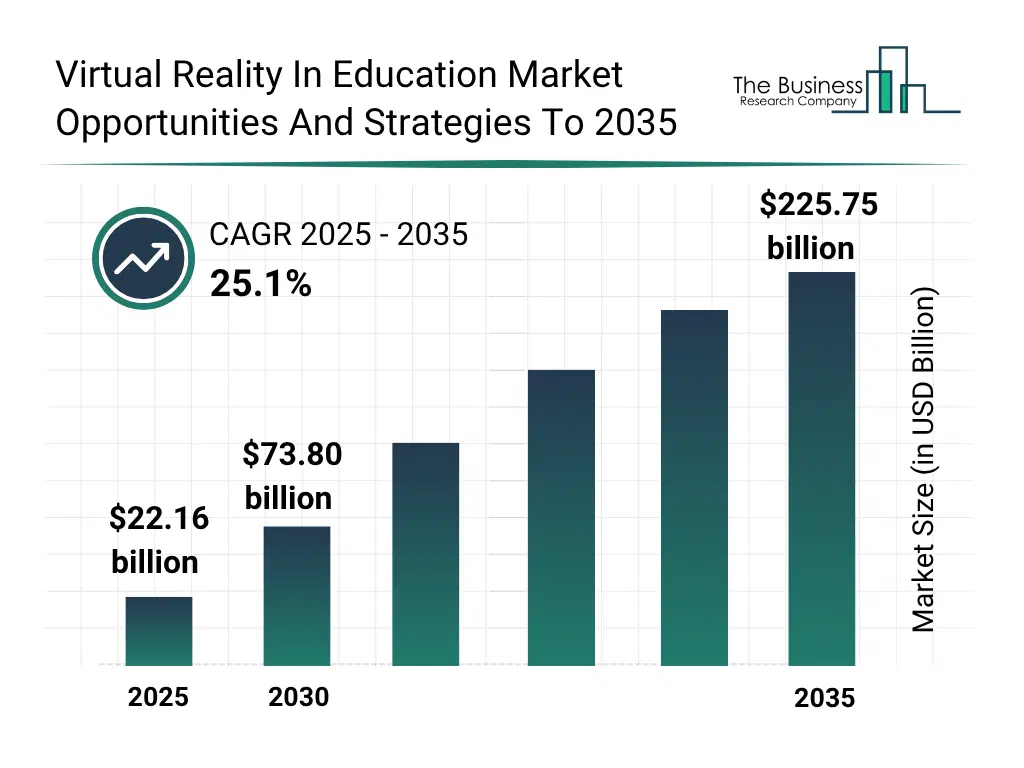
The global virtual reality in education market reached a value of nearly $22,156.3 million in 2025, having grown at a compound annual growth rate (CAGR) of 28.9% since 2020. The market is expected to grow from $22,156.3 million in 2025 to $73,803.6 million in 2030 at a rate of 27.2%. The market is then expected to grow at a CAGR of 25.1% from 2030 and reach $225,745.1 million in 2035. Growth in the historic period resulted from the rise of edtech startups, shift to remote and hybrid learning, rising demand for immersive learning experiences and increased use in simulation and training applications. Factors that negatively affected growth in the historic period were insufficient digital infrastructure in developing regions and limited technical expertise among educators. Going forward, the focus on stem education programs, rising internet and smartphone penetration, increase in specialized programs and curricula and growing demand for personalized learning will drive the growth. Factors that could hinder the growth of the virtual reality in education market in the future include high cost of VR hardware and infrastructure and content development challenges and barriers and impact of trade war and tariffs.Virtual Reality In Education Market Segmentation
The virtual reality in education market is segmented by component, by deployment, by application.By Component –
The virtual reality in education market is segmented by component into:
- a) Hardware
- b) Software
- c) Solutions
By Deployment –
The virtual reality in education market is segmented by deployment into:
- a) Cloud
- b) On-Premises
By Application –
The virtual reality in education market is segmented by application into:
- a) Residential
- b) Academic And Training Institutions
- c) Other Applications
By Geography - The virtual reality in education market is segmented by geography into:
- • China
- • India
- • Japan
- • Australia
- • Indonesia
- • South Korea
- • USA
- • Canada
- • Brazil
- • France
- • Germany
- • UK
- • Italy
- • Spain
- • Russia
-
o Asia Pacific
o Africa