

Urban Infrastructure Market Report 2026
Global Outlook – By Infrastructure Type (Transportation Infrastructure, Energy Infrastructure, Water And Wastewater Infrastructure, Communication Infrastructure, Social Infrastructure), By Deployment Model (Public Infrastructure Projects, Public-Private Partnership Projects, Private Infrastructure Projects), By Application (Transport, Cargo, Urban, Tourism, Defense), By End Use (Residential, Commercial, Industrial) – Market Size, Trends, Strategies, and Forecast to 2035
Urban Infrastructure Market Overview
• Urban Infrastructure market size has reached to $303 billion in 2025 • Expected to grow to $522.26 billion in 2030 at a compound annual growth rate (CAGR) of 11.6% • Growth Driver: Increasing Smart City Development Initiatives Driving The Market Growth Due To Rising Government Investment in Intelligent Urban Technologies • Market Trend: Advancements In Living Urban Mobility Testbeds For Smart City Infrastructure Development • Asia-Pacific was the largest region and fastest growing region.
What Is Covered Under Urban Infrastructure Market?
Urban infrastructure refers to the physical systems and facilities that keep cities operational, designed to support efficient urban living by facilitating transportation, safeguarding public health, enabling economic activities, and ensuring seamless connectivity. Additionally, it promotes sustainable development through better resource utilization, minimized environmental impact, and improved overall living standards. The main infrastructure type of urban infrastructure are transportation infrastructure, energy infrastructure, water and wastewater infrastructure, communication infrastructure, and social infrastructure. Transportation infrastructure refers to systems and physical assets such as roads, railways, bridges, and transit networks that enable the movement of people and goods within urban areas. These are developed through various deployment models, including public infrastructure projects, public-private partnership projects, and private infrastructure projects. They are utilized across multiple applications, such as transport, cargo, urban, tourism, and defense, and serve different end uses, including residential, commercial, and industrial.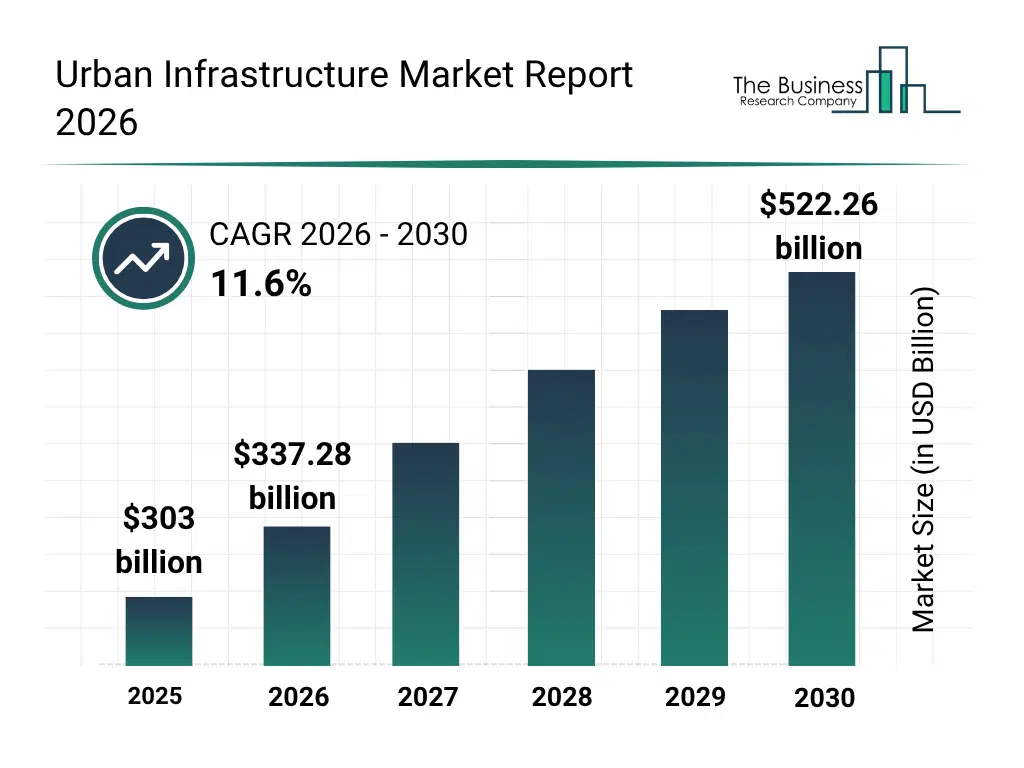
What Is The Urban Infrastructure Market Size and Share 2026?
The urban infrastructure market size has grown rapidly in recent years. It will grow from $303 billion in 2025 to $337.28 billion in 2026 at a compound annual growth rate (CAGR) of 11.3%. The growth in the historic period can be attributed to rapid urbanization and city expansion, growth in public infrastructure spending, rising demand for efficient transport systems, increasing energy consumption and power grid expansion, development of water supply and sanitation facilities.What Is The Urban Infrastructure Market Growth Forecast?
The urban infrastructure market size is expected to see rapid growth in the next few years. It will grow to $522.26 billion by 2030 at a compound annual growth rate (CAGR) of 11.6%. The growth in the forecast period can be attributed to increasing adoption of smart city initiatives, growing integration of renewable energy in urban infrastructure, rising deployment of IoT-enabled urban management systems, expansion of high-speed communication networks, focus on sustainable and climate-resilient urban planning. Major trends in the forecast period include increasing investment in public-private partnership infrastructure projects, rising adoption of smart urban transportation solutions, growing focus on water and wastewater management systems, expansion of communication and data center infrastructure, rising emphasis on resilient and disaster-ready social infrastructure.Global Urban Infrastructure Market Segmentation
1) By Infrastructure Type: Transportation Infrastructure, Energy Infrastructure, Water And Wastewater Infrastructure, Communication Infrastructure, Social Infrastructure 2) By Deployment Model: Public Infrastructure Projects, Public-Private Partnership Projects, Private Infrastructure Projects 3) By Application: Transport, Cargo, Urban, Tourism, Defense 4) By End Use: Residential, Commercial, Industrial Subsegments: 1) By Transportation Infrastructure: Road And Highway Infrastructure, Urban Rail Transit Infrastructure, Airport Infrastructure, Seaport And Inland Port Infrastructure, Public Bus And Transit Terminal Infrastructure 2) By Energy Infrastructure: Electric Power Generation Infrastructure, Electric Power Transmission Infrastructure, Electric Power Distribution Infrastructure, Natural Gas Pipeline Infrastructure, Renewable Energy Generation Infrastructure 3) By Water And Wastewater Infrastructure: Drinking Water Supply Infrastructure, Water Treatment Plant Infrastructure, Wastewater Treatment Plant Infrastructure, Stormwater Drainage Infrastructure, Sewage Collection And Conveyance Infrastructure 4) By Communication Infrastructure: Telecommunication Network Infrastructure, Fiber Optic Communication Infrastructure, Mobile Network Tower Infrastructure, Satellite Communication Ground Infrastructure, Data Center And Cloud Communication Infrastructure 5) By Social Infrastructure: Healthcare Facility Infrastructure, Educational Institution Infrastructure, Public Safety And Emergency Service Infrastructure, Government Administrative Building Infrastructure, Public Recreation And Community Facility InfrastructureWhat Is The Driver Of The Urban Infrastructure Market?
The increasing smart city development initiatives are expected to propel the growth of the urban infrastructure market going forward. Smart city development initiatives refer to government-led programs and investments that integrate digital technologies such as IoT, AI, and connected systems into urban infrastructure to enhance the efficiency, safety, and sustainability of city services. The increasing smart city development initiative, due to strong government policy support and substantial public funding, is accelerating the large-scale deployment of advanced smart community technologies. Urban infrastructure drives smart city development by enabling efficient transport, reliable utilities, and digital connectivity, supporting smart technologies that improve resource management, quality of life, and sustainability. For instance, in January 2024, according to the Institute of the Americas, a US-based non-profit organization, global spending on smart city initiatives in 2023 would surpass $190 billion. Therefore, increasing smart city development initiatives are driving the growth of the urban infrastructure industry.Key Players In The Global Urban Infrastructure Market
Major companies operating in the urban infrastructure market are China State Construction Engineering Corporation Limited, China Communications Construction Company Limited, Power Construction Corporation of China Limited, Vinci S.A., Bouygues Construction S.A., Samsung C&T Corporation, HOCHTIEF Aktiengesellschaft, Larsen & Toubro Limited, Hyundai Engineering & Construction Co. Ltd., STRABAG SE, Kiewit Corporation, Bechtel Corporation, Skanska AB, Fluor Corporation, AECOM, Jacobs Solutions Inc., Balfour Beatty plc, Ferrovial SE, Acciona S.A., Webuild S.p.A., Hindustan Construction Company Limited, GMR Group, Ghella S.p.A., Gülermak Ağır Sanayi İnşaat ve Taahhüt A.Ş.Global Urban Infrastructure Market Trends and Insights
Major companies operating in the urban infrastructure market are focusing on developing advancements in smart city infrastructure technologies, such as living urban mobility testbeds, to enable real-time experimentation, data-driven traffic management, and integrated transportation solutions that enhance urban efficiency, sustainability, and commuter experience. Living urban mobility testbeds enable developers, researchers, and city planners to evaluate how vehicles, infrastructure, and residents interact through connected data systems, advanced sensors, and coordinated traffic management technologies. For instance, in September 2025, Toyota Motor Corporation, a Japan-based automotive and mobility technology company, launched Woven City, a fully connected prototype urban environment designed as a real-world testing platform for future mobility and smart infrastructure. The city incorporates a three-type road network separating pedestrians, personal mobility devices, and vehicles, an underground logistics corridor for autonomous delivery, and multifunctional smart poles equipped with sensors and cameras that support infrastructure monitoring and traffic coordination.What Are Latest Mergers And Acquisitions In The Urban Infrastructure Market?
In February 2026, TomTom N.V., a Netherlands-based independent geolocation technology provider, partnered with AECOM to enhance urban mobility and infrastructure planning solutions globally. Through this partnership, the companies aim to integrate TomTom N.V.’s real-time and historical traffic data into AECOM’s transport planning and infrastructure advisory services to improve urban mobility modeling, infrastructure design, and smart city planning. AECOM is a US-based provider of urban infrastructure services.Regional Insights
Asia-Pacific was the largest region in the urban infrastructure market in 2025. Asia-Pacific is expected to be the fastest-growing region in the forecast period. The regions covered in this market report are Asia-Pacific, South East Asia, Western Europe, Eastern Europe, North America, South America, Middle East, Africa. The countries covered in this market report are Australia, Brazil, China, France, Germany, India, Indonesia, Japan, Taiwan, Russia, South Korea, UK, USA, Canada, Italy, Spain.What Defines the Urban Infrastructure Market?
The urban infrastructure market consists of revenues earned by entities by providing services such as planning, development, construction, maintenance, and management of urban facilities. The market value includes the value of related goods sold by the service provider or included within the service offering. The urban infrastructure market also includes sales of precast concrete elements, asphalt (bitumen mix), structural steel (beams and columns), bricks and concrete blocks (CMU), and street lighting systems (LED lights and poles). Values in this market are ‘factory gate’ values, that is, the value of goods sold by the manufacturers or creators of the goods, whether to other entities (including downstream manufacturers, wholesalers, distributors, and retailers) or directly to end customers. The value of goods in this market includes related services sold by the creators of the goods.How is Market Value Defined and Measured?
The market value is defined as the revenues that enterprises gain from the sale of goods and/or services within the specified market and geography through sales, grants, or donations in terms of the currency (in USD unless otherwise specified). The revenues for a specified geography are consumption values that are revenues generated by organizations in the specified geography within the market, irrespective of where they are produced. It does not include revenues from resales along the supply chain, either further along the supply chain or as part of other products.What Key Data and Analysis Are Included in the Urban Infrastructure Market Report 2026?
The urban infrastructure market research report is one of a series of new reports from The Business Research Company that provides market statistics, including industry global market size, regional shares, competitors with the market share, detailed market segments, market trends and opportunities, and any further data you may need to thrive in the urban infrastructure industry. The market research report delivers a complete perspective of everything you need, with an in-depth analysis of the current and future state of the industry.Urban Infrastructure Market Report Forecast Analysis
| Report Attribute | Details |
|---|---|
| Market Size Value In 2026 | $337.28 billion |
| Revenue Forecast In 2035 | $522.26 billion |
| Growth Rate | CAGR of 11.3% from 2026 to 2035 |
| Base Year For Estimation | 2025 |
| Actual Estimates/Historical Data | 2020-2025 |
| Forecast Period | 2026 - 2030 - 2035 |
| Market Representation | Revenue in USD Billion and CAGR from 2026 to 2035 |
| Segments Covered | Infrastructure Type, Deployment Model, Application, End Use |
| Regional Scope | Asia-Pacific, Western Europe, Eastern Europe, North America, South America, Middle East, Africa |
| Country Scope | The countries covered in the report are Australia, Brazil, China, France, Germany, India, ... |
| Key Companies Profiled | China State Construction Engineering Corporation Limited, China Communications Construction Company Limited, Power Construction Corporation of China Limited, Vinci S.A., Bouygues Construction S.A., Samsung C&T Corporation, HOCHTIEF Aktiengesellschaft, Larsen & Toubro Limited, Hyundai Engineering & Construction Co. Ltd., STRABAG SE, Kiewit Corporation, Bechtel Corporation, Skanska AB, Fluor Corporation, AECOM, Jacobs Solutions Inc., Balfour Beatty plc, Ferrovial SE, Acciona S.A., Webuild S.p.A., Hindustan Construction Company Limited, GMR Group, Ghella S.p.A., Gülermak Ağır Sanayi İnşaat ve Taahhüt A.Ş. |
| Customization Scope | Request for Customization |
| Pricing And Purchase Options | Explore Purchase Options |