

Unmanned Surface Vehicle (USV) Global Market Opportunities And Strategies To 2035
By Type (Surface, Sub-Surface), By Mode Of Operation (Autonomous Surface Vehicle, Remotely Operated Surface Vehicle), By Hull Type (Catamaran (Twin Hulls), Kayak (Single Hull), Trimaran (Triple Hulls), Rigid Inflatable Hull), By Size (Small, Medium, Large, Extra Large), By Application (Defense, Commercial, Scientific Research, Other Applications), And By Region, Opportunities And Strategies – Global Forecast To 2035
Unmanned Surface Vehicle (USV) Market Definition
An unmanned surface vehicle (USV) is a remotely operated or autonomous marine vessel that operates on the surface of the water without an onboard crew. It can be remotely controlled, semi-autonomous, or fully autonomous, using onboard sensors, navigation systems, and communication links to perform missions on seas, rivers, lakes, and coastal waters. The primary purpose of USVs is to enhance maritime operations while reducing risk to human personnel. The unmanned surface vehicle (USV) market consists of sales by entities (organizations, sole traders, or partnerships) of autonomous or remotely operated waterborne vessels designed to function without onboard human crews. These vessels utilize advanced sensors, navigation systems, and communication technologies to perform tasks such as surveillance, environmental monitoring, defense operations, ocean exploration, and infrastructure inspection.
Unmanned Surface Vehicle (USV) Market Size
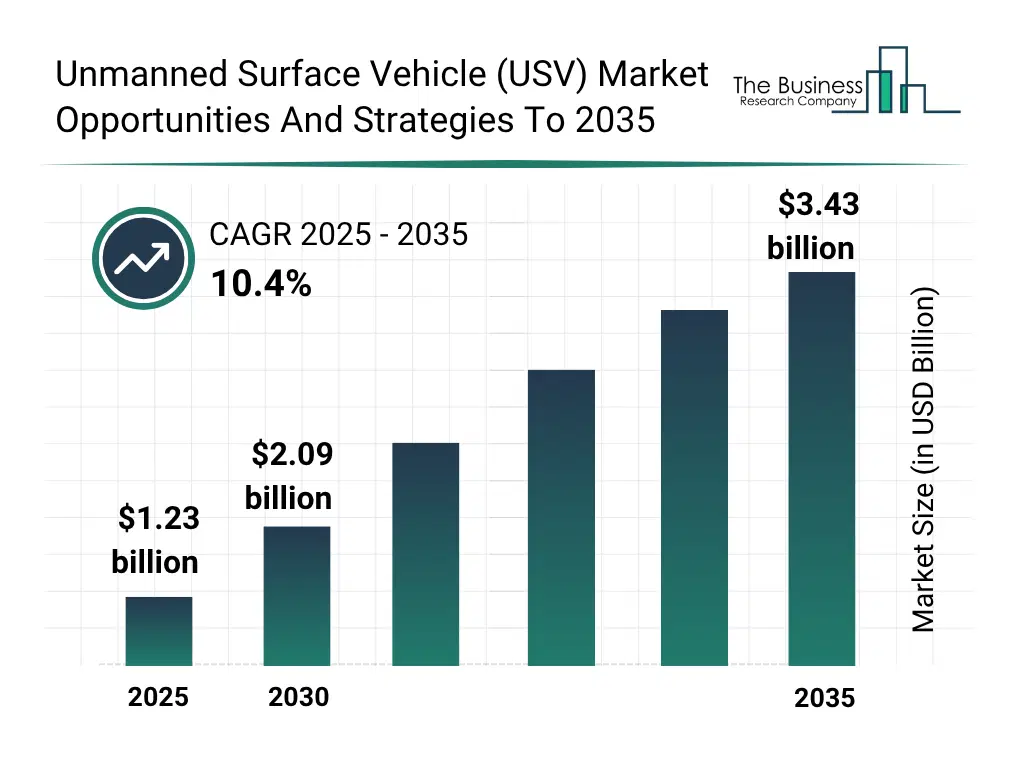
The global unmanned surface vehicle (USV) market reached a value of nearly $1,228.5 million in 2025, having grown at a compound annual growth rate (CAGR) of 12.5% since 2020. The market is expected to grow from $1,228.5 million in 2025 to $2,087.8 million in 2030 at a rate of 11.2%. The market is then expected to grow at a CAGR of 10.4% from 2030 and reach $3,429.8 million in 2035. Growth in the historic period resulted from the rising maritime security threats, rising defense expenditure, increasing use of USVs for mine countermeasure (MCM) operations and growing offshore oil and gas exploration. Factors that negatively affected growth in the historic period were high development and initial costs and cybersecurity and safety vulnerabilities. Going forward, the expansion of maritime security and ISR (intelligence, surveillance, reconnaissance) programs, growing demand for hydrographic surveying and seabed mapping, increasing naval modernization and fleet digitization programs and government support and investment on maritime robotics and autonomous vessel startups will drive the growth. Factors that could hinder the growth of the unmanned surface vehicle (USV) market in the future include operational and maintenance expenses, regulatory and legal challenges and trade war and tariffs.Unmanned Surface Vehicle (USV) Market Segmentation
The unmanned surface vehicle (USV) market is segmented by type, by mode of operation, by hull type, by size and by application.By Type –
The unmanned surface vehicle (USV) market is segmented by type into:
- a) Surface
- b) Sub-Surface
By Mode Of Operation –
The unmanned surface vehicle (USV) market is segmented by mode of operation into:
- a) Autonomous Surface Vehicle
- b) Remotely Operated Surface Vehicle
By Hull Type –
The unmanned surface vehicle (USV) market is segmented by hull type into:
- a) Catamaran (Twin Hulls)
- b) Kayak (Single Hull)
- c) Trimaran (Triple Hulls)
- d) Rigid Inflatable Hull
By Size –
The unmanned surface vehicle (USV) market is segmented by size into:
- a) Small
- b) Medium
- c) Large
- d) Extra Large
By Application –
The unmanned surface vehicle (USV) market is segmented by application into:
- a) Defense
- b) Commercial
- c) Scientific Research
- d) Other Applications
By Geography - The unmanned surface vehicle (USV) market is segmented by geography into:
- • China
- • India
- • Japan
- • Australia
- • Indonesia
- • South Korea
- • USA
- • Canada
- • Brazil
- • France
- • Germany
- • UK
- • Italy
- • Spain
- • Russia
-
o Asia Pacific
o Africa