

Undersea Warfare Systems Global Market Opportunities And Strategies To 2035
By Type (Communication And Surveillance Systems, Sensors And Computation Systems, Countermeasure Systems And Payload, Unmanned Underwater Vehicles (UUVs), Weapon Systems), By Mode Of Operation (Manned Operations, Autonomous Operations, Remotely Operated Operations), By End-User (Navy, Air Force, Army), And By Region, Opportunities And Strategies – Global Forecast To 2035
Undersea Warfare Systems Market Definition
Undersea warfare systems are integrated military technologies designed to operate in the underwater domain to detect, track, deter and neutralize threats beneath the sea surface. These systems include submarines, unmanned underwater vehicles (UUVs), sonar and acoustic sensors, torpedoes, naval mines, communication networks and command-and-control platforms used for both offensive and defensive operations. The primary purpose of undersea warfare systems is to maintain maritime security, protect naval assets and ensure strategic deterrence. The undersea warfare systems market consists of sales by entities (organizations, sole traders and partnerships) of undersea warfare systems that are used by naval forces, supported in some cases by air force and army units that operate in littoral or coastal zones; these users rely on undersea systems during peacetime for surveillance. Complementary technologies include surface and airborne radar and communications systems, satellite navigation and traditional naval weaponry, while substitutes might involve above‑water surveillance platforms or space‑based sensing when undersea access is restricted or not cost‑effective.
Undersea Warfare Systems Market Size
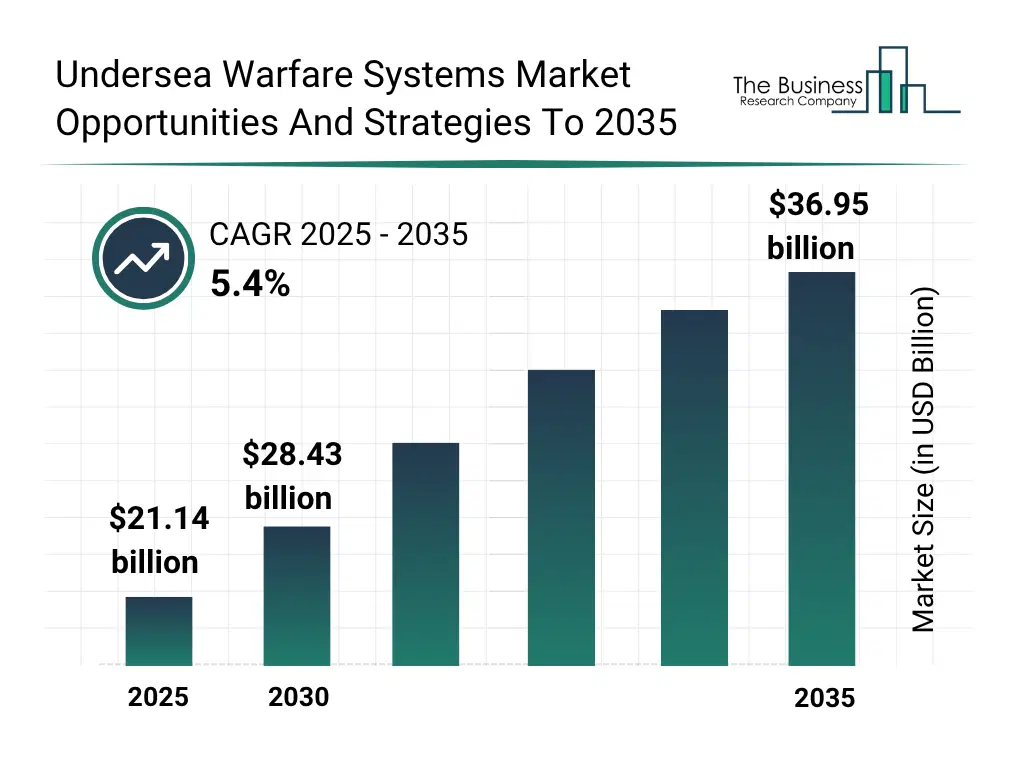
The global undersea warfare systems market reached a value of nearly $21,139.6 million in 2025, having grown at a compound annual growth rate (CAGR) of 6.9% since 2020. The market is expected to grow from $21,139.6 million in 2025 to $28,431.7 million in 2030 at a rate of 6.1%. The market is then expected to grow at a CAGR of 5.4% from 2030 and reach $36,954.0 million in 2035. Growth in the historic period resulted from the increasing defense budgets, rise in geopolitical tension, rising maritime security threats and government defense contracts and funding programs. Factors that negatively affected growth in the historic period were high development and implementation costs and limited specialized workforce. Going forward, the need for protection of maritime trade routes, expansion of undersea communication and data networks, rise in naval modernization programs and expansion of unmanned and autonomous systems will drive the growth. Factors that could hinder the growth of the undersea warfare systems market in the future include regulatory and export control restrictions, environmental and operational restrictions and impact of trade war and tariffs.Undersea Warfare Systems Market Segmentation
The undersea warfare systems market is segmented by type, by mode of operation and by end user.By Type –
The undersea warfare systems market is segmented by type into:
- a) Communication And Surveillance Systems
- b) Sensors And Computation Systems
- c) Countermeasure Systems And Payload
- d) Unmanned Underwater Vehicles
- e) Weapon Systems
By Mode Of Operation –
The undersea warfare systems market is segmented by mode of operation into:
- a) Manned Operations
- b) Autonomous Operations
- c) Remotely Operated Operations
By End User –
The undersea warfare systems market is segmented by end user into:
- a) Navy
- b) Air Force
- c) Army
By Geography - The undersea warfare systems market is segmented by geography into:
- • China
- • India
- • Japan
- • Australia
- • Indonesia
- • South Korea
- • USA
- • Canada
- • Brazil
- • France
- • Germany
- • UK
- • Italy
- • Spain
- • Russia
-
o Asia Pacific
o Africa