
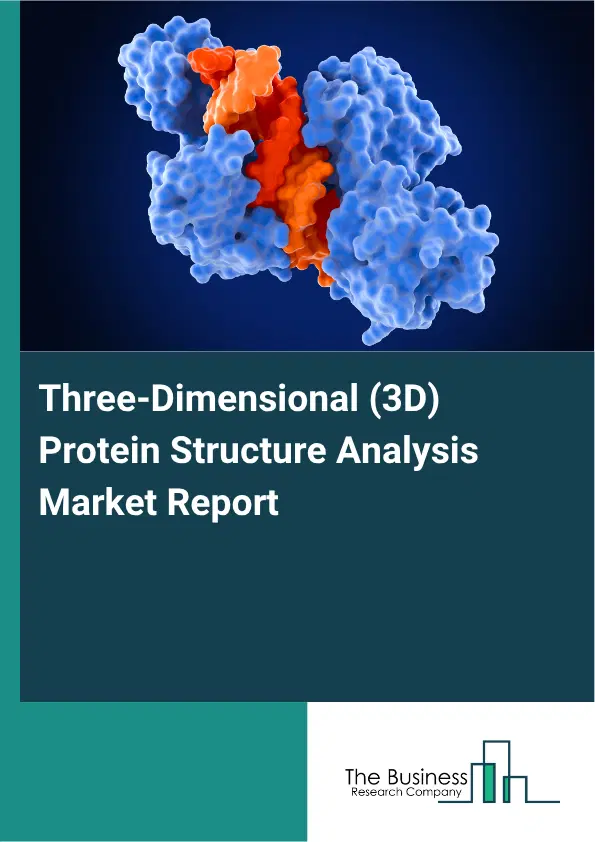
Three-Dimensional (3D) Protein Structure Analysis Market Report 2026
Global Outlook – By Component (Instruments and Imaging Systems, Software and Computational Tools, Reagents and Consumables, Services), By Workflow (Sample Preparation, Data Acquisition, Data Processing, Structure Determination, Visualization and Interpretation), By Technology (X-Ray Crystallography, Cryo-Electron Microscopy (Cryo-EM), Nuclear Magnetic Resonance (NMR) Spectroscopy, Small Angle X-Ray Scattering (SAXS), Computational Modeling and AI-Based Prediction, By End-Use Industry (Pharmaceutical and Biotechnology Companies, Academic and Research Institutes, Contract Research Organizations, Healthcare and Diagnostics Companies, Agricultural and Industrial Biotech Firms) – Market Size, Trends, Strategies, and Forecast to 2035
Three-Dimensional (3D) Protein Structure Analysis Market Overview
• Three-Dimensional (3D) Protein Structure Analysis market size has reached to $2.36 billion in 2025 • Expected to grow to $4.19 billion in 2030 at a compound annual growth rate (CAGR) of 12.2% • Growth Driver: Rising Demand For Personalized Medicine Driving The Market Growth Due To Advances In Genomic Technologies And Increasing Approval Of Targeted Therapies • Market Trend: Advancements In AI-Driven Structure-Based Computational Biology For Enhanced Drug Discovery • North America was the largest region in 2025 and Asia-Pacific is the fastest growing region.
What Is Covered Under Three-Dimensional (3D) Protein Structure Analysis Market?
Three-dimensional (3D) protein structure analysis is the computational or experimental examination of the three-dimensional arrangement of atoms in a protein to understand its function, stability, interactions, and dynamics. By analyzing structural features such as folding patterns, active sites, binding pockets, and conformational changes, this approach helps reveal how proteins work at the molecular level and supports applications in genomics, drug discovery, and disease research. The main components of 3D protein structure analysis include instruments and imaging systems, software and computational tools, reagents and consumables, and services. Instruments and imaging systems include devices used to capture high-resolution structural data of proteins for analysis and interpretation. These solutions support workflows such as sample preparation, data acquisition, data processing, structure determination, and visualization and interpretation, and leverage technologies including X-ray crystallography, cryo-electron microscopy, nuclear magnetic resonance spectroscopy, small angle X-ray scattering, computational modeling and AI-based prediction, and mass spectrometry-based methods. The various applications involved are drug discovery and development, structural genomics, biomarker identification, protein-protein interaction studies, enzyme engineering and industrial biotech, and academic research and education, and they are used by several end-use industries such as pharmaceutical and biotechnology companies, academic and research institutes, contract research organizations, healthcare and diagnostics companies, and agricultural and industrial biotech firms.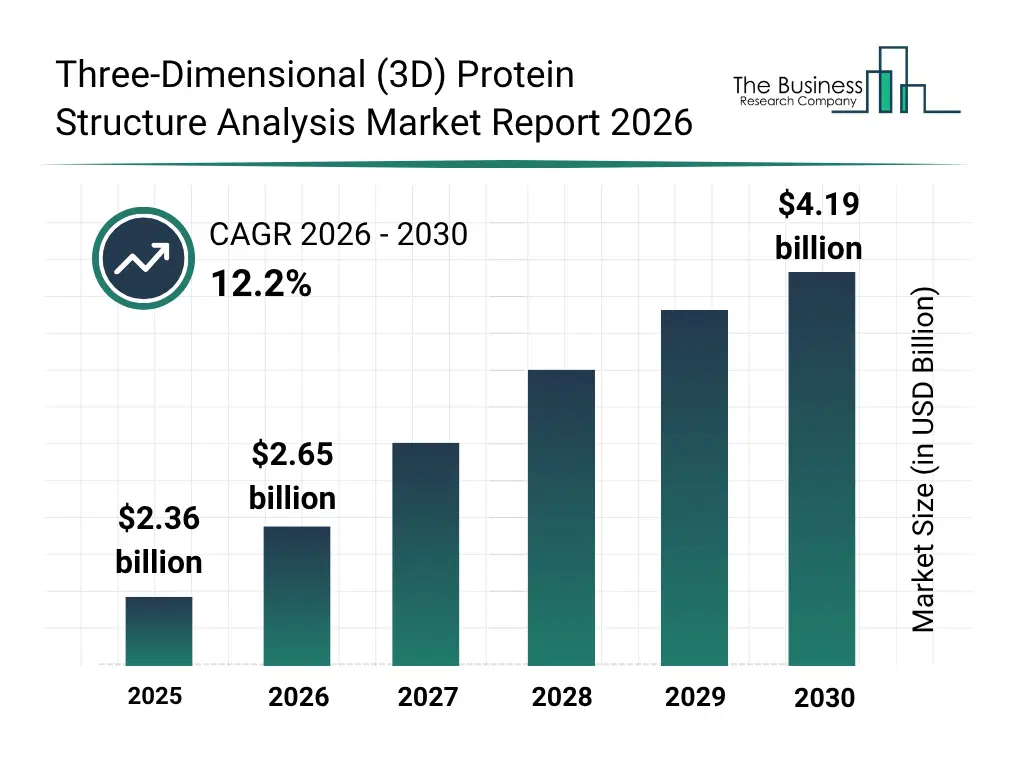
What Is The Three-Dimensional (3D) Protein Structure Analysis Market Size and Share 2026?
The three-dimensional (3D) protein structure analysis market size has grown rapidly in recent years. It will grow from $2.36 billion in 2025 to $2.65 billion in 2026 at a compound annual growth rate (CAGR) of 11.9%. The growth in the historic period can be attributed to increasing investment in structural genomics, adoption of x-ray crystallography and nmr spectroscopy, growth of pharmaceutical r&d, rising demand for biomarker identification, development of cryo-em technology.What Is The Three-Dimensional (3D) Protein Structure Analysis Market Growth Forecast?
The three-dimensional (3D) protein structure analysis market size is expected to see rapid growth in the next few years. It will grow to $4.19 billion in 2030 at a compound annual growth rate (CAGR) of 12.2%. The growth in the forecast period can be attributed to ai-driven structure prediction adoption, expansion of cloud-based computational tools, integration of multi-modal imaging techniques, rising focus on enzyme engineering, increased demand for personalized medicine applications. Major trends in the forecast period include ai-powered protein structure prediction, high-resolution imaging techniques, integration of computational and experimental workflows, automated data processing and analysis, cloud-based structural biology platforms.Global Three-Dimensional (3D) Protein Structure Analysis Market Segmentation
1) By Component: Instruments and Imaging Systems, Software and Computational Tools, Reagents and Consumables, Services 2) By Workflow: Sample Preparation, Data Acquisition, Data Processing, Structure Determination, Visualization and Interpretation 3) By Technology: X-Ray Crystallography, Cryo-Electron Microscopy (Cryo-EM), Nuclear Magnetic Resonance (NMR) Spectroscopy, Small Angle X-Ray Scattering (SAXS), Computational Modeling and AI-Based Prediction, Mass Spectrometry-Based Methods 4) By Application: Drug Discovery and Development, Structural Genomics, Biomarker Identification, Protein-Protein Interaction Studies, Enzyme Engineering and Industrial Biotech, Academic Research and Education 5) By End-Use Industry: Pharmaceutical and Biotechnology Companies, Academic and Research Institutes, Contract Research Organizations, Healthcare and Diagnostics Companies, Agricultural and Industrial Biotech Firms Subsegments: 1) By Instruments and Imaging Systems: X Ray Crystallography Systems, Cryogenic Electron Microscopy Systems, Nuclear Magnetic Resonance Spectroscopy Systems, Mass Spectrometry Systems For Structural Analysis, Protein Crystallization And Sample Preparation Instruments 2) By Software and Computational Tools: Molecular Modeling And Simulation Software, Protein Structure Visualization Software, Structure Prediction And Folding Analysis Software, Molecular Docking And Interaction Analysis Software, Data Processing And Image Reconstruction Software 3) By Reagents and Consumables: Protein Crystallization Reagents, Sample Preparation Kits, Labeling And Detection Reagents, Buffers And Stabilization Solutions, Microplates And Laboratory Consumables 4) By Services: Protein Structure Determination Services, Molecular Modeling And Simulation Services, Structural Data Analysis Services, Instrument Maintenance And Technical Support Services, Contract Research And Custom Analysis ServicesWhat Is The Driver Of The Three-Dimensional (3D) Protein Structure Analysis Market?
The growing demand for personalized medicine is expected to propel the growth of the three-dimensional (3D) protein structure analysis market. Personalized medicine focuses on tailoring healthcare and therapies based on an individual’s biological and clinical characteristics. Its expanding adoption is driven by advances in genomic technologies that enable the identification of disease-associated genetic variants and molecular targets. As personalized medicine increasingly relies on molecular-level insights to guide drug discovery and therapy development, 3D protein structure analysis plays a critical role by elucidating how genetic variations influence protein conformation and drug-binding interactions. For instance, in February 2024, according to the Personalized Medicine Coalition, a US-based non-profit organization, the US Food and Drug Administration approved 16 new personalized treatments for rare disease patients, up from six in 2022, including seven cancer therapies. Therefore, the growing demand for personalized medicine is driving the growth of the three-dimensional (3D) protein structure analysis industry.Key Players In The Global Three-Dimensional (3D) Protein Structure Analysis Market
Major companies operating in the three-dimensional (3D) protein structure analysis market are Merck KGaA, Lonza Group AG, Agilent Technologies Inc., Dassault Systèmes, WuXi AppTec, Charles River Laboratories Inc., Bruker Corporation, Waters Corporation, Revvity, JEOL Ltd., Greiner Bio-One International GmbH, Cambridge Isotope Laboratories Inc., Creative Biostructure, Cambridge Crystallographic Data Centre, NanoImaging Services Inc., Molecular Dimensions Inc., DNASTAR Inc., Jena Bioscience GmbH, Arinax Scientific Instrumentation, Bio-Prodict B.V., CD ComputaBio, and Discngine SAS.Global Three-Dimensional (3D) Protein Structure Analysis Market Trends and Insights
Major companies operating in the three-dimensional (3D) protein structure analysis market are focusing on developing innovative solutions such as, structure-based computational biology platforms to accelerate drug discovery, enable accurate protein modeling, and enhance target identification through advanced molecular simulations and AI-driven structural analysis. A structure-based computational biology platform refers to a digital system that uses three-dimensional protein structure data, molecular modeling, and simulation algorithms to analyze biomolecular interactions and support rational drug design and target validation. For instance, in March 2024, Basecamp Research, a UK-based AI company, launched BaseFold as a deep learning model that significantly advances 3D protein structure prediction for large, complex proteins. By augmenting AlphaFold2 with its proprietary BaseGraph dataset from global biodiversity sources, it achieves up to 6-fold higher accuracy and 3-fold better small molecule docking. This breakthrough accelerates AI-driven drug discovery by enabling precise modeling of challenging protein structures previously underrepresented in public data.What Are Latest Mergers And Acquisitions In The Three-Dimensional (3D) Protein Structure Analysis Market?
In February 2026, Nuclera Ltd., a UK-based biotechnology company, partnered with leadXpro AG to accelerate membrane protein production and support structure-based drug discovery through integrated cell-free expression technologies. With this partnership, companies aim to streamline membrane protein production, enhance structural biology research, and accelerate structure-based drug discovery for novel therapeutics. leadXpro AG is a Switzerland-based biotechnology company that specializes in structure-based drug discovery for challenging membrane protein targets.Regional Insights
North America was the largest region in the three-dimensional (3D) protein structure analysis market in 2025. Asia-Pacific is expected to be the fastest-growing region in the forecast period. The regions covered in this market report are Asia-Pacific, South East Asia, Western Europe, Eastern Europe, North America, South America, Middle East, Africa. The countries covered in this market report are Australia, Brazil, China, France, Germany, India, Indonesia, Japan, Taiwan, Russia, South Korea, UK, USA, Canada, Italy, Spain.What Defines the Three-Dimensional (3D) Protein Structure Analysis Market?
The three-dimensional (3D) protein structure analysis market consists of revenues earned by entities by providing services such as protein structure determination, homology modeling and de novo structure prediction, and molecular docking and protein–ligand interaction analysis. The market value includes the value of related goods sold by the service provider or included within the service offering. The 3D protein structure analysis market also includes sales of protein-ligand docking and binding site analysis tools, structure validation and quality assessment tools, and protein stability and mutation impact prediction tools. Values in this market are ‘factory gate’ values; that is, the value of goods sold by the manufacturers or creators of the goods, whether to other entities (including downstream manufacturers, wholesalers, distributors, and retailers) or directly to end customers. The value of goods in this market includes related services sold by the creators of the goods.How is Market Value Defined and Measured?
The market value is defined as the revenues that enterprises gain from the sale of goods and/or services within the specified market and geography through sales, grants, or donations in terms of the currency (in USD unless otherwise specified). The revenues for a specified geography are consumption values that are revenues generated by organizations in the specified geography within the market, irrespective of where they are produced. It does not include revenues from resales along the supply chain, either further along the supply chain or as part of other products.What Key Data And Analysis Are Included In The Three-Dimensional (3D) Protein Structure Analysis Market Report 2026?
The three-dimensional (3d) protein structure analysis market research report is one of a series of new reports from The Business Research Company that provides market statistics, including industry global market size, regional shares, competitors with the market share, detailed market segments, market trends and opportunities, and any further data you may need to thrive in the three-dimensional (3d) protein structure analysis industry. The market research report delivers a complete perspective of everything you need, with an in-depth analysis of the current and future state of the industry.Three-Dimensional (3D) Protein Structure Analysis Market Report Forecast Analysis
| Report Attribute | Details |
|---|---|
| Market Size Value In 2026 | $2.65 billion |
| Revenue Forecast In 2035 | $4.19 billion |
| Growth Rate | CAGR of 11.9% from 2026 to 2035 |
| Base Year For Estimation | 2025 |
| Actual Estimates/Historical Data | 2020-2025 |
| Forecast Period | 2026 - 2030 - 2035 |
| Market Representation | Revenue in USD Billion and CAGR from 2026 to 2035 |
| Segments Covered | Component, Workflow, Technology, Application, End-Use Industry |
| Regional Scope | Asia-Pacific, Western Europe, Eastern Europe, North America, South America, Middle East, Africa |
| Country Scope | The countries covered in the report are Australia, Brazil, China, France, Germany, India, Indonesia, Japan, Taiwan, Russia, South Korea, UK, USA, Canada, Italy, Spain. |
| Key Companies Profiled | Merck KGaA, Lonza Group AG, Agilent Technologies Inc., Dassault Systèmes, WuXi AppTec, Charles River Laboratories Inc., Bruker Corporation, Waters Corporation, Revvity, JEOL Ltd., Greiner Bio-One International GmbH, Cambridge Isotope Laboratories Inc., Creative Biostructure, Cambridge Crystallographic Data Centre, NanoImaging Services Inc., Molecular Dimensions Inc., DNASTAR Inc., Jena Bioscience GmbH, Arinax Scientific Instrumentation, Bio-Prodict B.V., CD ComputaBio, and Discngine SAS. |
| Customization Scope | Request for Customization |
| Pricing And Purchase Options | Explore Purchase Options |