
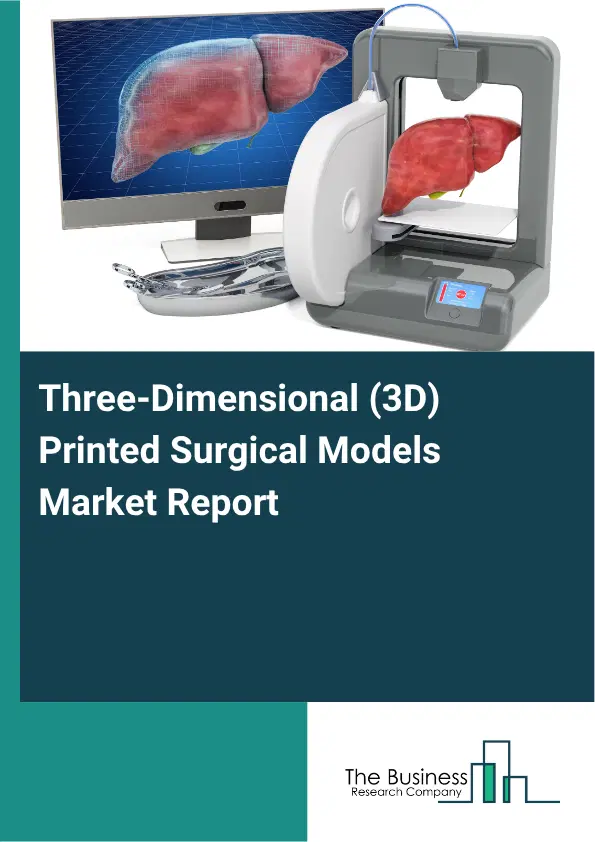
Three-Dimensional (3D) Printed Surgical Models Market Report 2026
Global Outlook – By Model Type (Soft Tissue Models, Bone Models, Organ Models, Vascular Models, Tumor Models), By Material Type (Polymer, Metal, Ceramic, Composite, Biomaterials), By Technology (Fused Deposition Modeling, Stereolithography, Selective Laser Sintering, Digital Light Processing, Binder Jetting), By Application (Preoperative Planning, Surgical Training, Patient-Specific Models, Anatomical Education, Surgical Simulation), By End User (Hospitals And Surgical Centers, Diagnostic Imaging Centers, Academic And Research Institutes, Medical Device Companies, Specialty Clinics, Other End Users) – Market Size, Trends, Strategies, and Forecast to 2035
Three-Dimensional (3D) Printed Surgical Models Market Overview
• Three-Dimensional (3D) Printed Surgical Models market size has reached to $0.85 billion in 2025 • Expected to grow to $1.61 billion in 2030 at a compound annual growth rate (CAGR) of 13.8% • Growth Driver: Growing Adoption Of Minimally Invasive Surgeries Driving Market Growth Due To Rising Demand For Patient-Centric Healthcare • Market Trend: Advancements In High-Fidelity Patient-Specific Anatomical 3D Printing Enhance Surgical Planning And Medical Training • North America was the largest region in 2025 and Asia-Pacific is the fastest growing region.
What Is Covered Under Three-Dimensional (3D) Printed Surgical Models Market?
Three-dimensional (3D) printed surgical models are physical replicas of human anatomy created using additive manufacturing technology. They provide highly accurate representations of organs, bones, or tissues based on medical imaging data. Three-dimensional (3D) printed surgical models are used to plan, simulate, and practice complex surgical procedures. The main model types of three-dimensional (3D) printed surgical models include soft tissue models, bone models, organ models, vascular models, and tumor models. Soft tissue models refer to 3D-printed replicas that mimic the texture and flexibility of human soft tissues for surgical practice and planning. The material types include polymer, metal, ceramic, composite, and biomaterials and the various technologies include fused deposition modeling, stereolithography, selective laser sintering, digital light processing, and binder jetting. The key applications of preoperative planning, surgical training, patient-specific models, anatomical education, and surgical simulation, while the end-use includes hospitals and surgical centers, diagnostic imaging centers, academic and research institutes, medical device companies, specialty clinics, and other end users.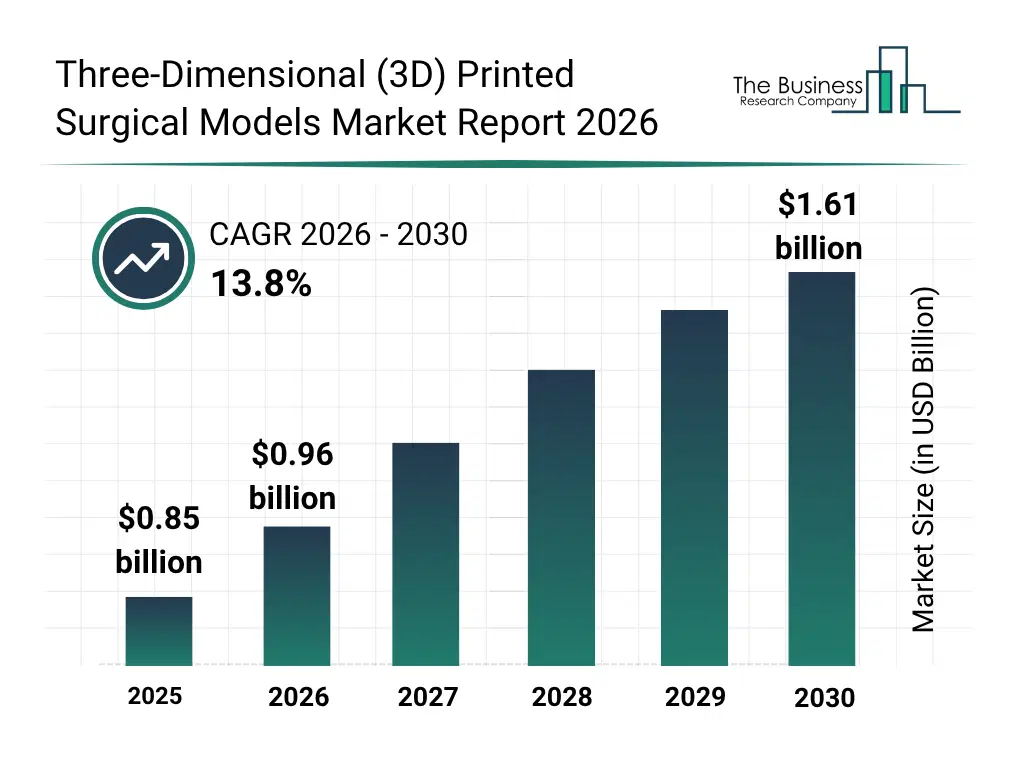
What Is The Three-Dimensional (3D) Printed Surgical Models Market Size and Share 2026?
The three-dimensional (3D) printed surgical models market size has grown rapidly in recent years. It will grow from $0.85 billion in 2025 to $0.96 billion in 2026 at a compound annual growth rate (CAGR) of 13.6%. The growth in the historic period can be attributed to rising demand for surgical planning tools, advancement in 3d printing technologies, adoption of polymer and biomaterials, growth of medical training programs, increasing research in anatomical modeling.What Is The Three-Dimensional (3D) Printed Surgical Models Market Growth Forecast?
The three-dimensional (3D) printed surgical models market size is expected to see rapid growth in the next few years. It will grow to $1.61 billion in 2030 at a compound annual growth rate (CAGR) of 13.8%. The growth in the forecast period can be attributed to integration with ai and machine learning, development of multi-material and composite models, expansion of surgical simulation centers, demand for customized patient-specific solutions, investment in real-time surgical planning platforms. Major trends in the forecast period include patient-specific model development, advanced surgical simulation, integration with medical imaging software, customizable organ and tissue models, preoperative planning optimization.Global Three-Dimensional (3D) Printed Surgical Models Market Segmentation
1) By Model Type: Soft Tissue Models, Bone Models, Organ Models, Vascular Models, Tumor Models 2) By Material Type: Polymer, Metal, Ceramic, Composite, Biomaterials 3) By Technology: Fused Deposition Modeling, Stereolithography, Selective Laser Sintering, Digital Light Processing, Binder Jetting 4) By Application: Preoperative Planning, Surgical Training, Patient-Specific Models, Anatomical Education, Surgical Simulation 5) By End User: Hospitals And Surgical Centers, Diagnostic Imaging Centers, Academic And Research Institutes, Medical Device Companies, Specialty Clinics, Other End Users Subsegments: 1) By Soft Tissue Models: Skin Layer Models, Muscle Structure Models, Ligament And Tendon Models, Cartilage Structure Models, Multilayer Soft Tissue Models, Facial Soft Tissue Models, Reconstructive Soft Tissue Models 2) By Bone Models: Cranial Bone Models, Dental And Jaw Bone Models, Spinal Bone Models, Orthopedic Bone Models 3) By Organ Models: Heart Organ Models, Liver Organ Models, Kidney Organ Models, Lung Organ Models, Brain Organ Models, Gastrointestinal Organ Models 4) By Vascular Models: Arterial System Models, Venous System Models, Cardiac Vascular Models, Neurovascular Models, Peripheral Vascular Models 5) By Tumor Models: Brain Tumor Models, Breast Tumor Models, Lung Tumor Models, Liver Tumor Models, Bone Tumor Models, Prostate Tumor Models, Customized Tumor ModelsWhat Is The Driver Of The Three-Dimensional (3D) Printed Surgical Models Market?
The growing adoption of minimally invasive surgeries is expected to propel the growth of the three-dimensional (3D)-printed surgical models market going forward. Minimally invasive surgeries are surgical techniques that limit the size and number of incisions needed, typically using small tools, cameras, and robotic assistance to reduce postoperative complications and recovery time. The adoption of minimally invasive surgeries is rising due to the growing preference for procedures that reduce patient recovery time, minimize pain, and lower the risk of postoperative complications. 3D-printed surgical models provide surgeons with precise, patient-specific anatomical replicas that allow detailed preoperative planning and practice, enhancing accuracy and safety during minimally invasive surgeries while reducing the risk of complications. For instance, according to the Annual Report 2023 published by Intuitive Surgical Inc., a US-based medical device company, in 2023, roughly 2,286,000 surgical procedures were performed using da Vinci surgical systems, up from approximately 1,875,000 procedures in 2022. Therefore, the growing adoption of minimally invasive surgeries is driving the growth of the three-dimensional (3D) printed surgical models industry.Key Players In The Global Three-Dimensional (3D) Printed Surgical Models Market
Major companies operating in the three-dimensional (3D) printed surgical models market are Stratasys Ltd, 3D Systems Corporation, Formlabs Inc, Materialise NV, WhiteClouds Inc, 3D Medical Support BV, Axial3D Ltd, Onkos Surgical Inc, GPI Prototype & Manufacturing Services LLC, DF3D Creations Private Limited, 3D Surgical, Lazarus 3D LLC, 3D LifePrints U.K. Ltd., 3Deus Dynamics, CliniModel 3D, MedCAD, Graft3D Health Care Solutions Pvt Ltd, MedScan3D, 3D Incredible, Curewith3D, Customy, MCare360.Global Three-Dimensional (3D) Printed Surgical Models Market Trends and Insights
Major companies operating in the three-dimensional (3D)-printed surgical models market are focusing on developing innovative products such as high-fidelity patient-specific anatomical 3D printers to enhance surgical planning, improve medical training, and accelerate device development. High-fidelity patient-specific anatomical 3D printers are advanced 3D printing systems that create accurate, life-accurate replicas of a patient’s anatomy using materials that mimic real tissue and bone, helping surgeons plan procedures, train medical staff, and test devices more effectively than traditional generic models or cadavers. For instance, in June 2024, Stratasys Ltd., a US-based 3D printing technology company, launched the J5 Digital Anatomy 3D printer, a high-fidelity patient-specific anatomical 3D printer designed to produce lifelike patient-specific anatomical models. The J5 Digital Anatomy printer features biomechanically accurate materials that mimic human tissue behavior, a compact office-friendly design, and high repeatability for precise modeling. It supports applications such as preoperative surgical planning, medical training, and iterative device prototyping while reducing reliance on animal testing and lowering operating room costs.What Are Latest Mergers And Acquisitions In The Three-Dimensional (3D) Printed Surgical Models Market?
In December 2023, Mentice AB, a Sweden-based healthcare technology company, acquired Biomodex SAS for an undisclosed amount. With this acquisition, Mentice aims to strengthen its technological capabilities significantly in image-guided interventional therapy simulation by integrating Biomodex’s advanced biorealistic 3D printing and flow systems, thereby expanding its product portfolio, enhancing procedural rehearsal solutions, and accelerating its strategic positioning in the rapidly growing patient-specific simulation and structural heart training market. Biomodex SAS is a France-based medical technology company that specializes in providing 3D-printed, patient-specific surgical models.Regional Insights
North America was the largest region in the three-dimensional (3D) printed surgical models market in 2025. Asia-Pacific is expected to be the fastest-growing region in the forecast period. The regions covered in this market report are Asia-Pacific, South East Asia, Western Europe, Eastern Europe, North America, South America, Middle East, Africa. The countries covered in this market report are Australia, Brazil, China, France, Germany, India, Indonesia, Japan, Taiwan, Russia, South Korea, UK, USA, Canada, Italy, Spain.What Defines the Three-Dimensional (3D) Printed Surgical Models Market?
The three-dimensional (3D) printed surgical models market consists of revenues earned by entities by providing services such as medical imaging processing and segmentation, patient-specific digital modeling, post-processing and finishing, quality assurance and validation, sterilization and packaging, delivery and logistics, workflow integration, and technical support. The market value includes the value of related goods sold by the service provider or included within the service offering. The three-dimensional (3D) printed surgical models market also includes sales of patient-specific anatomical models, preoperative planning models, surgical rehearsal models, and medical education and training models. Values in this market are ‘factory gate’ values; that is, the value of goods sold by the manufacturers or creators of the goods, whether to other entities (including downstream manufacturers, wholesalers, distributors, and retailers) or directly to end customers. The value of goods in this market includes related services sold by the creators of the goods.How is Market Value Defined and Measured?
The market value is defined as the revenues that enterprises gain from the sale of goods and/or services within the specified market and geography through sales, grants, or donations in terms of the currency (in USD unless otherwise specified). The revenues for a specified geography are consumption values that are revenues generated by organizations in the specified geography within the market, irrespective of where they are produced. It does not include revenues from resales along the supply chain, either further along the supply chain or as part of other products.What Key Data And Analysis Are Included In The Three-Dimensional (3D) Printed Surgical Models Market Report 2026?
The three-dimensional (3d) printed surgical models market research report is one of a series of new reports from The Business Research Company that provides market statistics, including industry global market size, regional shares, competitors with the market share, detailed market segments, market trends and opportunities, and any further data you may need to thrive in the three-dimensional (3d) printed surgical models industry. The market research report delivers a complete perspective of everything you need, with an in-depth analysis of the current and future state of the industry.Three-Dimensional (3D) Printed Surgical Models Market Report Forecast Analysis
| Report Attribute | Details |
|---|---|
| Market Size Value In 2026 | $0.96 billion |
| Revenue Forecast In 2035 | $1.61 billion |
| Growth Rate | CAGR of 13.6% from 2026 to 2035 |
| Base Year For Estimation | 2025 |
| Actual Estimates/Historical Data | 2020-2025 |
| Forecast Period | 2026 - 2030 - 2035 |
| Market Representation | Revenue in USD Billion and CAGR from 2026 to 2035 |
| Segments Covered | Model Type, Material Type, Technology, Application, End User |
| Regional Scope | Asia-Pacific, Western Europe, Eastern Europe, North America, South America, Middle East, Africa |
| Country Scope | The countries covered in the report are Australia, Brazil, China, France, Germany, India, Indonesia, Japan, Taiwan, Russia, South Korea, UK, USA, Canada, Italy, Spain. |
| Key Companies Profiled | Stratasys Ltd, 3D Systems Corporation, Formlabs Inc, Materialise NV, WhiteClouds Inc, 3D Medical Support BV, Axial3D Ltd, Onkos Surgical Inc, GPI Prototype & Manufacturing Services LLC, DF3D Creations Private Limited, 3D Surgical, Lazarus 3D LLC, 3D LifePrints U.K. Ltd., 3Deus Dynamics, CliniModel 3D, MedCAD, Graft3D Health Care Solutions Pvt Ltd, MedScan3D, 3D Incredible, Curewith3D, Customy, MCare360. |
| Customization Scope | Request for Customization |
| Pricing And Purchase Options | Explore Purchase Options |