
Thread Networking Market Report 2026
Global Outlook – By Component (Hardware, Software, Services), By Network Topology (Mesh Networking, Star Networking, Hybrid Networking), By Application (Smart Home, Industrial Automation, Building Automation, Healthcare, Energy Management, Other Applications), By End-User (Residential, Commercial, Industrial, Other End-Users) – Market Size, Trends, Strategies, and Forecast to 2035
Thread Networking Market Overview
• Thread Networking market size has reached to $2.35 billion in 2025 • Expected to grow to $5.83 billion in 2030 at a compound annual growth rate (CAGR) of 20% • Growth Driver: Rising Demand For Smart Home Automation Driving Thread Networking Growth • Market Trend: Advancements In Thread Networking Technology Strengthen Smart Home Connectivity And Device Responsiveness • North America was the largest region in 2025 and is the fastest growing region.
What Is Covered Under Thread Networking Market?
Thread networking is a low-power, wireless mesh networking protocol designed for connecting smart devices in home automation and IoT applications. It enables secure, reliable, and scalable communication between devices without relying on a central hub, using an IPv6-based architecture. Thread Networking is widely adopted to enhance device interoperability, energy efficiency, and seamless control. The main components of thread networking include hardware, software, and services. Hardware refers to physical networking devices that enable reliable and secure communication between devices in connected environments. These solutions are available in mesh networking, star networking, and hybrid networking topologies. The various applications involved are smart home, industrial automation, building automation, healthcare, energy management, and other applications, and they are utilized by end users including residential, commercial, industrial, and other end-users.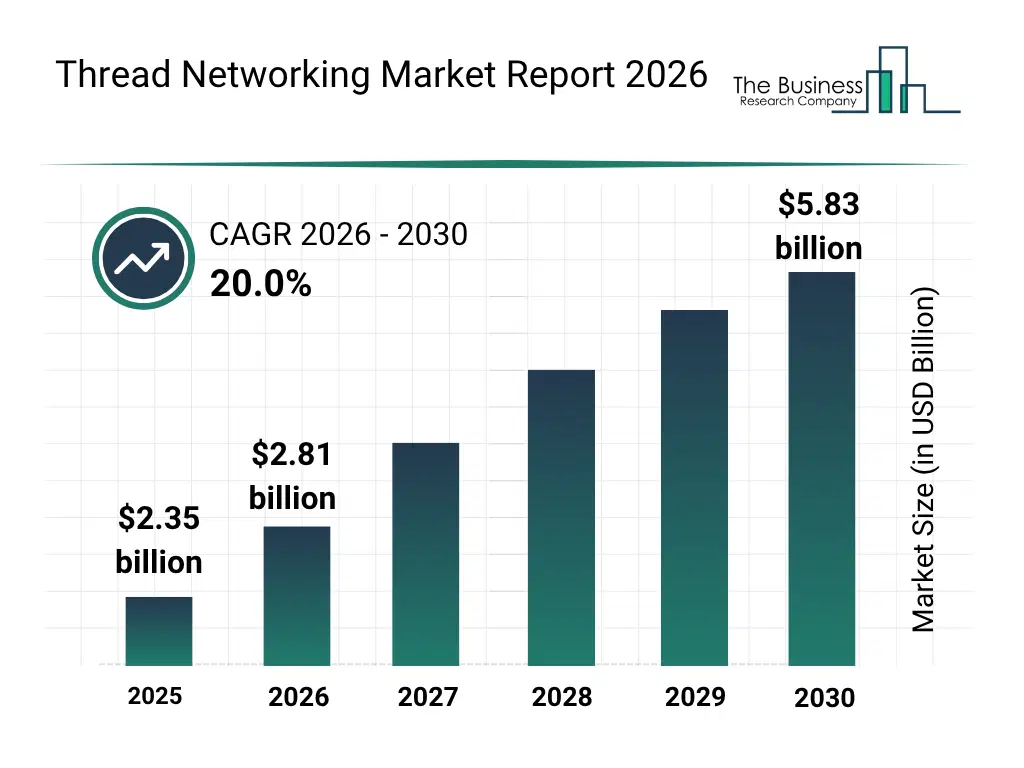
What Is The Thread Networking Market Size and Share 2026?
The thread networking market size has grown rapidly in recent years. It will grow from $2.35 billion in 2025 to $2.81 billion in 2026 at a compound annual growth rate (CAGR) of 19.7%. The growth in the historic period can be attributed to increasing adoption of smart home devices, growth of iot infrastructure, rising demand for energy-efficient communication, deployment of home automation systems, early adoption in industrial automation.What Is The Thread Networking Market Growth Forecast?
The thread networking market size is expected to see rapid growth in the next few years. It will grow to $5.83 billion in 2030 at a compound annual growth rate (CAGR) of 20.0%. The growth in the forecast period can be attributed to integration with ai-driven network management, expansion of commercial and industrial iot applications, rising adoption in healthcare automation, demand for secure ipv6 communication, development of scalable and interoperable mesh networks. Major trends in the forecast period include low-power mesh networking adoption, enhanced device interoperability, ipv6-based secure communication, energy-efficient network protocols, seamless smart home integration.Global Thread Networking Market Segmentation
1) By Component: Hardware, Software, Services 2) By Network Topology: Mesh Networking, Star Networking, Hybrid Networking 3) By Application: Smart Home, Industrial Automation, Building Automation, Healthcare, Energy Management, Other Applications 4) By End-User: Residential, Commercial, Industrial, Other End-Users Subsegments: 1) By Hardware: Thread Routers, Thread Border Routers, Thread End Devices 2) By Software: Network Management Software, Security Software, Device Firmware 3) By Services: Installation And Integration Services, Maintenance And Support Services, Consulting ServicesWhat Are The Drivers Of The Thread Networking Market?
The rising demand for smart home automation systems is expected to propel the growth of the thread networking market going forward. Smart home automation systems are internet-connected networks that enable seamless communication between devices, automate household tasks, and enhance energy efficiency through AI-driven controls. The demand for smart home automation is increasing as consumers prefer systems that offer convenience, safety, and remote accessibility via smartphones or voice assistants. Thread Networking enhances smart home ecosystems by providing low-power, reliable, and secure mesh connectivity, enabling devices to communicate efficiently. For instance, in October 2024, according to the Central Statistics Office, an Ireland-based government agency, in 2024, 30% of internet users utilized smart home security devices, including connected alarm systems, smoke detectors, security cameras, and smart doorbells, up from just 17% in 2022. Therefore, the rising demand for smart home automation systems is driving the growth of the thread networking industry. The growing industrial automation is expected to propel the growth of the thread networking market going forward. Industrial automation refers to the use of control systems such as computers, robots, and information technologies to handle industrial processes with minimal human intervention. The increasing demand for enhanced efficiency and productivity in manufacturing is driving industrial automation adoption, as companies seek to optimize operations, reduce operational costs, and maintain competitiveness in a rapidly evolving industrial landscape. Growing industrial automation increases the need for thread networking as it provides reliable, low-power wireless communication networks to connect sensors, controllers, and devices across automated factory floors, enabling real-time data exchange and seamless machine-to-machine connectivity. For instance, in September 2023, according to the World Robotics report published by the International Federation of Robotics, a Germany-based professional non-profit organization, there were 553,052 industrial robot installations in factories worldwide, marking a 5% year-on-year growth rate in 2022. Therefore, growing industrial automation is driving the growth of the thread networking industry.Key Players In The Global Thread Networking Market
Major companies operating in the thread networking market are Amazon.com Inc., Apple Inc., Google LLC, Samsung Electronics Co. Ltd., Qualcomm Incorporated, Texas Instruments Incorporated, Infineon Technologies AG, STMicroelectronics N.V., NXP Semiconductors N.V., Murata Manufacturing Co. Ltd., Renesas Electronics Corporation, Legrand SA, Microchip Technology Incorporated, Qorvo Inc., Synaptics Incorporated, Silicon Laboratories Inc., Nordic Semiconductor ASA, Tuya Inc., Espressif Systems Shanghai Co. Ltd., and Meross.Global Thread Networking Market Trends and Insights
Major companies operating in the thread networking market are focusing on developing advanced solutions, such as matter-compatible thread devices, to enhance low-latency communication, improve network reliability, and enable seamless device interoperability. Matter-compatible thread devices are smart home devices that operate on the Thread mesh networking protocol while adhering to the Matter standard to ensure cross-platform compatibility that provides secure, energy-efficient, and dependable communication between devices from different brands without the need for dedicated proprietary hubs. For instance, in November 2025, Meross, a China-based smart home device manufacturer, released the presence sensor MS605, the first Thread device designed to deliver faster response times and stable connectivity within Matter-compatible ecosystems. The device enhances automation accuracy by detecting human presence more precisely while leveraging Thread’s self-healing mesh network to ensure consistent performance across connected smart home environments.Regional Insights
North America was the largest region in the thread networking market in 2025. The regions covered in this market report are Asia-Pacific, South East Asia, Western Europe, Eastern Europe, North America, South America, Middle East, Africa. The countries covered in this market report are Australia, Brazil, China, France, Germany, India, Indonesia, Japan, Taiwan, Russia, South Korea, UK, USA, Canada, Italy, Spain.What Defines the Thread Networking Market?
The thread networking market consists of revenues earned by entities by providing services such as secure low-power mesh connectivity, self-healing network routing, IP-based device communication, and scalable device addressing and interoperability. The market value includes the value of related goods sold by the service provider or included within the service offering. The thread networking market also includes sales of Thread-enabled smart bulbs, smart thermostats with Thread support, Thread-compatible smart locks, smart sensors, and Thread routers and border routers. Values in this market are ‘factory gate’ values, that is, the value of goods sold by the manufacturers or creators of the goods, whether to other entities (including downstream manufacturers, wholesalers, distributors, and retailers) or directly to end customers. The value of goods in this market includes related services sold by the creators of the goods.How is Market Value Defined and Measured?
The market value is defined as the revenues that enterprises gain from the sale of goods and/or services within the specified market and geography through sales, grants, or donations in terms of the currency (in USD unless otherwise specified). The revenues for a specified geography are consumption values that are revenues generated by organizations in the specified geography within the market, irrespective of where they are produced. It does not include revenues from resales along the supply chain, either further along the supply chain or as part of other products.What Key Data And Analysis Are Included In The Thread Networking Market Report 2026?
The thread networking market research report is one of a series of new reports from The Business Research Company that provides market statistics, including industry global market size, regional shares, competitors with the market share, detailed market segments, market trends and opportunities, and any further data you may need to thrive in the thread networking industry. The market research report delivers a complete perspective of everything you need, with an in-depth analysis of the current and future state of the industry.Thread Networking Market Report Forecast Analysis
| Report Attribute | Details |
|---|---|
| Market Size Value In 2026 | $2.81 billion |
| Revenue Forecast In 2035 | $5.83 billion |
| Growth Rate | CAGR of 19.7% from 2026 to 2035 |
| Base Year For Estimation | 2025 |
| Actual Estimates/Historical Data | 2020-2025 |
| Forecast Period | 2026 - 2030 - 2035 |
| Market Representation | Revenue in USD Billion and CAGR from 2026 to 2035 |
| Segments Covered | Component, Network Topology, Application, End-User |
| Regional Scope | Asia-Pacific, Western Europe, Eastern Europe, North America, South America, Middle East, Africa |
| Country Scope | The countries covered in the report are Australia, Brazil, China, France, Germany, India, Indonesia, Japan, Taiwan, Russia, South Korea, UK, USA, Canada, Italy, Spain. |
| Key Companies Profiled | Amazon.com Inc., Apple Inc., Google LLC, Samsung Electronics Co. Ltd., Qualcomm Incorporated, Texas Instruments Incorporated, Infineon Technologies AG, STMicroelectronics N.V., NXP Semiconductors N.V., Murata Manufacturing Co. Ltd., Renesas Electronics Corporation, Legrand SA, Microchip Technology Incorporated, Qorvo Inc., Synaptics Incorporated, Silicon Laboratories Inc., Nordic Semiconductor ASA, Tuya Inc., Espressif Systems Shanghai Co. Ltd., and Meross. |
| Customization Scope | Request for Customization |
| Pricing And Purchase Options | Explore Purchase Options |