
Synbiotic Moisturizer Market Report 2026
Global Outlook – By Product Type (Creams, Lotions, Serums, Gels, Other Product Types), By Skin Type (Dry, Oily, Combination, Sensitive, Normal), By Distribution Channel (Online Stores, Supermarkets or Hypermarkets, Specialty Stores, Pharmacies, Other Distribution Channels), By Application (Face Care, Body Care, Other Applications), By End-User (Men, Women, Unisex) – Market Size, Trends, Strategies, and Forecast to 2035
Synbiotic Moisturizer Market Overview
• Synbiotic Moisturizer market size has reached to $1.09 billion in 2025 • Expected to grow to $1.76 billion in 2030 at a compound annual growth rate (CAGR) of 10.2% • Growth Driver: Rising Social Media Influence Fueling The Growth Of The Market Due To Increasing Consumer Awareness And Influencer-Driven Product Adoption • Market Trend: • North America was the largest region in 2025 and Asia-Pacific is the fastest growing region.
What Is Covered Under Synbiotic Moisturizer Market?
A synbiotic moisturizer is a skincare formulation that combines probiotics and prebiotics to support the skin’s natural microbiome balance. It works by nourishing beneficial microorganisms on the skin while helping to strengthen the protective barrier and improve moisture retention. This type of moisturizer promotes healthier, more resilient skin by enhancing hydration and defending against environmental stress. The main product types of symbiotic moisturizer are creams, lotions, serums, gels, and other product types. Creams refer to thick, emollient formulations designed to hydrate and nourish the skin while delivering synbiotic ingredients. These products are suitable for different skin types, including dry, oily, combination, sensitive, and normal. They are sold through various distribution channels, such as online stores, supermarkets or hypermarkets, specialty stores, pharmacies, and other distribution channels. They are used across multiple applications, including face care, body care, and other applications, and cater to various end-users, including men, women, and unisex.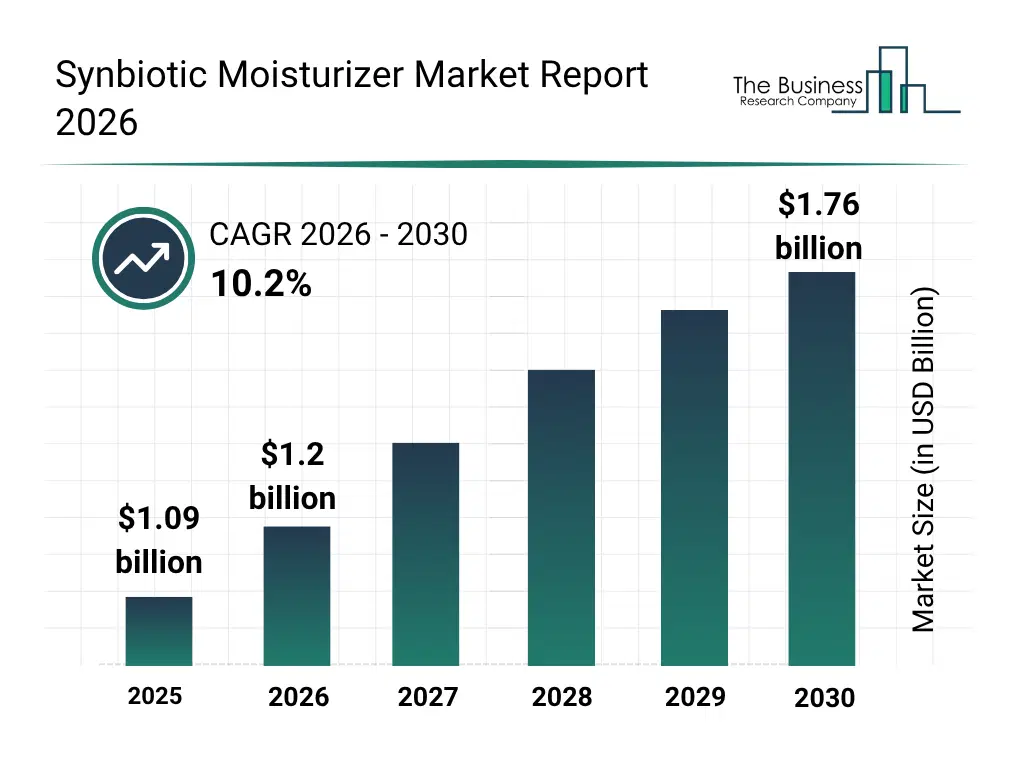
What Is The Synbiotic Moisturizer Market Size and Share 2026?
The synbiotic moisturizer market size has grown strongly in recent years. It will grow from $1.09 billion in 2025 to $1.2 billion in 2026 at a compound annual growth rate (CAGR) of 10.0%. The growth in the historic period can be attributed to growing awareness of skin microbiome health, increasing use of moisturizers in daily skincare routines, rising demand for natural and functional ingredients, expansion of online skincare retail, increasing consumer preference for personalized skincare.What Is The Synbiotic Moisturizer Market Growth Forecast?
The synbiotic moisturizer market size is expected to see rapid growth in the next few years. It will grow to $1.76 billion by 2030 at a compound annual growth rate (CAGR) of 10.2%. The growth in the forecast period can be attributed to rising adoption of synbiotic formulations in creams and serums, growing demand for sensitive and dry skin-targeted products, expansion of e-commerce and specialty retail channels, increasing use of hydrating and barrier-support technologies, growing focus on sustainable and eco-friendly packaging. Major trends in the forecast period include increasing adoption of microbiome-friendly skincare products, rising demand for hydrating and barrier repair formulations, growing integration of probiotics and prebiotics in creams and lotions, expansion of online and specialty retail channels, rising focus on gender-neutral and sensitive skin products.Global Synbiotic Moisturizer Market Segmentation
1) By Product Type: Creams, Lotions, Serums, Gels, Other Product Types 2) By Skin Type: Dry, Oily, Combination, Sensitive, Normal 3) By Distribution Channel: Online Stores, Supermarkets or Hypermarkets, Specialty Stores, Pharmacies, Other Distribution Channels 4) By Application: Face Care, Body Care, Other Applications 5) By End-User: Men, Women, Unisex Subsegments: 1) By Creams: Anti Aging Creams, Hydrating Creams, Brightening Creams, Barrier Repair Creams, Nourishing Creams 2) By Lotions: Lightweight Moisturizing Lotions, Daily Hydration Lotions, Balancing Skin Microbiome Lotions, Soothing Body Lotions, Protective Moisturizing Lotions 3) By Serums: Hydrating Facial Serums, Skin Barrier Repair Serums, Microbiome Balancing Serums, Anti Aging Treatment Serums, Brightening And Revitalizing Serums 4) By Gels: Hydrating Gel Moisturizers, Cooling Skin Gels, Oil Control Moisturizing Gels, Soothing And Calming Gels, Lightweight Barrier Support Gels 5) By Other Product Types: Moisturizing Face Mists, Skin Nourishing Balms, Overnight Hydration Masks, Moisturizing Ampoules, Skin Repair Sleeping PacksWhat Are The Drivers Of The Synbiotic Moisturizer Market?
The expanding influence of social media is expected to propel the growth of the synbiotic moisturizer market going forward. Social media is a digital platform that enables users to create, share, and interact with content and connect with others online in real time. Social media influence is rising due to widespread smartphone and internet access, which enables people to stay constantly connected and consume personalized, real-time content that shapes their opinions and decisions. The growing influence of social media boosts demand for synbiotic moisturizers by raising awareness through influencer promotions and informative content, helping consumers understand and trust microbiome-based skincare products. For instance, in February 2024, according to We Are Social, a UK-based digital marketing agency, the United Kingdom had around 56.2 million social media users in 2024, with individuals spending an average of 1 hour and 49 minutes per day across approximately 6.4 platforms. Several platforms, including Facebook, Instagram, TikTok, LinkedIn, and Snapchat, experienced year-over-year growth in advertising reach, while Pinterest stood out by increasing its potential advertising audience by 5.9 million users, reflecting a 77.9% increase compared to the previous year. Therefore, expanding influence of social media is driving the growth of the synbiotic moisturizer industry. The expansion of e-commerce channels is expected to propel the growth of the synbiotic moisturizer market going forward. E-commerce is the process of buying and selling goods or services over the internet through digital platforms that enable online transactions. E-commerce channels are rising due to increasing consumer preference for convenience, as online platforms allow people to browse, compare, and purchase products anytime from anywhere without the need to visit physical stores. The expansion of e-commerce channels supports synbiotic moisturizers by improving accessibility, enabling consumers to easily discover, compare, and purchase microbiome-based skincare products from a wide range of brands regardless of location. For instance, in March 2026, according to the Census Bureau, a US-based government agency, U.S. retail e-commerce sales were estimated at $316.1 billion in the fourth quarter of 2025 on a seasonally adjusted basis, excluding price adjustments, reflecting a 1.7% increase (±0.5%) compared to the third quarter of 2025. Therefore, expansion of e-commerce channels is driving the growth of the synbiotic moisturizer industry. The rising disposable income is expected to propel the growth of the synbiotic moisturizer market going forward. Disposable income refers to the amount of money an individual or household has available for spending and saving after all taxes and mandatory deductions have been subtracted from gross income. Increasing disposable income is primarily due to rising wages, as higher earnings from employment increase the amount of money individuals have left after taxes and essential expenses. Higher disposable income drives demand for synbiotic moisturizers by allowing consumers to afford premium, science-based skincare products that support long-term skin health and microbiome balance. For instance, in October 2024, according to Statistics Iceland, an Iceland-based government agency, household disposable income recorded a 6.6% growth in the second quarter of 2024 compared to the same quarter last year. Therefore, rising disposable income is driving the growth of the synbiotic moisturizer industry.Key Players In The Global Synbiotic Moisturizer Market
Major companies operating in the synbiotic moisturizer market are Dermalogica Inc., Dr. Dennis Gross Skincare LLC, Eminence Organic Skin Care Ltd., Lano-Luxe Pty Ltd., Dermaviduals, Esse Skincare (Pty) Ltd., Beauty Pie Ltd., Ellis Brooklyn Beauty Inc., Glowbiotics Skincare LLC, Seoulista Beauty Limited, Epara Skincare Limited, FarmHouse Fresh Skincare LLC, Juno & Co. LLC, Oskia Skincare Limited, Codex Beauty Labs, Gallinée, LaFlore Probiotic Skincare Inc., Aurelia Probiotic Skincare, Laboratoire Synbionyme, The Nue Co.Regional Insights
North America was the largest region in the synbiotic moisturizer market in 2025. Asia-Pacific is expected to be the fastest-growing region in the forecast period. The regions covered in this market report are Asia-Pacific, South East Asia, Western Europe, Eastern Europe, North America, South America, Middle East, Africa. The countries covered in this market report are Australia, Brazil, China, France, Germany, India, Indonesia, Japan, Taiwan, Russia, South Korea, UK, USA, Canada, Italy, Spain.What Defines the Synbiotic Moisturizer Market?
A synbiotic moisturizer market consists of sales of cleansers, face wash, facial oils, face masks, sheet masks, eye creams, night creams, day creams, sunscreens, toners, mists, and essences. Values in this market are ‘factory gate’ values, that is, the value of goods sold by the manufacturers or creators of the goods, whether to other entities (including downstream manufacturers, wholesalers, distributors, and retailers) or directly to end customers. The value of goods in this market includes related services sold by the creators of the goods.How is Market Value Defined and Measured?
The market value is defined as the revenues that enterprises gain from the sale of goods and/or services within the specified market and geography through sales, grants, or donations in terms of the currency (in USD unless otherwise specified). The revenues for a specified geography are consumption values that are revenues generated by organizations in the specified geography within the market, irrespective of where they are produced. It does not include revenues from resales along the supply chain, either further along the supply chain or as part of other products.What Key Data and Analysis Are Included in the Synbiotic Moisturizer Market Report 2026?
The synbiotic moisturizer market research report is one of a series of new reports from The Business Research Company that provides market statistics, including industry global market size, regional shares, competitors with the market share, detailed market segments, market trends and opportunities, and any further data you may need to thrive in the synbiotic moisturizer industry. The market research report delivers a complete perspective of everything you need, with an in-depth analysis of the current and future state of the industry.Synbiotic Moisturizer Market Report Forecast Analysis
| Report Attribute | Details |
|---|---|
| Market Size Value In 2026 | $1.2 billion |
| Revenue Forecast In 2035 | $1.76 billion |
| Growth Rate | CAGR of 10.0% from 2026 to 2035 |
| Base Year For Estimation | 2025 |
| Actual Estimates/Historical Data | 2020-2025 |
| Forecast Period | 2026 - 2030 - 2035 |
| Market Representation | Revenue in USD Billion and CAGR from 2026 to 2035 |
| Segments Covered | Product Type, Skin Type, Distribution Channel, Application, End-User |
| Regional Scope | Asia-Pacific, Western Europe, Eastern Europe, North America, South America, Middle East, Africa |
| Country Scope | The countries covered in the report are Australia, Brazil, China, France, Germany, India, ... |
| Key Companies Profiled | Dermalogica Inc., Dr. Dennis Gross Skincare LLC, Eminence Organic Skin Care Ltd., Lano-Luxe Pty Ltd., Dermaviduals, Esse Skincare (Pty) Ltd., Beauty Pie Ltd., Ellis Brooklyn Beauty Inc., Glowbiotics Skincare LLC, Seoulista Beauty Limited, Epara Skincare Limited, FarmHouse Fresh Skincare LLC, Juno & Co. LLC, Oskia Skincare Limited, Codex Beauty Labs, Gallinée, LaFlore Probiotic Skincare Inc., Aurelia Probiotic Skincare, Laboratoire Synbionyme, The Nue Co. |
| Customization Scope | Request for Customization |
| Pricing And Purchase Options | Explore Purchase Options |