

Structural Bioinformatics Software Market Report 2026
Global Outlook – By Product Type (Visualization Software, Modeling Software, Analysis Software, Database Management Software, Other Product Types), By Deployment Mode (On-Premises, Cloud-Based), By Application (Drug Discovery, Protein Structure Analysis, Molecular Dynamics, Genomics and Proteomics, Other Applications), By End-User (Pharmaceutical and Biotechnology Companies, Academic and Research Institutes, Contract Research Organizations, Other End Users) – Market Size, Trends, Strategies, and Forecast to 2035
Structural Bioinformatics Software Market Overview
• Structural Bioinformatics Software market size has reached to $1.56 billion in 2025 • Expected to grow to $2.54 billion in 2030 at a compound annual growth rate (CAGR) of 10.3% • Growth Driver: Rising Demand For Personalized Medicine Driving The Market Growth Due To Advances In Genomic Technologies And Increasing Approval Of Targeted Therapies • Market Trend: Innovation In Structural Bioinformatics Software Platforms Accelerates Drug Discovery And Protein Engineering Workflows • North America was the largest region in 2025 and Asia-Pacific is the fastest growing region.
What Is Covered Under Structural Bioinformatics Software Market?
Structural bioinformatics software refers to computational tools that analyze, visualize, and predict the three-dimensional structures of biological macromolecules such as proteins and nucleic acids. These platforms help understand molecular function, interactions, and dynamics, supporting applications such as drug design, protein engineering, and molecular simulations. The main product types of structural bioinformatics software include visualization software, modeling software, analysis software, database management software, and other product types. Visualization software provides graphical representations of molecular structures. These solutions are deployed through on-premises and cloud-based models. They are applied in drug discovery, protein structure analysis, molecular dynamics, genomics and proteomics, and other applications, and while the end users including pharmaceutical and biotechnology companies, academic and research institutes, contract research organizations, and other end users.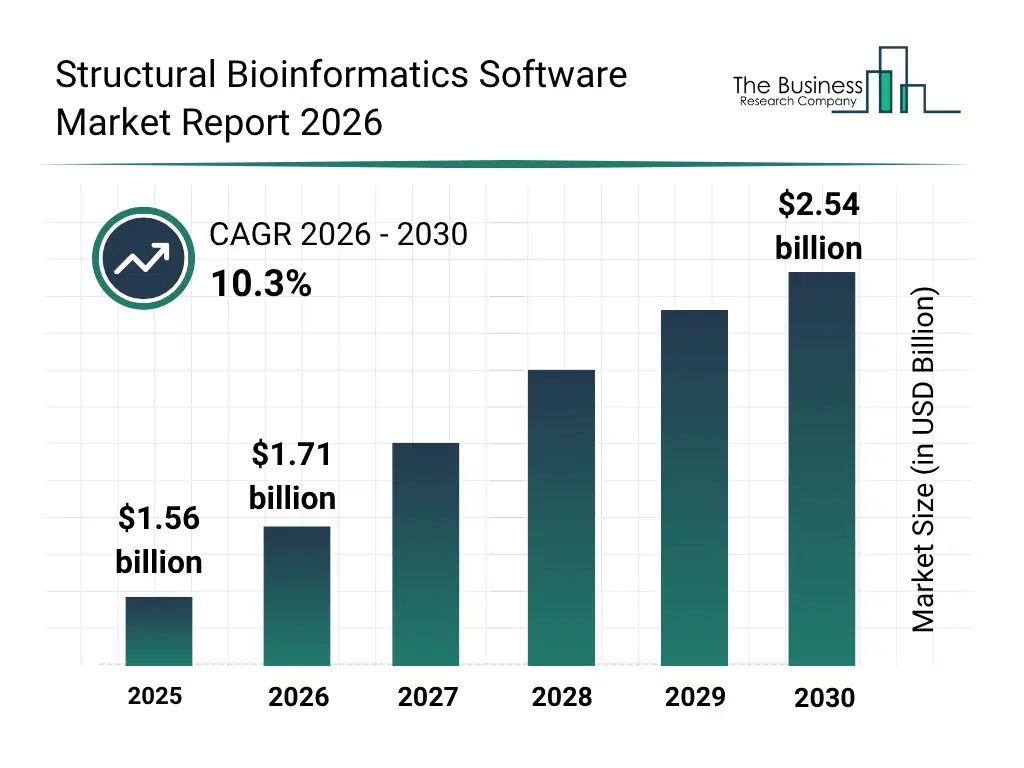
What Is The Structural Bioinformatics Software Market Size and Share 2026?
The structural bioinformatics software market size has grown rapidly in recent years. It will grow from $1.56 billion in 2025 to $1.71 billion in 2026 at a compound annual growth rate (CAGR) of 10.1%. The growth in the historic period can be attributed to increasing demand for protein structure analysis, growth of pharmaceutical and biotechnology research, adoption of molecular modeling tools, rising focus on genomics and proteomics studies, development of visualization and analysis software.What Is The Structural Bioinformatics Software Market Growth Forecast?
The structural bioinformatics software market size is expected to see rapid growth in the next few years. It will grow to $2.54 billion in 2030 at a compound annual growth rate (CAGR) of 10.3%. The growth in the forecast period can be attributed to ai-powered structural prediction adoption, cloud deployment of bioinformatics platforms, integration with advanced drug discovery workflows, expansion of academic and research institute capabilities, demand for high-throughput and collaborative analysis solutions. Major trends in the forecast period include ai-driven structural predictions, cloud-based structural bioinformatics platforms, high-throughput molecular simulations, integration with drug discovery pipelines, collaborative structural data management.Global Structural Bioinformatics Software Market Segmentation
1) By Product Type: Visualization Software, Modeling Software, Analysis Software, Database Management Software, Other Product Types 2) By Deployment Mode: On-Premises, Cloud-Based 3) By Application: Drug Discovery, Protein Structure Analysis, Molecular Dynamics, Genomics and Proteomics, Other Applications 4) By End-User: Pharmaceutical and Biotechnology Companies, Academic and Research Institutes, Contract Research Organizations, Other End Users Subsegments: 1) By Visualization Software: Three Dimensional Molecular Visualization, Protein Structure Rendering Tools, Interactive Structural Exploration Tools, Surface And Electrostatic Visualization Tools, Comparative Structure Visualization Tools 2) By Modeling Software: Homology Modeling Tools, Ab Initio Structure Prediction Tools, Threading And Fold Recognition Tools, Macromolecular Assembly Modeling Tools, Ligand Docking And Binding Modeling Tools 3) By Analysis Software: Structural Alignment And Comparison Tools, Binding Site Identification Tools, Energy Minimization And Stability Analysis Tools, Protein Folding And Conformation Analysis Tools, Mutational Impact And Functional Analysis Tools 4) By Database Management Software: Protein Structure Database Management Systems, Sequence And Structure Integration Databases, Annotation And Metadata Management Systems, Experimental Data Storage Platforms, Data Retrieval And Query Management Tools 5) By Other Product Types: Workflow Automation And Pipeline Management Tools, Simulation Support Utilities, Data Conversion And Format Standardization Tools, Collaboration And Reporting Tools, Integration And Application Programming Interface Management ToolsWhat Is The Driver Of The Structural Bioinformatics Software Market?
The growing demand for personalized medicine is expected to propel the growth of the structural bioinformatics software market going forward. Personalized medicine is an approach that customizes healthcare and therapies based on a patient’s unique biological and personal characteristics. The use of personalized medicine is increasing due to advances in genomic technologies, which allow healthcare providers to analyze a patient’s genetic information quickly and accurately, enabling more targeted and effective treatments. Structural bioinformatics software helps personalized medicine by analyzing the 3D structures of proteins and other biomolecules to predict how individual genetic variations affect drug response, enabling tailored therapies for each patient. For instance, in February 2024, according to the Personalized Medicine Coalition, a US-based non-profit organization, in 2023, the FDA approved 16 new personalized treatments for rare disease patients, up from six in 2022. The newly approved personalized treatments for 2023 also include seven cancer drugs and three for other diseases and conditions. Therefore, the growing demand for personalized medicine is driving the growth of the structural bioinformatics software industry.Key Players In The Global Structural Bioinformatics Software Market
Major companies operating in the structural bioinformatics software market are Dassault Systèmes SE, Schrödinger Inc., DeepMind Limited, Simulations Plus Inc., Chemical Computing Group ULC, MolSoft LLC, Cresset Group Ltd., OpenEye Scientific Software Inc., Nimbus Therapeutics LLC, Optibrium Ltd., DNASTAR Inc., Bioinformatics Solutions Inc., BioSolveIT GmbH, Acellera Ltd., InteLigand GmbH, Alchemistry Ltd., OpenStructure, Insilico Medicine Ltd., Exscientia plc, and Biortus Biosciences Co. Ltd.Global Structural Bioinformatics Software Market Trends and Insights
Major companies operating in the structural bioinformatics software market are focusing on developing innovative solutions such as integrated structural biology computational platforms to accelerate drug discovery, optimize protein engineering, and enhance molecular modeling accuracy. Integrated structural biology computational platforms are advanced digital systems that combine modeling, simulation, and data analysis tools to study the three-dimensional structure of biological molecules that help researchers understand molecular interactions, predict protein structures, and accelerate drug discovery and life science research. For instance, in August 2025, Biortus, a US-based contract research organization, launched BiortusAI, an AI- or ML-powered integrated structural biology computational platform that accelerates protein design, antibody engineering, and hit discovery. The platform integrates structural biology data from X-ray crystallography and cryo-EM with advanced models like AlphaFold2, Chai-1/2, and Proteinix, enabling workflows for enzyme optimization, nanobody design, and rapid GPCR hit identification with high accuracy. This structural bioinformatics tool shortens drug discovery cycles by over 50% through AI-driven virtual screening and high-performance computing.What Are Latest Mergers And Acquisitions In The Structural Bioinformatics Software Market?
In August 2023, Optibrium Ltd., a UK-based software company, acquired BioPharmics LLC for an undisclosed amount. Through this acquisition, Optibrium aims to enhance its 3D drug design and visualization capabilities by integrating BioPharmics’ advanced molecular modeling and visualization technologies, enabling researchers to more effectively design and optimize novel therapeutics. BioPharmics LLC is a US-based biotechnology company focused on providing 3D ligand- and structure-based modeling software used in computational drug design.Regional Insights
North America was the largest region in the structural bioinformatics software market in 2025. Asia-Pacific is expected to be the fastest-growing region in the forecast period. The regions covered in this market report are Asia-Pacific, South East Asia, Western Europe, Eastern Europe, North America, South America, Middle East, Africa. The countries covered in this market report are Australia, Brazil, China, France, Germany, India, Indonesia, Japan, Taiwan, Russia, South Korea, UK, USA, Canada, Italy, Spain.What Defines the Structural Bioinformatics Software Market?
The structural bioinformatics software market consists of revenues earned by entities by providing services such as protein structure prediction, molecular visualization, and molecular docking. The market value includes the value of related goods sold by the service provider or included within the service offering. Only goods and services traded between entities or sold to end consumers are included.How is Market Value Defined and Measured?
The market value is defined as the revenues that enterprises gain from the sale of goods and/or services within the specified market and geography through sales, grants, or donations in terms of the currency (in USD unless otherwise specified). The revenues for a specified geography are consumption values that are revenues generated by organizations in the specified geography within the market, irrespective of where they are produced. It does not include revenues from resales along the supply chain, either further along the supply chain or as part of other products.What Key Data And Analysis Are Included In The Structural Bioinformatics Software Market Report 2026?
The structural bioinformatics software market research report is one of a series of new reports from The Business Research Company that provides market statistics, including industry global market size, regional shares, competitors with the market share, detailed market segments, market trends and opportunities, and any further data you may need to thrive in the structural bioinformatics software industry. The market research report delivers a complete perspective of everything you need, with an in-depth analysis of the current and future state of the industry.Structural Bioinformatics Software Market Report Forecast Analysis
| Report Attribute | Details |
|---|---|
| Market Size Value In 2026 | $1.71 billion |
| Revenue Forecast In 2035 | $2.54 billion |
| Growth Rate | CAGR of 10.1% from 2026 to 2035 |
| Base Year For Estimation | 2025 |
| Actual Estimates/Historical Data | 2020-2025 |
| Forecast Period | 2026 - 2030 - 2035 |
| Market Representation | Revenue in USD Billion and CAGR from 2026 to 2035 |
| Segments Covered | Product Type, Deployment Mode, Application, End-User |
| Regional Scope | Asia-Pacific, Western Europe, Eastern Europe, North America, South America, Middle East, Africa |
| Country Scope | The countries covered in the report are Australia, Brazil, China, France, Germany, India, Indonesia, Japan, Taiwan, Russia, South Korea, UK, USA, Canada, Italy, Spain. |
| Key Companies Profiled | Dassault Systèmes SE, Schrödinger Inc., DeepMind Limited, Simulations Plus Inc., Chemical Computing Group ULC, MolSoft LLC, Cresset Group Ltd., OpenEye Scientific Software Inc., Nimbus Therapeutics LLC, Optibrium Ltd., DNASTAR Inc., Bioinformatics Solutions Inc., BioSolveIT GmbH, Acellera Ltd., InteLigand GmbH, Alchemistry Ltd., OpenStructure, Insilico Medicine Ltd., Exscientia plc, and Biortus Biosciences Co. Ltd. |
| Customization Scope | Request for Customization |
| Pricing And Purchase Options | Explore Purchase Options |