
Contact Us
  Search
The Business Research Company Logo
Space Propellant Tank Global Market Opportunities And Strategies To 2035
Published :May 2026
Pages :352
Format :PDF
Delivery Time :2-3 Business Days
Why 2-3 days? We update the report with the latest data and news before delivery. Let us know if you need us to expedite.
Report Price :$4,490.00

Space Propellant Tank Global Market Opportunities And Strategies To 2035

By Type (Liquid Propellants, Solid Propellants, Hybrid Propellants), By Material (Aluminum And Titanium Alloys, Carbon Fiber, Nanomaterials, Stainless Steel, Thermoset And Thermoplastic), By Tank Design (Cylindrical Tanks, Spherical Tanks, Toroidal Tanks, Custom Designed Tanks), By Application (Launch Vehicles, Satellites And Spacecraft, Orbital Transfer Vehicles, Deep Space Missions), By End-User (Commercial, Defense), And By Region, Opportunities And Strategies – Global Forecast To 2035

Space Propellant Tank Market Definition

Space propellant tanks are specialized storage vessels designed to safely contain liquid or gaseous propellants, such as liquid hydrogen, liquid oxygen, hydrazine, or other spacecraft fuels, used for spacecraft propulsion systems. These tanks are engineered with lightweight yet strong materials like aluminum alloys, titanium, or composite structures to withstand extreme pressures, temperatures, and the vacuum of space. The primary purpose of space propellant tanks is to store and deliver propellants reliably to rocket engines or thrusters during launch, orbital maneuvers, and deep-space missions. The space propellant tank market consists of sales, by entities (organizations, sole traders, or partnerships), fuel reservoirs that are employed during launch, orbital insertion, station-keeping, attitude adjustment, and deep-space propulsion. They are commonly complemented by other propulsion subsystems such as thrusters, feed lines, pressure regulation units, and valves. Substitute technologies may include electric propulsion systems that rely on alternative storage or energy-based thrust mechanisms.
Research Expert

Book your 30 minutes free consultation with our research experts

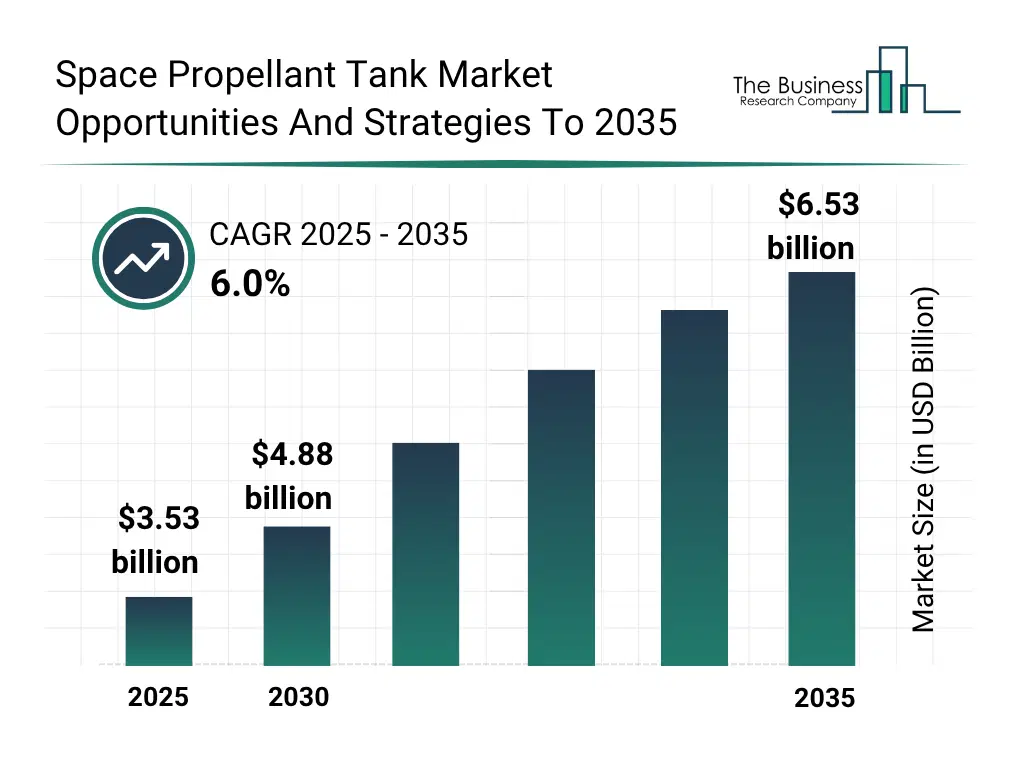
Space Propellant Tank Global Market Opportunities And Strategies To 2035 Market Size and growth rate 2025 to 2030: Graph

Space Propellant Tank Market Size

The global space propellant tank market reached a value of nearly $3,530.7 million in 2025, having grown at a compound annual growth rate (CAGR) of 7.9% since 2020. The market is expected to grow from $3,530.7 million in 2025 to $4,875.2 million in 2030 at a rate of 6.7%. The market is then expected to grow at a CAGR of 6.0% from 2030 and reach $6,531.2 million in 2035. Growth in the historic period resulted from the increase in demand for space exploration, rising investment in space programs, growing commercial space sector and increase in small satellite deployments. Factors that negatively affected growth in the historic period were labor shortages and high research, development, and manufacturing costs. Going forward, the rising defense spending in space programs, growth in space tourism, increasing number of satellites launches and adoption of reusable launch vehicles (RLVs) will drive the growth. Factor that could hinder the growth of the space propellant tank market in the future include impact of trade war and tariff, thermal instability and boil-off challenges for cryogenic propellants and stringent qualification and testing requirements.

Space Propellant Tank Market Segmentation

The space propellant tank market is segmented by type, by material, by tank design, by application and by end-user.

By Type –
The space propellant tank market is segmented by type into:
    • a) Liquid Propellants
    • b) Solid Propellants
    • c) Hybrid Propellants
The liquid propellants market was the largest segment of the space propellant tank market segmented by type, accounting for 69.3% or $2,445.6 million of the total in 2025. Going forward, the hybrid propellants segment is expected to be the fastest growing segment in the space propellant tank market segmented by type, at a CAGR of 11.1% during 2025-2030.

By Material –
The space propellant tank market is segmented by material into:
    • a) Aluminum And Titanium Alloys
    • b) Carbon Fiber
    • c) Nanomaterials
    • d) Stainless Steel
    • e) Thermoset And Thermoplastic
The aluminum and titanium alloys market was the largest segment of the space propellant tank market segmented by material, accounting for 39.4% or $1,390.5 million of the total in 2025. Going forward, the nanomaterials segment is expected to be the fastest growing segment in the space propellant tank market segmented by material, at a CAGR of 9.1% during 2025-2030.

By Tank Design –
The space propellant tank market is segmented by tank design into:
    • a) Cylindrical Tanks
    • b) Spherical Tanks
    • c) Toroidal Tanks
    • d) Custom Designed Tanks
The cylindrical tanks market was the largest segment of the space propellant tank market segmented by tank design, accounting for 53.7% or $1,897.7 million of the total in 2025. Going forward, the custom designed tanks segment is expected to be the fastest growing segment in the space propellant tank market segmented by tank design, at a CAGR of 7.3% during 2025-2030.

By Application –
The space propellant tank market is segmented by application into:
  1. a) Launch Vehicles
  2. b) Satellites And Spacecraft
  3. c) Orbital Transfer Vehicles
  4. d) Deep Space Missions
The launch vehicles market was the largest segment of the space propellant tank market segmented by application, accounting for 48.2% or $1,702.5 million of the total in 2025. Going forward, the orbital transfer vehicles segment is expected to be the fastest growing segment in the space propellant tank market segmented by application, at a CAGR of 11.9% during 2025-2030.

By End-User –
The space propellant tank market is segmented by end-user into:
  1. a) Commercial
  2. b) Defense
The commercial market was the largest segment of the space propellant tank market segmented by end-user, accounting for 72.3% or $2,378.9 million of the total in 2025. Going forward, the commercial segment is expected to be the fastest growing segment in the space propellant tank market segmented by end-user, at a CAGR of 7.8% during 2025-2030.

By Geography - The space propellant tank market is segmented by geography into:
      o Asia Pacific
      • • China
      • • India
      • • Japan
      • • Australia
      • • Indonesia
      • • South Korea
      o North America
      • • USA
      • • Canada
      o South America
      • • Brazil
      o Western Europe
      • • France
      • • Germany
      • • UK
      • • Italy
      • • Spain
      o Eastern Europe
      • • Russia
      o Middle East
      o Africa
North America was the largest region in the space propellant tank market, accounting for 57.8% or $2,041.1 million of the total in 2025. It was followed by Asia Pacific, Western Europe and then the other regions. Going forward, the fastest-growing regions in the space propellant tank market will be Asia Pacific and Western Europe where growth will be at CAGRs of 8.5% and 6.9% respectively. These will be followed by Eastern Europe and North America where the markets are expected to grow at CAGRs of 6.7% and 6.0% respectively.

Space Propellant Tank Market Drivers

The key drivers of the space propellant tank market include: Rising Defense Spending In Space Programs During the forecast period, increasing defense spending on space programs is expected to drive the growth of the space propellant tank market. Defense agencies are placing greater emphasis on launch systems and spacecraft capable of supporting national security missions, ensuring operational resilience, and maintaining secure and reliable access to orbit, all of which rely on advanced propulsion and fuel storage solutions. Higher investments in defense space initiatives are boosting demand for propellant tanks that provide high durability, stable pressurization, and efficient fuel management to enable mission-critical maneuvers and extended operations. As governments continue to expand funding for launch services, satellite deployments, and space infrastructure—including multibillion-dollar budgets for national security space launches—the need for robust, mission-ready propellant tank technologies is expected to increase significantly, thereby accelerating market growth. The rising defense spending in space programs growth contribution during the forecast period in 2025 is 2.0%.

Space Propellant Tank Market Restraints

The key restraints on the space propellant tank market include: Thermal Instability And Boil-Off Challenges For Cryogenic Propellants Thermal instability and boil-off challenges associated with cryogenic propellants are restraining the growth of the space propellant tank market during the forecast period. Cryogenic fuels such as liquid hydrogen, liquid oxygen, and methane are critical for high-performance propulsion but are highly sensitive to heat ingress and temperature variations, leading to vaporization and boil-off that reduce usable propellant mass. Managing these thermal effects increases the complexity of propellant tank design, necessitating advanced insulation, active cooling systems, or zero-boil-off technologies to maintain stable storage conditions, particularly in orbit. Consequently, spacecraft developers must dedicate additional mass, cost, and engineering effort to address thermal instability and boil-off risks, which limits design flexibility and slows broader adoption of cryogenic propellant tanks, thereby constraining market growth. Growth affected by thermal instability and boil-off challenges for cryogenic propellants during the forecast period in 2025 is -1.5%.

Space Propellant Tank Market Competitive Landscape

Major Competitors are:

  • IHI Aerospace Co. Ltd.
  • ArianeGroup
  • Northrop Grumman Corporation
  • Lockheed Martin Corporation
  • Rafael Advanced Defense Systems Ltd.
  • Other Competitors Include:

  • Space Exploration Technologies Corp. (SpaceX)
  • Airbus S.A.S.
  • MT Aerospace AG (OHB SE)
  • Nammo Space AS
  • The Boeing Company
  • Indian Space Research Organization (ISRO)
  • China Academy of Launch Vehicle Technology (CALT)
  • Hindustan Aeronautics Limited (HAL)
  • Shanghai Academy of Spaceflight Technology (SAST)
  • LandSpace Technology Corporation
  • MaruHachi Corp.
  • Innovative Space Carrier (ISC)
  • Progress Rocket Space Centre (formely TsSKB Progress)
  • ARCAspace
  • Blue Origin LLC
  • VENG SA
  • Need data on a specific region in this market?

    Opportunities And Recommendations In The Space Propellant Tank Market

    Opportunities – The top opportunities in the space propellant tank markets segmented by type will arise in the liquid propellants segment, which will gain $969.8 million of global annual sales by 2030. The top opportunities in the space propellant tank markets segmented by material will arise in the carbon fiber segment, which will gain $597.5 million of global annual sales by 2030. The top opportunities in the space propellant tank markets segmented by tank design will arise in the cylindrical tanks segment, which will gain $755.4 million of global annual sales by 2030. The top opportunities in the space propellant tank markets segmented by application will arise in the launch vehicles segment, which will gain $525.7 million of global annual sales by 2030. The top opportunities in the space propellant tank markets segmented by end-user will arise in the commercial segment, which will gain $1,185.1 million of global annual sales by 2030. The space propellant tank market size will gain the most in the USA at $620.2 million. Recommendations- To take advantage of the opportunities, The Business Research Company recommends the space propellant tank companies to focus on advanced zero-slosh tank development, focus on strategic collaborations for advanced tank development, focus on hybrid propellants segment, focus on nanomaterials for ultra-light high-strength tanks, focus on custom designed tanks for mission-specific applications, expand in emerging markets, continue to focus on developed markets, focus on expanding strategic distribution partnerships, focus on strategic and competitive pricing, focus on targeted industry campaigns, focus on strategic partnerships and demonstrations, focus on targeting commercial end-users.
    Chat with us