
Smart Hydroponics Kit Market Report 2026
Global Outlook – By Component (Hardware, Software, Services ), By Product Type (Indoor Smart Hydroponics Kits, Outdoor Smart Hydroponics Kits, Modular Smart Hydroponics Kits, Other Product Types ), By Crop Type (Vegetables, Fruits, Herbs, Flowers, Other Crop Types ), By Distribution Channel (Online Ecommerce Platforms, Specialty Horticulture Retailers, Big Box Home Improvement Stores, Direct To Consumer Subscriptions, Professional B2B Sales ), By End User (Residential Home Hobbyists, Commercial Indoor Farms, Educational And Research Centers, Hospitality And Restaurants, Urban Community Gardens ) – Market Size, Trends, Strategies, and Forecast to 2035
Smart Hydroponics Kit Market Overview
• Smart Hydroponics Kit market size has reached to $1.05 billion in 2025 • Expected to grow to $2.14 billion in 2030 at a compound annual growth rate (CAGR) of 15.4% • Growth Driver: Rising Demand For Sustainable And Resource-Efficient Farming Fueling The Growth Of The Market Due To Increasing Consumer Preference For Environmentally Responsible Food Production • Market Trend: Technological Advancements In AI-Powered Plant Care Fueling The Market Due To Enhanced Automation, Growth Accuracy, And User Convenience • North America was the largest region in 2025 and Asia-Pacific is the fastest growing region.
What Is Covered Under Smart Hydroponics Kit Market?
Smart hydroponics kit is an advanced agricultural technology solution that enables users to grow plants without soil by delivering nutrient-rich water directly to plant roots through an automated and controlled system. Its primary goal is to optimize plant growth, increase yield efficiency, and enable year-round cultivation in indoor or limited spaces. Smart hydroponics kit enhances resource efficiency, reduces water usage, minimizes manual intervention, supports sustainable farming practices, and enables precise monitoring of plant health through integrated sensors and automation. The main components of smart hydroponics kits include hardware, software, and services. Hardware refers to physical devices such as sensors, pumps, grow lights, and nutrient delivery systems that automate and optimize plant growth for home, commercial, and educational use. They are available as indoor smart hydroponics kits, outdoor smart hydroponics kits, modular smart hydroponics kits, and other product types and are used for vegetables, fruits, herbs, flowers, and other crop types. They are distributed through online e-commerce platforms, specialty horticulture retailers, big box home improvement stores, direct-to-consumer subscriptions, and professional B2B sales, and they are used by several end users such as residential home hobbyists, commercial indoor farms, educational and research centers, hospitality and restaurants, and urban community gardens.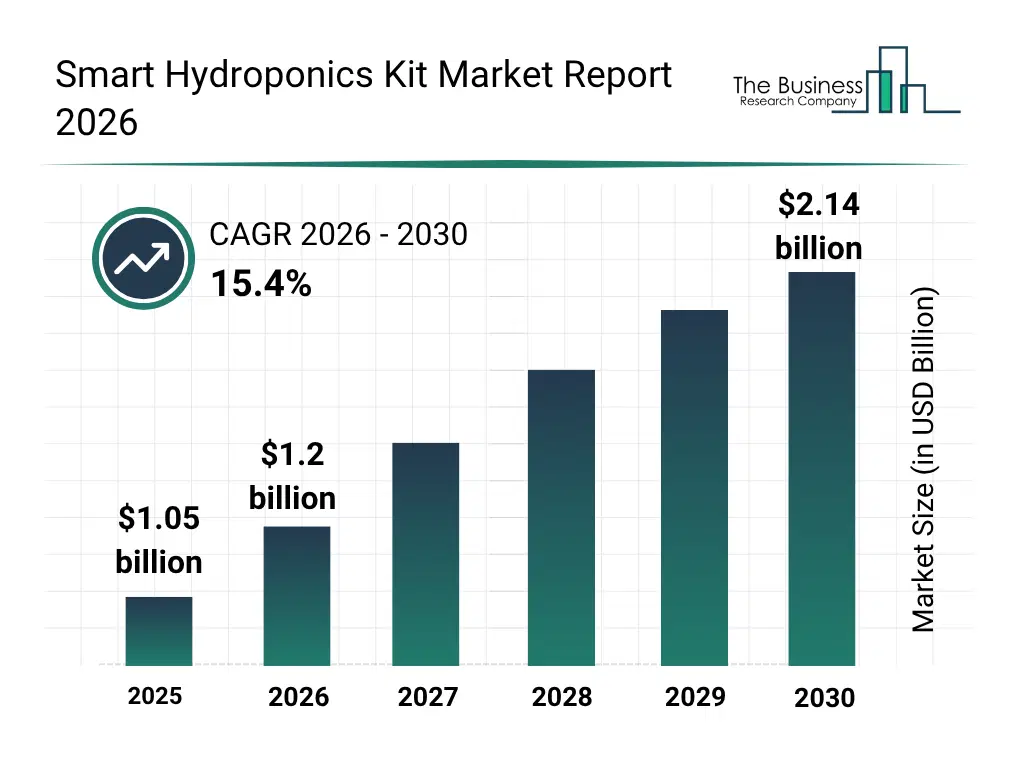
What Is The Smart Hydroponics Kit Market Size and Share 2026?
The smart hydroponics kit market size has grown rapidly in recent years. It will grow from $1.05 billion in 2025 to $1.2 billion in 2026 at a compound annual growth rate (CAGR) of 15.2%. The growth in the historic period can be attributed to increasing urban farming initiatives, rising consumer interest in sustainable agriculture, adoption of hydroponics for educational purposes, growth of indoor hobbyist farming, increasing demand for fresh produce in limited spaces.What Is The Smart Hydroponics Kit Market Growth Forecast?
The smart hydroponics kit market size is expected to see rapid growth in the next few years. It will grow to $2.14 billion by 2030 at a compound annual growth rate (CAGR) of 15.4%. The growth in the forecast period can be attributed to growing commercialization of smart hydroponics solutions, rising adoption in hospitality and restaurant verticals, increasing use of IoT-enabled monitoring, expansion of B2B indoor farm operations, rising focus on automation and predictive analytics in plant growth. Major trends in the forecast period include increasing adoption of modular smart hydroponics kits, rising demand for indoor year-round cultivation systems, growing integration of automated nutrient delivery units, expansion of predictive plant health monitoring, rising focus on water and energy efficient hydroponics systems.Global Smart Hydroponics Kit Market Segmentation
1) By Component: Hardware, Software, Services 2) By Product Type: Indoor Smart Hydroponics Kits, Outdoor Smart Hydroponics Kits, Modular Smart Hydroponics Kits, Other Product Types 3) By Crop Type: Vegetables, Fruits, Herbs, Flowers, Other Crop Types 4) By Distribution Channel: Online Ecommerce Platforms, Specialty Horticulture Retailers, Big Box Home Improvement Stores, Direct To Consumer Subscriptions, Professional B2B Sales 5) By End User: Residential Home Hobbyists, Commercial Indoor Farms, Educational And Research Centers, Hospitality And Restaurants, Urban Community Gardens Subsegments: 1) By Hardware: Valves And Actuators, Seals And Gaskets, Pumps And Dosing Units, Filling Needles And Nozzles, Filters And Filtration Components, Tubing And Connectors, Sensors And Monitoring Devices, Electrical And Control Components 2) By Software: Inventory Management Software, Maintenance Management Software, Predictive Maintenance Software, Equipment Monitoring Software, Supply Chain Management Software, Asset Tracking Software, Service Scheduling Software, Data Analytics Software 3) By Services: Preventive Maintenance Services, Corrective Maintenance Services, Spare Parts Replacement Services, Installation And Commissioning Services, Inspection And Validation Services, Technical Support Services, Training And Consultation Services, Emergency Repair ServicesWhat Is The Driver Of The Smart Hydroponics Kit Market?
The growing demand for sustainable and resource-efficient farming is expected to drive the growth of the smart hydroponics kit market in the coming years. Sustainable and resource-efficient farming focuses on maximizing crop yields while minimizing water consumption, energy use, and environmental impact. The growing demand for sustainable and resource-efficient farming is increasing as consumers show a stronger preference for environmentally responsible food production methods that support long-term resource conservation and sustainability. Smart hydroponics kits support these farming practices by incorporating sensor-based technologies that precisely monitor and control water, nutrient, and light usage. By optimizing input utilization and reducing waste, these systems enhance productivity while lowering resource consumption, making them well suited for sustainable agricultural operations. For instance, according to the Organic Trade Association, a US-based organic agriculture association, sales of certified organic products in the United States reached $69.7 billion in 2023, representing a 3.4% increase compared to the previous year. Therefore, a growing demand for sustainable and resource-efficient farming is expected to drive the growth of the smart hydroponics kit industry.Key Players In The Global Smart Hydroponics Kit Market
Major companies operating in the smart hydroponics kit market are VIVOSUN, Gardyn, Nutriculture, ZipGrow, FreshBox Farms, CropKing Inc., AeroGarden, Modern Sprout, Click & Grow, HydroBlue Technology, VegeBox, Ahopegarden, Nutraponics, Rise Gardens, Lettuce Grow, iDOO, Back To The Roots, Urban Cultivator, Hydrofarm Holdings Group, Oliz Smart Gardening.Global Smart Hydroponics Kit Market Trends and Insights
Major companies operating in the smart hydroponics kit market are focusing on technological advancements, such as AI-powered plant care, to improve plant growth accuracy, reduce manual effort, and enhance user convenience. AI-powered plant care refers to the use of artificial intelligence algorithms and smart sensors to monitor plant conditions, analyze growth data, and automatically adjust factors such as water, light, and nutrients to optimize plant health and productivity. For instance, in February 2026, Gardyn, a US-based smart indoor agriculture technology company, launched the Studio 2 growing system. The system features an upgraded HD camera for real-time plant health monitoring, AI-powered plant care automation, and sunrise and sunset lighting modes that replicate natural light cycles to improve growth consistency and user convenience. Additionally, the Studio 2 integrates advanced features such as an upgraded high-resolution camera, sealed maintenance-free modules, and automated lighting modes, enhancing plant monitoring and reducing maintenance while making indoor hydroponic gardening more efficient and accessible.What Are Latest Mergers And Acquisitions In The Smart Hydroponics Kit Market?
In July 2025, Growcer Media Inc., a Canada-based provider of modular indoor vertical farming solutions, acquired substantially all assets of Freight Farms Inc. for $2.6 million. With this acquisition, the Grocer sought to integrate Freight Farms' intellectual property, software, inventory, and manufacturing blueprints to support over 500 existing growers worldwide, expand its technological capabilities, and advance sustainable local food systems amid industry consolidation. Freight Farms Inc. is a US-based provider of container-based hydroponic farming systems equipped with smart monitoring and automation features akin to advanced smart hydroponics kits for controlled-environment agriculture.Regional Insights
North America was the largest region in the smart hydroponics kit market in 2025. Asia-Pacific is expected to be the fastest-growing region in the forecast period. The regions covered in this market report are Asia-Pacific, South East Asia, Western Europe, Eastern Europe, North America, South America, Middle East, Africa. The countries covered in this market report are Australia, Brazil, China, France, Germany, India, Indonesia, Japan, Taiwan, Russia, South Korea, UK, USA, Canada, Italy, Spain.What Defines the Smart Hydroponics Kit Market?
The smart hydroponics kit market consists of revenues earned by entities by providing services such as automated nutrient delivery, environmental monitoring, remote system control, plant growth analytics, and mobile or cloud-based system integration. The market value includes the value of related goods sold by the service provider or included within the service offering. The smart hydroponics kit market includes sales of hydroponic grow systems, nutrient dosing controllers, environmental sensors, automated lighting systems, water circulation units, and smart monitoring and control software. Values in this market are ‘factory gate’ values, that is, the value of goods sold by the manufacturers or creators of the goods, whether to other entities (including downstream manufacturers, wholesalers, distributors, and retailers) or directly to end customers. The value of goods in this market includes related services sold by the creators of the goods.How is Market Value Defined and Measured?
The market value is defined as the revenues that enterprises gain from the sale of goods and/or services within the specified market and geography through sales, grants, or donations in terms of the currency (in USD unless otherwise specified). The revenues for a specified geography are consumption values that are revenues generated by organizations in the specified geography within the market, irrespective of where they are produced. It does not include revenues from resales along the supply chain, either further along the supply chain or as part of other products.What Key Data and Analysis Are Included in the Smart Hydroponics Kit Market Report 2026?
The smart hydroponics kit market research report is one of a series of new reports from The Business Research Company that provides market statistics, including industry global market size, regional shares, competitors with the market share, detailed market segments, market trends and opportunities, and any further data you may need to thrive in the smart hydroponics kit industry. The market research report delivers a complete perspective of everything you need, with an in-depth analysis of the current and future state of the industry.Smart Hydroponics Kit Market Report Forecast Analysis
| Report Attribute | Details |
|---|---|
| Market Size Value In 2026 | $1.2 billion |
| Revenue Forecast In 2035 | $2.14 billion |
| Growth Rate | CAGR of 15.2% from 2026 to 2035 |
| Base Year For Estimation | 2025 |
| Actual Estimates/Historical Data | 2020-2025 |
| Forecast Period | 2026 - 2030 - 2035 |
| Market Representation | Revenue in USD Billion and CAGR from 2026 to 2035 |
| Segments Covered | Component, Product Type, Crop Type, Distribution Channel, End User |
| Regional Scope | Asia-Pacific, Western Europe, Eastern Europe, North America, South America, Middle East, Africa |
| Country Scope | The countries covered in the report are Australia, Brazil, China, France, Germany, India, ... |
| Key Companies Profiled | VIVOSUN, Gardyn, Nutriculture, ZipGrow, FreshBox Farms, CropKing Inc., AeroGarden, Modern Sprout, Click & Grow, HydroBlue Technology, VegeBox, Ahopegarden, Nutraponics, Rise Gardens, Lettuce Grow, iDOO, Back To The Roots, Urban Cultivator, Hydrofarm Holdings Group, Oliz Smart Gardening. |
| Customization Scope | Request for Customization |
| Pricing And Purchase Options | Explore Purchase Options |