

Smart City ICT Infrastructure Global Market Opportunities And Strategies To 2035
By Type (Smart Grid, Smart Building, Smart Water Network, Smart Healthcare, Smart Education, Smart Security, Smart Transport Other Types), By Components (Hardware, Software, Services), By Deployment Type (On-Premises, Cloud-Based, Hybrid Solutions), By Technology (Internet Of Things, Artificial Intelligence, Big Data Analytics, Cloud Computing, Other Technologies), By Application (Communications Industry, Transportation Industry, Express Industry, Government, Education, Other Applications), And By Region, Opportunities And Strategies – Global Forecast To 2035
Smart City ICT Infrastructure Market Definition
Smart City ICT (Information and Communication Technology) infrastructure refers to the integrated digital backbone that enables cities to collect, transmit, process, and analyze data to manage urban services intelligently. It includes components such as broadband networks (fiber and 5G), IoT sensors, data platforms, cloud computing, edge devices, cybersecurity systems, and city command-and-control centers that connect and coordinate smart city applications. The primary purpose of Smart City ICT infrastructure is to enable efficient, data-driven urban management and improved quality of life for citizens. The smart city ICT infrastructure market consists of sales by entities (organizations, sole traders and partnerships) of smart city ICT infrastructure that is used by municipal governments, public agencies, utility providers, transport authorities, healthcare systems, educational institutions and private enterprises that operate or support city services. These technologies are deployed continually, forming the backbone for operations such as traffic control, energy distribution, waste management, public safety, healthcare delivery and education access.
Smart City ICT Infrastructure Market Size
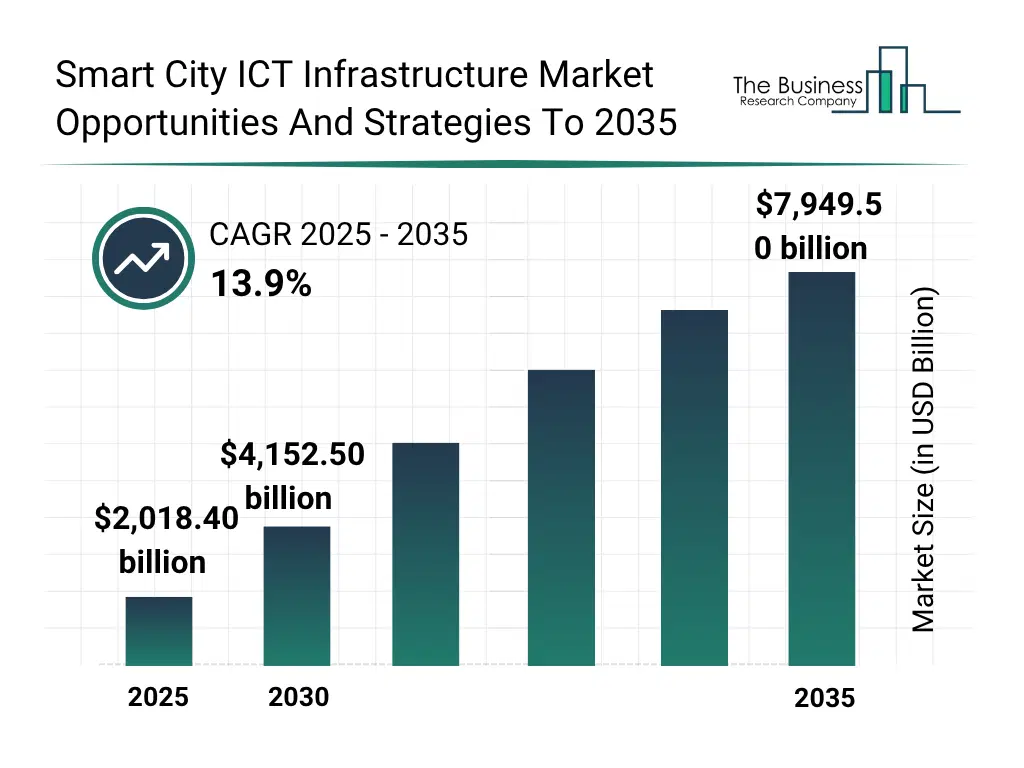
The global smart city ICT infrastructure market reached a value of nearly $2,018.4 billion in 2025, having grown at a compound annual growth rate (CAGR) of 18.1% since 2020. The market is expected to grow from $2,018.4 billion in 2025 to $4,152.5 billion in 2030 at a rate of 15.1%. The market is then expected to grow at a CAGR of 13.9% from 2030 and reach $7,949.5 billion in 2035. Growth in the historic period resulted from rise in deployment of 5G networks, expansion of smart city initiatives, expansion of intelligent transportation systems (ITS) and smart mobility solutions and government investment and support towards ICT infra development. Factors that negatively affected growth in the historic period were cybersecurity vulnerabilities and high capital and implementation cost. Going forward, increasing adoption of IoT solutions, growing importance of smart security and surveillance systems, rising demand for energy efficiency and smart grid and demand for sustainability, carbon reduction, and climate-resilient cities will drive the growth. Factors that could hinder the growth of the smart city ICT infrastructure market in the future include interoperability and integration challenges, data privacy regulations and impact of trade war and tariffs.Smart City ICT Infrastructure Market Segmentation
The smart city ICT infrastructure market is segmented by type, by components, by deployment type, by technology and by application.By Type –
The smart city ICT infrastructure market is segmented by type into:
- a) Smart Grid
- b) Smart Building
- c) Smart Water Network
- d) Smart Healthcare
- e) Smart Education
- f) Smart Security
- g) Smart Transport
- h) Other Types
By Components –
The smart city ICT infrastructure market is segmented by components into:
- a) Hardware
- b) Software
- c) Services
By Deployment Type –
The smart city ICT infrastructure market is segmented by deployment type into:
- a) On-Premises
- b) Cloud-Based
- c) Hybrid Solutions
By Technology –
The smart city ICT infrastructure market is segmented by technology into:
- a) Internet Of Things
- b) Artificial Intelligence
- c) Big Data Analytics
- d) Cloud Computing
- e) Other Technologies
By Application –
The smart city ICT infrastructure market is segmented by application into:
- a) Communications Industry
- b) Transportation Industry
- c) Express Industry
- d) Government
- e) Education
- f) Other Applications
By Geography - The smart city ICT infrastructure market is segmented by geography into:
- • China
- • India
- • Japan
- • Australia
- • Indonesia
- • South Korea
- • USA
- • Canada
- • Brazil
- • France
- • Germany
- • UK
- • Italy
- • Spain
- • Russia
-
o Asia Pacific
o Africa