
Sixth Generation (6G) Network Infrastructure Market Report 2026
Global Outlook – By Component (Hardware, Software, Services), By Communication Technology (Terahertz Communication, Optical Wireless Communication, Artificial Intelligence (AI)-Integrated Communication, Blockchain-Enabled Communication, Other Communication Technologies), By Deployment Mode (On Premises, Cloud Based, Hybrid), By Application Area (Enhanced Mobile Broadband (eMBB), Ultra-Reliable Low Latency Communication (URLLC), Massive Machine Type Communication (mMTC), Digital Twin Applications, Holographic Communication), By End User (Banking Financial Services And Insurance (BFSI), Healthcare And Life Sciences, Retail And Consumer Goods, Manufacturing And Automotive, Other End Users) – Market Size, Trends, Strategies, and Forecast to 2035
Sixth Generation (6G) Network Infrastructure Market Overview
• Sixth Generation (6G) Network Infrastructure market size has reached to $6.3 billion in 2025 • Expected to grow to $31.28 billion in 2030 at a compound annual growth rate (CAGR) of 37.8% • Growth Driver: Increasing Demand For Ultra-High-Speed Connectivity Driving The Market Growth Due To Rapid Proliferation Of Data-Intensive Applications • Market Trend: Advancements In Artificial Intelligence (AI) Platforms Accelerate The Development Of 6G Network Infrastructure • North America was the largest region in 2025 and Asia-Pacific is the fastest growing region.
What Is Covered Under Sixth Generation (6G) Network Infrastructure Market?
Sixth-generation (6G) network infrastructure is an advanced wireless communication system designed to follow 5G, offering extremely high data transmission speeds, minimal latency, and smart network operations powered by artificial intelligence. The main objective of sixth-generation (6G) network infrastructure is to support highly immersive digital applications and manage large-scale device connectivity with improved performance, dependability, and security. The main components of sixth generation (6G) network infrastructure include hardware, software, and services. Hardware refers to physical devices and network equipment that enable high-speed, low-latency, and reliable 6G connectivity for various applications. These solutions utilize communication technologies such as terahertz communication, optical wireless communication, artificial intelligence (AI)-integrated communication, blockchain-enabled communication, and other communication technologies, and are deployed through on-premises, cloud-based, and hybrid models. The various applications involved are enhanced mobile broadband (eMBB), ultra-reliable low latency communication (URLLC), massive machine type communication (mMTC), digital twin applications, and holographic communication, and they are utilized by end users including banking, financial services and insurance (BFSI), healthcare and life sciences, retail and consumer goods, manufacturing and automotive, and other end users.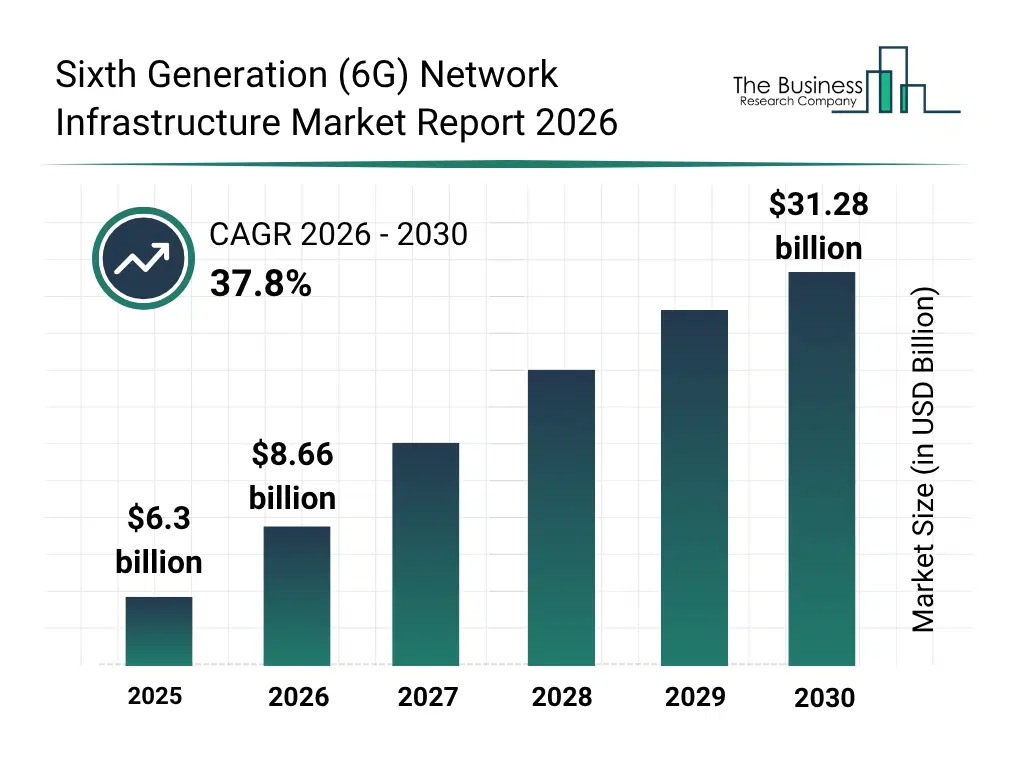
What Is The Sixth Generation (6G) Network Infrastructure Market Size and Share 2026?
The sixth generation (6G) network infrastructure market size has grown exponentially in recent years. It will grow from $6.3 billion in 2025 to $8.66 billion in 2026 at a compound annual growth rate (CAGR) of 37.6%. The growth in the historic period can be attributed to expansion of 5g networks, rising demand for high-speed data, adoption of cloud-based network solutions, increased mobile broadband usage, growth in connected devices.What Is The Sixth Generation (6G) Network Infrastructure Market Growth Forecast?
The sixth generation (6G) network infrastructure market size is expected to see exponential growth in the next few years. It will grow to $31.28 billion in 2030 at a compound annual growth rate (CAGR) of 37.8%. The growth in the forecast period can be attributed to deployment of ai-integrated communication, adoption of blockchain-enabled communication, expansion of holographic applications, growth in massive machine type communication, investment in ultra-low latency network infrastructure. Major trends in the forecast period include terahertz network deployment, ai-driven network optimization, holographic communication applications, digital twin network integration, ultra-reliable low latency communication enhancements.Global Sixth Generation (6G) Network Infrastructure Market Segmentation
1) By Component: Hardware, Software, Services 2) By Communication Technology: Terahertz Communication, Optical Wireless Communication, Artificial Intelligence (AI)-Integrated Communication, Blockchain-Enabled Communication, Other Communication Technologies 3) By Deployment Mode: On Premises, Cloud Based, Hybrid 4) By Application Area: Enhanced Mobile Broadband (eMBB), Ultra-Reliable Low Latency Communication (URLLC), Massive Machine Type Communication (mMTC), Digital Twin Applications, Holographic Communication 5) By End User: Banking Financial Services And Insurance (BFSI), Healthcare And Life Sciences, Retail And Consumer Goods, Manufacturing And Automotive, Other End Users Subsegments: 1) By Hardware: Base Stations, Antennas, Routers, Switches, Network Processors 2) By Software: Network Management Software, Network Security Software, Virtualization Software, Cloud Native Network Software, Automation And Orchestration Software 3) By Services: Consulting Services, Integration Services, Deployment Services, Maintenance And Support Services, Managed Network ServicesWhat Is The Driver Of The Sixth Generation (6G) Network Infrastructure Market?
The increasing demand for ultra-high-speed connectivity is expected to propel the growth of the sixth generation (6G) network infrastructure market going forward. Ultra-high-speed connectivity refers to next-generation wireless communication capable of delivering extremely high data transmission rates, minimal latency, and seamless network performance far beyond current 5G standards. The growing demand for ultra-high-speed connectivity is largely driven by the rapid proliferation of data-intensive applications, as these applications require consistently high bandwidth and near-instantaneous response times that existing network technologies are unable to adequately support. 6G network infrastructure delivers ultra-high-speed connectivity by leveraging terahertz (THz) frequency bands, next-generation massive MIMO technology, and AI-powered network management to handle vast data volumes with minimal latency, which enables rapid data processing and smooth, real-time communication across advanced digital applications. For instance, in November 2025, according to Ofcom, a UK-based government-approved regulatory and competition authority, adoption of ultra-high-speed packages (≥ 900 Mbps) grew from 14% in 2023 to 17% in 2024 and then to 21% by 2025. Therefore, the increasing demand for ultra-high-speed connectivity is driving the growth of the sixth generation (6G) network infrastructure industry.Key Players In The Global Sixth Generation (6G) Network Infrastructure Market
Major companies operating in the sixth generation (6G) network infrastructure market are Samsung Electronics Co. Ltd., Huawei Technologies Co. Ltd., T-Mobile US Inc., Cisco Systems Inc., Intel Corporation, Orange S.A., Telefonica S.A., KDDI Corporation, Mitsubishi Electric Corporation, Qualcomm Incorporated, BT Group plc, Fujitsu Limited, Telefonaktiebolaget LM Ericsson, NEC Corporation, Nokia Corporation, ZTE Corporation, SK Telecom Co. Ltd., Mavenir Systems Inc., 6WIND S.A., Cohere Technologies Inc., and DeepSig Inc.Global Sixth Generation (6G) Network Infrastructure Market Trends and Insights
Major companies operating in the sixth generation (6G) network infrastructure market are focusing on adopting strategic partnerships to strengthen next-generation connectivity capabilities and enhance global telecommunications competitiveness. A strategic partnership is a formal collaboration between two or more organizations that pool their capabilities, knowledge, and resources to accomplish common goals. For instance, in October 2025, NVIDIA Corporation, a US-based technology company, partnered with Nokia Corporation, a Finland-based telecommunications infrastructure provider, to pioneer an AI-native platform for 6G network development aimed at accelerating innovation and reinforcing America’s leadership in next-generation telecommunications. The collaboration focuses on integrating AI computing capabilities with advanced radio access network (RAN) technologies to enable intelligent network automation, enhanced data processing at the edge, and scalable infrastructure designed to meet the performance demands of future 6G ecosystems.What Are Latest Mergers And Acquisitions In The Sixth Generation (6G) Network Infrastructure Market?
In November 2025, Samsung Electronics, a South Korea-based developer and provider of components of 6G network infrastructure, entered into a strategic partnership with SK Telecom to accelerate the development of next-generation 6G network infrastructure. Through this collaboration, Samsung aims to advance core 6G technologies, including radio access network (RAN) innovation, AI-integrated wireless communication, and terahertz spectrum research, while strengthening its position in the future telecommunications infrastructure market. SK Telecom is a South Korea-based telecommunications operator focused on mobile network services and next-generation connectivity solutions.Regional Insights
North America was the largest region in the sixth-generation (6G) network infrastructure market in 2025. Asia-Pacific is expected to be the fastest-growing region in the forecast period. The regions covered in this market report are Asia-Pacific, South East Asia, Western Europe, Eastern Europe, North America, South America, Middle East, Africa. The countries covered in this market report are Australia, Brazil, China, France, Germany, India, Indonesia, Japan, Taiwan, Russia, South Korea, UK, USA, Canada, Italy, Spain.What Defines the Sixth Generation (6G) Network Infrastructure Market?
The sixth-generation (6G) network infrastructure market consists of revenues earned by entities by providing services such as radio access network deployment, terahertz communication solutions, AI-driven network optimization, open RAN integration, edge-native network architecture development, ultra-low latency connectivity solutions, and next-generation core network implementation. The market value includes the value of related goods sold by the service provider or included within the service offering. The sixth-generation (6G) network infrastructure market also includes sales of terahertz base stations, advanced antennas and transceivers, next-generation network routers and switches, AI-enabled network management platforms, open RAN hardware, and edge computing infrastructure. Values in this market are ‘factory gate’ values, that is, the value of goods sold by the manufacturers or creators of the goods, whether to other entities (including downstream manufacturers, wholesalers, distributors, and retailers) or directly to end customers. The value of goods in this market includes related services sold by the creators of the goods.How is Market Value Defined and Measured?
The market value is defined as the revenues that enterprises gain from the sale of goods and/or services within the specified market and geography through sales, grants, or donations in terms of the currency (in USD unless otherwise specified). The revenues for a specified geography are consumption values that are revenues generated by organizations in the specified geography within the market, irrespective of where they are produced. It does not include revenues from resales along the supply chain, either further along the supply chain or as part of other products.What Key Data And Analysis Are Included In The Sixth Generation (6G) Network Infrastructure Market Report 2026?
The sixth generation (6g) network infrastructure market research report is one of a series of new reports from The Business Research Company that provides market statistics, including industry global market size, regional shares, competitors with the market share, detailed market segments, market trends and opportunities, and any further data you may need to thrive in the sixth generation (6g) network infrastructure industry. The market research report delivers a complete perspective of everything you need, with an in-depth analysis of the current and future state of the industry.Sixth Generation (6G) Network Infrastructure Market Report Forecast Analysis
| Report Attribute | Details |
|---|---|
| Market Size Value In 2026 | $8.66 billion |
| Revenue Forecast In 2035 | $31.28 billion |
| Growth Rate | CAGR of 37.6% from 2026 to 2035 |
| Base Year For Estimation | 2025 |
| Actual Estimates/Historical Data | 2020-2025 |
| Forecast Period | 2026 - 2030 - 2035 |
| Market Representation | Revenue in USD Billion and CAGR from 2026 to 2035 |
| Segments Covered | Component, Communication Technology, Deployment Mode, Application Area, End User |
| Regional Scope | Asia-Pacific, Western Europe, Eastern Europe, North America, South America, Middle East, Africa |
| Country Scope | The countries covered in the report are Australia, Brazil, China, France, Germany, India, Indonesia, Japan, Taiwan, Russia, South Korea, UK, USA, Canada, Italy, Spain. |
| Key Companies Profiled | Samsung Electronics Co. Ltd., Huawei Technologies Co. Ltd., T-Mobile US Inc., Cisco Systems Inc., Intel Corporation, Orange S.A., Telefonica S.A., KDDI Corporation, Mitsubishi Electric Corporation, Qualcomm Incorporated, BT Group plc, Fujitsu Limited, Telefonaktiebolaget LM Ericsson, NEC Corporation, Nokia Corporation, ZTE Corporation, SK Telecom Co. Ltd., Mavenir Systems Inc., 6WIND S.A., Cohere Technologies Inc., and DeepSig Inc. |
| Customization Scope | Request for Customization |
| Pricing And Purchase Options | Explore Purchase Options |