
Seabed Security Market Report 2026
Global Outlook – By Component (Hardware, Software, Services), By Depth Of Operation (Shallow And Mid Water, Deep Water, Ultra-Deep Water), By Deployment Type (Permanent Installations, Submarine Communication Cables, Oil And Gas Pipelines, Offshore Energy Infrastructure, Military And Defense Assets, Scientific And Research Infrastructure, Other Subsea Infrastructure), By Industry (Telecommunications Companies, Oil And Gas Companies, Renewable Energy Developers And Operators, Government And Defense Agencies, Marine Research And Scientific Institutions) – Market Size, Trends, Strategies, and Forecast to 2035
Seabed Security Market Overview
• Seabed Security market size has reached to $6.33 billion in 2025 • Expected to grow to $9.18 billion in 2030 at a compound annual growth rate (CAGR) of 7.7% • Growth Driver: The Increasing Demand For Maritime Security Driving The Growth Of The Market Due To Rising Geopolitical Tensions • Market Trend: Next-Generation Underwater Monitoring Systems Strengthen Threat Detection Capabilities • North America was the largest region in 2025 and Asia-Pacific is the fastest growing region.
What Is Covered Under Seabed Security Market?
Seabed security refers to the protection and monitoring of infrastructure, resources, and activities located on or beneath the ocean floor, such as pipelines, communication cables, and energy installations. It involves the use of surveillance systems, policies, and technologies to prevent damage, unauthorized access, and threats to critical underwater assets. The main components of seabed security include hardware, software, and services. Hardware refers to physical equipment and devices used for monitoring, detecting, and protecting subsea assets and underwater infrastructure from potential threats or disruptions. These operate across shallow and mid water, deep water, and ultra-deep water. They are deployed through permanent installations, submarine communication cables, oil and gas pipelines, offshore energy infrastructure, military and defense assets, scientific and research infrastructure, and other subsea infrastructure and are used various industries such as telecommunications companies, oil and gas companies, renewable energy developers and operators, government and defense agencies, and marine research and scientific institutions.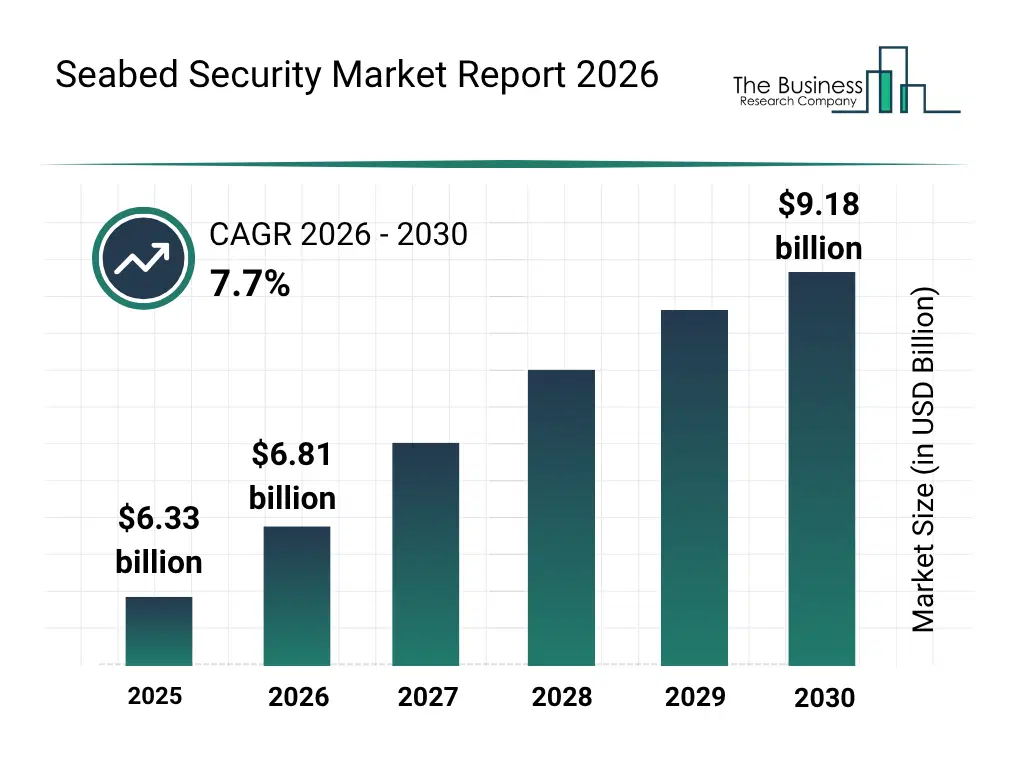
What Is The Seabed Security Market Size and Share 2026?
The seabed security market size has grown strongly in recent years. It will grow from $6.33 billion in 2025 to $6.81 billion in 2026 at a compound annual growth rate (CAGR) of 7.5%. The growth in the historic period can be attributed to increasing offshore oil and gas exploration, rising submarine cable installations, adoption of ROVs and AUVs for inspection, growth in offshore renewable energy projects, rising government and defense monitoring initiatives.What Is The Seabed Security Market Growth Forecast?
The seabed security market size is expected to see strong growth in the next few years. It will grow to $9.18 billion by 2030 at a compound annual growth rate (CAGR) of 7.7%. The growth in the forecast period can be attributed to growing demand for deep and ultra-deepwater infrastructure security, increasing use of AI-enabled threat detection software, expansion of remote monitoring and analytics capabilities, rising integration of IoT-enabled underwater sensors, increasing investments in subsea security services. Major trends in the forecast period include increasing adoption of real-time subsea monitoring systems, rising deployment of autonomous underwater vehicles for security, growing integration of threat detection software with infrastructure, expansion of maintenance and consulting services for subsea assets, rising focus on protection of critical submarine communication cables.Global Seabed Security Market Segmentation
1) By Component: Hardware, Software, Services 2) By Depth Of Operation: Shallow And Mid Water, Deep Water, Ultra-Deep Water 3) By Deployment Type: Permanent Installations, Submarine Communication Cables, Oil And Gas Pipelines, Offshore Energy Infrastructure, Military And Defense Assets, Scientific And Research Infrastructure, Other Subsea Infrastructure 4) By Industry: Telecommunications Companies, Oil And Gas Companies, Renewable Energy Developers And Operators, Government And Defense Agencies, Marine Research And Scientific Institutions Subsegments: 1) By Hardware: Sonar Systems, Underwater Sensors, Autonomous Underwater Vehicles, ROVs 2) By Software: Threat Detection Software, Navigation Software, Data Analytics Software, Monitoring And Surveillance Software 3) By Services: Installation Services, Maintenance Services, Consulting Services, Training ServicesWhat Is The Driver Of The Seabed Security Market?
The increasing demand for maritime security is expected to propel the growth of the seabed security market going forward. Maritime security refers to the protection of a nation’s maritime domain, including its waters, ports, vessels, offshore assets, and digital systems against threats such as piracy, terrorism, smuggling, illegal activities, and cyberattacks, ensuring safe and secure navigation and trade. The increasing demand for maritime security is primarily driven by rising geopolitical tensions, as disputes over maritime boundaries, strategic waterways, and offshore resources heighten the risk of conflicts, piracy, and cyber threats, necessitating stronger surveillance and protection measures. Seabed security helps maritime security by allowing the monitoring and protection of critical underwater infrastructure and enables early detection of underwater threats or unauthorized activities, thereby improving surveillance, safeguarding communication, and strengthening overall maritime safety and defense. For instance, in October 2023, according to the Offshore Energy Exhibition & Conference (OEEC), a Netherlands-based event management company, the average cost of a cyberattack in the maritime industry increased from $182,000 in 2022 to $550,000 in 2023. Therefore, the increasing demand for maritime security is driving the growth of the seabed security industry.Key Players In The Global Seabed Security Market
Major companies operating in the seabed security market are Thales Group, Teledyne Technologies, Covelya Group, AP Sensing, Optics11, ATLAS ELEKTRONIK GmbH, Sintela Limited, Royal IHC, Anduril, TIM Groups, RTX Corporation, Northrop Grumman, L3Harris Technologies, Inc, AXISCADES, Elbit Systems Limited, L3Harris Technologies, Inc., Fugro N.V., Oceaneering International, Inc., BAE Systems plc, General Dynamics Corporation, Leonardo S.p.A., Kongsberg Gruppen, Saab AB.Global Seabed Security Market Trends and Insights
Major companies operating in the seabed security market are focusing on advancements in underwater surveillance systems such as underwater early warning sensor networks to detect intrusions or anomalies and real-time alerting to potential threats. An underwater early warning sensor network refers to a system of subsea sensors and detection devices deployed across strategic underwater areas to monitor and protect critical infrastructure on the seabed with networked communication linking the sensors to a central command center for real-time data analysis and alerting. For instance, in October 2025, Fincantieri S.p.A., an Italy-based shipbuilding and defense company, launched the DEEP underwater drone system, an advanced seabed security solution designed to enhance the protection of critical underwater infrastructure. The system integrates an early-warning sensor network for continuous subsea monitoring, autonomous underwater vehicles (AUVs) for rapid anomaly detection and inspection, and a centralized command-and-control platform that leverages real-time data integration and AI-driven analytics to identify and prioritize potential threats. It provides scalable, persistent security for assets such as pipelines and submarine cables, while offering flexible, modular deployment for both shore-based and fixed installations. Additionally, the system supports dual-use applications across civil and defense sectors and can be seamlessly integrated with existing maritime surveillance networks to improve situational awareness and enable faster response across extensive seabed areas.What Are Latest Mergers And Acquisitions In The Seabed Security Market?
In March 2024, Fincantieri S.p.A., an Italy-based shipbuilding and defense company specializing in naval vessels and underwater defense systems, entered a collaboration agreement with Saipem S.p.A. to combine naval defense expertise with advanced subsea robotics and engineering capabilities. Through this collaboration, Fincantieri aims to strengthen its capabilities in seabed warfare and the subsea domain by combining its naval defense expertise with Saipem’s advanced offshore robotics and subsea engineering technologies to develop autonomous underwater systems and solutions for monitoring and protecting critical underwater infrastructure. Saipem S.p.A. is an Italy-based engineering and construction company specializing in offshore energy services, subsea robotics, and underwater infrastructure technologies.Regional Insights
North America was the largest region in the seabed security market in 2025. Asia-Pacific is expected to be the fastest-growing region in the forecast period. The regions covered in this market report are Asia-Pacific, South East Asia, Western Europe, Eastern Europe, North America, South America, Middle East, Africa. The countries covered in this market report are Australia, Brazil, China, France, Germany, India, Indonesia, Japan, Taiwan, Russia, South Korea, UK, USA, Canada, Italy, Spain.What Defines the Seabed Security Market?
The seabed security market consists of revenues earned by entities by providing services such as surveillance and monitoring services, infrastructure protection services, environmental management and conservation, maritime and regulatory compliance services, and defense and strategic security services. The market value includes the value of related goods sold by the service provider or included within the service offering. The seabed security market also includes sales of underwater sensors, sonar systems, autonomous underwater vehicles, remotely operated vehicles, and subsea drones. Values in this market are ‘factory gate’ values, that is the value of goods sold by the manufacturers or creators of the goods, whether to other entities (including downstream manufacturers, wholesalers, distributors and retailers) or directly to end customers. The value of goods in this market includes related services sold by the creators of the goods.How is Market Value Defined and Measured?
The market value is defined as the revenues that enterprises gain from the sale of goods and/or services within the specified market and geography through sales, grants, or donations in terms of the currency (in USD unless otherwise specified). The revenues for a specified geography are consumption values that are revenues generated by organizations in the specified geography within the market, irrespective of where they are produced. It does not include revenues from resales along the supply chain, either further along the supply chain or as part of other products.What Key Data and Analysis Are Included in the Seabed Security Market Report 2026?
The seabed security market research report is one of a series of new reports from The Business Research Company that provides market statistics, including industry global market size, regional shares, competitors with the market share, detailed market segments, market trends and opportunities, and any further data you may need to thrive in the seabed security industry. The market research report delivers a complete perspective of everything you need, with an in-depth analysis of the current and future state of the industry.Seabed Security Market Report Forecast Analysis
| Report Attribute | Details |
|---|---|
| Market Size Value In 2026 | $6.81 billion |
| Revenue Forecast In 2035 | $9.18 billion |
| Growth Rate | CAGR of 7.5% from 2026 to 2035 |
| Base Year For Estimation | 2025 |
| Actual Estimates/Historical Data | 2020-2025 |
| Forecast Period | 2026 - 2030 - 2035 |
| Market Representation | Revenue in USD Billion and CAGR from 2026 to 2035 |
| Segments Covered | Component, Depth Of Operation, Deployment Type, Industry |
| Regional Scope | Asia-Pacific, Western Europe, Eastern Europe, North America, South America, Middle East, Africa |
| Country Scope | The countries covered in the report are Australia, Brazil, China, France, Germany, India, ... |
| Key Companies Profiled | Thales Group, Teledyne Technologies, Covelya Group, AP Sensing, Optics11, ATLAS ELEKTRONIK GmbH, Sintela Limited, Royal IHC, Anduril, TIM Groups, RTX Corporation, Northrop Grumman, L3Harris Technologies, Inc, AXISCADES, Elbit Systems Limited, L3Harris Technologies, Inc., Fugro N.V., Oceaneering International, Inc., BAE Systems plc, General Dynamics Corporation, Leonardo S.p.A., Kongsberg Gruppen, Saab AB. |
| Customization Scope | Request for Customization |
| Pricing And Purchase Options | Explore Purchase Options |