
Post‑Quantum Crypto For Internet of Things (IoT) Market Report 2026
Global Outlook – By Component (Hardware, Software, Services), By Deployment Mode (On Premises, Cloud Based, Hybrid), By Organization Size (Small And Medium Enterprises, Large Enterprises), By Application (Smart Home, Industrial Internet of Things (IoT), Healthcare Internet of Things (IoT), Automotive, Smart Cities, Other Applications), By End-User (Manufacturing, Healthcare, Automotive, Energy And Utilities, Consumer Electronics, Other End-Users) – Market Size, Trends, Strategies, and Forecast to 2035
Post-Quantum Crypto For Internet of Things (IoT) Market Overview
• Post-Quantum Crypto For Internet of Things (IoT) market size has reached to $1.6 billion in 2025 • Expected to grow to $7.17 billion in 2030 at a compound annual growth rate (CAGR) of 35% • Growth Driver: Expansion Of Connected Devices Driving The Market Growth Due To Rising Quantum Security Vulnerabilities • Market Trend: Advancements In Post-Quantum-Resistant Public Key Infrastructure For Internet Of Things (IoT) Security • North America was the largest region in 2025 and Asia-Pacific is the fastest growing region.
What Is Covered Under Post-Quantum Crypto For Internet of Things (IoT) Market?
Post-quantum crypto for the Internet of Things (IoT) refers to cryptographic algorithms designed to protect connected devices from security threats posed by future quantum computers. It ensures that data exchanged between resource-constrained devices remains secure even against quantum-enabled attacks. This approach is critical for maintaining long-term confidentiality, integrity, and authentication across large-scale Internet of Things deployments. The main components of post-quantum crypto for the Internet of Things (IoT) include hardware, software, and services. Hardware refers to specialized cryptographic modules and processors designed to implement post-quantum algorithms for securing IoT devices and networks. They are deployed through on-premises, cloud-based, and hybrid models and are provided for small and medium enterprises and large enterprises. The key applications of smart home, industrial Internet of Things (IoT), healthcare Internet of Things (IoT), automotive, smart cities, and other applications, while the end-users include manufacturing, healthcare, automotive, energy and utilities, consumer electronics, and other end-users.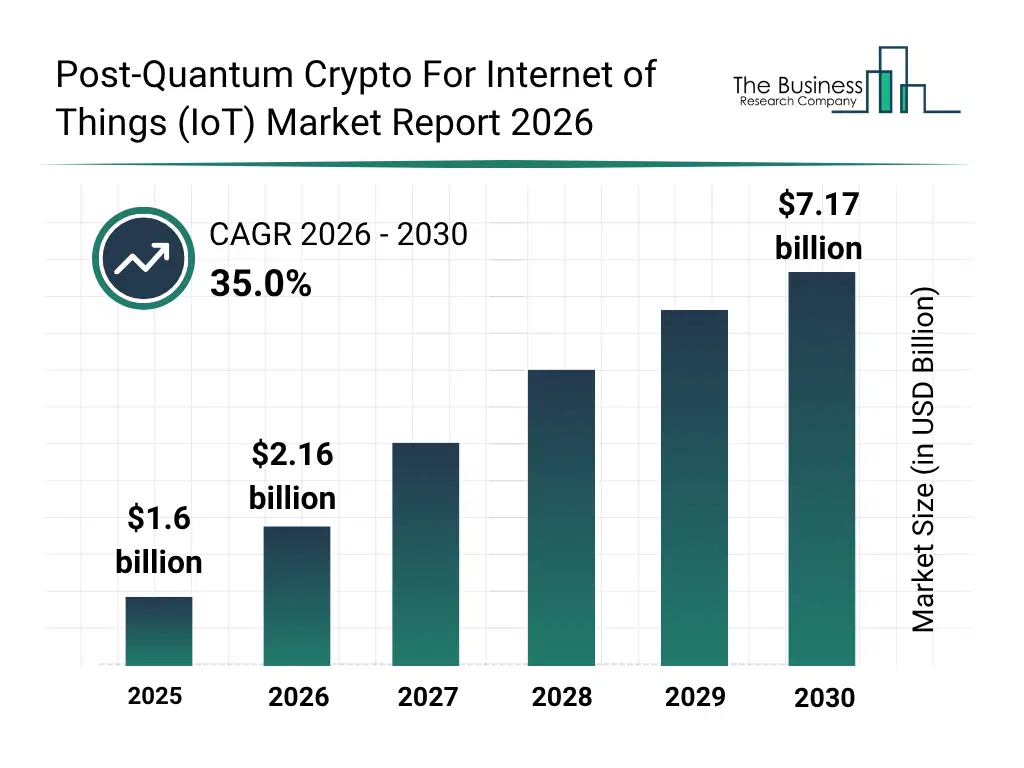
What Is The Post-Quantum Crypto For Internet of Things (IoT) Market Size and Share 2026?
The post-quantum crypto for internet of things (IoT) market size has grown exponentially in recent years. It will grow from $1.6 billion in 2025 to $2.16 billion in 2026 at a compound annual growth rate (CAGR) of 34.8%. The growth in the historic period can be attributed to growing iot device deployments, rising cybersecurity threats, adoption of conventional encryption protocols, regulatory emphasis on data protection, increasing smart home and industrial iot applications.What Is The Post-Quantum Crypto For Internet of Things (IoT) Market Growth Forecast?
The post-quantum crypto for internet of things (IoT) market size is expected to see exponential growth in the next few years. It will grow to $7.17 billion in 2030 at a compound annual growth rate (CAGR) of 35.0%. The growth in the forecast period can be attributed to adoption of post-quantum cryptography, increasing demand for quantum-safe iot devices, integration of ai for automated security, expansion of smart city and industrial iot networks, growth in edge computing and secure firmware updates. Major trends in the forecast period include lightweight cryptographic algorithms for iot devices, quantum-resistant key management solutions, edge-based post-quantum encryption, integration with iot device management platforms, secure firmware and authentication updates.Global Post-Quantum Crypto For Internet of Things (IoT) Market Segmentation
1) By Component: Hardware, Software, Services 2) By Deployment Mode: On Premises, Cloud Based, Hybrid 3) By Organization Size: Small And Medium Enterprises, Large Enterprises 4) By Application: Smart Home, Industrial Internet of Things (IoT), Healthcare Internet of Things (IoT), Automotive, Smart Cities, Other Applications 5) By End-User: Manufacturing, Healthcare, Automotive, Energy And Utilities, Consumer Electronics, Other End-Users Subsegments: 1) By Hardware: Cryptographic Processors, Secure Microcontrollers, Quantum Random Number Generators, Trusted Platform Modules, Hardware Security Modules 2) By Software: Post Quantum Cryptography Libraries, Encryption Software, Key Management Software, Authentication Software, Firmware Security Software 3) By Services: Consulting Services, Implementation Services, Managed Security Services, Training Services, Support And Maintenance ServicesWhat Is The Driver Of The Post‑Quantum Crypto For Internet of Things (IoT) Market?
The expansion of connected devices is expected to propel the growth of post-quantum crypto for the Internet of Things (IoT) market going forward. "Connected devices" refers to the internet-enabled physical objects that communicate and exchange data over networks. Connected devices expansion is primarily driven by accelerating digitalization across industries, as sectors such as healthcare, manufacturing, and smart infrastructure are integrating internet-connected devices at scale to enable automation and real-time data exchange, significantly broadening the IoT ecosystem. The growing proliferation of connected devices creates an urgent need for quantum-resistant encryption, as each additional device represents a potential vulnerability that conventional cryptography may fail to protect against future quantum computing attacks. For instance, in February 2025, according to Scania, a Sweden-based commercial vehicle manufacturer, by the end of 2024, Scania had approximately 638,000 connected vehicles, and this figure is growing rapidly. Therefore, the expansion of connected devices is driving the growth of the post-quantum crypto for the Internet of Things (IoT) market.Key Players In The Global Post‑Quantum Crypto For Internet of Things (IoT) Market
Major companies operating in the post‑quantum crypto for internet of things (IoT) market are Alphabet Inc., Microsoft Corporation, Samsung Electronics Co. Ltd., Huawei Technologies Co Ltd, International Business Machines Corporation, Thales S A, Infineon Technologies AG, Rambus Inc, Kudelski SA, QNu Labs Private Limited, PQShield Limited, ISARA Corporation, QuintessenceLabs Pty Ltd, Qrypt Inc, Securosys SA, Post Quantum Limited, CryptoNext Security, EvolutionQ Inc, QuSecure Inc, Crypto Quantique Limited, ExeQuantum, Xiphera Ltd, Crypto4A Technologies Inc, Arqit Quantum Inc, and ResQuant Ltd.Global Post‑Quantum Crypto For Internet of Things (IoT) Market Trends and Insights
Major companies operating in the post-quantum crypto for the internet of things (IoT) market are focusing on technology advancements such as post-quantum-resistant public key infrastructure (PKI) solutions to secure IoT devices against future quantum computing threats while ensuring scalability and compatibility with resource-constrained environments. Post-quantum-resistant PKI refers to cryptographic infrastructures that integrate NIST-aligned post-quantum algorithms for device authentication, secure key exchange, lifecycle management, and long-term data protection in IoT ecosystems. For instance, in December 2024, SEALSQ Corp, a Switzerland-based semiconductor company, launched INeS PKI, a post-quantum-resistant IoT security solution. The launched solution integrates quantum-resistant algorithms such as Crystals-Kyber and Crystals-Dilithium to protect IoT devices from quantum attacks. It enables secure device identity, zero-touch provisioning, and scalable key management across embedded, cloud, and on-premise deployments. INeS PKI supports high-performance and future-proof IoT security for applications including smart cities, industrial IoT, healthcare IoT, and connected vehicles.What Are Latest Mergers And Acquisitions In The Post‑Quantum Crypto For Internet of Things (IoT) Market?
In December 2025, Inturai, a Canada-based IoT edge solutions and secure connectivity company, entered into a strategic partnership with PQStation to deliver quantum-safe security for IoT devices. With this partnership, Inturai and PQStation aim to enable post-quantum cryptography on resource-constrained IoT edge devices by implementing quantum-safe encryption for IoT communication protocols such as MQTT, ensuring long-term protection of IoT data against future quantum computing threats while demonstrating the feasibility of post-quantum cryptography in real-world IoT deployments. PQStation is a Singapore-based company specializing in post-quantum cryptographic solutions and quantum-safe encryption technologies, securing IoT devices and communications.Regional Insights
North America was the largest region in the post-quantum crypto for the Internet of Things (IoT) market in 2025. Asia-Pacific is expected to be the fastest-growing region in the forecast period. The regions covered in the post‑quantum crypto for internet of things (IoT) market report are Asia-Pacific, South East Asia, Western Europe, Eastern Europe, North America, South America, Middle East, Africa. The countries covered in the post‑quantum crypto for internet of things (IoT) market report are Australia, Brazil, China, France, Germany, India, Indonesia, Japan, Taiwan, Russia, South Korea, UK, USA, Canada, Italy, Spain.What Defines the Post‑Quantum Crypto For Internet of Things (IoT) Market?
The post-quantum crypto for the internet of things (IoT) market consists of revenues earned by entities by providing services such as quantum-resistant key exchange, secure device authentication, encrypted data communication, secure firmware and software updates, key management and rotation, device identity protection, and end-to-end security for IoT networks. The market value includes the value of related goods sold by the service provider or included within the service offering. The post-quantum crypto for the Internet of Things (IoT) market also includes sales of post-quantum secure microcontrollers, quantum-resistant hardware security modules (HSMs), PQC-enabled secure elements, and cryptographic co-processors with lattice-based acceleration. Values in this market are ‘factory gate’ values, that is, the value of goods sold by the manufacturers or creators of the goods, whether to other entities (including downstream manufacturers, wholesalers, distributors, and retailers) or directly to end customers. The value of goods in this market includes related services sold by the creators of the goods.How is Market Value Defined and Measured?
The market value is defined as the revenues that enterprises gain from the sale of goods and/or services within the specified market and geography through sales, grants, or donations in terms of the currency (in USD unless otherwise specified). The revenues for a specified geography are consumption values that are revenues generated by organizations in the specified geography within the market, irrespective of where they are produced. It does not include revenues from resales along the supply chain, either further along the supply chain or as part of other products.What Key Data And Analysis Are Included In The Post‑Quantum Crypto For Internet of Things (IoT) Market Report 2026?
The post‑quantum crypto for internet of things (iot) market research report is one of a series of new reports from The Business Research Company that provides market statistics, including industry global market size, regional shares, competitors with the market share, detailed market segments, market trends and opportunities, and any further data you may need to thrive in the post‑quantum crypto for internet of things (iot) industry. The market research report delivers a complete perspective of everything you need, with an in-depth analysis of the current and future state of the industry.Post‑Quantum Crypto For Internet of Things (IoT) Market Report Forecast Analysis
| Report Attribute | Details |
|---|---|
| Market Size Value In 2026 | $2.16 billion |
| Revenue Forecast In 2035 | $7.17 billion |
| Growth Rate | CAGR of 34.8% from 2026 to 2035 |
| Base Year For Estimation | 2025 |
| Actual Estimates/Historical Data | 2020-2025 |
| Forecast Period | 2026 - 2030 - 2035 |
| Market Representation | Revenue in USD Billion and CAGR from 2026 to 2035 |
| Segments Covered | Component, Deployment Mode, Organization Size, Application, End-User |
| Regional Scope | Asia-Pacific, Western Europe, Eastern Europe, North America, South America, Middle East, Africa |
| Country Scope | The countries covered in the report are Australia, Brazil, China, France, Germany, India, Indonesia, Japan, Taiwan, Russia, South Korea, UK, USA, Canada, Italy, Spain. |
| Key Companies Profiled | Alphabet Inc., Microsoft Corporation, Samsung Electronics Co. Ltd., Huawei Technologies Co Ltd, International Business Machines Corporation, Thales S A, Infineon Technologies AG, Rambus Inc, Kudelski SA, QNu Labs Private Limited, PQShield Limited, ISARA Corporation, QuintessenceLabs Pty Ltd, Qrypt Inc, Securosys SA, Post Quantum Limited, CryptoNext Security, EvolutionQ Inc, QuSecure Inc, Crypto Quantique Limited, ExeQuantum, Xiphera Ltd, Crypto4A Technologies Inc, Arqit Quantum Inc, and ResQuant Ltd. |
| Customization Scope | Request for Customization |
| Pricing And Purchase Options | Explore Purchase Options |