
Positive Temperature Coefficient (PTC) Resettable Device Market Report 2026
Global Outlook – By Type (Polymer, Ceramic, Radial Leaded, Surface Mount, Axial Leaded, Strap Or Custom), By Current Rating (Below 5A, 5A-10A, 10A-20A, Above 20A), By Sales Channel (Original Equipment Manufacturer, Distributors, Online Retail), By Application (Automotive, Electronics, Telecommunications, Industrial, Other Applications), By End-Use Industry (Consumer Electronics, Automotive, Telecommunications, Industrial, Healthcare) – Market Size, Trends, Strategies, and Forecast to 2035
Positive Temperature Coefficient (PTC) Resettable Device Market Overview
• Positive Temperature Coefficient (PTC) Resettable Device market size has reached to $1.96 billion in 2025 • Expected to grow to $2.95 billion in 2030 at a compound annual growth rate (CAGR) of 8.6% • Growth Driver: The Growing Adoption Of Consumer Electronics Driving The Growth Of The Market Due To Rising Disposable Incomes • Market Trend: Breakthrough Surface-Mount Protection Device Enhances Overcurrent Control In High-Density Electronics • North America was the largest region in 2025 and Asia-Pacific is the fastest growing region.
What Is Covered Under Positive Temperature Coefficient (PTC) Resettable Device Market?
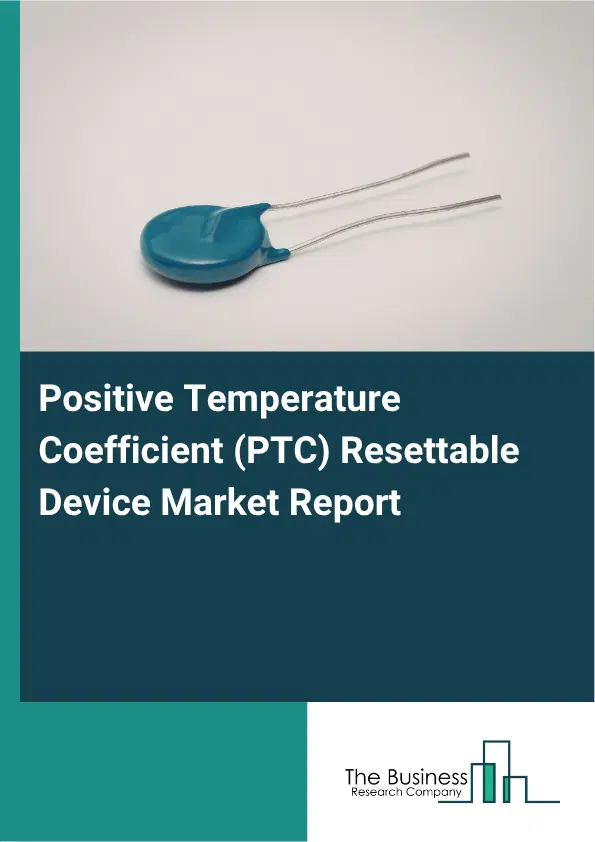
A positive temperature coefficient (PTC) resettable device is a protective component that increases its electrical resistance sharply when its temperature rises due to excessive current flow. This behavior limits the current in the circuit and automatically returns to its normal low-resistance state once the fault condition is removed and the device cools down. The main types of positive temperature coefficient (PTC) resettable device include polymer, ceramic, radial leaded, surface mount, axial leaded, and strap or custom. Polymer refers to resettable circuit protection devices made from conductive polymer materials that increase resistance significantly when excessive current or temperature is detected, thereby protecting electrical circuits from overcurrent damage. These are available in current ratings such as below 5A, 5A-10A, 10A-20A, and above 20A and are sold through original equipment manufacturer, distributors, and online retail. The various applications involved are automotive, electronics, telecommunications, industrial, and other applications and they are utilized by end-use industries including consumer electronics, automotive, telecommunications, industrial, and healthcare.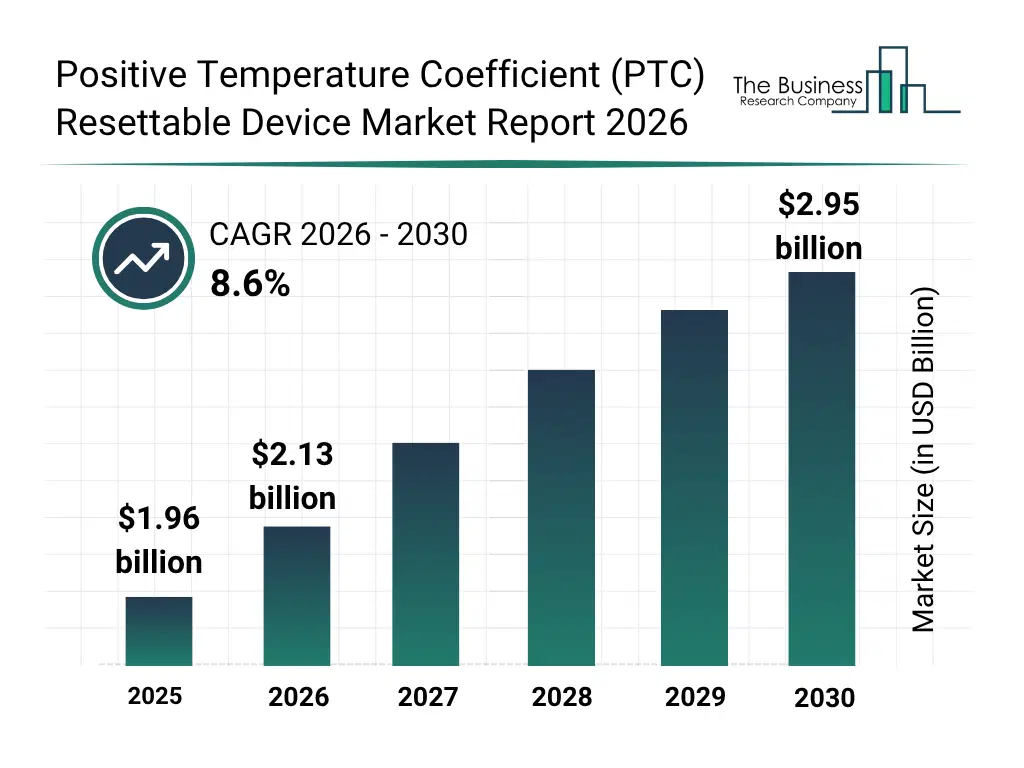
What Is The Positive Temperature Coefficient (PTC) Resettable Device Market Size and Share 2026?
The positive temperature coefficient (PTC) resettable device market size has grown strongly in recent years. It will grow from $1.96 billion in 2025 to $2.13 billion in 2026 at a compound annual growth rate (CAGR) of 8.3%. The growth in the historic period can be attributed to growing use of overcurrent protection in electronics, adoption of polymer and ceramic PTC devices, increasing electronics manufacturing, rising automotive electronics demand, growing industrial control system deployments.What Is The Positive Temperature Coefficient (PTC) Resettable Device Market Growth Forecast?
The positive temperature coefficient (PTC) resettable device market size is expected to see strong growth in the next few years. It will grow to $2.95 billion by 2030 at a compound annual growth rate (CAGR) of 8.6%. The growth in the forecast period can be attributed to rising deployment in electric vehicles, increasing integration with renewable energy systems, growth in industrial automation applications, adoption in high-density circuit protection, expansion in telecommunications equipment protection. Major trends in the forecast period include increasing adoption of surface mount ptc devices, rising demand for automotive circuit protection, growing integration of resettable overcurrent protection in consumer electronics, expansion of high current and specialized industrial applications, rising focus on compact and board-level protection solutions.Global Positive Temperature Coefficient (PTC) Resettable Device Market Segmentation
1) By Type: Polymer, Ceramic, Radial Leaded, Surface Mount, Axial Leaded, Strap Or Custom 2) By Current Rating: Below 5A, 5A-10A, 10A-20A, Above 20A 3) By Sales Channel: Original Equipment Manufacturer, Distributors, Online Retail 4) By Application: Automotive, Electronics, Telecommunications, Industrial, Other Applications 5) By End-Use Industry: Consumer Electronics, Automotive, Telecommunications, Industrial, Healthcare Subsegments: 1) By Polymer: Overcurrent Protection, Short Circuit Protection, Resettable Circuit Protection, Battery Protection, Consumer Electronics Protection 2) By Ceramic: High Temperature Protection, Motor Protection, Transformer Protection, Industrial Equipment Protection, Power Supply Protection 3) By Radial Leaded: Through Hole Mounting, Board Level Protection, Automotive Electronics Protection, Telecommunications Equipment Protection, Industrial Control Systems Protection 4) By Surface Mount: Compact Circuit Protection, Portable Device Protection, Printed Circuit Board Protection, High Density Circuit Protection, Automotive Electronics Protection 5) By Axial Leaded: Through Hole Circuit Protection, Power Supply Protection, Lighting System Protection, Industrial Equipment Protection, Consumer Appliance Protection 6) By Strap Or Custom: Custom Form Factor Protection, High Current Protection, Specialized Industrial Applications, Automotive Power Systems Protection, Renewable Energy Systems ProtectionWhat Are The Drivers Of The Positive Temperature Coefficient (PTC) Resettable Device Market?
The growing adoption of consumer electronics is expected to drive the growth of the positive temperature coefficient (PTC) resettable device market going forward. Consumer electronics refer to electronic devices designed for everyday personal use, including communication, entertainment, and home applications. Their increasing adoption is driven by factors such as rising disposable incomes, technological advancements, and growing demand for smart and connected devices. PTC resettable devices are widely used in consumer electronics to provide automatic overcurrent protection that resets after fault conditions, enhancing device safety, reliability, and lifespan without requiring fuse replacement. For instance, in May 2023, according to the Japan Electronics and Information Technology Industries Association, a Japan-based trade association, consumer electronics output increased from $183 million in May 2022 to $233 million in May 2023. Therefore, growing adoption of consumer electronics is driving the growth of the positive temperature coefficient (PTC) resettable device industry. The increasing penetration of electric vehicles (EVs) is expected to drive the growth of the positive temperature coefficient (PTC) resettable device market going forward. Electric vehicles are powered by one or more electric motors using energy stored in rechargeable batteries instead of internal combustion engines. Their growing adoption is driven by factors such as rising environmental concerns, supportive government policies, advancements in battery technology, and expanding charging infrastructure. PTC resettable devices are widely used in electric vehicles to provide self-resetting overcurrent protection, enhancing battery safety, preventing electrical damage, and improving the reliability of high-voltage and charging systems. For instance, in January 2025, according to Cox Automotive, a US-based system software company, electric vehicle (EV) sales increased from 2022 levels to 1,212,758 units in 2023, representing a 49% rise, and further grew by 7.3% in 2024 to reach 1,301,411 units. Therefore, the increasing penetration of electric vehicles is driving the growth of the positive temperature coefficient (PTC) resettable device industry.Key Players In The Global Positive Temperature Coefficient (PTC) Resettable Device Market
Major companies operating in the positive temperature coefficient (PTC) resettable device market are Bourns, Inc., Littelfuse, Inc., TE Connectivity Ltd., Eaton Corporation plc, Amphenol Corporation, Bel Fuse Inc., Murata Manufacturing Co., Ltd., AVX Corporation, Vishay Intertechnology, Inc., Polytronics Technology Corporation, EPCOS AG (a TDK Group Company), Raychem (a TE Connectivity Company), Schurter Holding AG, AEM Components, Inc., Wayon Electronics Co., Ltd., Fuzetec Technology Co., Ltd., Laird Performance Materials, Panasonic Corporation, Tyco Electronics Ltd., Ohmite Manufacturing Company, Schneider Electric SE (FR), Mitsubishi Electric Corporation (JP), Fujitsu Limited (JP).Global Positive Temperature Coefficient (PTC) Resettable Device Market Trends and Insights
Major companies operating in the positive temperature coefficient (PTC) resettable device market are focusing on developing innovative products, such as surface-mount devices, to enable compact, automated PCB integration for overcurrent protection in high-density and automotive electronic systems. Surface-mount devices (SMDs) are electronic components designed to be directly mounted onto the surface of a printed circuit board (PCB) without using through-holes, enabling smaller, faster, and more automated circuit assembly. For instance, in October 2023, Tokyo Denki Kagaku Kogyo, a Japan-based electronics company, launched the J404, the world’s first surface-mountable inrush current limiter (ICL) based on positive temperature coefficient (PTC) thermistor technology. The device utilizes advanced ceramic PTC thermistor materials integrated into a compact surface-mount package designed for high-density printed circuit boards, enabling effective suppression of inrush currents that occur when power is initially applied to electronic systems. It features rapid thermal response behavior, quickly increasing resistance during sudden current surges to protect sensitive components such as power supplies, chargers, and automotive control units from damage. Optimized for space-constrained applications, the solution provides enhanced reliability and repeatable protection compared to conventional resistor- and fuse-based circuits, thereby improving overall system safety and efficiency.Regional Insights
North America was the largest region in the positive temperature coefficient (PTC) resettable device market in 2025. Asia-Pacific is expected to be the fastest-growing region in the forecast period. The regions covered in this market report are Asia-Pacific, South East Asia, Western Europe, Eastern Europe, North America, South America, Middle East, Africa. The countries covered in this market report are Australia, Brazil, China, France, Germany, India, Indonesia, Japan, Taiwan, Russia, South Korea, UK, USA, Canada, Italy, Spain.What Defines the Positive Temperature Coefficient (PTC) Resettable Device Market?
The positive temperature coefficient (PTC) resettable device market consists of sales of resettable devices, automotive resettable fuses, overcurrent protection modules, resettable overcurrent protection chips, and multilayer ceramic positive temperature coefficient devices. Values in this market are ‘factory gate’ values, that is the value of goods sold by the manufacturers or creators of the goods, whether to other entities (including downstream manufacturers, wholesalers, distributors and retailers) or directly to end customers. The value of goods in this market includes related services sold by the creators of the goods.How is Market Value Defined and Measured?
The market value is defined as the revenues that enterprises gain from the sale of goods and/or services within the specified market and geography through sales, grants, or donations in terms of the currency (in USD unless otherwise specified). The revenues for a specified geography are consumption values that are revenues generated by organizations in the specified geography within the market, irrespective of where they are produced. It does not include revenues from resales along the supply chain, either further along the supply chain or as part of other products.What Key Data and Analysis Are Included in the Positive Temperature Coefficient (PTC) Resettable Device Market Report 2026?
The positive temperature coefficient (ptc) resettable device market research report is one of a series of new reports from The Business Research Company that provides market statistics, including industry global market size, regional shares, competitors with the market share, detailed market segments, market trends and opportunities, and any further data you may need to thrive in the positive temperature coefficient (ptc) resettable device industry. The market research report delivers a complete perspective of everything you need, with an in-depth analysis of the current and future state of the industry.Positive Temperature Coefficient (PTC) Resettable Device Market Report Forecast Analysis
| Report Attribute | Details |
|---|---|
| Market Size Value In 2026 | $2.13 billion |
| Revenue Forecast In 2035 | $2.95 billion |
| Growth Rate | CAGR of 8.3% from 2026 to 2035 |
| Base Year For Estimation | 2025 |
| Actual Estimates/Historical Data | 2020-2025 |
| Forecast Period | 2026 - 2030 - 2035 |
| Market Representation | Revenue in USD Billion and CAGR from 2026 to 2035 |
| Segments Covered | Type, Current Rating, Sales Channel, Application, End-Use Industry |
| Regional Scope | Asia-Pacific, Western Europe, Eastern Europe, North America, South America, Middle East, Africa |
| Country Scope | The countries covered in the report are Australia, Brazil, China, France, Germany, India, ... |
| Key Companies Profiled | Bourns, Inc., Littelfuse, Inc., TE Connectivity Ltd., Eaton Corporation plc, Amphenol Corporation, Bel Fuse Inc., Murata Manufacturing Co., Ltd., AVX Corporation, Vishay Intertechnology, Inc., Polytronics Technology Corporation, EPCOS AG (a TDK Group Company), Raychem (a TE Connectivity Company), Schurter Holding AG, AEM Components, Inc., Wayon Electronics Co., Ltd., Fuzetec Technology Co., Ltd., Laird Performance Materials, Panasonic Corporation, Tyco Electronics Ltd., Ohmite Manufacturing Company, Schneider Electric SE (FR), Mitsubishi Electric Corporation (JP), Fujitsu Limited (JP). |
| Customization Scope | Request for Customization |
| Pricing And Purchase Options | Explore Purchase Options |