
Contact Us
  Search
The Business Research Company Logo
Pork Global Market Opportunities And Strategies To 2035
Published :May 2026
Pages :326
Format :PDF
Delivery Time :2-3 Business Days
Why 2-3 days? We update the report with the latest data and news before delivery. Let us know if you need us to expedite.
Report Price :$4,490.00

Pork Global Market Opportunities And Strategies To 2035

By Type (Chilled, Frozen), By Packaging (Store Wrap, Modified Atmosphere Packaging, Vacuum Packaging, Shrink Bags, Others), By Application (Household, Commercial), And By Region, Opportunities And Strategies – Global Forecast To 2035

Pork Market Definition

Pork is the edible meat obtained from domesticated pigs (Sus scrofa domesticus). Pork is rich in protein, vitamins (especially B vitamins), and minerals such as iron and zinc. They are used to serve as a nutritious and versatile food source used in a wide range of culinary dishes across cultures. It provides essential nutrients, supports global food industries, and contributes significantly to agricultural economies through meat production, processing, and distribution. The pork market consists of sales, by entities (organizations, sole traders, or partnerships), of pork products that are derived from domesticated pigs and supplied in various forms including chilled and frozen pork across retail, foodservice, and industrial channels. It includes activities spanning the entire value chain such as breeding, farming, slaughtering, processing, packaging, and distribution. The market also covers the trade of pork products across domestic and international markets, influenced by consumer demand, regulatory standards, and global supply dynamics.
Research Expert

Book your 30 minutes free consultation with our research experts

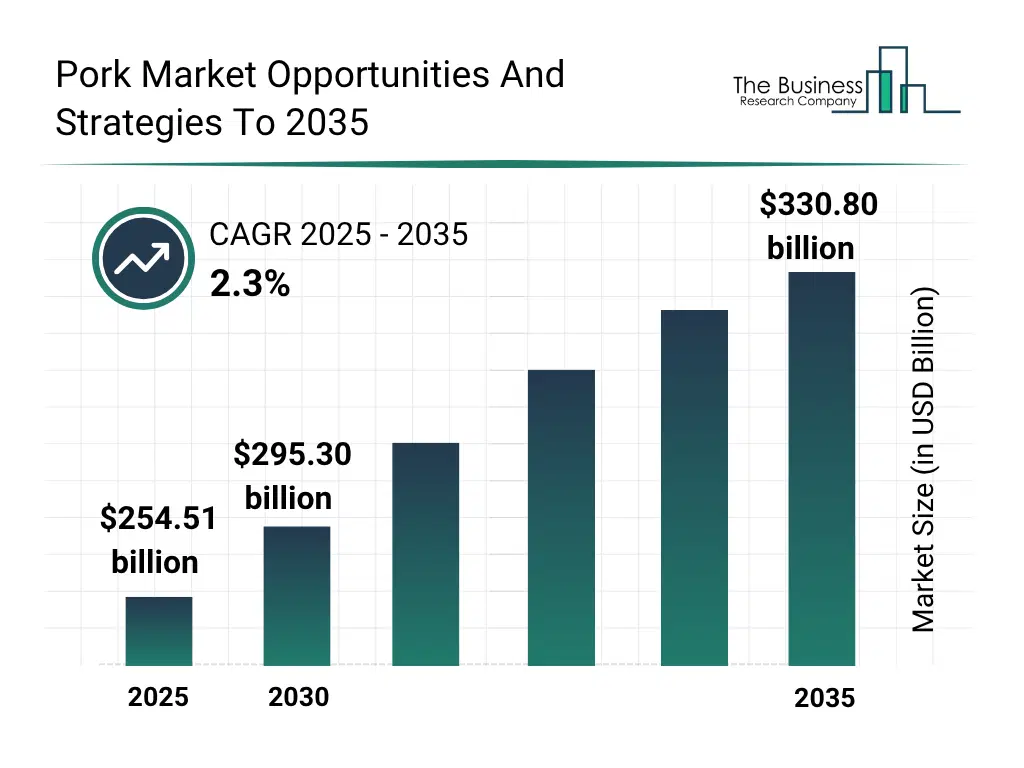
Pork Global Market Opportunities And Strategies To 2035 Market Size and growth rate 2025 to 2030: Graph

Pork Market Size

The global pork market reached a value of nearly $254,508.7 million in 2025, having grown at a compound annual growth rate (CAGR) of 3.7% since 2020. The market is expected to grow from $254,508.7 million in 2025 to $295,299.7 million in 2030 at a rate of 3.0%. The market is then expected to grow at a CAGR of 2.3% from 2030 and reach $330,795.6 million in 2035. Growth in the historic period resulted from rising demand for protein-rich diets, rising focus on food safety regulations, expansion of quick-service restaurant (QSR) and fast-casual chains and increasing global trade of pork. Factors that negatively affected growth in the historic period were rise of plant-based and other alternative proteins and competition from poultry and other meats. Going forward, growing meat consumption, government support for pork breeding, increasing penetration of online meat delivery platforms and significant investment in livestock farming and meat production will drive the growth. Factors that could hinder the growth of the pork market in the future include feed grain prices, public health and nutrition perceptions and impact of trade war and tariff.

Pork Market Segmentation

The pork market is segmented by type, by packaging and by application.

By Type –
The pork market is segmented by type into:
    • a) Chilled
    • b) Frozen
The chilled market was the largest segment of the pork market segmented by type, accounting for 73.1% or $186,126.1 million of the total in 2025. Going forward, the frozen segment is expected to be the fastest-growing segment in the pork market segmented by type, at a CAGR of 4.2% during 2025-2030.

By Packaging –
The pork market is segmented by packaging into:
    • a) Store Wrap
    • b) Modified Atmosphere Packaging
    • c) Vacuum Packaging
    • d) Shrink Bags
    • e) Others
The shrink bags market was the largest segment of the pork market segmented by packaging, accounting for 36.8% or $93,772.5 million of the total in 2025. Going forward, the vacuum packaging segment is expected to be the fastest-growing segment in the pork market segmented by packaging, at a CAGR of 4.7% during 2025-2030.

By Application –
The pork market is segmented by application into:
    • a) Household
    • b) Commercial
The household market was the largest segment of the pork market segmented by application, accounting for 69.8% or $177,675.9 million of the total in 2025. Going forward, the commercial segment is expected to be the fastest-growing segment in the pork market segmented by application, at a CAGR of 3.6% during 2025-2030.

By Geography - The pork market is segmented by geography into:
      o Asia Pacific
      • • China
      • • India
      • • Japan
      • • Australia
      • • Indonesia
      • • South Korea
      o North America
      • • USA
      • • Canada
      o South America
      • • Brazil
      o Western Europe
      • • France
      • • Germany
      • • UK
      • • Italy
      • • Spain
      o Eastern Europe
      • • Russia
      o Middle East
      o Africa
Asia Pacific was the largest region in the pork market, accounting for 48.4% or $123,254.8 million of the total in 2025. It was followed by North America, Western Europe and then the other regions. Going forward, the fastest-growing regions in the pork market will be South America and Western Europe where growth will be at CAGRs of 3.4% and 3.2% respectively. These will be followed by Asia Pacific and Africa where the markets are expected to grow at CAGRs of 3.1% and 3.1% respectively.

Pork Market Drivers

The key drivers of the pork market include: Growing Meat Consumption During the forecast period, the growing consumption of meat will propel the growth of the pork market. Rising incomes, urbanization, and shifting dietary preferences are driving consumers toward higher protein intake, increasing demand for a wide range of animal-source foods. Pork, being one of the most widely consumed and versatile meats worldwide, is well positioned to benefit from this trend, particularly in regions where population growth and economic development support greater meat purchasing power. As households expand their protein consumption and incorporate more meat into daily diets, the need for reliable, affordable, and high-quality pork products rises correspondingly. This ongoing shift toward meat-centric eating patterns strengthens demand across fresh, chilled, and processed pork categories. The growing consumption of meat growth contribution during the forecast period in 2025 is 1.5%.

Pork Market Restraints

The key restraints on the pork market include: Feed Grain Prices Rising feed grain prices are restricting the growth of the pork market during the forecast period. Feed accounts for one of the largest operating costs in pork production, and increases in the prices of grains such as maize, wheat, and barley directly raise the cost of raising pigs. Elevated grain prices also reduce profit margins for producers, making herd expansion less attractive and limiting overall production growth. In addition, fluctuations in global grain markets create uncertainty for pork producers, who depend on stable feed costs to maintain consistent supply and competitive pricing. Higher feed costs ultimately translate to higher retail pork prices, which may drive consumers toward more affordable protein alternatives such as poultry or plant-based products. As a result, rising feed grain prices are gradually weakening demand for pork, particularly in markets where affordability, predictable pricing, and production efficiency are major purchasing factors. Growth affected by the rising feed grain prices during the forecast period in 2025 is -2.6%.

Pork Market Competitive Landscape

Major Competitors are:

  • WH Group Limited (Smithfield Foods Inc.)
  • JBS S.A
  • Tyson Foods Inc.
  • Seaboard Corp. (Seaboard Foods)
  • Muyuan Foods Co. Ltd. (Muyuan Foodstuff)
  • Other Competitors Include:

  • Sysco Corp.
  • Cargill Incorporated
  • Vion Food Group
  • Hormel Foods Corporation
  • NH Foods Ltd. / Nippon Meat Packers
  • Piggman
  • Wens Foodstuff Group
  • New Hope Liuhe
  • Yurun Group
  • COFCO Meat Holdings Limited
  • Sumitomo Corporation
  • Charoen Pokphand Foods (CPF)
  • Marudai Food Co. Ltd.
  • Topigs Norsvin
  • Daesang Corporation
  • Dongwon F&B
  • Formento Group
  • Grupo Vall Companys
  • Pilgrim’s Europe
  • Cranswick
  • Danish Crown
  • Tönnies Group
  • Grupo Jorge
  • Cooperl Arc Atlantique
  • Linde Food Group
  • Animex Foods
  • Smithfield Foods
  • Mecom Group
  • Hajdúhús 2000 Ltd.
  • Tarczyński Group
  • Comtim Romania
  • Premium Porc
  • Miratorg Group
  • Rusagro Group
  • OSI Group
  • SuKarne
  • Clemens Food Group
  • Prairie Fresh
  • Hormel Foods
  • Cargill Meat Solutions
  • Olymel L.P.
  • Maple Leaf Foods
  • Sutton Group
  • HyLife Foods
  • Carleton Farms
  • Big Sky Farms
  • BRF S.A
  • Aurora Alimentos
  • Marfrig Global Foods S.A.
  • Agrosuper S.A.
  • INGACOT Agroindustrial S.A
  • Zambeef products plc
  • Hartlief Corporation Ltd
  • Supreme Meat Ventures Ltd
  • Gincho Nig. Ltd.
  • Lynca Meats
  • Eskort Bacon Co-Operative
  • RCL Foods & Tiger Brands
  • Need data on a specific region in this market?

    Opportunities And Recommendations In The Pork Market

    Opportunities – The top opportunities in the pork market segmented by type will arise in the chilled segment, which will gain $25,075.5 million of global annual sales by 2030. The top opportunities in the pork market segmented by packaging will arise in the modified atmosphere packaging segment, which will gain $13,618.1 million of global annual sales by 2030. The top opportunities in the pork market segmented by application will arise in the household segment, which will gain $25,730.2 million of global annual sales by 2030. The pork market size will gain the most in the USA at $6,767.7 million.. Recommendations- To take advantage of the opportunities, The Business Research Company recommends the pork companies to focus on modern farming complexes and vertical integration, focus on expanding processing and cold-chain capabilities, focus on digital traceability and farm-management solutions, focus on integrated value-chain partnerships, focus on frozen pork segment expansion, expand in emerging markets, continue to focus on developed markets, focus on expanding strategic retail partnerships, focus on competitive and tiered pricing strategies, focus on targeted digital campaigns, focus on retail and point-of-sale promotions, focus on targeting commercial end-users.
    Chat with us