

Pooled Clustered Regularly Interspaced Short Palindromic Repeats (CRISPR) Screening Market Report 2026
Global Outlook – By Screening Type (Genome Wide Screening, Targeted Screening), By Product Type (Libraries, Reagents And Kits, Instruments, Software, Services), By Technology (Clustered Regularly Interspaced Short Palindromic Repeats (CRISPR) Cas9 Screening, Clustered Regularly Interspaced Short Palindromic Repeats (CRISPR) Interference Screening, Clustered Regularly Interspaced Short Palindromic Repeats (CRISPR) Activation Screening), By Application (Functional Genomics, Drug Discovery, Cancer Research, Gene Regulation, Other Applications), By End-User (Pharmaceutical And Biotechnology Companies, Academic And Research Institutes, Contract Research Organizations, Other End-Users) – Market Size, Trends, Strategies, and Forecast to 2035
Pooled Clustered Regularly Interspaced Short Palindromic Repeats (CRISPR) Screening Market Overview
• Pooled Clustered Regularly Interspaced Short Palindromic Repeats (CRISPR) Screening market size has reached to $1.3 billion in 2025 • Expected to grow to $2.74 billion in 2030 at a compound annual growth rate (CAGR) of 16.1% • Growth Driver: Surge In Genetic Disorder Prevalence Fueling The Growth Of The Market Due To Expanding Genomic Diagnostics And Disease Identification • Market Trend: Innovative High-Throughput Approaches For Functional Genomics And Gene Target Discovery • North America was the largest region in 2025 and Asia-Pacific is the fastest growing region.
What Is Covered Under Pooled Clustered Regularly Interspaced Short Palindromic Repeats (CRISPR) Screening Market?
Pooled clustered regularly interspaced short palindromic repeats (CRISPR) screening refers to a high-throughput genetic technique that uses CRISPR-Cas systems to simultaneously modify or knock out many genes in a population of cells. It allows researchers to identify genes involved in specific cellular processes, disease mechanisms, or drug responses by observing the effects of these targeted genetic changes across the pooled cell population. The main screening types of pooled clustered regularly interspaced short palindromic repeats (CRISPR) screening include genome wide screening and targeted screening. Genome-wide screening is a comprehensive technique that analyzes the entire genome to identify genes, variants, or mutations associated with specific traits, diseases, or biological functions. The various product types include libraries, reagents and kits, instruments, software, and services and the technologies utilized include clustered regularly interspaced short palindromic repeats (CRISPR) Cas9 screening, clustered regularly interspaced short palindromic repeats (CRISPR) interference screening, and clustered regularly interspaced short palindromic repeats (CRISPR) activation screening. The various applications involved are functional genomics, drug discovery, cancer research, gene regulation, and other applications, and they are used by several end users such as pharmaceutical and biotechnology companies, academic and research institutes, contract research organizations, and other end-users.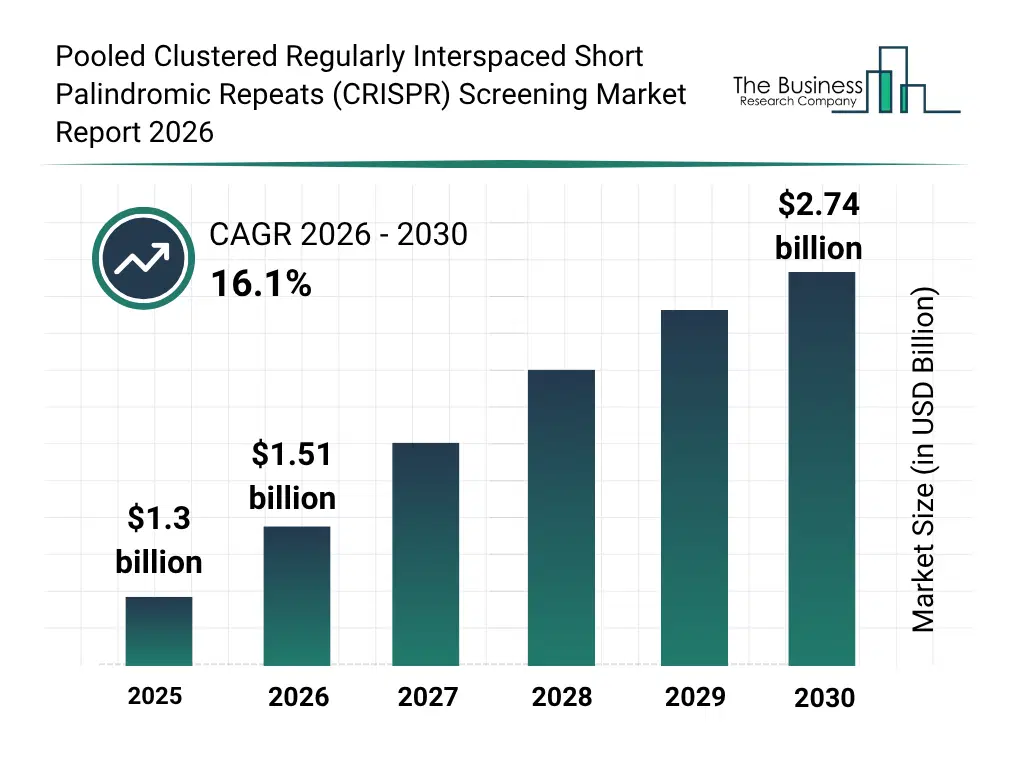
What Is The Pooled Clustered Regularly Interspaced Short Palindromic Repeats (CRISPR) Screening Market Size and Share 2026?
The pooled clustered regularly interspaced short palindromic repeats (crispr) screening market size has grown rapidly in recent years. It will grow from $1.3 billion in 2025 to $1.51 billion in 2026 at a compound annual growth rate (CAGR) of 15.9%. The growth in the historic period can be attributed to rising demand for functional genomics, increasing adoption of crispr-cas9 technology, growth of pharmaceutical r&d, advancements in gene editing tools, expansion of academic research programs.What Is The Pooled Clustered Regularly Interspaced Short Palindromic Repeats (CRISPR) Screening Market Growth Forecast?
The pooled clustered regularly interspaced short palindromic repeats (crispr) screening market size is expected to see rapid growth in the next few years. It will grow to $2.74 billion in 2030 at a compound annual growth rate (CAGR) of 16.1%. The growth in the forecast period can be attributed to ai-enabled gene screening, integration with cloud-based genomics platforms, demand for personalized medicine applications, expansion of biotech infrastructure, automation in high-throughput screening. Major trends in the forecast period include high-throughput screening techniques, integration with multi-omics data, automated crispr workflows, ai-driven gene target identification, real-time functional genomics analysis.Global Pooled Clustered Regularly Interspaced Short Palindromic Repeats (CRISPR) Screening Market Segmentation
1) By Screening Type: Genome Wide Screening, Targeted Screening 2) By Product Type: Libraries, Reagents And Kits, Instruments, Software, Services 3) By Technology: Clustered Regularly Interspaced Short Palindromic Repeats (CRISPR) Cas9 Screening, Clustered Regularly Interspaced Short Palindromic Repeats (CRISPR) Interference Screening, Clustered Regularly Interspaced Short Palindromic Repeats (CRISPR) Activation Screening 4) By Application: Functional Genomics, Drug Discovery, Cancer Research, Gene Regulation, Other Applications 5) By End-User: Pharmaceutical And Biotechnology Companies, Academic And Research Institutes, Contract Research Organizations, Other End-Users Subsegments: 1) By Genome Wide Screening: Knockout Screening, Activation Screening, Interference Screening 2) By Targeted Screening: Gene Specific Knockout, Gene Specific Activation, Gene Specific InterferenceWhat Are The Drivers Of The Pooled Clustered Regularly Interspaced Short Palindromic Repeats (CRISPR) Screening Market?
The rising prevalence of genetic disorders is expected to propel the growth of the pooled clustered regularly interspaced short palindromic repeats (CRISPR) screening market. Genetic disorders are conditions caused by inherited or acquired abnormalities in an individual’s DNA that affect normal development, metabolism, or physiological function. The increasing prevalence of these disorders is partly attributed to factors such as advanced parental age, improved diagnostic capabilities, and expanded genetic screening, all of which contribute to higher detection and reporting rates. Pooled CRISPR screening plays a critical role in genetic disorder research by enabling high-throughput, genome-wide identification of disease-associated genes and regulatory pathways. For instance, in October 2024, the Cystic Fibrosis Trust, a UK-based charity supporting individuals with cystic fibrosis, reported that approximately 11,148 cystic fibrosis patients were registered in 2022, increasing to 11,318 in 2023, representing a year-over-year growth of about 1.5%. Therefore, the rising prevalence of genetic disorders is driving the growth of the pooled clustered regularly interspaced short palindromic repeats (CRISPR) screening industry. The increasing research and development investments are expected to propel the growth of the pooled clustered regularly interspaced short palindromic repeats (CRISPR) screening market going forward. Research and development (R&D) investments refer to the allocation of resources toward creating new products, improving existing offerings, and advancing technologies to drive innovation and long-term business growth. Rising technological advancements are driving increasing research and development investments, as companies must continuously innovate and upgrade their products and processes to keep pace with rapid digital transformation and changing industry standards. Research and development (R&D) investments help CRISPR screening by enabling the development of advanced gene-editing tools, optimizing protocols, and improving accuracy and efficiency for faster discovery of gene functions. For instance, in 2023, according to the Office for National Statistics, a UK-based government agency, the UK government’s net spending on research and development (R&D) increased to £17.4 billion ($22.1 billion) in 2023, up from £16.1 billion ($20.45 billion) in 2022, marking an 8.2% rise. Therefore, the increasing research and development investments are driving the growth of the pooled clustered regularly interspaced short palindromic repeats (CRISPR) screening industry.Key Players In The Global Pooled Clustered Regularly Interspaced Short Palindromic Repeats (CRISPR) Screening Market
Major companies operating in the pooled clustered regularly interspaced short palindromic repeats (crispr) screening market are Thermo Fisher Scientific Inc., Merck KGaA, Danaher Corporation, Applied Biological Materials Inc., Agilent Technologies Inc., Charles River Laboratories International Inc., QIAGEN N.V., GenScript Biotech Corporation, Twist Bioscience Corporation, Ginkgo Bioworks Inc., Element Biosciences Inc., Synthego Corporation, Bit.bio Limited, Bioneer Corporation, VectorBuilder Inc., Admera Health LLC, Addgene Inc., Creative Biogene Inc., Cellecta Inc., Vivlion Inc., GeneCopoeia Inc.Global Pooled Clustered Regularly Interspaced Short Palindromic Repeats (CRISPR) Screening Market Trends and Insights
Major companies operating in the pooled clustered regularly interspaced short palindromic repeats (CRISPR) screening market are focusing on developing innovative solutions such as transcriptome-wide profiling to enable high-throughput functional genomics and precise identification of gene targets for therapeutic and research applications. Transcriptome-wide profiling refers to the comprehensive analysis of all RNA transcripts expressed in a cell or tissue at a given time, providing insights into gene activity, regulation, and cellular functions. For instance, in June 2023, Parse Biosciences Inc., a US-based biotechnology company, launched CRISPR Detect, a technology enabling high-scale single-cell pooled CRISPR screens. This innovation integrates with the company's Evercode Whole Transcriptome platform to pair individual gene perturbations, via Cas12-based single guide ribonucleic acid (RNA) (sgRNAs), with whole-transcriptome expression profiles across up to one million cells per experiment, overcoming prior throughput and cost barriers in droplet-based single-cell RNA-seq. It expands applications in genome-scale gene function analysis, regulatory networks, signaling pathways, and drug discovery beyond targeted validation.Regional Insights
North America was the largest region in the pooled clustered regularly interspaced short palindromic repeats (CRISPR) screening market in 2025. Asia-Pacific is expected to be the fastest-growing region in the forecast period. The regions covered in this market report are Asia-Pacific, South East Asia, Western Europe, Eastern Europe, North America, South America, Middle East, Africa. The countries covered in this market report are Australia, Brazil, China, France, Germany, India, Indonesia, Japan, Taiwan, Russia, South Korea, UK, USA, Canada, Italy, Spain.What Defines the Pooled Clustered Regularly Interspaced Short Palindromic Repeats (CRISPR) Screening Market?
The pooled clustered regularly interspaced short palindromic repeats (CRISPR) screening market consists of revenues earned by entities by providing services such as CRISPR screening services, custom library design, assay development services, data analysis services, bioinformatics solutions, cell line engineering services, and validation studies. The market value includes the value of related goods sold by the service provider or included within the service offering. The pooled clustered regularly interspaced short palindromic repeats (CRISPR) screening market also includes sales of CO₂ incubators, refrigerators and freezers, and automated liquid handling robots. Values in this market are ‘factory gate’ values; that is, the value of goods sold by the manufacturers or creators of the goods, whether to other entities (including downstream research organizations, biotechnology firms, pharmaceutical companies, and academic institutions) or directly to end customers. The value of goods in this market includes related services sold by the creators of the goods.How is Market Value Defined and Measured?
The market value is defined as the revenues that enterprises gain from the sale of goods and/or services within the specified market and geography through sales, grants, or donations in terms of the currency (in USD unless otherwise specified). The revenues for a specified geography are consumption values that are revenues generated by organizations in the specified geography within the market, irrespective of where they are produced. It does not include revenues from resales along the supply chain, either further along the supply chain or as part of other products.What Key Data And Analysis Are Included In The Pooled Clustered Regularly Interspaced Short Palindromic Repeats (CRISPR) Screening Market Report 2026?
The pooled clustered regularly interspaced short palindromic repeats (crispr) screening market research report is one of a series of new reports from The Business Research Company that provides market statistics, including industry global market size, regional shares, competitors with the market share, detailed market segments, market trends and opportunities, and any further data you may need to thrive in the pooled clustered regularly interspaced short palindromic repeats (crispr) screening industry. The market research report delivers a complete perspective of everything you need, with an in-depth analysis of the current and future state of the industry.Pooled Clustered Regularly Interspaced Short Palindromic Repeats (CRISPR) Screening Market Report Forecast Analysis
| Report Attribute | Details |
|---|---|
| Market Size Value In 2026 | $1.51 billion |
| Revenue Forecast In 2035 | $2.74 billion |
| Growth Rate | CAGR of 15.9% from 2026 to 2035 |
| Base Year For Estimation | 2025 |
| Actual Estimates/Historical Data | 2020-2025 |
| Forecast Period | 2026 - 2030 - 2035 |
| Market Representation | Revenue in USD Billion and CAGR from 2026 to 2035 |
| Segments Covered | Screening Type, Product Type, Technology, Application, End-User |
| Regional Scope | Asia-Pacific, Western Europe, Eastern Europe, North America, South America, Middle East, Africa |
| Country Scope | The countries covered in the report are Australia, Brazil, China, France, Germany, India, Indonesia, Japan, Taiwan, Russia, South Korea, UK, USA, Canada, Italy, Spain. |
| Key Companies Profiled | Thermo Fisher Scientific Inc., Merck KGaA, Danaher Corporation, Applied Biological Materials Inc., Agilent Technologies Inc., Charles River Laboratories International Inc., QIAGEN N.V., GenScript Biotech Corporation, Twist Bioscience Corporation, Ginkgo Bioworks Inc., Element Biosciences Inc., Synthego Corporation, Bit.bio Limited, Bioneer Corporation, VectorBuilder Inc., Admera Health LLC, Addgene Inc., Creative Biogene Inc., Cellecta Inc., Vivlion Inc., GeneCopoeia Inc. |
| Customization Scope | Request for Customization |
| Pricing And Purchase Options | Explore Purchase Options |