
Pharmaceutical Depyrogenation Equipment Market Report 2026
Global Outlook – By Equipment Type (Depyrogenation Tunnels, Dry Heat Sterilizers, Depyrogenation Ovens, Vial And Ampoule Depyrogenation Systems, Automated Depyrogenation Chambers), By Technology (Conveyor-Based Systems, Batch Processing Ovens, Continuous Flow Tunnels, High-Temperature Plasma Systems), By Application (Ampoules, Penicillin Bottles, Syringes), By End-User (Pharmaceutical Manufacturers, Biotechnology Companies, Contract Manufacturing Organizations (CMOs), Research And Academic Institutes, Vaccine And Biologics Manufacturing Facilities) – Market Size, Trends, Strategies, and Forecast to 2035
Pharmaceutical Depyrogenation Equipment Market Overview
• Pharmaceutical Depyrogenation Equipment market size has reached to $0.93 billion in 2025 • Expected to grow to $1.36 billion in 2030 at a compound annual growth rate (CAGR) of 7.8% • Growth Driver: Surge In Increasing Adoption Of Injectable Pharmaceuticals Fueling The Growth Of The Market Due To Rising Demand For Vaccines And Biologic Therapies • North America was the largest region in 2025 and Asia-Pacific is the fastest growing region.
What Is Covered Under Pharmaceutical Depyrogenation Equipment Market?
The pharmaceutical depyrogenation equipment refers to specialized machinery used in pharmaceutical manufacturing to remove or destroy pyrogens, particularly bacterial endotoxins, from glassware, containers, and pharmaceutical components through high-temperature dry heat processes. Its primary purpose is to ensure sterile and pyrogen-free conditions for pharmaceutical production, thereby maintaining product safety, regulatory compliance, and the integrity of injectable drugs and other sensitive formulations. The main equipment types of pharmaceutical dehydrogenation equipment are dehydrogenation tunnels, dry heat sterilizers, depyrogenation ovens, vial and ampoule depyrogenation systems, and automated depyrogenation chambers. Depyrogenation tunnels refer to equipment designed to remove pyrogens from pharmaceutical products continuously by exposing them to high temperatures in a controlled environment. These systems are based on various technologies, including conveyor-based systems, batch processing ovens, continuous flow tunnels, and high-temperature plasma systems, and are used across multiple applications, such as ampoules, penicillin bottles, and syringes. They serve diverse end-users, including pharmaceutical manufacturers, biotechnology companies, contract manufacturing organizations (CMOs), research and academic institutes, and vaccine and biologics manufacturing facilities.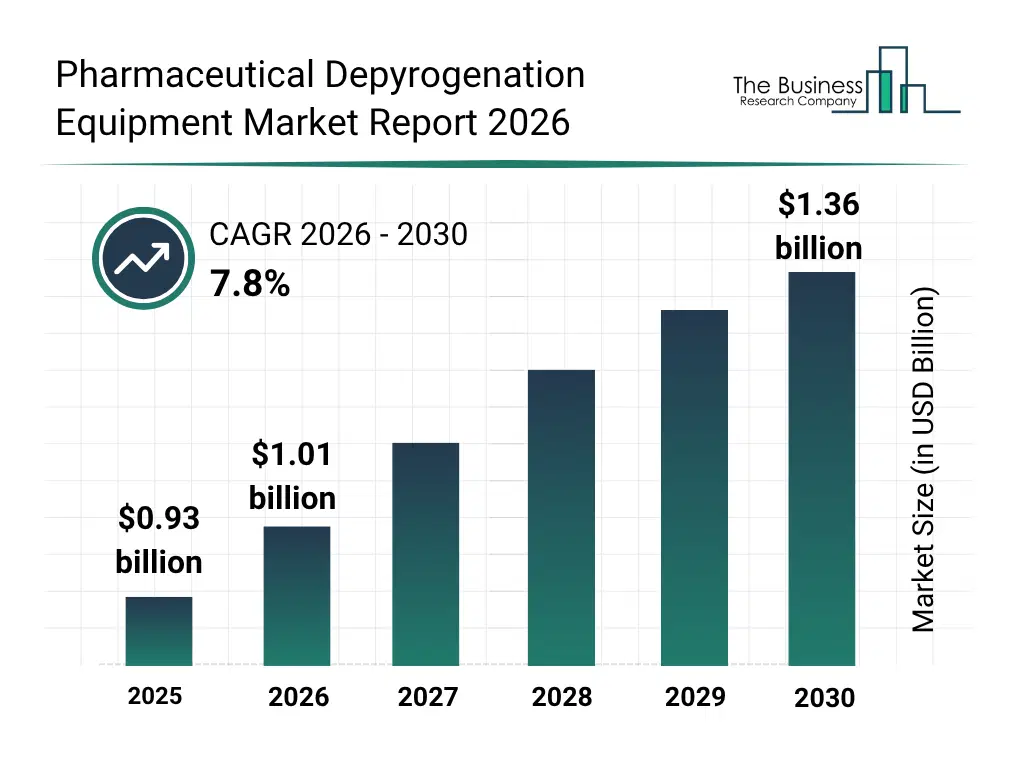
What Is The Pharmaceutical Depyrogenation Equipment Market Size and Share 2026?
The pharmaceutical depyrogenation equipment market size has grown strongly in recent years. It will grow from $0.93 billion in 2025 to $1.01 billion in 2026 at a compound annual growth rate (CAGR) of 7.6%. The growth in the historic period can be attributed to increasing pharmaceutical production volumes, rising incidence of injectable drug manufacturing, demand for sterile glassware and containers, regulatory requirements for endotoxin-free products, adoption of conventional batch depyrogenation systems.What Is The Pharmaceutical Depyrogenation Equipment Market Growth Forecast?
The pharmaceutical depyrogenation equipment market size is expected to see strong growth in the next few years. It will grow to $1.36 billion by 2030 at a compound annual growth rate (CAGR) of 7.8%. The growth in the forecast period can be attributed to growth in vaccine and biologics production, adoption of automated and high-throughput depyrogenation equipment, increasing R&D in sterile manufacturing technologies, integration of advanced monitoring and IoT-based control systems, expansion of contract manufacturing organizations (CMOs) globally. Major trends in the forecast period include increasing demand for automated depyrogenation systems, rising adoption of high-temperature dry heat sterilization, expansion of depyrogenation equipment in vaccine and biologics manufacturing, growing focus on regulatory compliance and sterility standards, integration of real-time monitoring and process control systems.Global Pharmaceutical Depyrogenation Equipment Market Segmentation
1) By Equipment Type: Depyrogenation Tunnels, Dry Heat Sterilizers, Depyrogenation Ovens, Vial And Ampoule Depyrogenation Systems, Automated Depyrogenation Chambers 2) By Technology: Conveyor-Based Systems, Batch Processing Ovens, Continuous Flow Tunnels, High-Temperature Plasma Systems 3) By Application: Ampoules, Penicillin Bottles, Syringes 4) By End-User: Pharmaceutical Manufacturers, Biotechnology Companies, Contract Manufacturing Organizations (CMOs), Research And Academic Institutes, Vaccine And Biologics Manufacturing Facilities Subsegments: 1) By Depyrogenation Tunnels: Conveyor Depyrogenation Tunnels, Modular Depyrogenation Tunnels, High Throughput Depyrogenation Tunnels, Compact Depyrogenation Tunnels 2) By Dry Heat Sterilizers: Horizontal Dry Heat Sterilizers, Vertical Dry Heat Sterilizers, Laboratory Dry Heat Sterilizers, Industrial Dry Heat Sterilizers 3) By Depyrogenation Ovens: Bench Top Depyrogenation Ovens, Floor Standing Depyrogenation Ovens, High Capacity Depyrogenation Ovens, Programmable Depyrogenation Ovens 4) By Vial And Ampoule Depyrogenation Systems: Glass Vial Depyrogenation Systems, Ampoule Depyrogenation Systems, Combined Vial And Ampoule Depyrogenation Systems, High Speed Container Depyrogenation Systems 5) By Automated Depyrogenation Chambers: Fully Automated Depyrogenation Chambers, Semi Automated Depyrogenation Chambers, Programmable Depyrogenation Chambers, Large Capacity Depyrogenation ChambersWhat Are The Drivers Of The Pharmaceutical Depyrogenation Equipment Market?
The increasing adoption of injectable pharmaceuticals is expected to propel the growth of the pharmaceutical depyrogenation equipment market going forward. Injectable pharmaceuticals are sterile drug formulations administered directly into the body using a syringe or infusion, bypassing the digestive system. Injectable pharmaceuticals are increasing due to the rising prevalence of chronic diseases such as diabetes and cancer, requiring rapid and effective drug delivery. Pharmaceutical depyrogenation equipment supports injectable pharmaceuticals by removing pyrogens and endotoxins from drug containers, ensuring sterility and patient safety. For instance, in July 2024, according to the United Nations Children's Fund (UNICEF), a US-based international organization that provides humanitarian and developmental aid to children worldwide, the global proportion of adolescent girls receiving at least one dose of the HPV vaccine rose from 20% in 2022 to 27% in 2023, marking a 7-percentage-point increase. Therefore, increasing adoption of injectable pharmaceuticals is driving the growth of the pharmaceutical depyrogenation equipment industry. The expansion of the biopharmaceutical and biotechnology industry is expected to propel the growth of the pharmaceutical depyrogenation equipment market going forward. The biopharmaceutical and biotechnology industry develops medical therapies using biological systems and advances innovation in drug discovery, vaccines, and treatments through technologies like genetic engineering and molecular biology. The rapid growth of the biopharmaceutical and biotechnology sector is largely driven by increasing investment in the research and development of novel biologics, biosimilars, and advanced therapies, which necessitate highly controlled and contamination-free manufacturing environments. The growing scale of biopharmaceutical production intensifies the need for depyrogenation equipment, as these systems are critical to ensuring endotoxin-free conditions required for the safe manufacture of injectable drugs, vaccines, and biological therapies. For instance, in January 2023, according to Cardinal Health Inc., a US-based healthcare company, as of January 2022, the US had 33 biosimilar products approved by the FDA, with 21 available on the market. By 2023, FDA-approved biosimilars had increased to 40, with 25 commercially available. Therefore, the expansion of the biopharmaceutical and biotechnology industry is driving the growth of the pharmaceutical depyrogenation equipment industry.Key Players In The Global Pharmaceutical Depyrogenation Equipment Market
Major companies operating in the pharmaceutical depyrogenation equipment market are STERIS Public Limited Company, Getinge Aktiebolag, Azbil Telstar Sociedad Limitada Unipersonal, Syntegon Technology Gesellschaft mit beschränkter Haftung, Belimed Aktiengesellschaft, Shibuya Corporation (Kabushiki Kaisha Shibuya Kogyo), OPTIMA Packaging Group Gesellschaft mit beschränkter Haftung, Marchesini Group Società per Azioni, Bausch + Ströbel SE & Co. Kommanditgesellschaft, Shanghai Tofflon Science and Technology Group Co. Ltd., Zhangjiagang Tofflon Machinery Co. Ltd., Fedegari Autoclavi Società per Azioni, Pharmalab India Private Limited, Steriline Società a responsabilità limitata, De Lama Società per Azioni, Dara Pharmaceutical Packaging S.A., Neelam Industries Private Limited, Lodha International Limited Liability Partnership, Stericox India Private Limited, Steelco.What Are Latest Mergers And Acquisitions In The Pharmaceutical Depyrogenation Equipment Market?
In June 2024, Syntegon Technology GmbH, a Germany-based provider of pharmaceutical processing and packaging equipment, acquired Telstar for an undisclosed amount. With this acquisition, Syntegon aims to expand its portfolio of integrated aseptic processing solutions and strengthen its technological capabilities in freeze-drying and containment systems to offer end-to-end solutions for sterile pharmaceutical manufacturing. Telstar is a Spain-based provider of pharmaceutical equipment, including lyophilization systems, sterilization and depyrogenation solutions, isolators, and cleanroom engineering services.Regional Insights
North America was the largest region in the pharmaceutical depyrogenation equipment market in 2025. Asia-Pacific is expected to be the fastest-growing region in the forecast period. The regions covered in this market report are Asia-Pacific, South East Asia, Western Europe, Eastern Europe, North America, South America, Middle East, Africa. The countries covered in this market report are Australia, Brazil, China, France, Germany, India, Indonesia, Japan, Taiwan, Russia, South Korea, UK, USA, Canada, Italy, Spain.What Defines the Pharmaceutical Depyrogenation Equipment Market?
The pharmaceutical depyrogenation equipment market consists of sales of glassware depyrogenation units, stainless steel component depyrogenation systems, sterilization monitoring sensors, and cleanroom-compatible heating modules. Values in this market are ‘factory gate’ values, that is, the value of goods sold by the manufacturers or creators of the goods, whether to other entities (including downstream manufacturers, wholesalers, distributors, and retailers) or directly to end customers. The value of goods in this market includes related services sold by the creators of the goods.How is Market Value Defined and Measured?
The market value is defined as the revenues that enterprises gain from the sale of goods and/or services within the specified market and geography through sales, grants, or donations in terms of the currency (in USD unless otherwise specified). The revenues for a specified geography are consumption values that are revenues generated by organizations in the specified geography within the market, irrespective of where they are produced. It does not include revenues from resales along the supply chain, either further along the supply chain or as part of other products.What Key Data and Analysis Are Included in the Pharmaceutical Depyrogenation Equipment Market Report 2026?
The pharmaceutical depyrogenation equipment market research report is one of a series of new reports from The Business Research Company that provides market statistics, including industry global market size, regional shares, competitors with the market share, detailed market segments, market trends and opportunities, and any further data you may need to thrive in the pharmaceutical depyrogenation equipment industry. The market research report delivers a complete perspective of everything you need, with an in-depth analysis of the current and future state of the industry.Pharmaceutical Depyrogenation Equipment Market Report Forecast Analysis
| Report Attribute | Details |
|---|---|
| Market Size Value In 2026 | $1.01 billion |
| Revenue Forecast In 2035 | $1.36 billion |
| Growth Rate | CAGR of 7.6% from 2026 to 2035 |
| Base Year For Estimation | 2025 |
| Actual Estimates/Historical Data | 2020-2025 |
| Forecast Period | 2026 - 2030 - 2035 |
| Market Representation | Revenue in USD Billion and CAGR from 2026 to 2035 |
| Segments Covered | Equipment Type, Technology, Application, End-User |
| Regional Scope | Asia-Pacific, Western Europe, Eastern Europe, North America, South America, Middle East, Africa |
| Country Scope | The countries covered in the report are Australia, Brazil, China, France, Germany, India, ... |
| Key Companies Profiled | STERIS Public Limited Company, Getinge Aktiebolag, Azbil Telstar Sociedad Limitada Unipersonal, Syntegon Technology Gesellschaft mit beschränkter Haftung, Belimed Aktiengesellschaft, Shibuya Corporation (Kabushiki Kaisha Shibuya Kogyo), OPTIMA Packaging Group Gesellschaft mit beschränkter Haftung, Marchesini Group Società per Azioni, Bausch + Ströbel SE & Co. Kommanditgesellschaft, Shanghai Tofflon Science and Technology Group Co. Ltd., Zhangjiagang Tofflon Machinery Co. Ltd., Fedegari Autoclavi Società per Azioni, Pharmalab India Private Limited, Steriline Società a responsabilità limitata, De Lama Società per Azioni, Dara Pharmaceutical Packaging S.A., Neelam Industries Private Limited, Lodha International Limited Liability Partnership, Stericox India Private Limited, Steelco. |
| Customization Scope | Request for Customization |
| Pricing And Purchase Options | Explore Purchase Options |