
Nature Credit Market Report 2026
Global Outlook – By Credit Type (Biodiversity Credits, Carbon Credits, Water Credits, Soil Credits, Other Credit Types ), By Trading Platform (Voluntary, Compliance, Other Trading Platforms ), By Application (Conservation, Restoration, Sustainable Agriculture, Forestry, Other Applications ), By End-User (Corporates, Governments, Non-Governmental Organizations (NGOs), Financial Institutions, Other End-Users ) – Market Size, Trends, Strategies, and Forecast to 2035
Nature Credit Market Overview
• Nature Credit market size has reached to $19.5 billion in 2025 • Expected to grow to $48.06 billion in 2030 at a compound annual growth rate (CAGR) of 19.8% • Growth Driver: Rising Global Investments In Nature-Based Solutions Driving The Market Growth Due To Increasing Demand for Verified Carbon and Biodiversity Credits • Market Trend: Adoption Of Advanced Digital Monitoring And Verification Solutions Is Accelerating Growth Due To Enhanced Transparency, Data Accuracy, And Credit Integrity • North America was the largest region in 2025 and Asia-Pacific is the fastest growing region.
What Is Covered Under Nature Credit Market?
Nature credit markets are a market-based mechanism that quantifies and verifies environmental benefits such as carbon sequestration, biodiversity protection, and ecosystem restoration. These verified outcomes are converted into tradable credits that can be purchased by organizations to support conservation and restoration initiatives. Nature credit assigns financial value to nature-positive activities and encourages investment in sustainable land management and ecosystem protection. The main credit types of nature credit markets include biodiversity credits, carbon credits, water credits, soil credits, and other credit types. Biodiversity credits represent measurable conservation outcomes that can be traded to support ecological initiatives. The trading platforms consist of voluntary, compliance, and other trading platforms. The key applications of conservation, restoration, sustainable agriculture, forestry, and other applications, while the end-use includes corporates, governments, non-governmental organizations (NGOs), financial institutions, and other end users.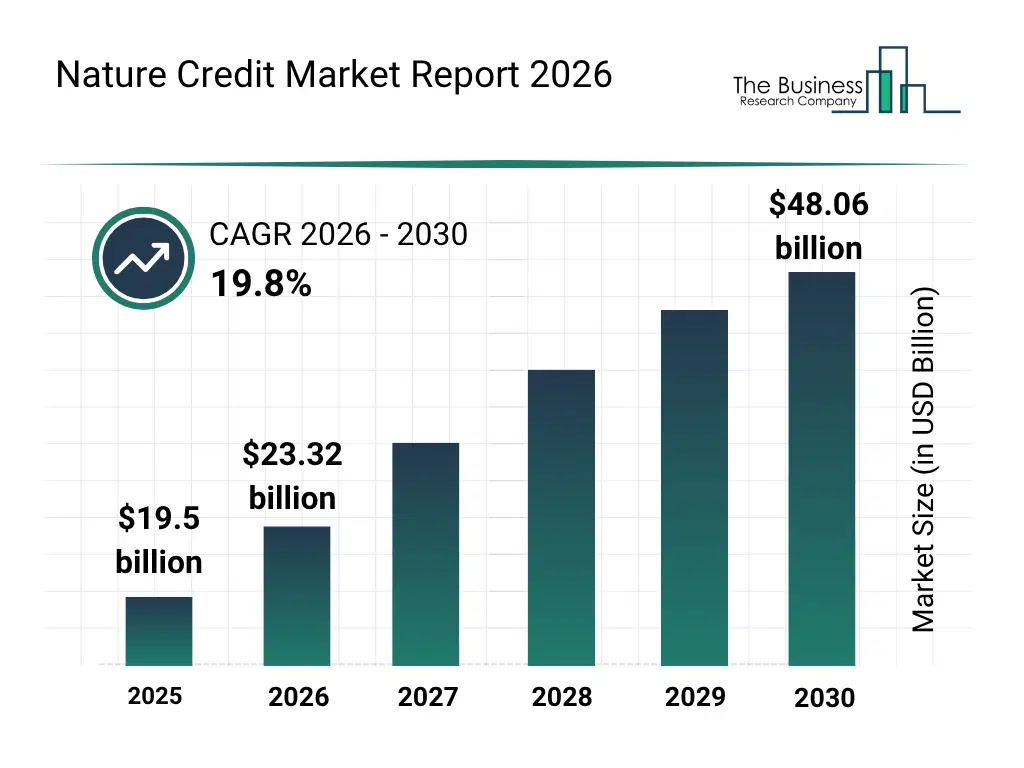
What Is The Nature Credit Market Size and Share 2026?
The nature credit market size has grown rapidly in recent years. It will grow from $19.5 billion in 2025 to $23.32 billion in 2026 at a compound annual growth rate (CAGR) of 19.6%. The growth in the historic period can be attributed to growing awareness of environmental degradation, emergence of carbon and biodiversity credit frameworks, increasing corporate sustainability commitments, government-backed conservation programs, early adoption of voluntary environmental trading platforms.What Is The Nature Credit Market Growth Forecast?
The nature credit market size is expected to see rapid growth in the next few years. It will grow to $48.06 billion by 2030 at a compound annual growth rate (CAGR) of 19.8%. The growth in the forecast period can be attributed to expansion of compliance-driven nature credit markets, integration of ai and blockchain for verification, rising investment in climate-positive projects, increasing cross-border nature credit trading, growth in corporate net-zero and ESG commitments. Major trends in the forecast period include increasing adoption of verified nature credits, rising demand for transparent environmental impact measurement, expansion of ecosystem restoration and conservation initiatives, growing integration of nature credits with corporate sustainability strategies, emergence of innovative trading platforms for nature-based credits.Global Nature Credit Market Segmentation
1) By Credit Type: Biodiversity Credits, carbon credits, Water Credits, Soil Credits, Other Credit Types 2) By Trading Platform: Voluntary, Compliance, Other Trading Platforms 3) By Application: Conservation, Restoration, Sustainable Agriculture, Forestry, Other Applications 4) By End-User: Corporates, Governments, Non-Governmental Organizations (NGOs), Financial Institutions, Other End-Users Subsegments: 1) By Biodiversity Credits: Habitat Restoration Credits, Species Protection Credits, Ecosystem Services Credits, Conservation Area Credits 2) By Carbon Credits: Avoided Deforestation (REDD+) Credits, Afforestation Or Reforestation Credits, Soil Carbon Sequestration Credits, Blue Carbon Credits (Coastal And Marine), Renewable Energy Offset Credits, Methane Capture Credits 3) By Water Credits: Water Quality Credits, Water QuantityOrUsage Credits, Watershed Management Credits, Wetlands Restoration Credits 4) By Soil Credits: Soil Carbon Sequestration Credits, Erosion Control Credits, Nutrient Management Credits, Sustainable Agriculture Practice Credits 5) By Other Credit Types: Air Quality Credits, Pollinator Protection Credits, Ecosystem Service Bundled Credits, Climate Resilience CreditsWhat Is The Driver Of The Nature Credit Market?
The rising global investments in nature-based solutions (NbS) are expected to propel the growth of the nature credit markets market going forward. Nature-based solutions refer to actions that protect, restore, or sustainably manage ecosystems to address societal challenges such as climate change, biodiversity loss, and land degradation, while simultaneously generating tradeable environmental credits. The growing scale of NbS investments is largely driven by expanding regulatory frameworks and international biodiversity commitments, as governments and financial institutions align spending with global targets such as the Kunming-Montreal Global Biodiversity Framework, which has accelerated capital flows toward conservation and restoration activities. The surge in NbS investment directly expands the supply of verifiable nature credits, including biodiversity offsets and carbon units, increasing participation from both public and private actors and broadening the scope of traded instruments within the market. For instance, in January 2026, according to the United Nations Environment Programme, a Kenya-based intergovernmental environmental authority, total global finance flows into nature-based solutions reached approximately $220 billion in 2023, increasing from around $200 billion in 2022, highlighting a continued rise in investments directed toward ecosystem restoration, biodiversity conservation, and nature-positive initiatives. Therefore, rising global investments in nature-based solutions are driving the growth of the nature credit markets market.Key Players In The Global Nature Credit Market
Major companies operating in the nature credit market are Indigo Ag Inc., South Pole, Ecosphere+ Ltd, ClimatePartner GmbH, The Nature Conservancy, Sylvera Ltd, Pachama Inc., Verra, CarbonCure Technologies Inc., Terra Global Capital LLC, Bluesource LLC, BioCarbon Partners Limited, Finite Carbon Corporation, C Quest Capital LLC, Climate Impact X Pte Ltd, Gold Standard Foundation, Natural Capital Exchange Inc., Everland LLC, Carbon Streaming Corporation, Nori Inc.Global Nature Credit Market Trends and Insights
Major companies operating in the nature credit markets market are focusing on developing advanced digital verification systems to enhance credit transparency, strengthen environmental integrity, and improve buyer confidence in tradable nature assets. Digital verification systems are digital platforms that electronically confirm and authenticate the identity, information, or credentials of individuals and transactions through secure verification technologies and protocols. For instance, in August 2024, Verra, a US-based environmental standards organization, launched its Digital Project Submission Tool to modernize environmental credit accounting. The initiative integrates satellite-based data collection, automated data processing tools, and standardized methodologies to improve data accuracy, reduce reliance on manual field audits, and enable more frequent project performance assessments, thereby supporting scalable and transparent issuance of verified environmental credits.What Are Latest Mergers And Acquisitions In The Nature Credit Market?
In April 2023, Abatable, a UK-based carbon procurement and market intelligence company, acquired Ecosphere+ for an undisclosed amount. Through this acquisition, Abatable aims to expand its access to high-quality nature-based carbon credits and strengthen its project sourcing, structuring, and distribution capabilities within the voluntary carbon market. Ecosphere+ is a UK-based nature-based carbon credits provider.Regional Insights
North America was the largest region in the nature credit markets market in 2025. Asia-Pacific is expected to be the fastest-growing region in the forecast period. The regions covered in this market report are Asia-Pacific, South East Asia, Western Europe, Eastern Europe, North America, South America, Middle East, Africa. The countries covered in this market report are Australia, Brazil, China, France, Germany, India, Indonesia, Japan, Taiwan, Russia, South Korea, UK, USA, Canada, Italy, Spain.What Defines the Nature Credit Market?
The nature credit market consists of revenues earned by entities by providing services such as biodiversity credit generation and certification, ecosystem restoration project development, environmental impact measurement and verification (MRV), sustainability investment advisory, and portfolio management. The market value includes the value of related goods sold by the service provider or included within the service offering. Only goods and services traded between entities or sold to end consumers are included.How is Market Value Defined and Measured?
The market value is defined as the revenues that enterprises gain from the sale of goods and/or services within the specified market and geography through sales, grants, or donations in terms of the currency (in USD unless otherwise specified). The revenues for a specified geography are consumption values that are revenues generated by organizations in the specified geography within the market, irrespective of where they are produced. It does not include revenues from resales along the supply chain, either further along the supply chain or as part of other products.What Key Data and Analysis Are Included in the Nature Credit Market Report 2026?
The nature credit market research report is one of a series of new reports from The Business Research Company that provides market statistics, including industry global market size, regional shares, competitors with the market share, detailed market segments, market trends and opportunities, and any further data you may need to thrive in the nature credit industry. The market research report delivers a complete perspective of everything you need, with an in-depth analysis of the current and future state of the industry.Nature Credit Market Report Forecast Analysis
| Report Attribute | Details |
|---|---|
| Market Size Value In 2026 | $23.32 billion |
| Revenue Forecast In 2035 | $48.06 billion |
| Growth Rate | CAGR of 19.6% from 2026 to 2035 |
| Base Year For Estimation | 2025 |
| Actual Estimates/Historical Data | 2020-2025 |
| Forecast Period | 2026 - 2030 - 2035 |
| Market Representation | Revenue in USD Billion and CAGR from 2026 to 2035 |
| Segments Covered | Credit Type, Trading Platform, Application, End-User |
| Regional Scope | Asia-Pacific, Western Europe, Eastern Europe, North America, South America, Middle East, Africa |
| Country Scope | The countries covered in the report are Australia, Brazil, China, France, Germany, India, ... |
| Key Companies Profiled | Indigo Ag Inc., South Pole, Ecosphere+ Ltd, ClimatePartner GmbH, The Nature Conservancy, Sylvera Ltd, Pachama Inc., Verra, CarbonCure Technologies Inc., Terra Global Capital LLC, Bluesource LLC, BioCarbon Partners Limited, Finite Carbon Corporation, C Quest Capital LLC, Climate Impact X Pte Ltd, Gold Standard Foundation, Natural Capital Exchange Inc., Everland LLC, Carbon Streaming Corporation, Nori Inc. |
| Customization Scope | Request for Customization |
| Pricing And Purchase Options | Explore Purchase Options |