
Contact Us
  Search
The Business Research Company Logo
Modular Construction Global Market Opportunities And Strategies To 2035
Published :May 2026
Pages :338
Format :PDF
Delivery Time :2-3 Business Days
Why 2-3 days? We update the report with the latest data and news before delivery. Let us know if you need us to expedite.
Report Price :$4,490.00

Modular Construction Global Market Opportunities And Strategies To 2035

By Type (Permanent, Relocatable), By Material (Steel, Wood, Concrete, Other Materials), By Module (Four-Sided, Open-Sided, Partially Open-Sided Modules, Mixed Modules And Floor Cassettes, Modules Supported By A Primary Structure, Other Modules), By End-Use Sector (Residential, Office, Education, Retail And Commercial, Hospitality, Healthcare, Other End Users), And By Region, Opportunities And Strategies – Global Forecast To 2035

Modular Construction Market Definition

Modular construction refers to a method of building in which individual sections or units—known as modules—are pre‑manufactured off‑site in factory settings and then transported to and assembled at the final construction site. The modular construction market consists of revenues earned by entities (organizations, sole traders, or partnerships) by designing, manufacturing and assembling pre-fabricated building sections that are transported and installed on-site to create complete structures.
Research Expert

Book your 30 minutes free consultation with our research experts

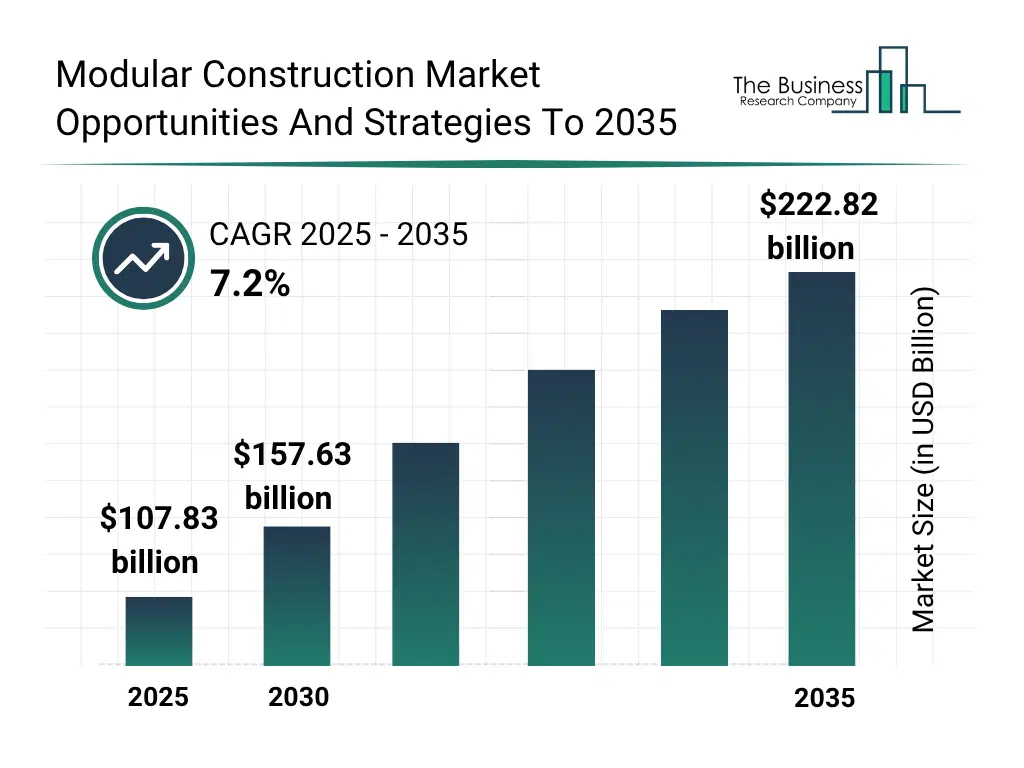
Modular Construction Global Market Opportunities And Strategies To 2035 Market Size and growth rate 2025 to 2030: Graph

Modular Construction Market Size

The global modular construction market reached a value of nearly $107,830.0 million in 2025, having grown at a compound annual growth rate (CAGR) of 7.7% since 2020. The market is expected to grow from $107,830.0 million in 2025 to $157,634.5 million in 2030 at a rate of 7.9%. The market is then expected to grow at a CAGR of 7.2% from 2030 and reach $222,823.4 million in 2035. Growth in the historic period resulted from rising skilled labor shortages, rising demand for affordable housing, growing renovation and remodeling activities and urban site constraints and land scarcity. Factors that negatively affected growth in the historic period were limited awareness and acceptance and design limitations. Going forward, increase in demand for green buildings, increasing focus on infrastructure development, increased demand for sustainable construction and growing need for relocatable and temporary buildings will drive growth. Factors that could hinder the growth of the modular construction market in the future include transport logistics bottlenecks, competition from traditional construction and impact of trade war and tariff.

Modular Construction Market Segmentation

The modular construction market is segmented by type, by material, by module and by end-use sector.

By Type –
The modular construction market is segmented by type into:
    • a) Permanent
    • b) Relocatable
The permanent market was the largest segment of the modular construction market segmented by type, accounting for 63.4% or $68,358.2 million of the total in 2025. Going forward, the relocatable segment is expected to be the fastest growing segment in the modular construction market segmented by type, at a CAGR of 9.5% during 2025-2030.

By Material –
The modular construction market is segmented by material into:
    • a) Steel
    • b) Wood
    • c) Concrete
    • d) Other Materials
The steel market was the largest segment of the modular construction market segmented by material, accounting for 40.5% or $43,674.0 million of the total in 2025. Going forward, the concrete segment is expected to be the fastest growing segment in the modular construction market segmented by material, at a CAGR of 9.4% during 2025-2030.

By Module –
The modular construction market is segmented by module into:
    • a) Four-Sided
    • b) Open-Sided
    • c) Partially Open-Sided
    • d) Mixed Modules And Floor Cassettes
    • e) Modules Supported By A Primary Structure
    • f) Other Modules
The four-sided market was the largest segment of the modular construction market segmented by module, accounting for 32.2% or $34,843.9 million of the total in 2025. Going forward, the open-sided segment is expected to be the fastest growing segment in the modular construction market segmented by module, at a CAGR of 9.6% during 2025-2030.

By End-Use Sector –
The modular construction market is segmented by end-use sector into:
  1. a) Residential
  2. b) Office
  3. c) Education
  4. d) Retail And Commercial
  5. e) Hospitality
  6. f) Healthcare
  7. g) Other End Users
The residential market was the largest segment of the modular construction market segmented by end-use sector, accounting for 44.2% or $47,611.5 million of the total in 2025. Going forward, the retail and commercial segment is expected to be the fastest growing segment in the modular construction market segmented by end-use sector, at a CAGR of 8.8% during 2025-2030.

By Geography - The modular construction market is segmented by geography into:
      o Asia Pacific
      • • China
      • • India
      • • Japan
      • • Australia
      • • Indonesia
      • • South Korea
      o North America
      • • USA
      • • Canada
      o South America
      • • Brazil
      o Western Europe
      • • France
      • • Germany
      • • UK
      • • Italy
      • • Spain
      o Eastern Europe
      • • Russia
      o Middle East
      o Africa
Asia Pacific was the largest region in the modular construction market, accounting for 44.8% or $52,701.5 million of the total in 2025. It was followed by Western Europe and North America then the other regions. Going forward, the fastest-growing regions in the modular construction market will be Asia Pacific and Africa where growth will be at CAGRs of 9.0% and 8.6% respectively. These will be followed by Middle East and North America where the markets are expected to grow at CAGRs of 7.9% and 7.6% respectively.

Modular Construction Market Drivers

The key drivers of the modular construction market include: Increase In Demand For Green Buildings During the forecast period, increase in demand for green buildings will propel growth in the modular construction market. As sustainability and eco‑friendly practices gain importance among developers, policymakers and end users, there is a rising focus on reducing waste, conserving energy and minimizing environmental impact in construction projects. Modular construction supports these sustainability goals by enabling controlled off‑site manufacturing, reducing material waste and optimizing energy use in buildings. Developers are increasingly seeking solutions that comply with green building standards and certifications, making modular construction a preferred approach. The adoption of energy-efficient and eco-friendly designs is expected to continue driving the expansion of modular construction globally. The increase in demand for green buildings during the forecast period in 2025 is 1.6%.

Modular Construction Market Restraints

The key restraints on the modular construction market include: Transport Logistics Bottlenecks Transport logistics bottlenecks are restricting the growth of the modular construction market during the forecast period. Modular construction relies heavily on the transportation of large volumetric units from factories to construction sites, which creates unique logistical challenges that traditional methods do not face. Transporting large modules requires specialized equipment and careful coordination due to their size and handling requirements and current global shipping conditions such as port congestion and high freight costs exacerbate delivery delays and increase project complexity. These logistical hurdles often result in unpredictable delivery schedules, stretching project timelines, increasing costs and forcing developers to reallocate resources to manage transportation risk rather than on-site construction activities. As a result, modular construction projects may face delayed installations, crane scheduling conflicts, or idle labor crews while waiting for module deliveries, thereby restricting the growth of the modular construction market during the forecast period. Growth affected by transport logistics bottlenecks during the forecast period in 2025 is -0.8%.

Modular Construction Market Competitive Landscape

Major Competitors are:

  • Bechtel Corporation
  • Skanska AB
  • Bouygues Construction SA
  • Larsen & Toubro Limited
  • Fluor Corporation
  • Other Competitors Include:

  • Lendlease Corporation
  • Balfour Beatty Plc.
  • Laing O’Rourke
  • Sekisui House Ltd
  • Daiwa House Industry Co. Ltd
  • Broad Sustainable Building
  • Lida Group
  • ATCO Ltd.
  • Misawa Homes Co., Ltd.
  • Taisei Corporation
  • System House R & C Co. Ltd.
  • the Korea Institute of Civil Engineering and Building Technology (KICT)
  • NRB
  • Hyundai Engineering & Construction (Hyundai E&C)
  • Samsung C&T (SAMSUNG E&A)
  • GS E&C
  • PLANM Co., Ltd.
  • EPACK Prefab
  • Premier Modular Limited
  • Wernick Group
  • Portakabin
  • Baufritz
  • WeberHaus
  • Dwellii
  • Unihouse SA
  • KOMA MODULAR s.r.o.
  • BlockMaster Modular Buildings
  • ModularUA
  • Masterplast Nyrt
  • Palomar Modular Buildings
  • SG Blocks, Inc.
  • Guerdon Modular Buildings
  • Grupo GMI
  • Sunbelt Modular Inc.
  • Kent Homes
  • Modular Homes
  • NRB Modular Solutions
  • Stellar Modular
  • Matrex
  • Boxx Modular
  • Simply Homes
  • Greystar
  • Sekisui House
  • Honomobo Corporation
  • Modular Building Systems, Inc. (MBS)
  • Factory OS
  • Method Homes
  • Set Ideas
  • Tecverde Engenharia
  • Brasil ao Cubo
  • Cyrela Build Up
  • Tecno Fast
  • Opus Construtech
  • Master Módulos Construções Modulares
  • Grupo Imdi
  • ROSHN Group
  • DuBox
  • Karmod
  • Red Sea International Company
  • Prefabrik Yapı A.Ş.
  • Vefa Group
  • Emirates Precast
  • Dub ox by Amana
  • Zamil Industrial Investment Co.
  • Red Sea Housing Services
  • Kwikspace Modular Buildings
  • Need data on a specific region in this market?

    Opportunities And Recommendations In The Modular Construction Market

    Opportunities – The top opportunities in the modular construction market segmented by type will arise in the permanent segment, which will gain $27,009.7 million of global annual sales by 2030. The top opportunities in the modular construction market segmented by material will arise in the steel segment, which will gain $49,804.4 million of global annual sales by 2030. The top opportunities in the modular construction market segmented by module will arise in the four-sided segment, which will gain $15,060.4 million of global annual sales by 2030. The top opportunities in the modular construction market segmented by end-use sector will arise in the residential segment, which will gain $22,054.9 million of global annual sales by 2030. The modular construction market size will gain the most in China at $13,577.3 million. Recommendations- To take advantage of the opportunities, The Business Research Company recommends the modular construction companies to focus on energy-efficient factory-built housing to accelerate scalable delivery, focus on landmark modular projects to prove speed and quality advantages, focus on relocatable modular construction for speed and flexibility, focus on concrete modular systems for high-growth structural demand, focus on open-sided modules for design-led growth, expand in emerging markets, focus on research-validated energy-efficient modular housing, focus on cost-transparent and risk-balanced pricing framework, anchor promotion on speed, quality and delivery certainty, drive conversion through segment focus and proof-based engagement and focus on retail and commercial modular projects for accelerated returns.
    Chat with us