
Contact Us
  Search
The Business Research Company Logo
Metastatic Breast Cancer Treatment Global Market Opportunities And Strategies To 2035
Published :May 2026
Pages :303
Format :PDF
Delivery Time :2-3 Business Days
Why 2-3 days? We update the report with the latest data and news before delivery. Let us know if you need us to expedite.
Report Price :$4,490.00

Metastatic Breast Cancer Treatment Global Market Opportunities And Strategies To 2035

By Therapy Type (Chemotherapy, Radiation Therapy, Targeted Therapy, Surgery, Hormone Therapy), By Molecule Type (Monoclonal Antibody, Peptides And Hormones, Small Molecule, Others), By End-User (Hospitals, Clinics, Ambulatory Surgical Centers, Other End-Users), And By Region, Opportunities And Strategies – Global Forecast To 2035

Metastatic Breast Cancer Treatment Market Definition

Metastatic breast cancer treatment refers to the medical treatment of breast cancer that has spread beyond the breast and nearby lymph nodes to other parts of the body, such as the bones, liver, lungs, or brain (also known as stage IV breast cancer). The primary purpose of metastatic breast cancer treatment is to control disease progression, relieve symptoms, and extend survival while maintaining quality of life. The metastatic breast cancer treatment market consists of sales, by entities (organizations, sole traders, or partnerships), of treatments that are primarily used by oncologists, surgeons, radiation therapists, and healthcare institutions such as hospitals, oncology clinics, and ambulatory surgical centers. Treatments are administered based on individual patient profiles, prior treatments received, genetic markers, and overall health status. Therapies may be used as standalone interventions or in combination to maximize efficacy and counter resistance.
Research Expert

Book your 30 minutes free consultation with our research experts

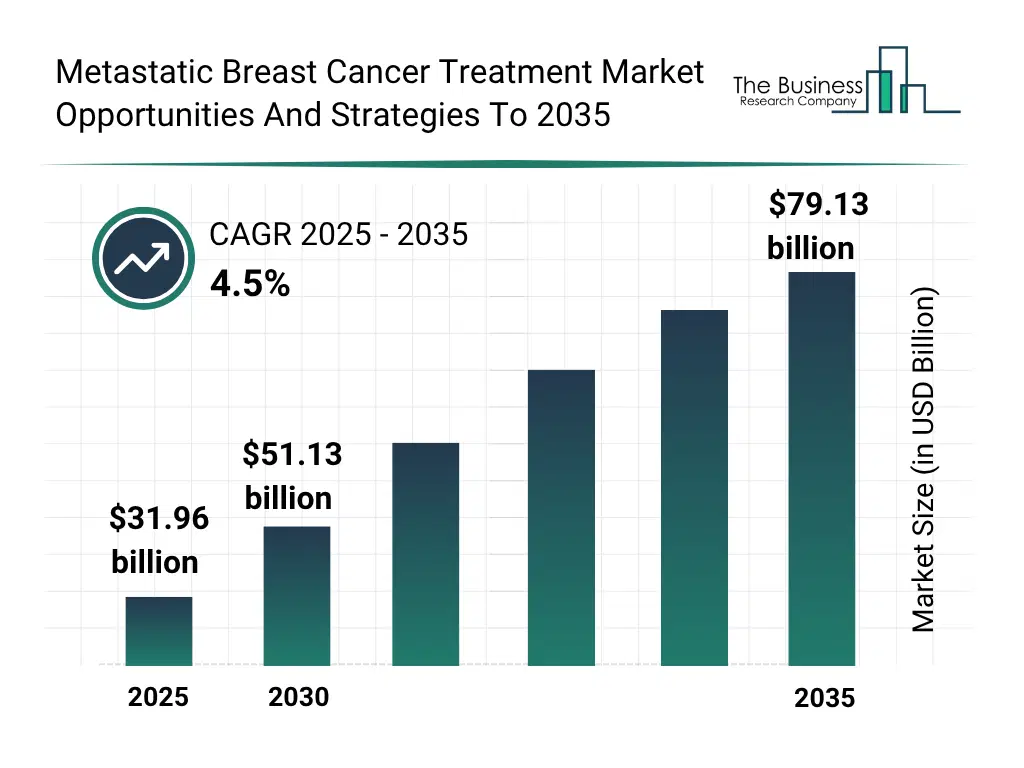
Metastatic Breast Cancer Treatment Global Market Opportunities And Strategies To 2035 Market Size and growth rate 2025 to 2030: Graph

Metastatic Breast Cancer Treatment Market Size

The global metastatic breast cancer treatment market reached a value of nearly $31,956.9 million in 2025, having grown at a compound annual growth rate (CAGR) of 5.6% since 2020. The market is expected to grow from $31,956.9 million in 2025 to $51,125.2 million in 2030 at a rate of 9.9%. The market is then expected to grow at a CAGR of 4.5% from 2030 and reach $79,134.4 million in 2035. Growth in the historic period resulted from the growth of precision medicine and targeted therapies, changes in lifestyle, shift towards personalized medicine and rising incidence rates of breast cancer. Factors that negatively affected growth in the historic period were high treatment costs and lack of skilled healthcare professionals. Going forward, the rising aging population, rising healthcare expenditures, growing public awareness campaigns and increasing awareness and screening programs will drive the growth. Factor that could hinder the growth of the metastatic breast cancer treatment market in the future include lengthy and complex regulatory approval, side effect–related treatment discontinuation and impact of trade wars and tariffs.

Metastatic Breast Cancer Treatment Market Segmentation

The metastatic breast cancer treatment market is segmented by therapy type, by molecule type and by end user.

By Therapy Type –
The metastatic breast cancer treatment market is segmented by therapy type into:
    • a) Chemotherapy
    • b) Radiation Therapy
    • c) Targeted Therapy
    • d) Surgery
    • e) Hormone Therapy
The targeted therapy market was the largest segment of the metastatic breast cancer treatment market segmented by therapy type, accounting for 42.8% or $13,663.1 million of the total in 2025. Going forward, the hormone therapy segment is expected to be the fastest growing segment in the metastatic breast cancer treatment market segmented by therapy type, at a CAGR of 11.5% during 2025-2030.

By Molecular Type –
The metastatic breast cancer treatment market is segmented by molecular type into:
    • a) Monoclonal Antibody
    • b) Peptides And Hormones
    • c) Small Molecule
    • d) Others
The small molecule market was the largest segment of the metastatic breast cancer treatment market segmented by molecule type, accounting for 35.7% or $11,411.6 million of the total in 2025. Going forward, the monoclonal antibody segment is expected to be the fastest growing segment in the metastatic breast cancer treatment market segmented by molecule type, at a CAGR of 13.1% during 2025-2030.

By End User –
The metastatic breast cancer treatment market is segmented by end user into:
    • a) Hospitals
    • b) Clinics
    • c) Ambulatory Surgical Centers
    • d) Other End-Users
The hospitals market was the largest segment of the metastatic breast cancer treatment market segmented by end-user, accounting for 61.8% or $19,742.9 million of the total in 2025. Going forward, the other end-user segment is expected to be the fastest growing segment in the metastatic breast cancer treatment market segmented by end-user, at a CAGR of 14.6% during 2025-2030.

By Geography - The metastatic breast cancer treatment market is segmented by geography into:
      o Asia Pacific
      • • China
      • • India
      • • Japan
      • • Australia
      • • Indonesia
      • • South Korea
      o North America
      • • USA
      • • Canada
      o South America
      • • Brazil
      o Western Europe
      • • France
      • • Germany
      • • UK
      • • Italy
      • • Spain
      o Eastern Europe
      • • Russia
      o Middle East
      o Africa
North America was the largest region in the metastatic breast cancer treatment market, accounting for 37.4% or $11,944.3 million of the total in 2025. It was followed by Asia Pacific, Western Europe and then the other regions. Going forward, the fastest-growing regions in the metastatic breast cancer treatment market will be Asia Pacific and Middle East where growth will be at CAGRs of 11.7% and 10.3% respectively. These will be followed by Africa and North America where the markets are expected to grow at CAGRs of 10.3% and 9.2% respectively.

Metastatic Breast Cancer Treatment Market Drivers

The key drivers of the metastatic breast cancer treatment market include: Rising Aging Population The rising aging population is driving demand for metastatic breast cancer treatment. A larger aging population raises lifetime exposure to hormonal, genetic, and environmental risk factors associated with breast cancer development and progression. Older patients are more likely to present with comorbidities and delayed diagnoses, increasing the likelihood of disease advancing to metastatic stages. This demographic shift also contributes to higher recurrence rates, necessitating prolonged systemic treatments that balance efficacy with tolerability. Consequently, the growing need for long-term management of advanced disease is expected to significantly propel the metastatic breast cancer treatment market. The rising aging population growth contribution during the forecast period in 2025 is 1.5%.

Metastatic Breast Cancer Treatment Market Restraints

The key restraints on the metastatic breast cancer treatment market include: Lengthy And Complex Regulatory Approval The lengthy and complex regulatory approval remains a significant barrier to market expansion. Stringent clinical trial requirements, extended safety evaluations, and multi-step national and international approval processes delay the introduction of new treatments. These regulatory hurdles postpone patient access to innovative therapies and slow the integration of emerging treatment options into standard care. As a result, healthcare providers face challenges in offering timely interventions, and patients may experience delays in receiving advanced therapies that could improve survival and quality of life. Growth affected by lengthy and complex regulatory approval during the forecast period in 2025 is -2.0%.

Metastatic Breast Cancer Treatment Market Competitive Landscape

Major Competitors are:

  • F. Hoffmann-La Roche AG (Genentech Inc.)
  • Eli Lilly & Co.
  • Pfizer Inc.
  • Novartis AG
  • Merck & Co. Inc.
  • Other Competitors Include:

  • Gilead Sciences Inc.
  • AstraZeneca plc
  • Bristol-Myers Squibb Company
  • Amgen Inc.
  • Mayo Clinic
  • Sanofi
  • Menarini
  • SciClone Pharmaceuticals, Inc.
  • 3SBio (Sunshine Guojian)
  • Zai Lab
  • Junshi Biosciences
  • Akeso
  • Sichuan Kelun-Biotech
  • Jiangsu Hengrui Pharmaceuticals
  • Henlius
  • Daiichi Sankyo
  • Eisai Co., Ltd.
  • Chugai Pharmaceutical (Member of the Roche Group)
  • Celltrion
  • Samsung Bioepis
  • Bixink Therapeutics
  • Hyundai ADM Bio
  • IntoCell
  • Immutep Ltd.
  • Imugene Ltd.
  • Natco Pharma Ltd.
  • Emcure
  • Hetero
  • Biocon
  • Olema Pharmaceuticals, Inc. (Olema Oncology)
  • Byondis B.V.
  • BioNTech
  • Servier
  • Menarini Group
  • Johnson & Johnson
  • BriaCell Therapeutics
  • Knight Therapeutics
  • Pharmascience
  • Accord Healthcare
  • Roche Holding AG
  • GlaxoSmithKline plc (GSK)
  • AbbVie Inc.
  • Aspen Pharmacare
  • Eurolab Pharmaceuticals
  • EVA Pharma
  • Need data on a specific region in this market?

    Opportunities And Recommendations In The Metastatic Breast Cancer Treatment Market

    Opportunities – The top opportunities in the metastatic breast cancer treatment market segmented by therapy type will arise in the targeted therapy segment, which will gain $9,223.5 million of global annual sales by 2030. The top opportunities in the metastatic breast cancer treatment market segmented by molecule type will arise in the monoclonal antibody segment, which will gain $9,415.3 million of global annual sales by 2030. The top opportunities in the metastatic breast cancer treatment market segmented by end-user will arise in the hospitals segment, which will gain $10,127.4 million of global annual sales by 2030. The metastatic breast cancer treatment market size will gain the most in the USA at $5,914.0 million. Recommendations- To take advantage of the opportunities, The Business Research Company recommends the metastatic breast cancer treatment companies to focus on scalable deployment of driver monitoring systems, focus on real-time vital sign monitoring, focus on AI-driven predictive health and fatigue detection, focus on multi-modal biometric sensor integration, focus on fleet and commercial vehicle safety applications, focus on AI-driven predictive and biometric monitoring for fleet and commercial vehicles, focus on expanding sensor integration in automotive active health monitoring systems, focus on expanding dashboard and driver seat integration in vehicle health systems, focus on cloud-based platforms for automotive health monitoring, focus on expanding active health monitoring in passenger vehicles, focus on blood pressure monitoring in automotive health systems, focus on expanding distribution channels through fleet and OEM partnerships, focus on value-based and tiered pricing strategies, focus on data-driven awareness campaigns, focus on strategic OEM and fleet partnerships, focus on targeting electric vehicle manufacturers and fleet operators.
    Chat with us