
Metagenome-Assembled Genomes (MAGs) Services Market Report 2026
Global Outlook – By Service Type (Genome Assembly, Genome Annotation, Data Analysis, Custom Bioinformatics, Other Service Types), By Technology (Next-Generation Sequencing (NGS), Third-Generation Sequencing (Long-Read Sequencing), Cloud-Based Bioinformatics Platforms, Artificial Intelligence (AI) And Machine Learning-Based Analytics), By Application (Environmental Microbiology, Clinical Diagnostics, Agricultural Research, Biotechnology, Other Applications), By End-User (Academic And Research Institutes, Pharmaceutical And Biotechnology Companies, Contract Research Organizations, Other End-Users) – Market Size, Trends, Strategies, and Forecast to 2035
Metagenome-Assembled Genomes (MAGs) Services Market Overview
• Metagenome-Assembled Genomes (MAGs) Services market size has reached to $1.38 billion in 2025 • Expected to grow to $2.89 billion in 2030 at a compound annual growth rate (CAGR) of 15.9% • Growth Driver: Rising Prevalence Of Infectious Diseases Driving The Market Growth Due To Increasing Pathogen Surveillance Needs • Market Trend: Innovative Long-Read Sequencing Solutions Drive Advanced Microbiome Analysis • Asia-Pacific was the largest region and fastest growing region.
What Is Covered Under Metagenome-Assembled Genomes (MAGs) Services Market?
Metagenome-assembled genomes (MAGs) services refer to specialized bioinformatics and sequencing services that reconstruct individual microbial genomes directly from metagenomic data obtained from complex environmental or clinical samples. These services involve DNA sequencing, quality control, assembly, binning, and genome annotation to generate draft or near-complete genomes of uncultured microorganisms, enabling the identification, functional analysis, and ecological characterization of microbial community members without the need for laboratory cultivation. The main service types of metagenome-assembled genomes (MAGs) services include genome assembly, genome annotation, data analysis, custom bioinformatics, and other service types. Genome assembly refers to computational processes that reconstruct complete genomes from fragmented sequencing data to enable downstream analysis. The technologies include next-generation sequencing (NGS), third-generation sequencing (long-read sequencing), cloud-based bioinformatics platforms, and artificial intelligence (AI) and machine learning-based analytics. The various applications involved are environmental microbiology, clinical diagnostics, agricultural research, biotechnology, and other applications, and they are used by several end users such as academic and research institutes, pharmaceutical and biotechnology companies, contract research organizations, and other end-users.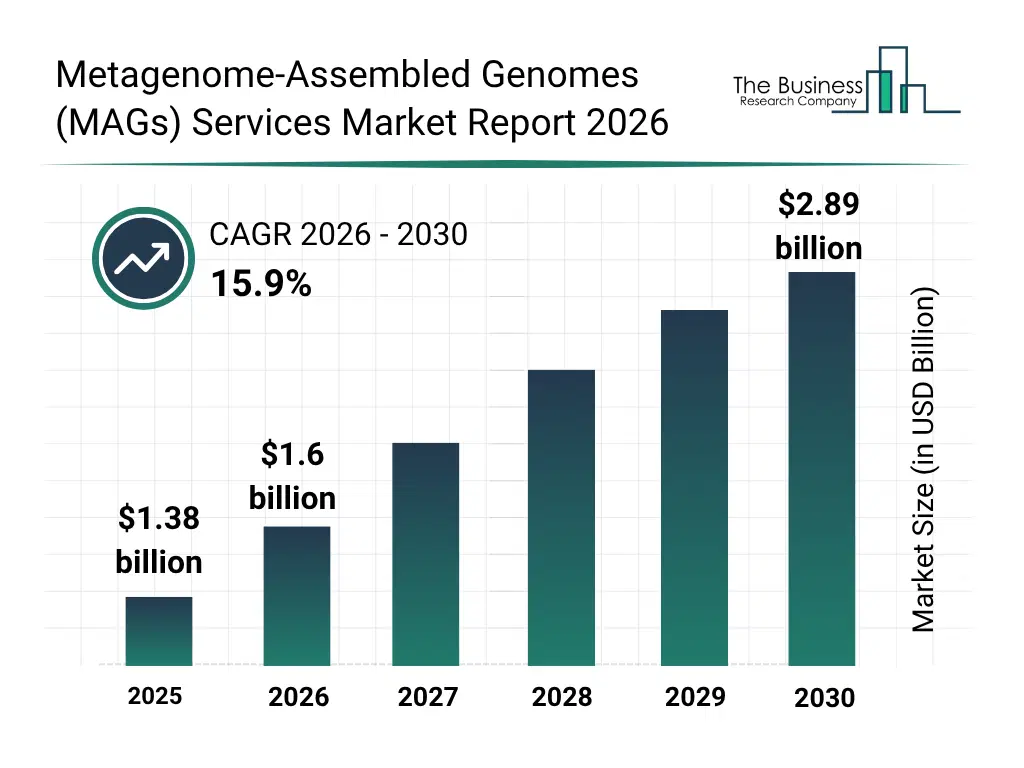
What Is The Metagenome-Assembled Genomes (MAGs) Services Market Size and Share 2026?
The metagenome-assembled genomes (MAGs) services market size has grown rapidly in recent years. It will grow from $1.38 billion in 2025 to $1.6 billion in 2026 at a compound annual growth rate (CAGR) of 15.7%. The growth in the historic period can be attributed to advancements in next-generation sequencing technologies, growth in microbiome research initiatives, increasing availability of high-throughput sequencing platforms, rising academic funding for environmental microbiology, expansion of bioinformatics expertise and infrastructure.What Is The Metagenome-Assembled Genomes (MAGs) Services Market Growth Forecast?
The metagenome-assembled genomes (MAGs) services market size is expected to see rapid growth in the next few years. It will grow to $2.89 billion in 2030 at a compound annual growth rate (CAGR) of 15.9%. The growth in the forecast period can be attributed to growing demand for precision microbiome-based therapeutics, increasing adoption of AI-driven genome reconstruction tools, rising application in agricultural microbiome optimization, expansion of cloud-based Bioinformatics Services, increasing focus on uncultured microbial diversity exploration. Major trends in the forecast period include increasing adoption of hybrid genome assembly approaches, rising demand for high-quality metagenome binning services, growing use of long-read sequencing for complex microbiomes, expansion of functional and comparative Genomics annotation, rising integration of end-to-end custom bioinformatics pipelines.Global Metagenome-Assembled Genomes (MAGs) Services Market Segmentation
1) By Service Type: Genome Assembly, Genome Annotation, Data Analysis, Custom Bioinformatics, Other Service Types 2) By Technology: Next-Generation Sequencing (NGS), Third-Generation Sequencing (Long-Read Sequencing), Cloud-Based Bioinformatics Platforms, Artificial Intelligence (AI) And Machine Learning-Based Analytics 3) By Application: Environmental Microbiology, Clinical Diagnostics, Agricultural Research, Biotechnology, Other Applications 4) By End-User: Academic And Research Institutes, Pharmaceutical And Biotechnology Companies, Contract Research Organizations, Other End-Users Subsegments: 1) By Genome Assembly: De Novo Assembly, Reference Guided Assembly, Hybrid Assembly, Metagenome Binning, Quality Assessment And Validation 2) By Genome Annotation: Structural Annotation, Functional Annotation, Gene Prediction, Pathway Analysis, Comparative Genomics Annotation 3 By Data Analysis: Microbial Diversity Analysis, Taxonomic Classification, Metabolic Pathway Analysis, Statistical Data Interpretation, Visualization And Reporting 4) By Custom Bioinformatics: Workflow Development, Algorithm Optimization, Pipeline Integration, Data Management Solutions, Consulting And Technical Support 5) By Other Service Types: Data Storage And Management, Training And Support Services, Regulatory Compliance Assistance, Sample Preparation Consultation, Project Management ServicesWhat Is The Driver Of The Metagenome-Assembled Genomes (MAGs) Services Market?
The rising prevalence of infectious diseases is expected to propel the growth of the metagenome assembled genomes (MAGs) services market going forward. Infectious diseases refer to illnesses caused by harmful microorganisms, such as bacteria, viruses, fungi, or parasites, that can spread directly or indirectly between people or through the environment. The prevalence of infectious diseases is growing due to urbanization, which increases population density and close human contact, facilitating the spread of pathogens. Metagenome assembled genomes (MAGs) services support the study and management of infectious diseases by reconstructing complete microbial genomes from complex environmental or clinical samples, enabling researchers to identify pathogens, track outbreaks, and understand microbial diversity and resistance mechanisms in a precise and timely manner. For instance, in March 2024, according to the Centers for Disease Control and Prevention, a US-based government agency, the number of tuberculosis cases increased from 8,320 in 2022 to 9,615 in 2023, representing a rise of 1,295 cases. Therefore, the rising prevalence of infectious diseases is driving the growth of the metagenome assembled genomes (MAGs) services market.Key Players In The Global Metagenome-Assembled Genomes (MAGs) Services Market
Major companies operating in the metagenome-assembled genomes (MAGs) services market are Thermo Fisher Scientific Inc., QIAGEN N.V., BGI Genomics Co. Ltd., Novogene Co. Ltd., Oxford Nanopore Technologies Ltd., Pacific Biosciences of California Inc., Macrogen Inc., Seven Bridges Genomics Inc., DNAnexus Inc., Lifebit Biotech Ltd., Eurofins Genomics Germany GmbH, Zymo Research Corp., CD Genomics Inc., BaseClear B.V., QIAGEN Digital Insights GmbH, Eagle Genomics Ltd., Creative Biogene Inc., MR DNA LLC, Microba Life Sciences Pty Ltd, CosmosID Inc., One Codex Inc.Global Metagenome-Assembled Genomes (MAGs) Services Market Trends and Insights
Major companies operating in the metagenome-assembled genomes (MAGs) services market are focusing on developing innovative solutions such as, high-resolution long-read sequencing platforms to improve accuracy and completeness in microbial genome reconstruction. High-resolution long-read sequencing platforms are technologies that generate extended DNA reads with high accuracy, helping researchers capture complete microbial genomes and resolve complex regions that short-read methods often miss, improving genome assembly and microbial profiling in a single workflow. For instance, in April 2024, Clinical Microbiomics A/S, a Denmark-based microbiome-focused biotechnology company, launched its advanced long-read 16S, ITS, 18S isolate, and metagenomics sequencing services, offering a comprehensive platform for microbial identification and functional analysis. The platforms combine optimized sample preparation, high-fidelity long-read sequencing, and robust bioinformatics pipelines to reconstruct complete metagenome-assembled genomes, providing precise insights into microbial diversity and function. They enable researchers to explore complex environmental, clinical, and gut microbiomes with enhanced resolution, support high-throughput studies, and reduce ambiguity in genome assembly compared to conventional approaches. These services are particularly beneficial for applications in microbiome research, clinical diagnostics, and biotechnology development.What Are Latest Mergers And Acquisitions In The Metagenome-Assembled Genomes (MAGs) Services Market?
In March 2024, Clinical Microbiomics A/S, a Denmark-based healthcare technology company, acquired DNASense ApS for an undisclosed amount. With this acquisition, Clinical Microbiomics aimed to enhance its technological capabilities by integrating long-read DNA and RNA sequencing to expand services across human, animal, and environmental microbiome applications. DNASense ApS is a Denmark-based healthcare technology company that specializes in providing provides metagenome-assembled genomes (MAGs) services.Regional Insights
North America was the largest region in the metagenome-assembled genomes (MAGs) services market in 2025. Asia-Pacific is expected to be the fastest-growing region in the forecast period. The regions covered in this market report are Asia-Pacific, South East Asia, Western Europe, Eastern Europe, North America, South America, Middle East, Africa. The countries covered in this market report are Australia, Brazil, China, France, Germany, India, Indonesia, Japan, Taiwan, Russia, South Korea, UK, USA, Canada, Italy, Spain.What Defines the Metagenome-Assembled Genomes (MAGs) Services Market?
The metagenome-assembled genomes (MAGs) services market includes revenues earned by entities by providing services such as sequencing services, bioinformatics analysis, cloud-based data processing, consulting, and customized microbial genome reconstruction solutions. The market value includes the value of related goods sold by the service provider or included within the service offering. Only goods and services traded between entities or sold to end consumers are included.How is Market Value Defined and Measured?
The market value is defined as the revenues that enterprises gain from the sale of goods and/or services within the specified market and geography through sales, grants, or donations in terms of the currency (in USD unless otherwise specified). The revenues for a specified geography are consumption values that are revenues generated by organizations in the specified geography within the market, irrespective of where they are produced. It does not include revenues from resales along the supply chain, either further along the supply chain or as part of other products.What Key Data And Analysis Are Included In The Metagenome-Assembled Genomes (MAGs) Services Market Report 2026?
The metagenome-assembled genomes (mags) services market research report is one of a series of new reports from The Business Research Company that provides market statistics, including industry global market size, regional shares, competitors with the market share, detailed market segments, market trends and opportunities, and any further data you may need to thrive in the metagenome-assembled genomes (mags) services industry. The market research report delivers a complete perspective of everything you need, with an in-depth analysis of the current and future state of the industry.Metagenome-Assembled Genomes (MAGs) Services Market Report Forecast Analysis
| Report Attribute | Details |
|---|---|
| Market Size Value In 2026 | $1.6 billion |
| Revenue Forecast In 2035 | $2.89 billion |
| Growth Rate | CAGR of 15.7% from 2026 to 2035 |
| Base Year For Estimation | 2025 |
| Actual Estimates/Historical Data | 2020-2025 |
| Forecast Period | 2026 - 2030 - 2035 |
| Market Representation | Revenue in USD Billion and CAGR from 2026 to 2035 |
| Segments Covered | Service Type, Technology, Application, End-User |
| Regional Scope | Asia-Pacific, Western Europe, Eastern Europe, North America, South America, Middle East, Africa |
| Country Scope | The countries covered in the report are Australia, Brazil, China, France, Germany, India, Indonesia, Japan, Taiwan, Russia, South Korea, UK, USA, Canada, Italy, Spain. |
| Key Companies Profiled | Thermo Fisher Scientific Inc., QIAGEN N.V., BGI Genomics Co. Ltd., Novogene Co. Ltd., Oxford Nanopore Technologies Ltd., Pacific Biosciences of California Inc., Macrogen Inc., Seven Bridges Genomics Inc., DNAnexus Inc., Lifebit Biotech Ltd., Eurofins Genomics Germany GmbH, Zymo Research Corp., CD Genomics Inc., BaseClear B.V., QIAGEN Digital Insights GmbH, Eagle Genomics Ltd., Creative Biogene Inc., MR DNA LLC, Microba Life Sciences Pty Ltd, CosmosID Inc., One Codex Inc. |
| Customization Scope | Request for Customization |
| Pricing And Purchase Options | Explore Purchase Options |