
Memristive Devices For Computing Market Report 2026
Global Outlook – By Component (Hardware, Software, Services), By Device Type (Resistive Random-Access Memory, Spin-Transfer Torque Magnetic Random-Access Memory, Spin-Orbit Torque Magnetic Random-Access Memory, Phase-Change Memory, Ferroelectric Random-Access Memory, Conductive Bridging Random-Access Memory), By Material Type (Metal Oxide Based Materials, Two Dimensional Materials, Chalcogenide Materials, Organic Materials), By Application, By End-User (Consumer Electronics, Information Technology And Telecommunications, Data Centers And Cloud Computing, Automotive And Autonomous Vehicles, Healthcare And Medical Devices, Aerospace And Defense, Industrial Automation And Robotics, Research And Academia) – Market Size, Trends, Strategies, and Forecast to 2035
Memristive Devices For Computing Market Overview
• Memristive Devices For Computing market size has reached to $33.62 billion in 2025 • Expected to grow to $274.93 billion in 2030 at a compound annual growth rate (CAGR) of 52.3% • Growth Driver: Rising IoT Connectivity Driving The Market Growth Due To Increasing Demand For Advanced Computing Solutions • Market Trend: Advancements In Memristive Memory Technology Enable Automotive-Grade Reliability For Edge And AI Computing Applications • North America was the largest region in 2025 and Asia-Pacific is the fastest growing region.
What Is Covered Under Memristive Devices For Computing Market?
Memristive devices for computing are next-generation semiconductor components that both store and process data by utilizing resistive switching mechanisms, enabling in-memory and Neuromorphic Computing architectures. Their core objective is to improve computational performance and energy efficiency while minimizing latency and power usage compared to traditional transistor-based systems. Memristive devices for computing facilitate brain-inspired computing models, accelerate artificial intelligence workloads, enhance high-density data storage, and drive innovation in advanced, next-generation computing platforms. The main components of memristive devices for computing include hardware, software, and services. Hardware refers to physical devices and circuitry that implement memory and computing functionalities in advanced computing systems. The device types include resistive random-access memory (RRAM), spin-transfer torque magnetic random-access memory (STT-MRAM), spin-orbit torque magnetic random-access memory (SOT-MRAM), phase-change memory (PCM), ferroelectric random-access memory (FeRAM), and conductive bridging random-access memory (CBRAM). These devices are built using various materials such as metal oxide-based materials, two-dimensional materials, chalcogenide materials, and organic materials. They find application in spiking neural networks, non-volatile memory systems, programmable logic and signal processing systems, artificial neural networks, machine learning, and neuromorphic computing systems, serving end users including consumer electronics, information technology and telecommunications, data centers and cloud computing, automotive and autonomous vehicles, healthcare and medical devices, aerospace and defense, industrial automation and robotics, and research and academia.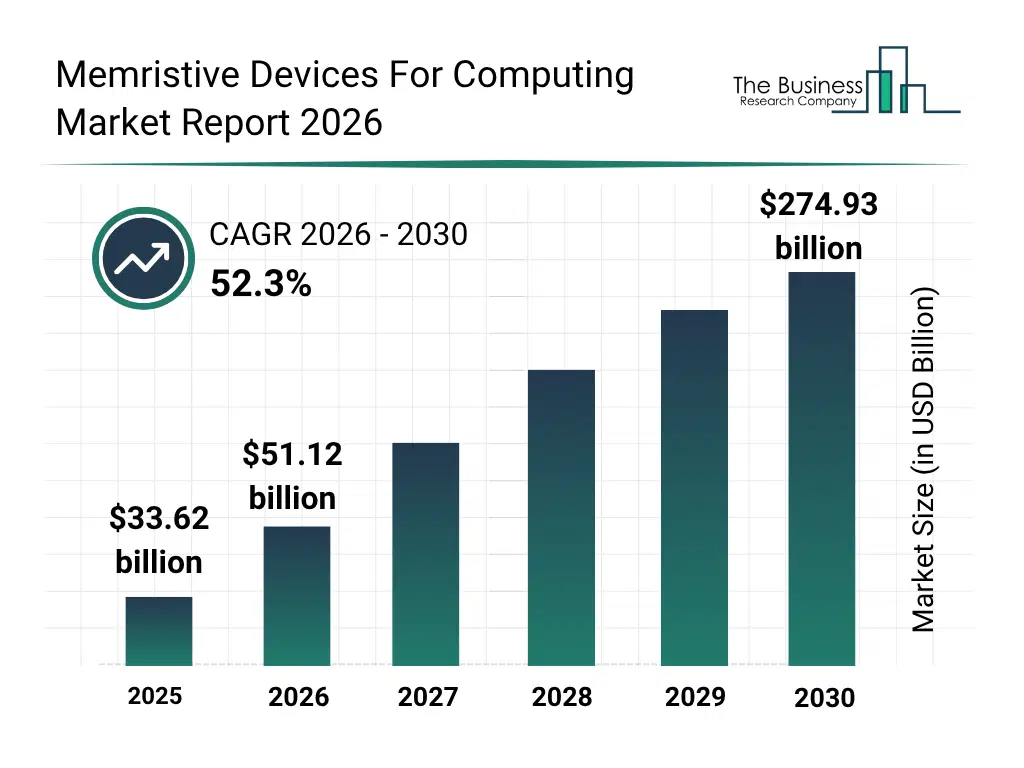
What Is The Memristive Devices For Computing Market Size and Share 2026?
The memristive devices for computing market size has grown exponentially in recent years. It will grow from $33.62 billion in 2025 to $51.12 billion in 2026 at a compound annual growth rate (CAGR) of 52.0%. The growth in the historic period can be attributed to growth in AI and machine learning workloads, increasing limitations of traditional transistor scaling, rising demand for high-speed data processing, expansion of semiconductor R&D investments, growing need for low-power computing solutions.What Is The Memristive Devices For Computing Market Growth Forecast?
The memristive devices for computing market size is expected to see exponential growth in the next few years. It will grow to $274.93 billion in 2030 at a compound annual growth rate (CAGR) of 52.3%. The growth in the forecast period can be attributed to increasing deployment of edge AI devices, growing demand for energy-efficient data centers, rising adoption of autonomous systems computing platforms, expansion of neuromorphic research initiatives, increasing integration of advanced memory technologies in consumer electronics. Major trends in the forecast period include increasing development of In-Memory Computing architectures, rising adoption of neuromorphic computing systems, growing integration of crossbar array modules in AI hardware, expansion of high-density non-volatile memory solutions, rising focus on energy-efficient semiconductor design.Global Memristive Devices For Computing Market Segmentation
1) By Component: Hardware, Software, Services 2) By Device Type: Resistive Random-Access Memory, Spin-Transfer Torque Magnetic Random-Access Memory, Spin-Orbit Torque Magnetic Random-Access Memory, Phase-Change Memory, Ferroelectric Random-Access Memory, Conductive Bridging Random-Access Memory 3) By Material Type: Metal Oxide Based Materials, Two Dimensional Materials, Chalcogenide Materials, Organic Materials 4) By Application: Spiking Neural Networks, Non-Volatile Memory Systems, Programmable Logic And Signal Processing Systems, Artificial Neural Networks, Machine Learning, Neuromorphic Computing Systems 5) By End-User: Consumer Electronics, Information Technology And Telecommunications, Data Centers And Cloud Computing, Automotive And Autonomous Vehicles, Healthcare And Medical Devices, Aerospace And Defense, Industrial Automation And Robotics, Research And Academia Subsegments: 1) By Hardware: Memristor Chips, Crossbar Array Modules, Compute In Memory Processors, Analog Memory Devices, Hybrid Memory Logic Circuits, Neuromorphic Computing Boards 2) By Software: Device Modeling And Simulation Software, Programming And Development Platforms, Data Mapping And Optimization Software, Memory Management Software, Artificial Intelligence Training Software, System Control And Integration Software 3) By Services: Consulting And Design Services, Fabrication And Prototyping Services, System Integration Services, Testing And Validation Services, Maintenance And Support Services, Research And Development ServicesWhat Is The Driver Of The Memristive Devices For Computing Market?
The rising IoT connectivity is expected to propel the growth of the memristive devices for the computing market going forward. IoT connectivity refers to the network infrastructure and communication protocols that enable Internet of Things devices to connect, communicate, and exchange data with each other and cloud-based systems. The growing IoT connectivity is largely driven by the expansion of 5G networks and edge computing infrastructure, as these technologies provide the high-speed, low-latency connections necessary to support billions of interconnected devices across smart cities, industrial automation, and consumer applications. The rising IoT connectivity boosts demand for memristive devices as they offer energy-efficient, high-density memory and neuromorphic computing capabilities essential for processing vast amounts of data generated by connected devices at the edge. For instance, in April 2025, according to Ericsson, a Sweden-based telecommunications company, global IoT connections reached 18.8 billion connections in 2024 and are expected to increase to 43.0 billion connections by 2030. Therefore, rising IoT connectivity is driving the growth of the memristive devices for the computing market.Key Players In The Global Memristive Devices For Computing Market
Major companies operating in the memristive devices for computing market are Samsung Electronics Co. Ltd., Sony Group Corporation, Taiwan Semiconductor Manufacturing Company Limited, International Business Machines Corporation, SK hynix Inc., Panasonic Holdings Corporation, Intel Corporation, Fujitsu Limited, Toshiba Corporation, Infineon Technologies AG, Micron Technology Inc., Renesas Electronics Corporation, GlobalFoundries Inc., United Microelectronics Corporation, Tower Semiconductor Ltd., Everspin Technologies Inc., Avalanche Technology Inc., Aspinity Inc., Crossbar Inc., Weebit Nano Ltd., Knowm Inc., and Nantero Inc.Global Memristive Devices For Computing Market Trends and Insights
Major companies operating in the memristive devices for the computing market are focusing on achieving automotive-grade qualification standards to enhance reliability, endurance, and performance in harsh operating environments. Automotive-grade qualification ensures that memory technologies meet stringent reliability, temperature, and stress requirements necessary for deployment in advanced driver assistance systems (ADAS), edge AI processors, and in-vehicle computing platforms. For instance, in March 2025, Weebit Nano Ltd., an Israel-based semiconductor memory technology company, announced the full qualification of its embedded Resistive Random-Access Memory (ReRAM) module to the AEC-Q100 standard for automotive applications. This qualification confirms that its silicon oxide-based ReRAM technology meets rigorous automotive reliability benchmarks, enabling its integration into automotive microcontrollers and system-on-chip (SoC) devices to support AI-driven edge computing, neuromorphic architectures, and next-generation vehicle electronics.What Are Latest Mergers And Acquisitions In The Memristive Devices For Computing Market?
In February 2023, GlobalFoundries Inc., a US-based semiconductor foundry and fabrication services provider, acquired the conductive bridging random access memory (CBRAM) technology from Renesas Electronics Corporation for an undisclosed amount. Through this acquisition, GlobalFoundries enhanced its embedded non-volatile memory portfolio by adding low-power CBRAM resistive memory technology, enabling improved performance, lower energy consumption, and greater SoC integration flexibility. Renesas Electronics Corporation is a Japan-based semiconductor company specializing in microcontrollers, analog, and power devices, including advanced memory technologies such as resistive RAM.Regional Insights
North America was the largest region in the memristive devices for computing market in 2025. Asia-Pacific is expected to be the fastest-growing region in the forecast period. The regions covered in this market report are Asia-Pacific, South East Asia, Western Europe, Eastern Europe, North America, South America, Middle East, Africa. The countries covered in this market report are Australia, Brazil, China, France, Germany, India, Indonesia, Japan, Taiwan, Russia, South Korea, UK, USA, Canada, Italy, Spain.What Defines the Memristive Devices For Computing Market?
The memristive devices for the computing market consist of sales of neuromorphic crossbar arrays, in-memory computing accelerators, analog AI inference chips, and adaptive synaptic processor modules. Values in this market are ‘factory gate’ values, that is, the value of goods sold by the manufacturers or creators of the goods, whether to other entities (including downstream manufacturers, wholesalers, distributors, and retailers) or directly to end customers. The value of goods in this market includes related services sold by the creators of the goods.How is Market Value Defined and Measured?
The market value is defined as the revenues that enterprises gain from the sale of goods and/or services within the specified market and geography through sales, grants, or donations in terms of the currency (in USD unless otherwise specified). The revenues for a specified geography are consumption values that are revenues generated by organizations in the specified geography within the market, irrespective of where they are produced. It does not include revenues from resales along the supply chain, either further along the supply chain or as part of other products.What Key Data And Analysis Are Included In The Memristive Devices For Computing Market Report 2026?
The memristive devices for computing market research report is one of a series of new reports from The Business Research Company that provides market statistics, including industry global market size, regional shares, competitors with the market share, detailed market segments, market trends and opportunities, and any further data you may need to thrive in the memristive devices for computing industry. The market research report delivers a complete perspective of everything you need, with an in-depth analysis of the current and future state of the industry.Memristive Devices For Computing Market Report Forecast Analysis
| Report Attribute | Details |
|---|---|
| Market Size Value In 2026 | $51.12 billion |
| Revenue Forecast In 2035 | $274.93 billion |
| Growth Rate | CAGR of 52.0% from 2026 to 2035 |
| Base Year For Estimation | 2025 |
| Actual Estimates/Historical Data | 2020-2025 |
| Forecast Period | 2026 - 2030 - 2035 |
| Market Representation | Revenue in USD Billion and CAGR from 2026 to 2035 |
| Segments Covered | Component, Device Type, Material Type, Application, End-User |
| Regional Scope | Asia-Pacific, Western Europe, Eastern Europe, North America, South America, Middle East, Africa |
| Country Scope | The countries covered in the report are Australia, Brazil, China, France, Germany, India, Indonesia, Japan, Taiwan, Russia, South Korea, UK, USA, Canada, Italy, Spain. |
| Key Companies Profiled | Samsung Electronics Co. Ltd., Sony Group Corporation, Taiwan Semiconductor Manufacturing Company Limited, International Business Machines Corporation, SK hynix Inc., Panasonic Holdings Corporation, Intel Corporation, Fujitsu Limited, Toshiba Corporation, Infineon Technologies AG, Micron Technology Inc., Renesas Electronics Corporation, GlobalFoundries Inc., United Microelectronics Corporation, Tower Semiconductor Ltd., Everspin Technologies Inc., Avalanche Technology Inc., Aspinity Inc., Crossbar Inc., Weebit Nano Ltd., Knowm Inc., and Nantero Inc. |
| Customization Scope | Request for Customization |
| Pricing And Purchase Options | Explore Purchase Options |