

Contact Us
  Search
The Business Research Company Logo
Liquid Carbon Dioxide Global Market Opportunities And Strategies To 2035
Published :May 2026
Pages :335
Format :PDF
Delivery Time :2-3 Business Days
Why 2-3 days? We update the report with the latest data and news before delivery. Let us know if you need us to expedite.
Report Price :$4,490.00

Liquid Carbon Dioxide Global Market Opportunities And Strategies To 2035

By Source Of Production (Natural Source, Synthetic Production), By Purity Level (Industrial Grade, Food Grade, Pharmaceutical Grade), By Distribution Channel (Direct Sales, Distributors, Online Sales, Retail), By Application (Food And Beverage Industry, Oil And Gas Industry, Medical And Healthcare, Chemical Manufacturing, Metallurgical Applications), By End-User (Industrial Manufacturing, Food Processing, Healthcare, Agriculture, Research And Development), And By Region, Opportunities And Strategies – Global Forecast To 2035

Liquid Carbon Dioxide Market Definition

Liquid carbon dioxide refers to carbon dioxide (CO₂) that has been pressurized and cooled below its critical temperature to exist in a liquid state. It is typically stored in insulated pressure vessels or cryogenic cylinders at temperatures around −56.6°C and pressures above 5.18 atmospheres. Liquid CO₂ is a versatile industrial commodity valued for its high purity, chemical inertness, and broad range of physical properties that make it suitable for applications requiring cooling, freezing, carbonation, chemical processing, and pressurized delivery. The liquid carbon dioxide market consists of revenues generated from the sale of liquid CO₂ by entities (organizations, sole traders, or partnerships) to industrial, food and beverage, medical, agricultural, and research end-users. The market is segmented by source of production into natural source and synthetic production; by purity level into industrial grade, food grade and pharmaceutical grade; by distribution channel into direct sales, distributors, online sales and retail; by application into food and beverage industry, oil and gas industry, medical and healthcare, chemical manufacturing and metallurgical applications; and by end-user into industrial manufacturing, food processing, healthcare, agriculture and research and development. Liquid carbon dioxide products are distributed across all major global regions including Asia-Pacific, Western Europe, Eastern Europe, North America, South America, the Middle East and Africa.
Research Expert

Book your 30 minutes free consultation with our research experts

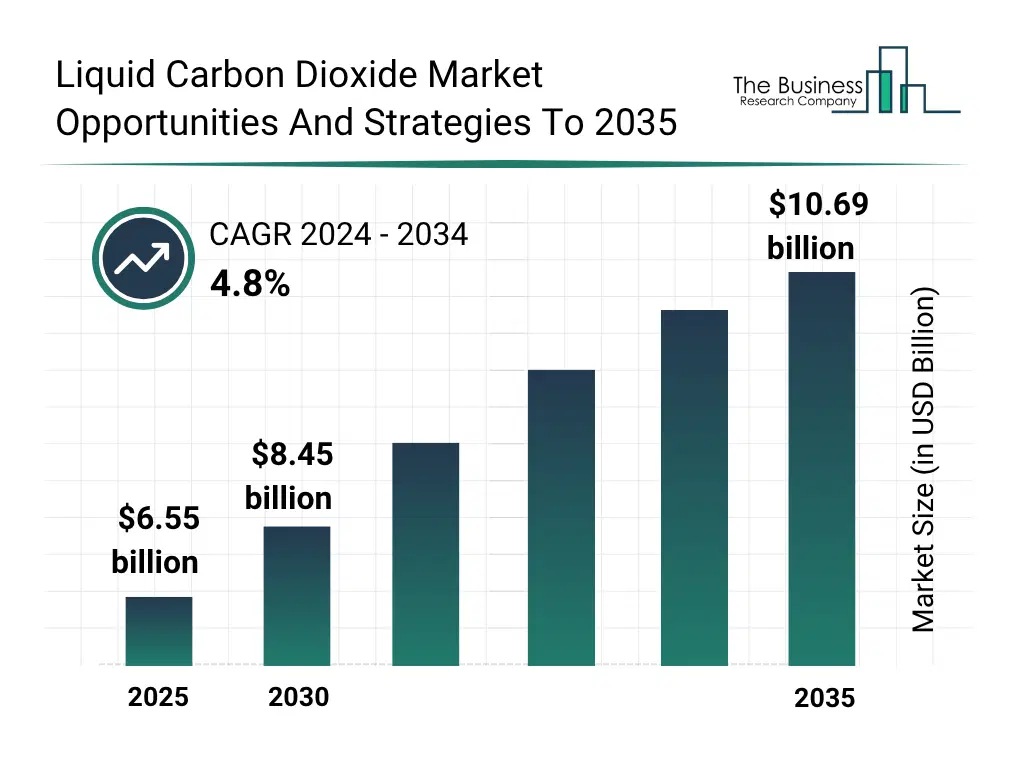
Liquid Carbon Dioxide Global Market Opportunities And Strategies To 2035 Market Size and growth rate 2025 to 2030: Graph

Liquid Carbon Dioxide Market Size

The global liquid carbon dioxide market reached a value of nearly $6,545.1 million in 2025, having grown at a compound annual growth rate (CAGR) of 6.7% since 2020. The market is expected to grow from $6,545.1 million in 2025 to $8,454.0 million in 2030 at a rate of 5.3%. The market is then expected to grow at a CAGR of 4.8% from 2030 and reach $10,686.9 million in 2035. Growth in the historic period resulted from increasing demand in food and beverage industry, expansion of medical, pharmaceutical, and life-science applications, rising investments in industrial gas infrastructure and bulk storage facilities and increasing industrial uses and enhanced oil recovery (EOR). Factors that negatively affected growth in the historic period were limited refrigerated storage capacity and stringent safety and handling regulations. Going forward, integration of carbon capture, utilization, and storage (CCUS) infrastructure, expansion in chemical industry applications, growth of cold-chain and refrigeration logistics and expansion of industrial gas distribution networks will drive growth. Factors that could hinder the growth of the liquid carbon dioxide market in the future include supply dependence on by-product CO₂ sources, high transportation and logistics costs and trade war and tariffs.

Liquid Carbon Dioxide Market Segmentation

The liquid carbon dioxide market is segmented by source of production, by purity level, by distribution channel, by application and by end-user.

By Type –
The liquid carbon dioxide market is segmented by source of production into into:
    • a) Natural Source
    • b) Synthetic Production
The synthetic production market was the largest segment of the liquid carbon dioxide market segmented by source of production, accounting for 88.9% or $5,820.0 million of the total in 2025. Going forward, the synthetic production segment is expected to be the fastest growing segment in the liquid carbon dioxide market segmented by source of production, at a CAGR of 5.7% during 2025-2030.

By Purity Level –
The liquid carbon dioxide market is segmented by purity level into:
    • a) Industrial Grade
    • b) Food Grade
    • c) Pharmaceutical Grade
The food grade market was the largest segment of the liquid carbon dioxide market segmented by purity level, accounting for 44.3% or $2,900.2 million of the total in 2025. Going forward, the pharmaceutical grade segment is expected to be the fastest growing segment in the liquid carbon dioxide market segmented by purity level, at a CAGR of 6.3% during 2025-2030.

By Distribution Channel –
The liquid carbon dioxide market is segmented by distribution channel into:
    • a) Direct Sales
    • b) Distributors
    • c) Online Sales
    • d) Retail
The direct sales market was the largest segment of the liquid carbon dioxide market segmented by distribution channel, accounting for 60.0% or $3,928.2 million of the total in 2025. Going forward, the online sales segment is expected to be the fastest growing segment in the liquid carbon dioxide market segmented by distribution channel, at a CAGR of 14.1% during 2025-2030.

By Application –
The liquid carbon dioxide market is segmented by application into:
  1. a) Food And Beverage Industry
  2. b) Oil And Gas Industry
  3. c) Medical And Healthcare
  4. d) Chemical Manufacturing
  5. e) Metallurgical Applications
The food and beverage industry market was the largest segment of the liquid carbon dioxide market segmented by application, accounting for 31.2% or $1,927.6 million of the total in 2025. Going forward, the medical and healthcare segment is expected to be the fastest growing segment in the liquid carbon dioxide market segmented by application, at a CAGR of 5.9% during 2025-2030.

By End-User –
The liquid carbon dioxide market is segmented by end-user into:
  1. a) Industrial Manufacturing
  2. b) Food Processing
  3. c) Healthcare
  4. d) Agriculture
  5. e) Research And Development
The industrial manufacturing market was the largest segment of the liquid carbon dioxide market segmented by end-user, accounting for 42.9% or $2,652.1 million of the total in 2025. Going forward, the healthcare segment is expected to be the fastest growing segment in the liquid carbon dioxide market segmented by end-user, at a CAGR of 9.6% during 2025-2030.

By Geography - The liquid carbon dioxide market is segmented by geography into:
      o Asia Pacific
      • • China
      • • India
      • • Japan
      • • Australia
      • • Indonesia
      • • South Korea
      o North America
      • • USA
      • • Canada
      o South America
      • • Brazil
      o Western Europe
      • • France
      • • Germany
      • • UK
      • • Italy
      • • Spain
      o Eastern Europe
      • • Russia
      o Middle East
      o Africa
Asia Pacific was the largest region in the liquid carbon dioxide market, accounting for 45.1% or $2,948.6 million of the total in 2025. It was followed by North America, Western Europe and then the other regions. Going forward, the fastest-growing regions in the liquid carbon dioxide market will be Asia Pacific and Eastern Europe where growth will be at CAGRs of 6.9% and 5.6% respectively. These will be followed by Middle East and Africa where the markets are expected to grow at CAGRs of 5.1% and 4.7% respectively.

Liquid Carbon Dioxide Market Drivers

The key drivers of the liquid carbon dioxide market include: Integration Of Carbon Capture, Utilization, And Storage (CCUS) Infrastructure Integration of carbon capture, utilization, and storage (CCUS) infrastructure is expected to be a key driver of the growth of the liquid carbon dioxide market in the forecast period. The expansion of large-scale carbon capture, utilization, and storage systems increases the volume of captured CO₂ that must be conditioned, purified, and converted into liquid form for transport, storage, or downstream use. Liquefaction enables efficient handling of CO₂ over long distances, especially where pipelines are not viable, supporting cross-border movement and centralized storage solutions. Captured CO₂ also creates new supply streams for food, industrial, and chemical applications once appropriately processed. As capture projects scale up, demand rises for reliable liquefaction, storage, and logistics infrastructure, strengthening the role of liquid CO₂ across industrial value chains. The integration of carbon capture, utilization, and storage (CCUS) infrastructure growth contribution during the forecast period in 2025 is 1.5%.

Liquid Carbon Dioxide Market Restraints

The key restraints on the liquid carbon dioxide market include: Supply Dependence On By-Product CO₂ Sources Supply dependence on by-product CO₂ sources is restricting the growth of the liquid carbon dioxide market during the forecast period. Reliance on by-product CO₂ generated from ammonia, ethanol, and hydrogen plants creates supply constraints due to fluctuations in operating rates and unplanned shutdowns at these facilities. When primary host plants reduce output or undergo maintenance, the availability of recoverable CO₂ declines sharply, leading to shortages and price volatility. This dependence limits supply stability and reduces flexibility in meeting demand peaks across food, industrial, and medical applications. It also restricts expansion into new regions where suitable host facilities are absent, increasing logistical complexity and supply risk. Growth affected by supply dependence on by-product CO₂ sources during the forecast period in 2025 is -2.0%.

Liquid Carbon Dioxide Market Competitive Landscape

Major Competitors are:

  • Linde plc
  • Air Products and Chemicals, Inc.
  • Air Liquide SA
  • Nippon Sanso Holdings Corporation (Matheson Tri-Gas, Inc., Taiyo Nippon Sanso Corporation)
  • Messer Group GmbH
  • Other Competitors Include:

  • SOL SpA
  • India Glycols Limited
  • Iwatani Corporation
  • Continental Carbonic Products Inc.
  • Westfalen AG
  • Chongqing Tonghui Gas Co. Ltd.
  • Wuxi Yuantong Gas Co. Ltd.
  • Jinhong Gas Co. Ltd.
  • Qingdao Hyperion Special Gas Co. Ltd.
  • Shandong Yizhong Industrial Co. Ltd.
  • Osaka Gas Liquid Co. Ltd.
  • Air Water Inc.
  • Nagaoka Carbonic Co. Ltd.
  • KOREA LIQUID CARBONIC CHEMICAL CO. LTD.
  • Air Liquide Korea Co. Ltd.
  • Linde Korea Co. Ltd.
  • Coregas Pty Ltd.
  • Advanced Carbonic
  • Aurangabad Carbon Products (ACPPL)
  • PT Molindo Inti Gas
  • Air Liquide Deutschland GmbH
  • Nippon Gases
  • Heidelberg Materials
  • PKN Orlen
  • Saint-Gobain Romania
  • OMV Petrom (Romania)
  • LLC SELVI
  • Arctic Gas Company
  • Air Liquide LLC
  • ACP Polska
  • Petrogas SRL
  • Messer Romania Gaz SRL
  • GTH Gaze Industriale SA
  • Matheson Tri-Gas Inc.
  • Ferus Inc.
  • Air Liquide Canada
  • Linde Canada Inc.
  • Messer Canada
  • White Martins
  • Messer SE & Co. KGaA
  • Gulf Cryo
  • Gulf Industrial Gases Company (GIGC)
  • Arabian Industrial Gases Co. LLC
  • Air Liquide
  • Sasol
  • Afrox
  • Carbacid (CO₂) Limited
  • Sino Africa Gases
  • Industrial & Medical Gases Nigeria Plc
  • Need data on a specific region in this market?

    Opportunities And Recommendations In The Liquid Carbon Dioxide Market

    Opportunities – The top opportunities in the liquid carbon dioxide market segmented by source of production will arise in the synthetic production segment, which will gain $1,854.5 million of global annual sales by 2030. The top opportunities in the liquid carbon dioxide market segmented by purity level will arise in the food grade segment, which will gain $932.5 million of global annual sales by 2030. The top opportunities in the liquid carbon dioxide market segmented by distribution channel will arise in the direct sales segment, which will gain $1,005.9 million of global annual sales by 2030. The top opportunities in the liquid carbon dioxide market segmented by application will arise in the food and beverage industry segment, which will gain $624.9 million of global annual sales by 2030. The top opportunities in the liquid carbon dioxide market segmented by end-user will arise in the food processing segment, which will gain $779.7 million of global annual sales by 2030. The liquid carbon dioxide market size will gain the most in China at $643.0 million. Recommendations- To take advantage of the opportunities, The Business Research Company recommends the liquid carbon dioxide companies to focus on regional capacity expansion and local supply networks, focus on cross-border CO₂ transport infrastructure development, focus on energy-efficient CO₂ purification and liquefaction, focus on advanced liquid CO₂ transportation infrastructure, focus on scaling energy efficient CO₂ liquefaction for carbon capture integration, focus on synthetic production segment expansion, focus on pharmaceutical grade segment expansion, expand in emerging markets, continue to focus on developed markets, focus on expanding regional distribution networks, focus on structured and demand-aligned pricing strategies, build value-centric and education-driven promotion, expand digital and distributor-led promotion for growth segments, focus on skilled workforce alignment for medical and healthcare needs.
    Chat with us