
Internet Of Things (IoT)-Powered Virtual Hospitals And Telemedicine 2.0 Market Report 2026
Global Outlook – By Component (Hardware, Software, Services), By Technology (Internet Of Things (IoT) Devices And Sensors, Telemedicine Platform), By Deployment (Cloud-Based, On-Premises, Hybrid), By Application (Chronic Disease Management, Emergency Care And Triage, Mental Health Services, Post Surgery Monitoring, Elderly Care And Assisted Living), By End User (Healthcare Provider Organizations, Public Health And Government Agencies, Health Insurance Payers, Home Care And Individual Patients) – Market Size, Trends, Strategies, and Forecast to 2035
Internet Of Things (IoT)-Powered Virtual Hospitals And Telemedicine 2.0 Market Overview
• Internet Of Things (IoT)-Powered Virtual Hospitals And Telemedicine 2.0 market size has reached to $134.94 billion in 2025 • Expected to grow to $332.57 billion in 2030 at a compound annual growth rate (CAGR) of 19.8% • Growth Driver: Growing Demand For Remote Patient Monitoring Is Driving The Market Growth Due To Rising Prevalence Of Chronic Diseases • Market Trend: Transformative IoT And AI-Driven Solutions Revolutionizing Remote Patient Monitoring, Virtual Care, And Telemedicine Delivery • North America was the largest region in 2025 and Asia-Pacific is the fastest growing region.
What Is Covered Under Internet Of Things (IoT)-Powered Virtual Hospitals And Telemedicine 2.0 Market?
Internet of Things (IoT)-powered virtual hospitals and telemedicine 2.0 refer to an advanced digital healthcare ecosystem where interconnected medical devices, wearable sensors, and smart systems continuously collect and transmit real-time patient data over the internet. It integrates remote monitoring, AI-driven diagnostics, and automated clinical workflows to deliver hospital-level care beyond traditional physical facilities. The main components of internet of things-powered virtual hospitals and telemedicine 2.0 include hardware, software, and services. Hardware includes connected devices and sensors used to monitor patient health and enable real-time telemedicine interactions. These solutions incorporate technologies such as internet of things devices and sensors and telemedicine platforms and are deployed through cloud-based, on-premises, and hybrid models. They find application in chronic disease management, emergency care and triage, mental health services, post surgery monitoring, elderly care and assisted living, serving end users including healthcare provider organizations, public health and government agencies, health insurance payers, and home care and individual patients.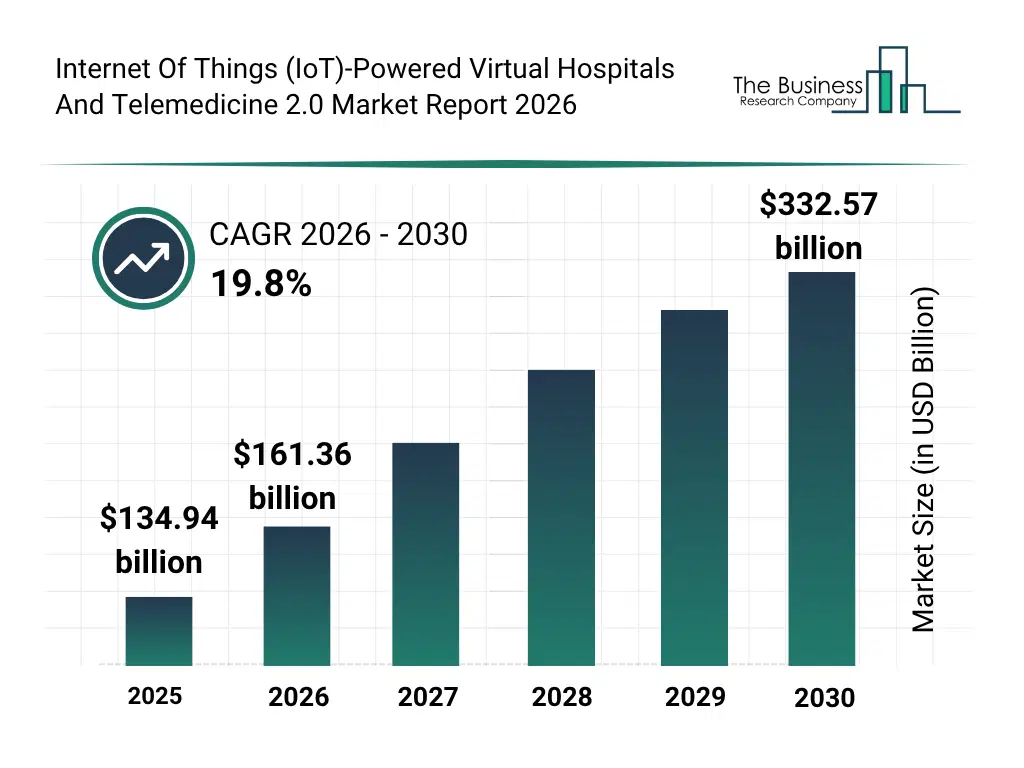
What Is The Internet Of Things (IoT)-Powered Virtual Hospitals And Telemedicine 2.0 Market Size and Share 2026?
The internet of things (IoT)-powered virtual hospitals and telemedicine 2.0 market size has grown rapidly in recent years. It will grow from $134.94 billion in 2025 to $161.36 billion in 2026 at a compound annual growth rate (CAGR) of 19.6%. 0 market size has grown rapidly in recent years. It will grow from $4.55 billion in 2025 to $5.36 billion in 2026 at a compound annual growth rate (CAGR) of 17.6%. The growth in the historic period can be attributed to growing demand for remote healthcare services, rising prevalence of chronic diseases, increasing internet penetration in healthcare, expansion of telemedicine platforms, demand for cost-effective care delivery.What Is The Internet Of Things (IoT)-Powered Virtual Hospitals And Telemedicine 2.0 Market Growth Forecast?
The internet of things (IoT)-powered virtual hospitals and telemedicine 2.0 market size is expected to see rapid growth in the next few years. It will grow to $332.57 billion in 2030 at a compound annual growth rate (CAGR) of 19.8%. 0 market size is expected to see rapid growth in the next few years. The growth in the forecast period can be attributed to increasing adoption of AI-driven diagnostics, growing use of cloud-based healthcare infrastructure, rising elderly population, expansion of connected medical devices, increasing focus on personalized and preventive healthcare. Major trends in the forecast period include expansion of hospital-at-home care models, rising adoption of continuous remote patient monitoring, integration of virtual intensive care units (tele-icu), growth in digital chronic disease management programs, increasing deployment of smart wearable health devices.Global Internet Of Things (IoT)-Powered Virtual Hospitals And Telemedicine 2.0 Market Segmentation
1) By Component: Hardware, Software, Services 2) By Technology: Internet Of Things (IoT) Devices And Sensors, Telemedicine Platform 3) By Deployment: Cloud-Based, On-Premises, Hybrid 4) By Application: Chronic Disease Management, Emergency Care And Triage, Mental Health Services, Post Surgery Monitoring, Elderly Care And Assisted Living 5) By End User: Healthcare Provider Organizations, Public Health And Government Agencies, Health Insurance Payers, Home Care And Individual Patients Subsegments: 1) By Hardware: Remote Patient Monitoring Devices, Wearable Health Monitoring Devices, Medical Sensors And Biosensors, Connected Diagnostic Devices, Home Care Medical Equipment, Smart Medical Imaging Devices 2) By Software: Virtual Care Platform Software, Clinical Decision Support Software, Remote Monitoring And Data Analytics Software, Electronic Health Record Integration Software, Telemedicine Management Software, Artificial Intelligence Enabled Care Coordination Software 3) By Services: Virtual Clinical Consultation Services, Remote Patient Monitoring Services, Tele Intensive Care Unit Services, Virtual Ward And Hospital At Home Services, Tele Pharmacy And Medication Management Services, Technical Support And System Integration ServicesWhat Is The Driver Of The Internet Of Things (IoT)-Powered Virtual Hospitals And Telemedicine 2.0 Market?
The growing demand for remote patient monitoring is expected to propel the growth of the internet of things (IoT)-powered virtual hospitals and telemedicine 2.0 market going forward. Remote patient monitoring refers to the use of connected digital devices to collect and transmit patients’ physiological health data from home or non-clinical settings to healthcare providers for continuous monitoring and timely medical intervention. The demand for remote patient monitoring is increasing due to the rising prevalence of chronic diseases, as patients with long-term conditions require continuous oversight and timely medical intervention that cannot be effectively managed through occasional in-person visits alone. IoT-powered virtual hospitals and Telemedicine 2.0 enhance remote patient monitoring by connecting smart devices, real-time data systems, and virtual care platforms to enable continuous patient monitoring and timely medical intervention outside traditional hospital settings. For instance, in August 2025, according to the Office of Inspector General (OIG), a US-based independent organization, the number of Medicare beneficiaries using remote patient monitoring increased significantly, reaching nearly 1 million in 2024, representing a 27% rise compared to 2023. Therefore, the growing demand for remote patient monitoring is driving the growth of the internet of things (IoT)-powered virtual hospitals and telemedicine 2.0 industry.Key Players In The Global Internet Of Things (IoT)-Powered Virtual Hospitals And Telemedicine 2.0 Market
Major companies operating in the internet of things (IoT)-powered virtual hospitals and telemedicine 2.0 market are F. Hoffmann-La Roche AG, Medtronic plc, Koninklijke Philips N.V., GE HealthCare Technologies Inc., Omron Healthcare Co. Ltd., Teladoc Health Inc., Advantech Co. Ltd., Oura Health Oy, Digi International Inc., TMA Solutions, American Well Corporation, Biofourmis Inc., HealthSnap Inc., Viz.ai Inc., AMC Health Inc., Accuhealth Technologies LLC, Mend VIP Inc., Heidi Health Pty Ltd, GlobalMedia Group LLC, CareSimple Inc., and NuraLogix Corporation.Global Internet Of Things (IoT)-Powered Virtual Hospitals And Telemedicine 2.0 Market Trends and Insights
Major companies operating in the internet of things (IoT)-powered virtual hospitals and telemedicine 2.0 market are focusing on developing innovative solutions such as artificial intelligence (AI)-driven remote patient management systems to enable continuous patient monitoring, improve care outcomes, and reduce hospital readmissions. Artificial intelligence (AI)-driven remote patient management systems are platforms that use AI algorithms to continuously collect, analyze, and interpret patient health data from IoT devices and wearables, helping healthcare providers detect early warning signs, personalize treatment plans, and proactively manage patient care, all without requiring in-person visits. For instance, in February 2025, Validic Inc., a US-based healthcare technology company, launched the Validic Inform Health IoT platform and Remote Patient Management solutions powered by generative AI, available through AWS Marketplace. It connects hundreds of personal health data sources, streaming real-world data into client applications for comprehensive patient engagement, while the Remote Patient Management solutions leverage AI to generate actionable insights, detect trends, and streamline clinician workflows. Together, these solutions integrate logistics and patient service desk support for device provisioning and onboarding, enabling healthcare providers to deliver continuous, personalized care across multiple clinical programs without relying on fragmented point solutions.What Are Latest Mergers And Acquisitions In The Internet Of Things (IoT)-Powered Virtual Hospitals And Telemedicine 2.0 Market?
In May 2023, Doccla Ltd., a UK-based digital health company that offers virtual ward and virtual care solutions, partnered with AliveCor Inc. and University Hospitals Coventry & Warwickshire (UHCW) NHS Trust to provide virtual ward monitoring for patients with atrial fibrillation (AF). With this partnership, Doccla Ltd., AliveCor, Inc., and UHCW aim to remotely track vital signs, ECG data, activity, and symptoms of AF patients using Doccla’s platform and AliveCor’s smartphone-linked ECG devices, improving early assessment, prioritization of care, and reducing hospital readmissions. AliveCor Inc. is a US-based company specializing in providing remote cardiac monitoring solutions, and University Hospitals Coventry & Warwickshire (UHCW) is a UK-based hospital that specializes in providing cardiac care and patient management programs.Regional Insights
North America was the largest region in the internet of things (IoT)-powered virtual hospitals and telemedicine 2.0 market in 2025. Asia-Pacific is expected to be the fastest-growing region in the forecast period. The regions covered in this market report are Asia-Pacific, South East Asia, Western Europe, Eastern Europe, North America, South America, Middle East, Africa. The countries covered in this market report are Australia, Brazil, China, France, Germany, India, Indonesia, Japan, Taiwan, Russia, South Korea, UK, USA, Canada, Italy, Spain.What Defines the Internet Of Things (IoT)-Powered Virtual Hospitals And Telemedicine 2.0 Market?
The internet of things (IoT)-powered virtual hospitals and telemedicine 2.0 market consists of revenues earned by entities by providing services such as remote patient monitoring, virtual consultations, clinical decision support, connected device management, healthcare data integration, analytics, artificial intelligence-enabled diagnostics, cybersecurity, and cloud-based care platforms. The market value includes the value of related goods sold by the service provider or included within the service offering. The internet of things (IoT)-powered virtual hospitals and telemedicine 2.0 market also includes sales of connected medical devices, wearable health sensors, remote diagnostic equipment, telemedicine software platforms, interoperability middleware, and healthcare internet of things gateways. Values in this market are ‘factory gate’ values, that is, the value of goods sold by the manufacturers or creators of the goods, whether to other entities (including downstream manufacturers, wholesalers, distributors, and retailers) or directly to end customers. The value of goods in this market includes related services sold by the creators of the goods.How is Market Value Defined and Measured?
The market value is defined as the revenues that enterprises gain from the sale of goods and/or services within the specified market and geography through sales, grants, or donations in terms of the currency (in USD unless otherwise specified). The revenues for a specified geography are consumption values that are revenues generated by organizations in the specified geography within the market, irrespective of where they are produced. It does not include revenues from resales along the supply chain, either further along the supply chain or as part of other products.What Key Data And Analysis Are Included In The Internet Of Things (IoT)-Powered Virtual Hospitals And Telemedicine 2.0 Market Report 2026?
The internet of things (iot)-powered virtual hospitals and telemedicine 2.0 market research report is one of a series of new reports from The Business Research Company that provides market statistics, including industry global market size, regional shares, competitors with the market share, detailed market segments, market trends and opportunities, and any further data you may need to thrive in the internet of things (iot)-powered virtual hospitals and telemedicine 2.0 industry. The market research report delivers a complete perspective of everything you need, with an in-depth analysis of the current and future state of the industry.Internet Of Things (IoT)-Powered Virtual Hospitals And Telemedicine 2.0 Market Report Forecast Analysis
| Report Attribute | Details |
|---|---|
| Market Size Value In 2026 | $161.36 billion |
| Revenue Forecast In 2035 | $332.57 billion |
| Growth Rate | CAGR of 19.6% from 2026 to 2035 |
| Base Year For Estimation | 2025 |
| Actual Estimates/Historical Data | 2020-2025 |
| Forecast Period | 2026 - 2030 - 2035 |
| Market Representation | Revenue in USD Billion and CAGR from 2026 to 2035 |
| Segments Covered | Component, Technology, Deployment, Application, End User |
| Regional Scope | Asia-Pacific, Western Europe, Eastern Europe, North America, South America, Middle East, Africa |
| Country Scope | The countries covered in the report are Australia, Brazil, China, France, Germany, India, Indonesia, Japan, Taiwan, Russia, South Korea, UK, USA, Canada, Italy, Spain. |
| Key Companies Profiled | F. Hoffmann-La Roche AG, Medtronic plc, Koninklijke Philips N.V., GE HealthCare Technologies Inc., Omron Healthcare Co. Ltd., Teladoc Health Inc., Advantech Co. Ltd., Oura Health Oy, Digi International Inc., TMA Solutions, American Well Corporation, Biofourmis Inc., HealthSnap Inc., Viz.ai Inc., AMC Health Inc., Accuhealth Technologies LLC, Mend VIP Inc., Heidi Health Pty Ltd, GlobalMedia Group LLC, CareSimple Inc., and NuraLogix Corporation. |
| Customization Scope | Request for Customization |
| Pricing And Purchase Options | Explore Purchase Options |