
Hydrogen Refueling Station Construction Market Report 2026
Global Outlook – By Solution (Engineering Procurement And Construction, Components And Equipment), By Station Type (Fixed Or Stationary Stations, Mobile Or Relocatable Stations), By Station Size (Small Scale Stations, Medium Scale Stations, Large Scale Stations), By Fueling Type (Fast Refueling Stations, Standard Refueling Stations, On-Site Generation Stations), By End-Use (Transportation, Light-duty Vehicles, Heavy-duty Vehicles, Public Transportation, Industrial Applications, Backup Power Systems, Material Handling Equipment) – Market Size, Trends, Strategies, and Forecast to 2035
Hydrogen Refueling Station Construction Market Overview
• Hydrogen Refueling Station Construction market size has reached to $0.9 billion in 2025 • Expected to grow to $1.95 billion in 2030 at a compound annual growth rate (CAGR) of 16.7% • Growth Driver: Rising Adoption Of Fuel Cell Electric Vehicles Driving The Market Growth Due To Expanding Hydrogen Refueling Infrastructure Demand • Market Trend: Expansion Of Green Hydrogen Infrastructure Accelerates Development Of Hydrogen Refuelling Stations For Clean Mobility • North America was the largest region in 2025 and Asia-Pacific is the fastest growing region.
What Is Covered Under Hydrogen Refueling Station Construction Market?
Hydrogen refueling station construction refers to the development and installation of infrastructure facilities designed to store, compress, and dispense hydrogen fuel for fuel cell vehicles. These solutions typically involve the integration of hydrogen production or supply systems, storage tanks, compression units, dispensing equipment, safety systems, and monitoring technologies to ensure efficient and safe hydrogen fueling operations. They are commonly used to support the expansion of hydrogen mobility networks and enable the transition toward low-emission transportation systems. The main solutions of hydrogen refueling station construction are engineering procurement and construction and components and equipment. Engineering procurement and construction solutions are specialized offerings designed to deliver fully integrated hydrogen refueling stations, ensuring safety, efficiency, and compliance with industry standards. The different station types include fixed or stationary stations and mobile or relocatable stations, and multiple station sizes include small scale stations, medium scale stations, and large scale stations, used by various fueling types including fast refueling stations, standard refueling stations, and on-site generation stations, and they are used by several end users such as transportation, light-duty vehicles, heavy-duty vehicles, public transportation, industrial applications, backup power systems, and material handling equipment.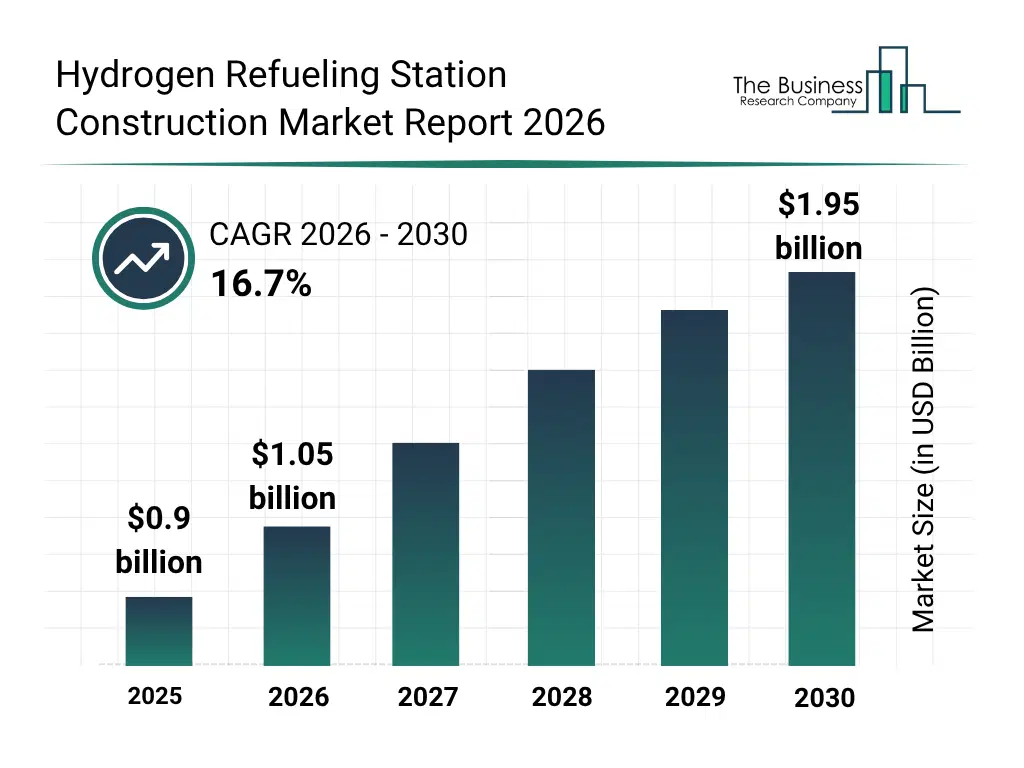
What Is The Hydrogen Refueling Station Construction Market Size and Share 2026?
The hydrogen refueling station construction market size has grown rapidly in recent years. It will grow from $0.9 billion in 2025 to $1.05 billion in 2026 at a compound annual growth rate (CAGR) of 16.5%. The growth in the historic period can be attributed to growing fuel cell vehicle adoption, government incentives for hydrogen infrastructure, rising global demand for low-emission transportation, technological advancements in hydrogen storage, early investment in pilot hydrogen stations.What Is The Hydrogen Refueling Station Construction Market Growth Forecast?
The hydrogen refueling station construction market size is expected to see rapid growth in the next few years. It will grow to $1.95 billion by 2030 at a compound annual growth rate (CAGR) of 16.7%. The growth in the forecast period can be attributed to expansion of hydrogen mobility networks, increasing demand for fast and efficient refueling solutions, integration of smart infrastructure and IoT systems, growth in public and private funding for hydrogen projects, advancements in hydrogen compression and dispensing technologies. Major trends in the forecast period include expansion of hydrogen refueling infrastructure networks, integration of on-site hydrogen generation systems, adoption of fast refueling technologies, implementation of advanced safety and monitoring systems, rising investments in large-scale hydrogen stations.Global Hydrogen Refueling Station Construction Market Segmentation
1) By Solution: Engineering Procurement And Construction, Components And Equipment 2) By Station Type: Fixed Or Stationary Stations, Mobile Or Relocatable Stations 3) By Station Size: Small Scale Stations, Medium Scale Stations, Large Scale Stations 4) By Fueling Type: Fast Refueling Stations, Standard Refueling Stations, On-Site Generation Stations 5) By End-Use: Transportation, Light-duty Vehicles, Heavy-duty Vehicles, Public Transportation, Industrial Applications, Backup Power Systems, Material Handling Equipment Subsegments: 1) By Engineering Procurement And Construction: Design And Planning Services, Site Preparation Services, Civil Construction Services, Electrical Installation Services, Mechanical Installation Services, System Integration Services, Commissioning And Testing Services, Maintenance And Support Services 2) By Components And Equipment: Hydrogen Storage Tanks, Hydrogen Compressors, Hydrogen Dispensers, Hydrogen Cooling Systems, Hydrogen Pumps, Hydrogen Valves And Regulators, Hydrogen Sensors And Safety Systems, Piping And Tubing Systems, Control And Monitoring SystemsWhat Is The Driver Of The Hydrogen Refueling Station Construction Market?
The rising adoption of fuel cell electric vehicles (FCEVs) is expected to propel the growth of the hydrogen refueling station construction market going forward. Fuel cell electric vehicles are zero-emission vehicles powered by hydrogen fuel cells that convert hydrogen gas into electricity, emitting only water vapor as a byproduct. The growing adoption of FCEVs is largely driven by stringent global emission regulations and government-backed decarbonization targets, as nations across developed economies mandate rapid transitions away from fossil-fuel-powered transportation. The increasing deployment of FCEVs directly elevates the need for supporting refueling infrastructure, compelling governments and private operators to accelerate the construction of new hydrogen stations to ensure adequate coverage for growing vehicle fleets. For instance, according to the ANNUAL REPORT 2023 published by the International Energy Agency, a France-based intergovernmental organization, by the end of 2023, the global stock of fuel cell electric vehicles (FCEVs) reached 87,600 units, representing a 20% increase compared to the previous year. Therefore, the rising adoption of fuel cell electric vehicles is driving the growth of the hydrogen refueling station construction industry.Key Players In The Global Hydrogen Refueling Station Construction Market
Major companies operating in the hydrogen refueling station construction market are Shell plc, TotalEnergies SE, Hyundai Engineering & Construction Co Ltd, Cummins Inc, Linde plc, L Air Liquide SA, Tokyo Gas Co Ltd, Kawasaki Heavy Industries Ltd, Air Products and Chemicals Inc, Chart Industries Inc, Plug Power Inc, Hexagon Purus ASA, Nel ASA, Enapter AG, Hydrogen Refueling Solutions SA, McPhy Energy SA, Everfuel AS, ITM Power plc, FirstElement Fuel Inc, H2 MOBILITY Deutschland GmbH & Co KG.Global Hydrogen Refueling Station Construction Market Trends and Insights
Major companies operating in the hydrogen refueling station construction market are focusing on developing advanced green hydrogen infrastructure to support zero-emission transportation and accelerate the adoption of hydrogen-powered vehicles. Green hydrogen infrastructure refers to the integrated network of facilities and technologies used to produce, store, transport, and distribute hydrogen generated from renewable energy sources for large-scale industrial and transportation use. For instance, in June 2025, Viva Energy, an Australia-based energy infrastructure company, opened Australia’s first publicly accessible renewable hydrogen refueling station at its Energy Hub in Geelong, Victoria. The facility integrates a 2.5-megawatt electrolyzer that produces green hydrogen using renewable electricity and recycled water, enabling the refueling of hydrogen-powered trucks, buses, and other heavy vehicles. It is designed to dispense up to 300 kilograms of hydrogen in under two hours. The station supports multiple vehicles consecutively and represents a major step toward decarbonizing heavy transport while advancing hydrogen infrastructure deployment in Australia.What Are Latest Mergers And Acquisitions In The Hydrogen Refueling Station Construction Market?
In January 2025, Toyota Motor Europe, a Belgium-based automotive manufacturer, partnered with Hydrogen Refueling Solutions (HRS) and ENGIE to develop a fast and cost-efficient hydrogen refueling infrastructure across Europe. Through this partnership, the companies aim to accelerate the deployment of hydrogen refueling stations by combining Toyota’s hydrogen mobility expertise with HRS’s hydrogen station manufacturing capabilities and ENGIE’s energy infrastructure development experience. Hydrogen Refueling Solutions is a France-based company specializing in the design and manufacturing of hydrogen refueling stations, while ENGIE is a France-based energy company focused on low-carbon energy and infrastructure solutions.Regional Insights
North America was the largest region in the hydrogen refueling station construction market in 2025. Asia-Pacific is expected to be the fastest-growing region in the forecast period. The regions covered in this market report are Asia-Pacific, South East Asia, Western Europe, Eastern Europe, North America, South America, Middle East, Africa. The countries covered in this market report are Australia, Brazil, China, France, Germany, India, Indonesia, Japan, Taiwan, Russia, South Korea, UK, USA, Canada, Italy, Spain.What Defines the Hydrogen Refueling Station Construction Market?
The hydrogen refueling station construction market consists of revenues earned by entities by providing services such as site feasibility assessment and permitting support, hydrogen compression and storage system installation, dispenser calibration and commissioning services, and remote monitoring and maintenance services. The market value includes the value of related goods sold by the service provider or included within the service offering. The hydrogen refueling station construction market also includes sales of hydrogen compressors, high-pressure hydrogen storage tanks, hydrogen dispensers, and cooling and pre-cooling systems. Values in this market are ‘factory gate’ values, that is, the value of goods sold by the manufacturers or creators of the goods, whether to other entities (including downstream manufacturers, wholesalers, distributors, and retailers) or directly to end customers. The value of goods in this market includes related services sold by the creators of the goods.How is Market Value Defined and Measured?
The market value is defined as the revenues that enterprises gain from the sale of goods and/or services within the specified market and geography through sales, grants, or donations in terms of the currency (in USD unless otherwise specified). The revenues for a specified geography are consumption values that are revenues generated by organizations in the specified geography within the market, irrespective of where they are produced. It does not include revenues from resales along the supply chain, either further along the supply chain or as part of other products.What Key Data and Analysis Are Included in the Hydrogen Refueling Station Construction Market Report 2026?
The hydrogen refueling station construction market research report is one of a series of new reports from The Business Research Company that provides market statistics, including industry global market size, regional shares, competitors with the market share, detailed market segments, market trends and opportunities, and any further data you may need to thrive in the hydrogen refueling station construction industry. The market research report delivers a complete perspective of everything you need, with an in-depth analysis of the current and future state of the industry.Hydrogen Refueling Station Construction Market Report Forecast Analysis
| Report Attribute | Details |
|---|---|
| Market Size Value In 2026 | $1.05 billion |
| Revenue Forecast In 2035 | $1.95 billion |
| Growth Rate | CAGR of 16.5% from 2026 to 2035 |
| Base Year For Estimation | 2025 |
| Actual Estimates/Historical Data | 2020-2025 |
| Forecast Period | 2026 - 2030 - 2035 |
| Market Representation | Revenue in USD Billion and CAGR from 2026 to 2035 |
| Segments Covered | Solution, Station Type, Station Size, Fueling Type, End-Use |
| Regional Scope | Asia-Pacific, Western Europe, Eastern Europe, North America, South America, Middle East, Africa |
| Country Scope | The countries covered in the report are Australia, Brazil, China, France, Germany, India, ... |
| Key Companies Profiled | Shell plc, TotalEnergies SE, Hyundai Engineering & Construction Co Ltd, Cummins Inc, Linde plc, L Air Liquide SA, Tokyo Gas Co Ltd, Kawasaki Heavy Industries Ltd, Air Products and Chemicals Inc, Chart Industries Inc, Plug Power Inc, Hexagon Purus ASA, Nel ASA, Enapter AG, Hydrogen Refueling Solutions SA, McPhy Energy SA, Everfuel AS, ITM Power plc, FirstElement Fuel Inc, H2 MOBILITY Deutschland GmbH & Co KG. |
| Customization Scope | Request for Customization |
| Pricing And Purchase Options | Explore Purchase Options |