
Humanoid Robot Global Market Opportunities And Strategies To 2035
By Component (Hardware, Software, Services), By Motion Type (Biped, Wheel Drive), By Application (Education And Entertainment, Research And Space Exploration, Personal Assistance And Caregiving, Search And Rescue, Public Relations, Other Applicationss.), And By Region, Opportunities And Strategies – Global Forecast To 2035
Humanoid Robot Market Definition
A humanoid robot is a robot designed with a body structure that resembles the human form, typically featuring a head, torso, arms and legs. It is built to mimic human movements, behaviors and interactions using a combination of sensors, actuators, artificial intelligence and control systems. The primary purpose of humanoid robots is to perform tasks and interact with people in human-centered environments. The humanoid robot market consists of sales by entities (organizations, sole traders and partnerships) robots that are used by a wide range of end‑users, including research institutions exploring advanced robotics, enterprises seeking automation in dynamic or human‑centric settings, educational organizations teaching robotics, healthcare providers and caregivers assisting with patient support, entertainment and media companies creating engaging experiences and government or emergency services deploying robots for complex tasks like rescue operations.
Humanoid Robot Market Size
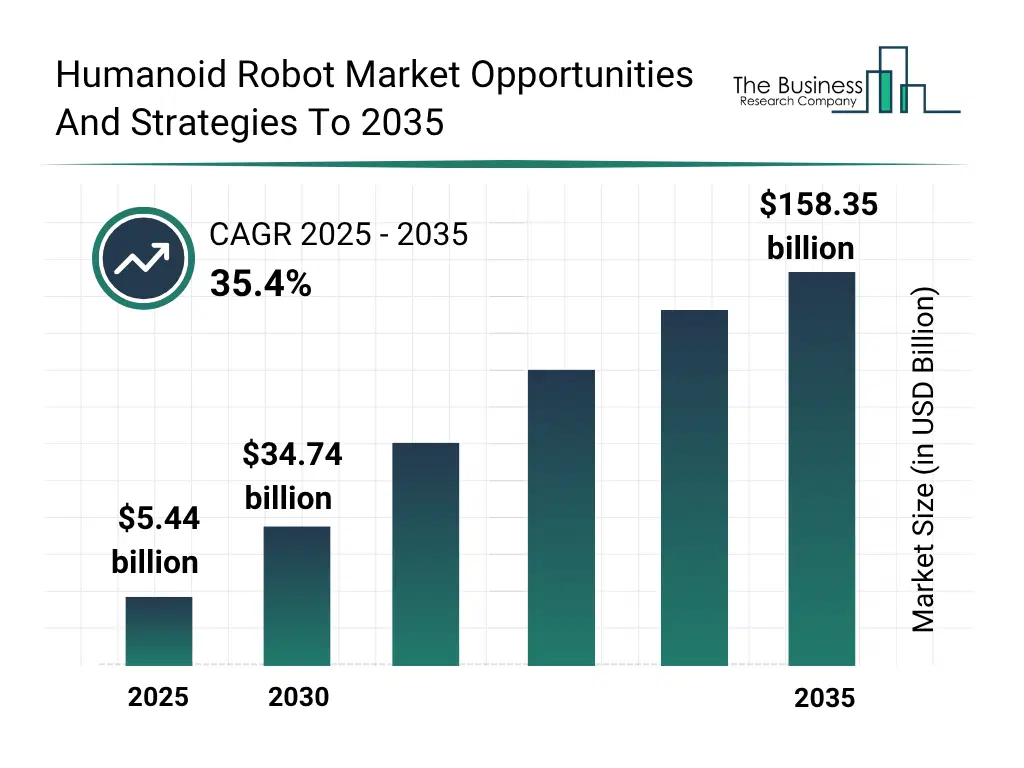
The global humanoid robot market reached a value of nearly $5,442.6 million in 2025, having grown at a compound annual growth rate (CAGR) of 49.3% since 2020. The market is expected to grow from $5,442.6 million in 2025 to $34,743.9 million in 2030 at a rate of 44.9%. The market is then expected to grow at a CAGR of 35.4% from 2030 and reach $158,348.5 million in 2035. Growth in the historic period resulted from rising smart city initiatives, increasing demand for automation in industrial operations, rising labor costs and rise of industry 4.0. Factors that negatively affected growth in the historic period were high development and adoption costs and regulatory barriers and uncertainty. Going forward, the rise in e-commerce and logistics, growing focus on workplace safety, rising use in medical procedures and patient care and education and research expansion will drive the growth. Factors that could hinder the growth of the humanoid robot market in the future include ethical and job displacement concerns, lack of skilled personnel and technical expertise and impact of trade war and tariffs.Humanoid Robot Market Segmentation
The humanoid robot market is segmented by component, by motion type and by application.By Component –
The humanoid robot market is segmented by component into:
- a) Hardware
- b) Software
- c) Services
By Motion Type –
The humanoid robot market is segmented by motion type into:
- a) Biped
- b) Wheel Drive
By Application –
The humanoid robot market is segmented by application into:
- a) Education And Entertainment
- b) Research And Space Exploration
- c) Personal Assistance And Caregiving
- d) Search And Rescue
- e) Public Relations
- f) Other Applications
By Geography - The humanoid robot market is segmented by geography into:
- • China
- • India
- • Japan
- • Australia
- • Indonesia
- • South Korea
- • USA
- • Canada
- • Brazil
- • France
- • Germany
- • UK
- • Italy
- • Spain
- • Russia
-
o Asia Pacific
o Africa