
Human Fibroblast Growth Factor Market Report 2026
Global Outlook – By Product Type (Animal Derived, Natural, Recombinant), By Form (Liquid, Lyophilized, Powder), By Sales Channel (Direct Sales, Distributor, E Commerce), By Application (Cell Proliferation, Diagnostics, Drug Screening, Tissue Engineering), By End User (Biotech Companies, Hospitals, Pharmaceutical Companies, Research Institutes) – Market Size, Trends, Strategies, and Forecast to 2035
Human Fibroblast Growth Factor Market Overview
• Human Fibroblast Growth Factor market size has reached to $1.1 billion in 2025 • Expected to grow to $1.83 billion in 2030 at a compound annual growth rate (CAGR) of 10.6% • Growth Driver: Human Fibroblast Growth Factor Growth Due To Increasing Incidence Of Chronic Diseases • Market Trend: Advancements In Synthetic Growth Factor Engineering Enhancing Stability And Efficiency Of Biologic Alternatives • North America was the largest region in 2025 and Asia-Pacific is the fastest growing region.
What Is Covered Under Human Fibroblast Growth Factor Market?
Human fibroblast growth factor (hFGF) refers to a family of naturally occurring proteins in the human body that play key roles in cell growth and development and these growth factors act as signalling molecules that bind to specific fibroblast growth factor receptors (FGFRs) on the surface of cells, triggering a cascade of intracellular signals that regulate cell proliferation, survival and angiogenesis. The main product types of human fibroblast growth factor include animal derived, natural, and recombinant. Animal derived are extracted from animal tissues and used in research and therapeutic applications for promoting cell growth and regeneration. The forms include liquid, lyophilized, and powder, and they are distributed through direct sales, distributors, and e-commerce channels. The various applications involved are cell proliferation, diagnostics, drug screening, and tissue engineering, and they are used by several end users such as biotech companies, hospitals, pharmaceutical companies, and research institutes.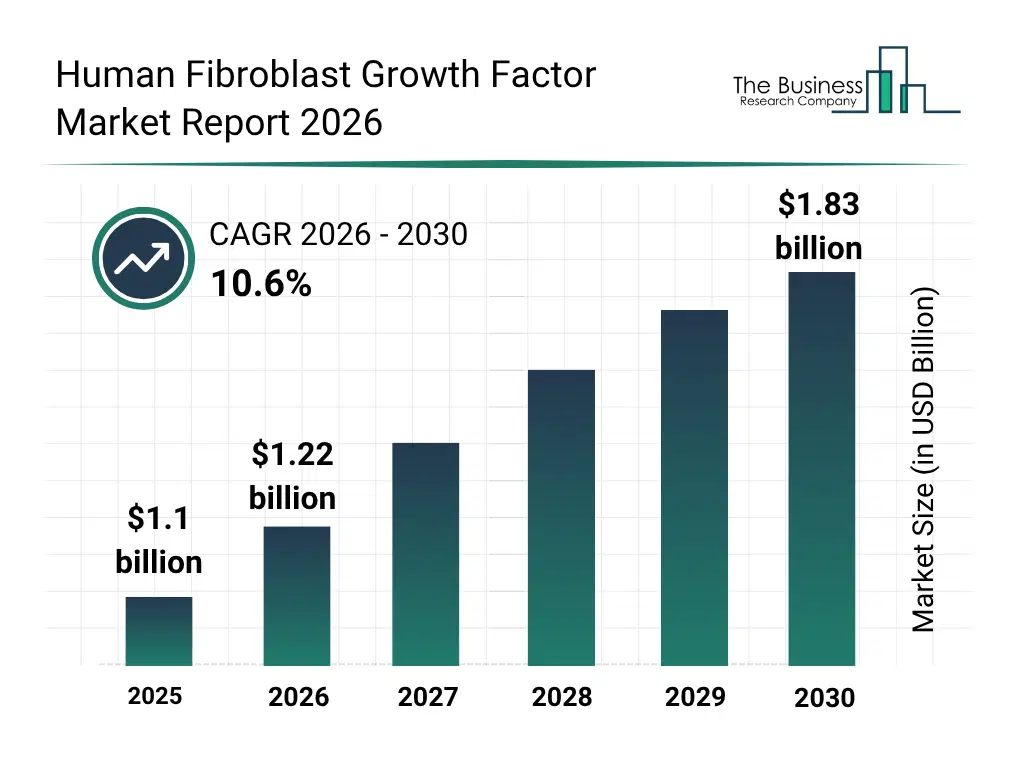
What Is The Human Fibroblast Growth Factor Market Size and Share 2026?
The human fibroblast growth factor market size has grown rapidly in recent years. It will grow from $1.1 billion in 2025 to $1.22 billion in 2026 at a compound annual growth rate (CAGR) of 10.4%. The growth in the historic period can be attributed to growth in regenerative medicine research, increasing demand for human tissue derived proteins, rising investment in biotech R&D, expansion of hospital and research institute networks, adoption of hfgf in diagnostic applications.What Is The Human Fibroblast Growth Factor Market Growth Forecast?
The human fibroblast growth factor market size is expected to see rapid growth in the next few years. It will grow to $1.83 billion by 2030 at a compound annual growth rate (CAGR) of 10.6%. The growth in the forecast period can be attributed to increasing adoption of recombinant hfgf products, growth in tissue engineering and cell therapy markets, rising use in high-throughput drug screening, advancements in protein stabilization technologies, expansion of direct sales and e-commerce channels. Major trends in the forecast period include increasing development of recombinant hfgf variants, rising use of hfgf in tissue engineering applications, expansion of high-purity and lyophilized formulations, growing adoption of hfgf in drug screening platforms, integration of hfgf solutions with cell proliferation research.Global Human Fibroblast Growth Factor Market Segmentation
1) By Product Type: Animal Derived, Natural, Recombinant 2) By Form: Liquid, Lyophilized, Powder 3) By Sales Channel: Direct Sales, Distributor, E Commerce 4) By Application: Cell Proliferation, Diagnostics, Drug Screening, Tissue Engineering 5) By End User: Biotech Companies, Hospitals, Pharmaceutical Companies, Research Institutes Subsegments: 1) By Animal Derived: Bovine Derived Fibroblast Growth Factor, Porcine Derived Fibroblast Growth Factor, Other Animal Sources 2) By Natural: Tissue Extracted Fibroblast Growth Factor, Plant Derived Fibroblast Growth Factor, Human Tissue Derived Fibroblast Growth Factor 3) By Recombinant: Recombinant Human Fibroblast Growth Factor 1, Recombinant Human Fibroblast Growth Factor 2, Recombinant Human Fibroblast Growth Factor 7, Recombinant Human Fibroblast Growth Factor 10What Is The Driver Of The Human Fibroblast Growth Factor Market?
The increasing incidence of chronic diseases is expected to propel the growth of the human fibroblast growth factor market going forward. Chronic diseases refer to health conditions that are long-lasting and typically persist for three months or more which often progress slowly and cannot usually be cured completely although their symptoms can be managed, and these diseases often require ongoing medical attention or long-term medication. The rise of chronic diseases is due to people lifestyle changes and environmental factors associated with modern life which accumulate over time to cause long-term health problems. Human fibroblast growth factor helps to prevent chronic diseases by allowing the body to repair damaged tissues, form new blood vessels and reduce chronic inflammation which lower the risk and progression of long-term health conditions. For instance, in 2025, according to The Northern Arizona Medical Group, a US-based healthcare provider reported that nearly three-quarters of the world’s population is projected to live with at least one chronic illness and the prevalence of chronic illnesses continued to increase notably and in the United States, in 2023, about 76.4% of adults reported having at least one chronic condition, and 51.4% had two or more. Therefore, the increasing incidence of chronic diseases is driving the growth of human fibroblast growth factor industry.Key Players In The Global Human Fibroblast Growth Factor Market
Major companies operating in the human fibroblast growth factor market are Thermo Fisher Scientific Inc., Merck KGaA, Lonza Group AG, Bio‑Techne Corporation, STEMCELL Technologies Inc., GenScript Biotech Corporation, Promega Corporation, Sino Biological Inc., Cell Signaling Technology Inc, ACROBiosystems Co. Ltd., RayBiotech Inc., Proteintech Group Inc., PromoCell GmbH, Creative Biolabs Co. Ltd., BPS Bioscience Inc., MedChemExpress LLC, ProSpec‑Tany Technogene Ltd., Novoprotein Scientific Inc., Elabscience Biotechnology Inc., Enzo Life Sciences Inc.Global Human Fibroblast Growth Factor Market Trends and Insights
Major companies operating in the human fibroblast growth factor market are focusing on technological advancements, such as synthetic growth factor engineering, which allows the development of engineered peptide or protein mimetics that replicate the biological activity of native FGFs while offering enhanced stability, reduced degradation, improved receptor specificity, and lower production costs. Synthetic growth factor engineering refers to the design and development of artificially created or modified molecules that mimic or enhance the biological activity of natural growth factors, while improving properties like stability, specificity, and manufacturability. For instance, in October 2024, PeptiGrowth Inc, a Japan-based biotechnology company, launched novel synthetic peptide growth factor, offers enhanced biological performance by mimicking natural growth factor activity while improving stability and efficiency. It provides prolonged activity in cell culture systems, reducing the need for frequent media replacement. These peptides are more resistant to degradation, ensuring consistent results across experiments.What Are Latest Mergers And Acquisitions In The Human Fibroblast Growth Factor Market?
In August 2023, Danaher Corporation, a U.S.–based global science and technology company specializing in life sciences, diagnostics, and biotechnology solutions, acquired Abcam plc for approximately $5.7 billion. Through this acquisition, Danaher gained access to Abcam’s extensive portfolio of recombinant proteins, antibodies, and life science research reagents, including human fibroblast growth factors widely used in cell culture, stem cell research, and regenerative medicine applications. Abcam plc is a UK-based biotechnology company specializing in the development and supply of high-quality antibodies, recombinant proteins, and assays for research, diagnostic, and drug discovery applications.Regional Insights
North America was the largest region in the human fibroblast growth factor market in 2025. Asia-Pacific is expected to be the fastest-growing region in the forecast period. The regions covered in this market report are Asia-Pacific, South East Asia, Western Europe, Eastern Europe, North America, South America, Middle East, Africa. The countries covered in this market report are Australia, Brazil, China, France, Germany, India, Indonesia, Japan, Taiwan, Russia, South Korea, UK, USA, Canada, Italy, Spain.What Defines the Human Fibroblast Growth Factor Market?
The human fibroblast growth factor (hFGF) market includes of revenues earned by entities by providing services such as wound healing and tissue repair, angiogenesis, cosmetic and dermatology applications, drug development services, metabolic and systemic health support, and laboratory and biotechnology applications. The market value includes the value of related goods sold by the service provider or included within the service offering. Only goods and services traded between entities or sold to end consumers are included. The human fibroblast growth factor (hFGF) market consists of sales of wound healing gels and creams, ophthalmic preparations, bone and cartilage repair products, anti-aging serums and creams, cell culture supplements, and drug screening kits. Values in this market are ‘factory gate’ values, that is the value of goods sold by the manufacturers or creators of the goods, whether to other entities (including downstream manufacturers, wholesalers, distributors and retailers) or directly to end customers. The value of goods in this market includes related services sold by the creators of the goods.How is Market Value Defined and Measured?
The market value is defined as the revenues that enterprises gain from the sale of goods and/or services within the specified market and geography through sales, grants, or donations in terms of the currency (in USD unless otherwise specified). The revenues for a specified geography are consumption values that are revenues generated by organizations in the specified geography within the market, irrespective of where they are produced. It does not include revenues from resales along the supply chain, either further along the supply chain or as part of other products.What Key Data and Analysis Are Included in the Human Fibroblast Growth Factor Market Report 2026?
The human fibroblast growth factor market research report is one of a series of new reports from The Business Research Company that provides market statistics, including industry global market size, regional shares, competitors with the market share, detailed market segments, market trends and opportunities, and any further data you may need to thrive in the human fibroblast growth factor industry. The market research report delivers a complete perspective of everything you need, with an in-depth analysis of the current and future state of the industry.Human Fibroblast Growth Factor Market Report Forecast Analysis
| Report Attribute | Details |
|---|---|
| Market Size Value In 2026 | $1.22 billion |
| Revenue Forecast In 2035 | $1.83 billion |
| Growth Rate | CAGR of 10.4% from 2026 to 2035 |
| Base Year For Estimation | 2025 |
| Actual Estimates/Historical Data | 2020-2025 |
| Forecast Period | 2026 - 2030 - 2035 |
| Market Representation | Revenue in USD Billion and CAGR from 2026 to 2035 |
| Segments Covered | Product Type, Form, Sales Channel, Application, End User |
| Regional Scope | Asia-Pacific, Western Europe, Eastern Europe, North America, South America, Middle East, Africa |
| Country Scope | The countries covered in the report are Australia, Brazil, China, France, Germany, India, ... |
| Key Companies Profiled | Thermo Fisher Scientific Inc., Merck KGaA, Lonza Group AG, Bio‑Techne Corporation, STEMCELL Technologies Inc., GenScript Biotech Corporation, Promega Corporation, Sino Biological Inc., Cell Signaling Technology Inc, ACROBiosystems Co. Ltd., RayBiotech Inc., Proteintech Group Inc., PromoCell GmbH, Creative Biolabs Co. Ltd., BPS Bioscience Inc., MedChemExpress LLC, ProSpec‑Tany Technogene Ltd., Novoprotein Scientific Inc., Elabscience Biotechnology Inc., Enzo Life Sciences Inc. |
| Customization Scope | Request for Customization |
| Pricing And Purchase Options | Explore Purchase Options |