
Hospice Indoor Air Quality (IAQ) Monitoring Market Report 2026
Global Outlook – By Product Type (Portable Monitors, Fixed Monitors, Wearable Devices, Other Product Types), By Pollutant Type (Particulate Matter, Carbon Dioxide, Volatile Organic Compounds, Biological Contaminants, Other Pollutant Types), By Technology (Sensor-Based, Internet of Things (IoT)-Enabled, Wireless, Other Technologies), By Application (Patient Rooms, Common Areas, Administrative Offices, Other Applications), By End-User (Hospices, Palliative Care Centers, Home Care Settings, Other End-Users) – Market Size, Trends, Strategies, and Forecast to 2035
Hospice Indoor Air Quality (IAQ) Monitoring Market Overview
• Hospice Indoor Air Quality (IAQ) Monitoring market size has reached to $1.52 billion in 2025 • Expected to grow to $2.29 billion in 2030 at a compound annual growth rate (CAGR) of 8.6% • Growth Driver: Rising Green Building Certifications Driving The Market Growth Due To Increasing Demand For Sustainable And Healthy Indoor Environments • North America was the largest region in 2025 and Asia-Pacific is the fastest growing region.
What Is Covered Under Hospice Indoor Air Quality (IAQ) Monitoring Market?
Hospice indoor air quality (IAQ) monitoring involves using sensors and monitoring systems to measure pollutants, particulate matter, humidity, and ventilation within Hospice Care facilities. Its primary purpose is to ensure a safe, comfortable, and healthy environment for patients with compromised immunity, improving respiratory comfort and overall well-being. It also helps staff take timely actions to reduce airborne contaminants and maintain compliance with health and safety standards. The main product types of hospice indoor air quality (IAQ) monitoring include portable monitors, fixed monitors, wearable devices, and other product types. Portable monitors refer to devices designed for flexible, on-the-go air quality assessment. They are applied to particulate matter, carbon dioxide, volatile organic compounds, biological contaminants, and other pollutant types and utilize technologies such as sensor-based, internet of things (IoT)-enabled, wireless, and others. The various applications involved are patient rooms, common areas, administrative offices, and other applications, and are used by several end users such as hospices, palliative care centers, home care settings, and other end-users.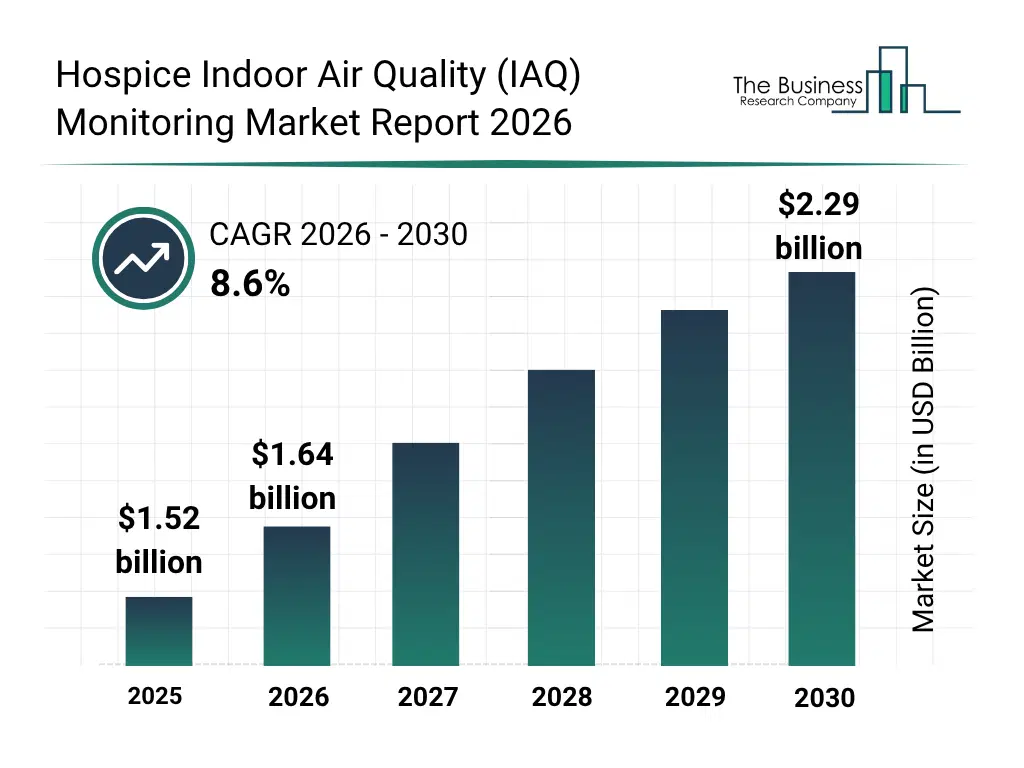
What Is The Hospice Indoor Air Quality (IAQ) Monitoring Market Size and Share 2026?
The hospice indoor air quality (IAQ) monitoring market size has grown strongly in recent years. It will grow from $1.52 billion in 2025 to $1.64 billion in 2026 at a compound annual growth rate (CAGR) of 8.4%. The growth in the historic period can be attributed to increasing awareness of indoor air pollution risks, rising respiratory health concerns among elderly patients, expansion of hospice and palliative care facilities, growing regulatory standards for healthcare environments, adoption of basic sensor based monitoring systems.What Is The Hospice Indoor Air Quality (IAQ) Monitoring Market Growth Forecast?
The hospice indoor air quality (IAQ) monitoring market size is expected to see strong growth in the next few years. It will grow to $2.29 billion in 2030 at a compound annual growth rate (CAGR) of 8.6%. The growth in the forecast period can be attributed to growing adoption of smart healthcare infrastructure, increasing investment in patient centric care environments, rising integration of AI driven air quality analytics, expansion of home based hospice services, increasing emphasis on sustainable and energy efficient Ventilation Systems. Major trends in the forecast period include increasing deployment of zoned iaq monitoring systems, rising demand for real time air quality alerts, growing integration of iaq data with hvac systems, expansion of portable multifunction iaq devices, rising focus on infection control and respiratory comfort.Global Hospice Indoor Air Quality (IAQ) Monitoring Market Segmentation
1) By Product Type: Portable Monitors, Fixed Monitors, Wearable Devices, Other Product Types 2) By Pollutant Type: Particulate Matter, Carbon Dioxide, Volatile Organic Compounds, Biological Contaminants, Other Pollutant Types 3) By Technology: Sensor-Based, Internet of Things (IoT)-Enabled, Wireless, Other Technologies 4) By Application: Patient Rooms, Common Areas, Administrative Offices, Other Applications 5) By End-User: Hospices, Palliative Care Centers, Home Care Settings, Other End-Users Subsegments: 1) By Portable Monitors: Handheld Monitors, Tabletop Portable Stations, Portable Multifunction Devices 2) By Fixed Monitors: Wall Mounted Fixed Monitors, Networked Fixed Systems, Zoned IAQ Monitoring 3) By Wearable Devices: Pendant Wearables, Wrist Mounted Monitors, Badge Style Devices 4) By Other Product Types: Environmental Sensor Kits, Integrated Smart Building Sensors, Retrofit Add On SensorsWhat Are The Drivers Of The Hospice Indoor Air Quality (IAQ) Monitoring Market?
The growing green building certifications are expected to propel the growth of the hospice indoor air quality (IAQ) monitoring market going forward. Green building certifications are formal recognitions awarded to buildings that meet standards for sustainability, energy efficiency, and minimal environmental impact. Green building certifications are increasing due to rising environmental awareness, driving demand for buildings that minimize resource use and carbon emissions. Hospice indoor air quality (IAQ) monitoring helps green building certifications by providing continuous data on air quality, ensuring healthy indoor environments, reducing pollutants, and supporting compliance with sustainability and wellness standards required for certification. For instance, in July 2024, according to the Green Building Council, a US-based non-profit organization, over 46,000 residential projects earned LEED green building certification, showing nearly a 5% rise in new registrations compared to 2023. Therefore, the growing green building certifications are driving the growth of the hospice indoor air quality (IAQ) monitoring industry. The increasing pollution levels are expected to propel the growth of the hospice indoor air quality (IAQ) monitoring market going forward. Pollution levels refers to the concentration of harmful substances in air, water, or soil that can negatively impact health and the environment. Increasing pollution levels occur due to rapid industrialization, which releases large amounts of harmful gases, particulates, and chemicals into the environment, deteriorating air and water quality and affecting health. Hospice indoor air quality (IAQ) monitoring helps control pollution levels by continuously detecting harmful airborne pollutants and enabling timely ventilation or filtration measures, ensuring a healthier and safer environment for patients and staff. For instance, in February 2026, according to the United States Environmental Protection Agency, a US-based government agency, in 2024, approximately 64 million tons of pollutants were released into the atmosphere in the United States. Therefore, the increasing pollution levels are driving the growth of the hospice indoor air quality (IAQ) monitoring industry. The rising healthcare expenditure is expected to propel the growth of the hospice indoor air quality (IAQ) monitoring market going forward. Healthcare expenditure refers to the total financial resources spent by individuals, organizations, or governments on preventing, treating, and managing health conditions. Healthcare expenditure is increasing due to advancements in medical technology, as new diagnostic tools, treatments, and innovative therapies often come at higher costs, leading to greater overall spending on healthcare. Rising healthcare expenditure drives demand for hospice indoor air quality (IAQ) monitoring because hospitals and hospices prioritize patient safety and quality of care, allocating funds to install advanced air quality systems that prevent airborne infections and enhance overall indoor environmental health. For instance, in May 2024, according to the Office for National Statistics, a UK-based government department, total healthcare expenditure saw a 5.6% increase in nominal terms in 2023, an increase of 0.9% growth compared to 2022. Therefore, the rising healthcare expenditure is driving the growth of the hospice indoor air quality (IAQ) monitoring industry.Key Players In The Global Hospice Indoor Air Quality (IAQ) Monitoring Market
Major companies operating in the hospice indoor air quality (IAQ) monitoring market are Thermo Fisher Scientific Inc., Honeywell International Incorporated, Johnson Controls International plc, Carrier Global Corporation, Trane Technologies plc., Emerson Electric Company, SGS SA, HORIBA Ltd., Camfil AB, Sensirion Aktiengesellschaft, TSI Incorporated, Siemens Aktiengesellschaft, IQAir AG, Airthings ASA, Awair Inc., BGE Indoor Air Quality Solutions Ltd., Testo SE & Co. Kommanditgesellschaft auf Aktien, Anewtech Systems, Aeroqual Limited, Critical Environment Technologies Canada Inc., DevineAir Limited.Regional Insights
North America was the largest region in the hospice indoor air quality (IAQ) monitoring market in 2025. Asia-Pacific is expected to be the fastest-growing region in the forecast period. The regions covered in this market report are Asia-Pacific, South East Asia, Western Europe, Eastern Europe, North America, South America, Middle East, Africa. The countries covered in this market report are Australia, Brazil, China, France, Germany, India, Indonesia, Japan, Taiwan, Russia, South Korea, UK, USA, Canada, Italy, Spain.What Defines the Hospice Indoor Air Quality (IAQ) Monitoring Market?
The hospice indoor air quality (IAQ) monitoring market consists of revenues earned by entities by providing services such as continuous air quality monitoring, real-time data analysis, indoor pollutant detection, reporting and compliance assessment, and risk evaluation. The market value includes the value of related goods sold by the service provider or included within the service offering. The indoor air quality (IAQ) monitoring market also includes sales of indoor air quality monitors, multi-parameter IAQ sensors and units, continuous IAQ monitoring systems, humidity and temperature sensors, air sampling devices, and associated software platforms. Values in this market are ‘factory gate’ values, that is, the value of goods sold by the manufacturers or creators of the goods, whether to other entities (including downstream manufacturers, wholesalers, distributors, and retailers) or directly to end customers. The value of goods in this market includes related services sold by the creators of the goods.How is Market Value Defined and Measured?
The market value is defined as the revenues that enterprises gain from the sale of goods and/or services within the specified market and geography through sales, grants, or donations in terms of the currency (in USD unless otherwise specified). The revenues for a specified geography are consumption values that are revenues generated by organizations in the specified geography within the market, irrespective of where they are produced. It does not include revenues from resales along the supply chain, either further along the supply chain or as part of other products.What Key Data And Analysis Are Included In The Hospice Indoor Air Quality (IAQ) Monitoring Market Report 2026?
The hospice indoor air quality (iaq) monitoring market research report is one of a series of new reports from The Business Research Company that provides market statistics, including industry global market size, regional shares, competitors with the market share, detailed market segments, market trends and opportunities, and any further data you may need to thrive in the hospice indoor air quality (iaq) monitoring industry. The market research report delivers a complete perspective of everything you need, with an in-depth analysis of the current and future state of the industry.Hospice Indoor Air Quality (IAQ) Monitoring Market Report Forecast Analysis
| Report Attribute | Details |
|---|---|
| Market Size Value In 2026 | $1.64 billion |
| Revenue Forecast In 2035 | $2.29 billion |
| Growth Rate | CAGR of 8.4% from 2026 to 2035 |
| Base Year For Estimation | 2025 |
| Actual Estimates/Historical Data | 2020-2025 |
| Forecast Period | 2026 - 2030 - 2035 |
| Market Representation | Revenue in USD Billion and CAGR from 2026 to 2035 |
| Segments Covered | Product Type, Pollutant Type, Technology, Application, End-User |
| Regional Scope | Asia-Pacific, Western Europe, Eastern Europe, North America, South America, Middle East, Africa |
| Country Scope | The countries covered in the report are Australia, Brazil, China, France, Germany, India, Indonesia, Japan, Taiwan, Russia, South Korea, UK, USA, Canada, Italy, Spain. |
| Key Companies Profiled | Thermo Fisher Scientific Inc., Honeywell International Incorporated, Johnson Controls International plc, Carrier Global Corporation, Trane Technologies plc., Emerson Electric Company, SGS SA, HORIBA Ltd., Camfil AB, Sensirion Aktiengesellschaft, TSI Incorporated, Siemens Aktiengesellschaft, IQAir AG, Airthings ASA, Awair Inc., BGE Indoor Air Quality Solutions Ltd., Testo SE & Co. Kommanditgesellschaft auf Aktien, Anewtech Systems, Aeroqual Limited, Critical Environment Technologies Canada Inc., DevineAir Limited. |
| Customization Scope | Request for Customization |
| Pricing And Purchase Options | Explore Purchase Options |