
High-Plex Protein Biomarker Platforms Market Report 2026
Global Outlook – By Technology (Mass Spectrometry, Immunoassays, Multiplexed Immunofluorescence, Next-Generation Sequencing, Other Technologies), By Product (Protein Biomarker Detection Instruments, Reagents And Assay Kits, Software And Data Analysis Tools, Consumables And Accessories, Service And Support Contracts), By Application (Biomarker Discovery, Translational Research, Drug Discovery And Development, Clinical Diagnostics, Precision Medicine, Immunology And Oncology Research, Other Applications), By End User (Pharmaceutical And Biotechnology Companies, Academic And Research Institutes, Contract Research Organizations (CROs), Healthcare And Diagnostic Centers, Biopharmaceutical Service Providers) – Market Size, Trends, Strategies, and Forecast to 2035
High-Plex Protein Biomarker Platforms Market Overview
• High-Plex Protein Biomarker Platforms market size has reached to $1.72 billion in 2025 • Expected to grow to $3.15 billion in 2030 at a compound annual growth rate (CAGR) of 12.8% • Growth Driver: Surge In Adoption Of Precision Medicine Fueling The Growth Of The Market Due To Improved Treatment Outcomes And Personalized Therapy Selection • Market Trend: Innovations In Deep Learning Technology Enhance High-Plex Spatial Proteomics And Biomarker Discovery • Asia-Pacific was the largest region and fastest growing region.
What Is Covered Under High-Plex Protein Biomarker Platforms Market?
High-plex protein biomarker platforms are sophisticated analytical systems that enable the simultaneous measurement and quantification of numerous protein Biomarkers from a single biological sample. Their main objective is to enhance biomarker discovery, strengthen disease diagnosis and prognosis, facilitate patient stratification, and advance precision medicine by delivering comprehensive, high-dimensional proteomic insights with high efficiency and accuracy. The main technologies of high-plex protein biomarker platforms include mass spectrometry, immunoassays, multiplexed immunofluorescence, next-generation sequencing, and others. Mass spectrometry (MS) is an analytical technique that identifies and quantifies molecules by measuring the mass-to-charge ratio of their ions. The various product typewsw include protein biomarker detection instruments, reagents and assay kits, software and data analysis tools, consumables and accessories, and service and support contracts. The key applications of biomarker discovery, translational research, drug discovery and development, clinical diagnostics, precision medicine, immunology and oncology research, and other applications, while the end-use includes pharmaceutical and biotechnology companies, academic and research institutes, contract research organizations (CROs), healthcare and diagnostic centers, and biopharmaceutical service providers.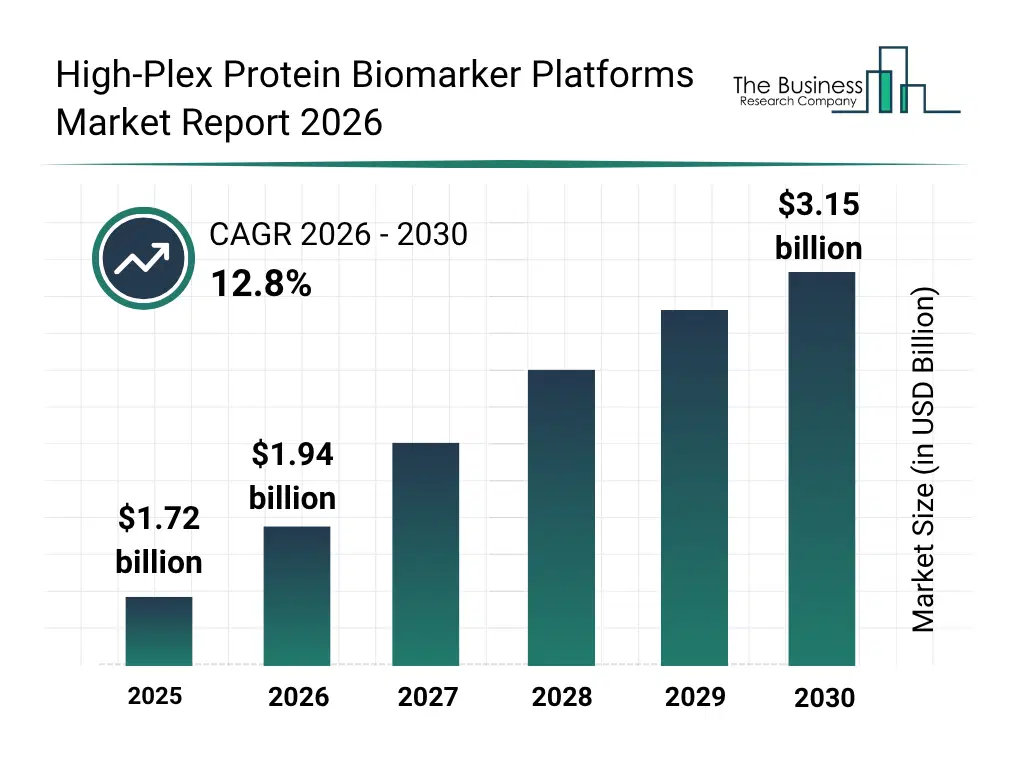
What Is The High-Plex Protein Biomarker Platforms Market Size and Share 2026?
The high-plex protein biomarker platforms market size has grown rapidly in recent years. It will grow from $1.72 billion in 2025 to $1.94 billion in 2026 at a compound annual growth rate (CAGR) of 12.6%. The growth in the historic period can be attributed to growing investment in proteomics research, rising prevalence of chronic and complex diseases, expansion of pharmaceutical r&d activities, increasing demand for early disease detection tools, advancements in mass spectrometry technologies.What Is The High-Plex Protein Biomarker Platforms Market Growth Forecast?
The high-plex protein biomarker platforms market size is expected to see rapid growth in the next few years. It will grow to $3.15 billion in 2030 at a compound annual growth rate (CAGR) of 12.8%. The growth in the forecast period can be attributed to increasing adoption of precision medicine initiatives, growing demand for companion diagnostics development, rising funding for translational research programs, expansion of oncology and immunology biomarker studies, technological innovation in next-generation proteomic platforms. Major trends in the forecast period include increasing adoption of ultra-high multiplex protein profiling, rising demand for integrated multi-omics platforms, growing use of high-sensitivity immunoassay technologies, expansion of biomarker validation in clinical trials, increasing focus on standardization and reproducibility in proteomics.Global High-Plex Protein Biomarker Platforms Market Segmentation
1) By Technology: Mass Spectrometry, Immunoassays, Multiplexed Immunofluorescence, Next-Generation Sequencing, Other Technologies 2) By Product: Protein Biomarker Detection Instruments, Reagents And Assay Kits, Software And Data Analysis Tools, Consumables And Accessories, Service And Support Contracts 3) By Application: Biomarker Discovery, Translational Research, Drug Discovery And Development, Clinical Diagnostics, Precision Medicine, Immunology And Oncology Research, Other Applications 4) By End User: Pharmaceutical And Biotechnology Companies, Academic And Research Institutes, Contract Research Organizations (CROs), Healthcare And Diagnostic Centers, Biopharmaceutical Service Providers Subsegments: 1) By Mass Spectrometry: Matrix Assisted Laser Desorption Ionization, Electrospray Ionization, Tandem Mass Spectrometry, Time Of Flight Mass Spectrometry 2) By Immunoassays: Enzyme Linked Immunosorbent Assay, Radioimmunoassay, Fluorescence Immunoassay, Chemiluminescence Immunoassay 3) By Multiplexed Immunofluorescence: Tissue Based Multiplexed Immunofluorescence, Cell Based Multiplexed Immunofluorescence, Quantitative Multiplexed Immunofluorescence 4) By Next Generation Sequencing: Targeted Protein Sequencing, Whole Proteome Sequencing, Transcriptome Based Protein Sequencing 5) By Other Technologies: Protein Microarray Platforms, Surface Plasmon Resonance Platforms, Electrochemical Biosensor Platforms, Label Free Detection PlatformsWhat Is The Driver Of The High-Plex Protein Biomarker Platforms Market?
The rising adoption of precision medicine is expected to propel the growth of the high-plex protein biomarker platforms market going forward. Precision medicine refers to a medical approach that tailors disease prevention, diagnosis, and treatment based on an individual’s genetic makeup, biological characteristics, and environmental factors. The rising adoption of precision medicine is driven by improved treatment outcomes, as therapies tailored to individual genetic and molecular profiles enhance effectiveness while reducing adverse effects. High-plex protein biomarker platforms accelerate the adoption of precision medicine by enabling comprehensive profiling of multiple protein biomarkers, which allows for more accurate patient stratification, personalized therapy selection, and improved monitoring of treatment response. For instance, in February 2024, according to the Personalized Medicine Coalition, a US-based nonprofit advocacy organization, 16 new personalized treatments for rare diseases were approved, up from six in 2022. Therefore, the increasing adoption of precision medicine is driving the growth of the high-plex protein biomarker platforms industry.Key Players In The Global High-Plex Protein Biomarker Platforms Market
Major companies operating in the high-plex protein biomarker platforms market are SomaLogic Inc, F. Hoffmann-La Roche AG, Thermo Fisher Scientific Inc, Merck KGaA, Agilent Technologies Inc, PerkinElmer Inc, Bio-Rad Laboratories Inc, Bio-Techne Corporation, Novogene Co Ltd, Meso Scale Diagnostics LLC, Quanterix Corporation, Akoya Biosciences Inc, RayBiotech Inc, Protavio Ltd, Proteome Sciences plc, Lucence Diagnostics Pte Ltd, Applied Biomics Inc, Sword Bio, BGI Group, Immudex A/S.Global High-Plex Protein Biomarker Platforms Market Trends and Insights
Major companies operating in the high-plex protein biomarker platforms market are focusing on developing advanced solutions, such as deep learning-powered spatial proteomics models, to automate multiplexed protein analysis, improve biomarker identification accuracy, and accelerate therapeutic development. Deep learning-powered spatial proteomics models refer to artificial intelligence-based computational systems that analyze highly multiplexed protein expression data within intact tissue samples, enabling precise spatial mapping and quantitative profiling of biomarkers at single-cell resolution. For instance, in April 2025, Nucleai, a US-based spatial biology company, launched the first-of-its-kind deep learning model designed to automate spatial proteomics analysis. The solution enhances the discovery and validation of protein biomarkers by integrating high-dimensional imaging data with AI-driven analytics, supporting the development of antibody-drug conjugates (ADCs), bispecific antibodies, and immunotherapies by enabling deeper insights into tumor microenvironments and target expression patterns.What Are Latest Mergers And Acquisitions In The High-Plex Protein Biomarker Platforms Market?
In July 2024, Thermo Fisher Scientific Inc., a US‑based provider of life sciences tools, laboratory instruments, and analytical systems, acquired Olink Holding AB for approximately $3.1 billion. Through this acquisition, Thermo Fisher aims to strengthen its proteomics and high‑plex protein biomarker analysis capabilities by integrating Olink’s proprietary Proximity Extension Assay (PEA) technology into its life sciences solutions portfolio, enabling broader high‑throughput protein analysis for research and clinical applications. Olink Holding AB is a Sweden‑based provider of high-plex protein biomarker platforms for research and proteomics applications.Regional Insights
North America was the largest region in the high-plex protein biomarker platforms market in 2025. Asia-Pacific is expected to be the fastest-growing region in the forecast period. The regions covered in this market report are Asia-Pacific, South East Asia, Western Europe, Eastern Europe, North America, South America, Middle East, Africa. The countries covered in this market report are Australia, Brazil, China, France, Germany, India, Indonesia, Japan, Taiwan, Russia, South Korea, UK, USA, Canada, Italy, Spain.What Defines the High-Plex Protein Biomarker Platforms Market?
The high-plex protein biomarker platforms market consists of revenues earned by entities by providing services such as clinical research support services, instrument maintenance services, technical support, and training services. The market value includes the value of related goods sold by the service provider or included within the service offering. The high-plex protein biomarker platforms market also includes sales of high-throughput plate readers, reagents and buffers, calibration standards and controls, and sample preparation kits. Values in this market are ‘factory gate’ values, that is, the value of goods sold by the manufacturers or creators of the goods, whether to other entities (including downstream manufacturers, wholesalers, distributors, and retailers) or directly to end customers. The value of goods in this market includes related services sold by the creators of the goods.How is Market Value Defined and Measured?
The market value is defined as the revenues that enterprises gain from the sale of goods and/or services within the specified market and geography through sales, grants, or donations in terms of the currency (in USD unless otherwise specified). The revenues for a specified geography are consumption values that are revenues generated by organizations in the specified geography within the market, irrespective of where they are produced. It does not include revenues from resales along the supply chain, either further along the supply chain or as part of other products.What Key Data And Analysis Are Included In The High-Plex Protein Biomarker Platforms Market Report 2026?
The high-plex protein biomarker platforms market research report is one of a series of new reports from The Business Research Company that provides market statistics, including industry global market size, regional shares, competitors with the market share, detailed market segments, market trends and opportunities, and any further data you may need to thrive in the high-plex protein biomarker platforms industry. The market research report delivers a complete perspective of everything you need, with an in-depth analysis of the current and future state of the industry.High-Plex Protein Biomarker Platforms Market Report Forecast Analysis
| Report Attribute | Details |
|---|---|
| Market Size Value In 2026 | $1.94 billion |
| Revenue Forecast In 2035 | $3.15 billion |
| Growth Rate | CAGR of 12.6% from 2026 to 2035 |
| Base Year For Estimation | 2025 |
| Actual Estimates/Historical Data | 2020-2025 |
| Forecast Period | 2026 - 2030 - 2035 |
| Market Representation | Revenue in USD Billion and CAGR from 2026 to 2035 |
| Segments Covered | Technology, Product, Application, End User |
| Regional Scope | Asia-Pacific, Western Europe, Eastern Europe, North America, South America, Middle East, Africa |
| Country Scope | The countries covered in the report are Australia, Brazil, China, France, Germany, India, Indonesia, Japan, Taiwan, Russia, South Korea, UK, USA, Canada, Italy, Spain. |
| Key Companies Profiled | SomaLogic Inc, F. Hoffmann-La Roche AG, Thermo Fisher Scientific Inc, Merck KGaA, Agilent Technologies Inc, PerkinElmer Inc, Bio-Rad Laboratories Inc, Bio-Techne Corporation, Novogene Co Ltd, Meso Scale Diagnostics LLC, Quanterix Corporation, Akoya Biosciences Inc, RayBiotech Inc, Protavio Ltd, Proteome Sciences plc, Lucence Diagnostics Pte Ltd, Applied Biomics Inc, Sword Bio, BGI Group, Immudex A/S. |
| Customization Scope | Request for Customization |
| Pricing And Purchase Options | Explore Purchase Options |