
Contact Us
  Search
The Business Research Company Logo
GLP-1 Receptor Agonist Global Market Opportunities And Strategies To 2035
Published :May 2026
Pages :355
Format :PDF
Delivery Time :2-3 Business Days
Why 2-3 days? We update the report with the latest data and news before delivery. Let us know if you need us to expedite.
Report Price :$4,490.00

GLP-1 Receptor Agonist Global Market Opportunities And Strategies To 2035

By Drug Class (Liraglutide, Semaglutide, Tirzepatide, Dulaglutide, Other Drugs), By Route Of Administration (Parenteral, Oral), By End-User (Hospitals, Surgical Clinics, Other Users), And By Region, Opportunities And Strategies – Global Forecast To 2035

GLP-1 Receptor Agonist Market Definition

GLP-1 receptor agonist are a class of medications that mimic the action of the natural hormone glucagon-like peptide-1 (GLP-1), which helps regulate blood sugar levels. These drugs enhance insulin secretion, reduce glucagon production, slow gastric emptying and promote satiety. The primary purpose of GLP-1 receptor agonist is to improve blood glucose control and support weight reduction in patients with type 2 diabetes or obesity. The GLP-1 receptor agonist market consists of sales, by entities (organizations, sole traders, or partnerships), of products and services related to GLP-1 receptor agonist, that gained approval for use in individuals with obesity, including those without diabetes, to assist in achieving and maintaining weight loss, especially in cases where traditional lifestyle interventions have been ineffective.
Research Expert

Book your 30 minutes free consultation with our research experts

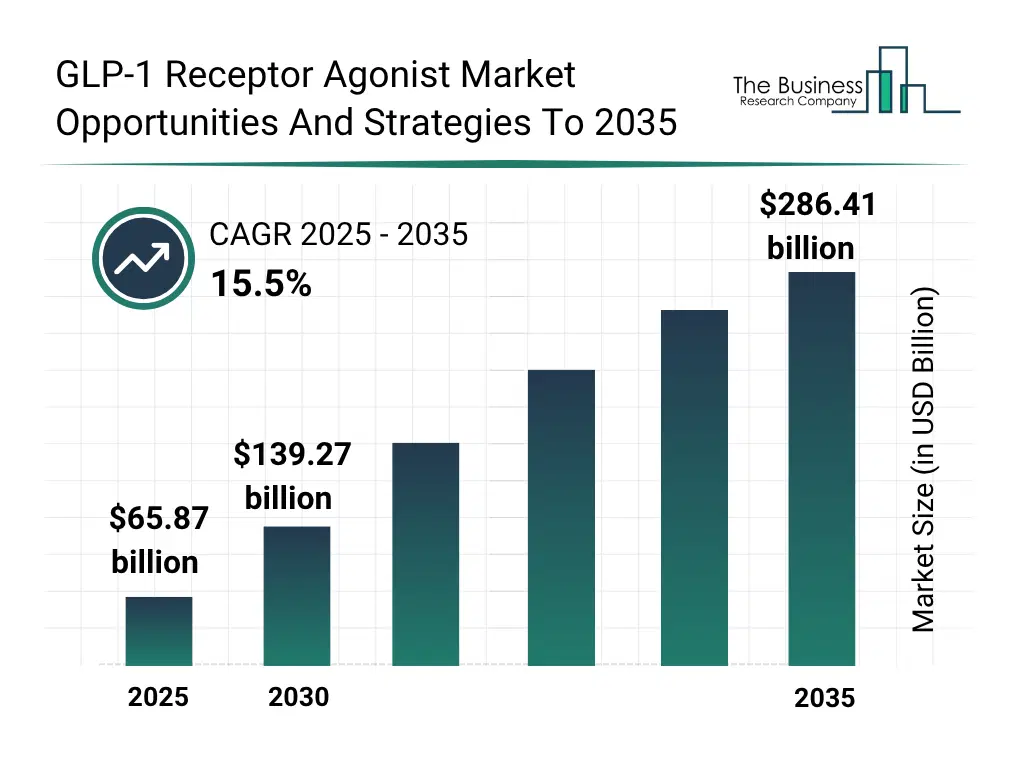
GLP-1 Receptor Agonist Global Market Opportunities And Strategies To 2035 Market Size and growth rate 2025 to 2030: Graph

Home Bedding Market Size

The global GLP-1 receptor agonist market reached a value of nearly $65,865.6 million in 2025, having grown at a compound annual growth rate (CAGR) of 37.0% since 2020. The market is expected to grow from $65,865.6 million in 2025 to $139,268.4 million in 2030 at a rate of 16.2%. The market is then expected to grow at a CAGR of 15.5% from 2030 and reach $286,412.5 million in 2035. Growth in the historic period resulted from the growth of personalized and precision medicine, increased diagnosis rates of metabolic disorders, rising prevalence of diabetes and surge in real-world evidence supporting long-term weight loss. Factors that negatively affected growth in the historic period were high discontinuation rates due to GI side effects and rising competition from alternative therapies. Going forward, the increased focus on preventive care, rise in obesity rates, growing awareness of cardiovascular and weight-loss benefits and expansion of insurance coverage for obesity treatments will drive the growth. Factors that could hinder the growth of the GLP-1 receptor agonist market in the future include misuse, off-label use, and non-medical consumption, high drug costs compared to standard diabetes or obesity therapy and impact of trade war and tariffs.

GLP-1 Receptor Agonist Market Segmentation

The GLP-1 receptor agonist market is segmented by drug class, by route of administration and by end-user industry.

By Type –
The GLP-1 receptor agonist market is segmented by drug class into:
    • a) Liraglutide
    • b) Semaglutide
    • c) Tirzepatide
    • d) Dulaglutide
    • e) Other Drugs
The semaglutide market was the largest segment of the GLP-1 receptor agonist market segmented by drug class, accounting for 51.9% or $34,188.0 million of the total in 2025. Going forward, the tirzepatide segment is expected to be the fastest growing segment in the GLP-1 receptor agonist market segmented by drug class, at a CAGR of 17.8% during 2025-2030.

By Route Of Administration –
The GLP-1 receptor agonist market is segmented by route of administration into:
    • a) Parenteral
    • b) Oral
The parenteral market was the largest segment of the GLP-1 receptor agonist market segmented by route of administration, accounting for 81.2% or $53,493.9 million of the total in 2025. Going forward, the oral segment is expected to be the fastest growing segment in the GLP-1 receptor agonist market segmented by route of administration, at a CAGR of 25.3% during 2025-2030.

By End-User –
The GLP-1 receptor agonist market is segmented by end-user into:
  1. a) Hospitals
  2. b) Surgical Clinics
  3. c) Other End-Users
The hospitals market was the largest segment of the GLP-1 receptor agonist market segmented by end users, accounting for 55.1% or $36,266.2 million of the total in 2025. Going forward, the hospitals segment is expected to be the fastest growing segment in the GLP-1 receptor agonist market segmented by end users, at a CAGR of 17.1% during 2025-2030.

By Geography - The GLP-1 receptor agonist market is segmented by geography into:
      o Asia Pacific
      • • China
      • • India
      • • Japan
      • • Australia
      • • Indonesia
      • • South Korea
      o North America
      • • USA
      • • Canada
      o South America
      • • Brazil
      o Western Europe
      • • France
      • • Germany
      • • UK
      • • Italy
      • • Spain
      o Eastern Europe
      • • Russia
      o Middle East
      o Africa
North America was the largest region in the GLP-1 receptor agonist market, accounting for 72.63% or $47,836.01 million of the total in 2025. It was followed by Western Europe, Asia Pacific and then the other regions. Going forward, the fastest-growing regions in the GLP-1 receptor agonist market will be Africa and Middle East where growth will be at CAGRs of 33.25% and 29.92% respectively. These will be followed by Eastern Europe and South America where the markets are expected to grow at CAGRs of 26.44% and 26.42% respectively.

GLP-1 Receptor Agonist Market Drivers

The key drivers of the GLP-1 receptor agonist market include: Rise In Obesity Rates During the forecast period, the rise in obesity rates will propel the growth of the GLP-1 receptor agonist market. Increasing global obesity prevalence heightens the need for effective pharmacological interventions that can address weight gain, metabolic dysfunction and the progression of obesity-related chronic diseases. Obesity significantly elevates the risk of conditions such as type 2 diabetes, hypertension and cardiovascular disorders, creating stronger demand for treatments capable of producing sustained weight loss and improving overall metabolic health. This sharp increase in obesity rates expands the population requiring structured weight-management therapies and clinical support. As more individuals face health risks associated with excess weight, the demand for GLP-1 receptor agonist, proven to reduce weight, improve glycemic control and lower cardiometabolic risk, is expected to rise substantially, thereby driving the growth of the GLP-1 receptor agonist market. The rise in obesity rates growth contribution during the forecast period in 2025 is 4.5%.

GLP-1 Receptor Agonist Market Restraints

The key restraints on the GLP-1 receptor agonist market include: High Drug Costs Compared To Standard Diabetes Or Obesity Therapy High drug costs compared to standard diabetes or obesity therapy are restricting the growth of the GLP-1 receptor agonist market during the forecast period. GLP-1 drugs remain significantly more expensive than traditional treatments, creating financial barriers for patients and limiting adoption among those without comprehensive insurance coverage. Their high monthly price also places pressure on payers, who may impose restrictions, prior authorizations, or step-therapy requirements that reduce access. Additionally, cost-effectiveness analyses have shown that current GLP-1 pricing does not align with accepted value thresholds, making health systems less likely to support broad reimbursement. As a result, many individuals and providers continue to rely on lower-cost diabetes or weight-management therapies, limiting the potential expansion of GLP-1 receptor agonist. Growth affected by high drug costs compared to standard diabetes or obesity therapy across regions during the forecast period in 2025 is -0.8%.

GLP-1 Receptor Agonist Market Competitive Landscape

Major Competitors are:

  • Novo Nordisk AS
  • Eli Lilly Company
  • AstraZeneca Inc.
  • Sanofi SA
  • Glenmark Pharmaceuticals Limited
  • Other Competitors Include:

  • Teva Pharmaceutical Industries Ltd.
  • Amneal Pharmaceuticals
  • Johnson & Johnson
  • Daiichi Sankyo Company Limited
  • Mitsubishi Tanabe Pharma Corporation
  • Merck & Co., Inc.
  • Boehringer Ingelheim International
  • Hanmi Pharmaceutical Co., Ltd
  • Amgen
  • PegBio Co., Ltd
  • Bristol-Myers Squibb Company
  • Chongqing Lummy Pharmaceutical Co. Ltd
  • Dong-A ST Co. Ltd.
  • YaoPharma Co., Ltd.
  • Innovent Biologics, Inc.
  • Hansoh Pharma
  • Sciwind Biosciences
  • Hangzhou Jiuyuan Gene Engineering Co., Ltd
  • Daewoong Pharmaceutical Co., Ltd.
  • Celltrion Pharm, Inc.
  • Yuhan Corporation
  • Chong Kun Dang pharmaceutical Corp
  • Nxera Pharma
  • Corden Pharma GmbH
  • Merck Sharp & Dohme
  • Zealand Pharma A/S
  • Ascendis Pharma
  • Geropharm
  • Sun Pharmaceutical Industries Ltd.
  • Jiangsu Hengrui Medicine Co.
  • Novartis AG
  • Need data on a specific region in this market?

    Opportunities And Recommendations In The GLP-1 Receptor Agonist Market

    Opportunities – The top opportunities in the GLP-1 receptor agonist markets segmented by drug class will arise in the semaglutide segment, which will gain $38,237.9 million of global annual sales by 2030. The top opportunities in the GLP-1 receptor agonist markets segmented by route of administration will arise in the parenteral segment, which will gain $47,566.5 million of global annual sales by 2030. The top opportunities in the GLP-1 receptor agonist markets segmented by end users will arise in the hospitals segment, which will gain $43,597.5 million of global annual sales by 2030. The GLP-1 receptor agonist market size will gain the most in the USA at $36,441.0 million. Recommendations- To take advantage of the opportunities, The Business Research Company recommends the GLP-1 receptor agonist companies to focus on expanding oral and patient-centric GLP-1 therapies, focus on advancing dual GLP-1/GIP therapies for superior obesity outcomes, focus on developing dual GLP-1/glucagon agonists for metabolic liver disease, focus on expanding semaglutide and tirzepatide offerings to capture high-growth segments, focus on expanding oral glp-1 therapies to capture rapidly growing market demand, focus on wind power systems as the fastest-growing segment, focus on variable speed drives to capture high-growth opportunities, focus on expanding distribution channels across non-traditional care settings, focus on strategic pricing to enhance market access and competitiveness, focus on educating healthcare providers to drive adoption, focus on patient-centric awareness campaigns to expand engagement, focus on expanding GLP-1 access through other users channels.
    Chat with us