
Freshness Prediction Artificial Intelligence (AI) Market Report 2026
Global Outlook – By Component (Solutions, Services ), By Technology Input (Internet Of Things (IoT) Sensor Data, Visual Data, Historical Sales And Supply Chain Data, Multi-Modal Data Fusion ), By Deployment Mode (Cloud-Based Or Software As A Service (SaaS), On-Premises Or Edge ), By Application (Retail And Grocery, Dynamic Pricing And Markdown Optimization, Inventory Rotation And Stock Replenishment, Food Service And Hospitality, Kitchen And Menu Management, Prep Schedule Optimization, Logistics And Supply Chain, Other Applications ), By End-User (Supermarkets And Grocery Chains, Food And Beverage Manufacturers, Restaurants And Catering Services, Third-Party Logistics Providers, Other End-Users ) – Market Size, Trends, Strategies, and Forecast to 2035
Freshness Prediction Artificial Intelligence (AI) Market Overview
• Freshness Prediction Artificial Intelligence (AI) market size has reached to $1.83 billion in 2025 • Expected to grow to $4.52 billion in 2030 at a compound annual growth rate (CAGR) of 19.9% • Growth Driver: Rising Food Waste Reduction Initiatives Driving Growth Of The Market Due To Strong Government Sustainability Targets And Investment Commitments • Market Trend: Integrated AI-Driven Platforms Improve Freshness Prediction And Optimize Perishable Inventory Decisions • North America was the largest region in 2025 and Asia-Pacific is the fastest growing region.
What Is Covered Under Freshness Prediction Artificial Intelligence (AI) Market?
Freshness prediction artificial intelligence (AI) refers to the use of intelligent algorithms and data analysis techniques to estimate the remaining freshness or shelf life of perishable products. It uses inputs such as temperature history, storage conditions, sensor data, and product characteristics to predict quality changes over time. It helps improve inventory management, reduce food waste, and maintain product quality across the supply chain. The main components of freshness prediction artificial intelligence (AI) include solutions and services. Solutions refer to platforms that analyze data inputs to estimate product freshness, shelf life, and spoilage patterns for improved decision-making. The various technology inputs include internet of things (IoT) sensor data, visual data, historical sales and supply chain data, and multi-modal data fusion and are deployed through cloud-based or software as a service (SaaS) and on-premises or edge models. The various applications involved are retail and grocery, dynamic pricing and markdown optimization, inventory rotation and stock replenishment, food service and hospitality, kitchen and menu management, prep schedule optimization, logistics and supply chain, and other applications, and they are utilized by end users including supermarkets and grocery chains, food and beverage manufacturers, restaurants and catering services, third-party logistics providers, and other end-users.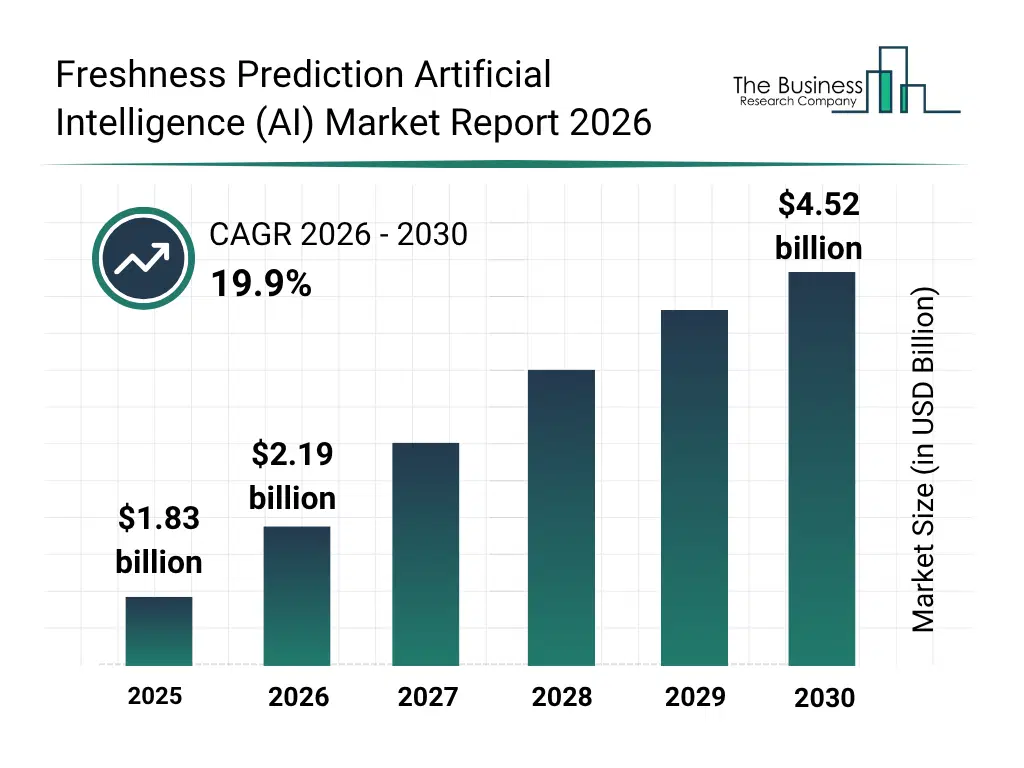
What Is The Freshness Prediction Artificial Intelligence (AI) Market Size and Share 2026?
The freshness prediction artificial intelligence (AI) market size has grown rapidly in recent years. It will grow from $1.83 billion in 2025 to $2.19 billion in 2026 at a compound annual growth rate (CAGR) of 19.6%. The growth in the historic period can be attributed to rising concerns over food waste reduction, growth in perishable goods trade, increasing adoption of cold chain logistics, expansion of retail and grocery chains, demand for improved inventory management efficiency.What Is The Freshness Prediction Artificial Intelligence (AI) Market Growth Forecast?
The freshness prediction artificial intelligence (AI) market size is expected to see rapid growth in the next few years. It will grow to $4.52 billion by 2030 at a compound annual growth rate (CAGR) of 19.9%. The growth in the forecast period can be attributed to increasing demand for real-time predictive analytics, growth in smart supply chain solutions, rising focus on sustainability in food systems, integration of ai-driven quality assessment tools, expansion of automated inventory and logistics systems. Major trends in the forecast period include increasing adoption of real-time shelf life prediction solutions, growing use of data-driven inventory optimization strategies, rising demand for food waste reduction technologies, expansion of predictive quality monitoring across supply chains, increasing integration of freshness prediction in retail operations.Global Freshness Prediction Artificial Intelligence (AI) Market Segmentation
1) By Component: Solutions, Services 2) By Technology Input: Internet Of Things (IoT) Sensor Data, Visual Data, Historical Sales And Supply Chain Data, Multi-Modal Data Fusion 3) By Deployment Mode: Cloud-Based Or Software As A Service (SaaS), On-Premises Or Edge 4) By Application: Retail And Grocery, Dynamic Pricing And Markdown Optimization, Inventory Rotation And Stock Replenishment, Food Service And Hospitality, Kitchen And Menu Management, Prep Schedule Optimization, Logistics And Supply Chain, Other Applications 5) By End-User: Supermarkets And Grocery Chains, Food And Beverage Manufacturers, Restaurants And Catering Services, Third-Party Logistics Providers, Other End-Users Subsegments: 1) By Solutions: Predictive Analytics Solutions, Computer Vision Solutions, Data Integration Solutions, Supply Chain Optimization Solutions 2) By Services: Consulting Services, Implementation Services, Support And Maintenance Services, Training And Education ServicesWhat Is The Driver Of The Freshness Prediction Artificial Intelligence (AI) Market?
The increasing food waste reduction initiatives are expected to propel the growth of the freshness prediction artificial intelligence (AI) market going forward. Food waste reduction initiatives refer to strategic actions and interventions implemented by governments, businesses, and organizations to decrease food wastage, improve resource efficiency, and enhance sustainability across the food value chain. Increasing food waste reduction initiatives are driven by rising environmental sustainability concerns, as reducing food waste helps lower greenhouse gas emissions, conserve resources, and minimize overall environmental impact. Freshness Prediction Artificial Intelligence (AI) supports food waste reduction initiatives by analyzing real-time data such as temperature, humidity, and product conditions to accurately estimate shelf life, enabling optimized inventory management, timely distribution, and reduced spoilage across the supply chain. For instance, in January 2026, according to the United States Environmental Protection Agency, a US-based federal executive agency, the U.S. government has set a target to reduce food waste in the retail, food service, and residential sectors by 50% by 2030, with annual investments of $14 billion in cost-effective solutions projected to cut 45 million tons of food waste each year. Therefore, the increasing food waste reduction initiatives are driving the growth of the freshness prediction artificial intelligence (AI) industry.Key Players In The Global Freshness Prediction Artificial Intelligence (AI) Market
Major companies operating in the freshness prediction artificial intelligence (AI) market are Google LLC, Microsoft Corporation, Cargill Incorporated, Amazon Web Services Inc., Siemens AG, IBM Corporation, Oracle Corporation, SAP SE, TOMRA Systems ASA, Leanpath Inc., Afresh Technologies Inc., Intello Labs Private Limited, Winnow Solutions Limited, Clarifruit Ltd., OneThird B.V., AgShift Inc., Strella Biotechnology Inc., Wasteless Ltd., OpSense Ltd., Kitro SA.Global Freshness Prediction Artificial Intelligence (AI) Market Trends and Insights
Major companies operating in the freshness prediction artificial intelligence (AI) market are focusing on developing advanced solutions, such as integrated AI-driven fresh operations platforms, to improve freshness prediction accuracy, optimize perishable inventory decisions, and reduce food waste across retail supply chains. Integrated AI-driven fresh operations platforms refer to centralized digital solutions that use artificial intelligence to optimize fresh food inventory, demand forecasting, and shelf-life management in real time to reduce waste and improve supply chain efficiency. For instance, in September 2025, Afresh Technologies, a US-based freshness optimization AI company, launched the Fresh Store Suite, an AI-powered platform that integrates inventory management, demand forecasting, ordering, and production planning into a unified freshness optimization system across fresh departments. The platform enables grocers to make faster, data-driven decisions, reduce food waste, and improve product freshness through predictive replenishment and cross-department AI optimization while streamlining fresh operations and improving profitability.What Are Latest Mergers And Acquisitions In The Freshness Prediction Artificial Intelligence (AI) Market?
In March 2025, Crisp Inc., a US-based retail AI platform, acquired Shelf Engine Inc. for an undisclosed amount. With this acquisition, Crisp aims to leverage Shelf Engine’s AI technology to optimize retail demand forecasting, improve inventory management, and enhance operational efficiency across its retail and food distribution networks. Shelf Engine Inc. is a US-based technology company using Freshness Prediction AI to optimize inventory and reduce waste for perishable goods.Regional Insights
North America was the largest region in the freshness prediction artificial intelligence (AI) market in 2025. Asia-Pacific is expected to be the fastest-growing region in the forecast period. The regions covered in this market report are Asia-Pacific, South East Asia, Western Europe, Eastern Europe, North America, South America, Middle East, Africa. The countries covered in this market report are Australia, Brazil, China, France, Germany, India, Indonesia, Japan, Taiwan, Russia, South Korea, UK, USA, Canada, Italy, Spain.What Defines the Freshness Prediction Artificial Intelligence (AI) Market?
The freshness prediction artificial intelligence (AI) market consists of revenues earned by entities by providing services such as food freshness detection, shelf life prediction, spoilage risk assessment, quality grading automation, real-time freshness monitoring, supply chain optimization, storage condition analysis, predictive inventory management, waste reduction analytics, and automated quality inspection. The market value includes the value of related goods sold by the service provider or included within the service offering. The freshness prediction artificial intelligence (AI) market includes sales of computer vision-based models, machine learning prediction models, sensor-based prediction systems, cloud-based freshness prediction systems, edge artificial intelligence systems, and multimodal artificial intelligence models. Values in this market are ‘factory gate’ values, that is, the value of goods sold by the manufacturers or creators of the goods, whether to other entities (including downstream manufacturers, wholesalers, distributors, and retailers) or directly to end customers. The value of goods in this market includes related services sold by the creators of the goods.How is Market Value Defined and Measured?
The market value is defined as the revenues that enterprises gain from the sale of goods and/or services within the specified market and geography through sales, grants, or donations in terms of the currency (in USD unless otherwise specified). The revenues for a specified geography are consumption values that are revenues generated by organizations in the specified geography within the market, irrespective of where they are produced. It does not include revenues from resales along the supply chain, either further along the supply chain or as part of other products.What Key Data and Analysis Are Included in the Freshness Prediction Artificial Intelligence (AI) Market Report 2026?
The freshness prediction artificial intelligence (ai) market research report is one of a series of new reports from The Business Research Company that provides market statistics, including industry global market size, regional shares, competitors with the market share, detailed market segments, market trends and opportunities, and any further data you may need to thrive in the freshness prediction artificial intelligence (ai) industry. The market research report delivers a complete perspective of everything you need, with an in-depth analysis of the current and future state of the industry.Freshness Prediction Artificial Intelligence (AI) Market Report Forecast Analysis
| Report Attribute | Details |
|---|---|
| Market Size Value In 2026 | $2.19 billion |
| Revenue Forecast In 2035 | $4.52 billion |
| Growth Rate | CAGR of 19.6% from 2026 to 2035 |
| Base Year For Estimation | 2025 |
| Actual Estimates/Historical Data | 2020-2025 |
| Forecast Period | 2026 - 2030 - 2035 |
| Market Representation | Revenue in USD Billion and CAGR from 2026 to 2035 |
| Segments Covered | Component, Technology Input, Deployment Mode, Application, End-User |
| Regional Scope | Asia-Pacific, Western Europe, Eastern Europe, North America, South America, Middle East, Africa |
| Country Scope | The countries covered in the report are Australia, Brazil, China, France, Germany, India, ... |
| Key Companies Profiled | Google LLC, Microsoft Corporation, Cargill Incorporated, Amazon Web Services Inc., Siemens AG, IBM Corporation, Oracle Corporation, SAP SE, TOMRA Systems ASA, Leanpath Inc., Afresh Technologies Inc., Intello Labs Private Limited, Winnow Solutions Limited, Clarifruit Ltd., OneThird B.V., AgShift Inc., Strella Biotechnology Inc., Wasteless Ltd., OpSense Ltd., Kitro SA. |
| Customization Scope | Request for Customization |
| Pricing And Purchase Options | Explore Purchase Options |