
Fifth Party Logistics Market Report 2026
Global Outlook – By Service Type (Consulting Services, Transportation Services, Warehousing Services, Technology Services), By Business Model (Business To Business, Business To Consumer, Consumer To Consumer), By Technology (Artificial Intelligence, Blockchain, Internet Of Things, Automation), By Application (Supply Chain Management, Inventory Management, Transportation Management, Order Fulfillment), By End Use (Retail, Manufacturing, E-commerce, Healthcare) – Market Size, Trends, Strategies, and Forecast to 2035
Fifth Party Logistics Market Overview
• Fifth Party Logistics market size has reached to $15.14 billion in 2025 • Expected to grow to $21.99 billion in 2030 at a compound annual growth rate (CAGR) of 7.8% • Growth Driver: Increasing Expansion Of E Commerce Fueling The Growth Of The Market Due To Higher Order Volumes And Wider Fulfillment Complexity • Market Trend: Accelerating Warehouse Automation And Operational Efficiency Through Orchestration Platforms • Asia-Pacific was the largest region and fastest growing region.
What Is Covered Under Fifth Party Logistics Market?
Fifth party logistics is an advanced logistics management model where a provider oversees and integrates multiple supply chain networks and logistics partners using digital platforms and strategic coordination. It primarily optimizes entire supply chain ecosystems by managing and orchestrating logistics resources, technologies, and service providers to improve efficiency and cost effectiveness. The main service types of fifth party logistics include consulting services, transportation services, warehousing services, and technology services. Consulting services involve strategic planning, supply chain optimization, and end-to-end logistics management solutions to improve efficiency and reduce operational costs. There are business models include business to business, business to consumer, and consumer to consumer. The technologies used include artificial intelligence, blockchain, internet of things, and automation. The applications cover supply chain management, inventory management, transportation management, and order fulfillment and the key end uses include retail, manufacturing, e-commerce, and healthcare.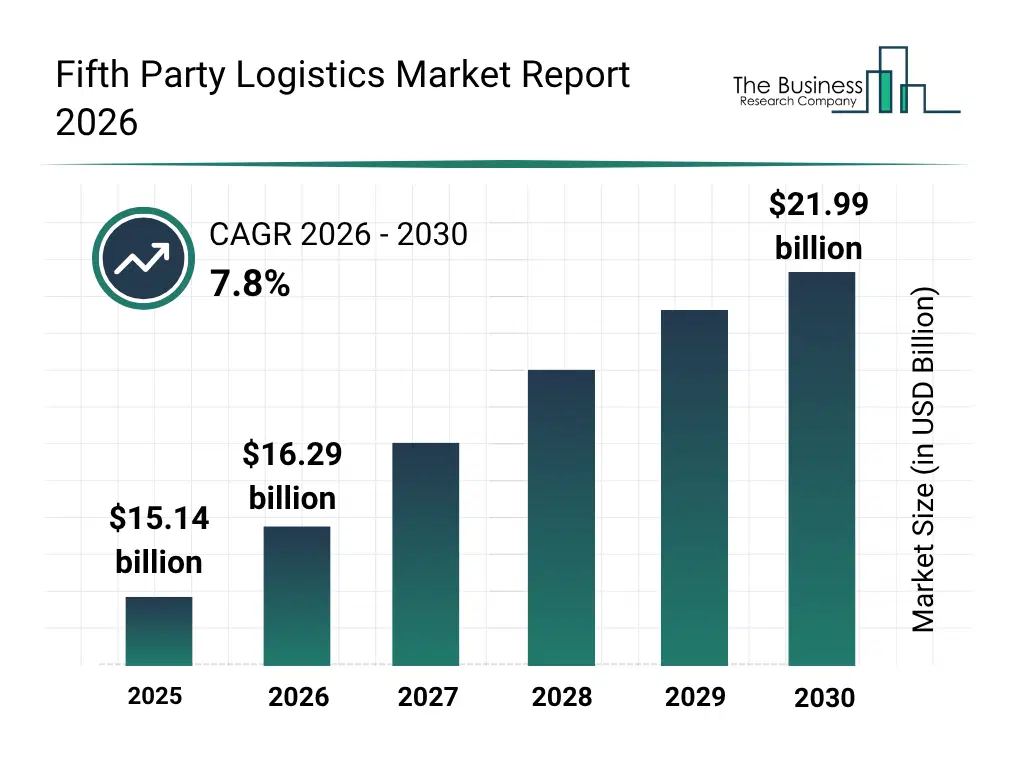
What Is The Fifth Party Logistics Market Size and Share 2026?
The fifth party logistics market size has grown strongly in recent years. It will grow from $15.14 billion in 2025 to $16.29 billion in 2026 at a compound annual growth rate (CAGR) of 7.6%. The growth in the historic period can be attributed to increasing globalization of supply chains, rising outsourcing of logistics operations, growth of e-commerce fulfillment networks, expansion of third-party logistics providers, increasing need for cost reduction in logistics operations.What Is The Fifth Party Logistics Market Growth Forecast?
The fifth party logistics market size is expected to see strong growth in the next few years. It will grow to $21.99 billion by 2030 at a compound annual growth rate (CAGR) of 7.8%. The growth in the forecast period can be attributed to growing adoption of autonomous logistics ecosystems, rising implementation of AI-driven supply chain orchestration, increasing demand for real-time logistics visibility, expansion of cross-border trade digitization, growing emphasis on sustainable and optimized supply chain networks. Major trends in the forecast period include increasing adoption of logistics orchestration platforms for multi-network integration, growing demand for end-to-end supply chain visibility solutions, rising use of predictive analytics in logistics optimization, expansion of cloud-based logistics coordination platforms, increasing integration of sustainability tracking in supply chain operations.Global Fifth Party Logistics Market Segmentation
1) By Service Type: Consulting Services, Transportation Services, Warehousing Services, Technology Services 2) By Business Model: Business To Business, Business To Consumer, Consumer To Consumer 3) By Technology: Artificial Intelligence, Blockchain, Internet Of Things, Automation 4) By Application: Supply Chain Management, Inventory Management, Transportation Management, Order Fulfillment 5) By End Use: Retail, Manufacturing, E-commerce, Healthcare Subsegments: 1) By Consulting Services: Supply Chain Strategy Consulting, Network Design And Optimization Consulting, Logistics Process Improvement Consulting, Digital Supply Chain Transformation Consulting, Risk And Compliance Consulting, Sustainability And Green Logistics Consulting 2) By Transportation Services: Freight Transportation Management, Multimodal Transportation Coordination, Carrier Procurement And Management, Route Planning And Optimization, Last Mile Delivery Management, Cross Border Transportation Management 3) By Warehousing Services: Inventory Storage Management, Distribution Center Operations Management, Order Picking And Packing Services, Cross Docking Operations, Reverse Logistics Handling, Inventory Control And Replenishment 4) By Technology Services: Supply Chain Visibility Platforms, Transportation Management System Solutions, Warehouse Management System Solutions, Data Analytics And Demand Forecasting Solutions, Digital Integration Platforms, Cloud Based Logistics Management SolutionsWhat Are The Drivers Of The Fifth Party Logistics Market?
The increasing expansion of e-commerce is expected to propel the growth of the fifth party logistics market going forward. E-commerce is the buying and selling of goods and services over the internet, including online transactions, digital payments, and electronic order fulfillment. The expansion of e-commerce is driven by growing internet penetration, rising smartphone usage, shifting consumer preferences toward online shopping, and the convenience of digital payments and home delivery options. Fifth party logistics supports e-commerce by managing end-to-end supply chain operations, including warehousing, inventory management, order fulfillment, last-mile delivery, and returns processing, ensuring faster, more efficient, and cost-effective delivery of products to online consumers. For instance, in February 2025, according to the U.S. Census Bureau, a US-based government statistics agency, retail e-commerce sales in the fourth quarter of 2024 reached $352.9 billion on a not adjusted basis, up 9.3% from the fourth quarter of 2023, while total retail sales increased 4.5% over the same period. Therefore, the increasing expansion of e-commerce is expected to drive the growth of the fifth party logistics industry. The expansion of digital logistics platforms is expected to propel the growth of the fifth party logistics market going forward. Digital logistics platforms are technology-driven systems that integrate, manage, and optimize the end-to-end movement of goods, data, and information across supply chains in real time. The adoption of digital logistics platforms is increasing as businesses demand real-time visibility, cost efficiency, and seamless coordination across fragmented logistics networks. Fifth party logistics supports the expansion of digital logistics platforms by orchestrating multiple carriers, warehouses, and digital systems into a unified control layer that enhances coordination and execution at scale. For instance, in 2025, according to FreightAmigo, a Hong Kong-based digital logistics platform, the adoption of digital logistics platforms has increased significantly, enabling centralized operations and reducing logistics costs by up to 30% through AI-driven optimization and automation. Therefore, the expansion of digital logistics platforms is expected to drive the growth of the fifth party logistics industry.Key Players In The Global Fifth Party Logistics Market
Major companies operating in the fifth party logistics market are Amazon.com Inc., United Parcel Service Inc., DHL Group (DHL Supply Chain & Global Forwarding), Kuehne + Nagel International AG, DSV A/S, J.B. Hunt Transport Services Inc., Expeditors International of Washington Inc., TFI International Inc., C.H. Robinson Worldwide Inc., GXO Logistics Inc., InPost sp. z o.o., Ryder System Inc., Schneider National Inc., Delhivery Limited, ArcBest Corporation, RXO Inc., Universal Logistics Holdings Inc., GoFreight, Inbound Logistics, FM Logistic.Global Fifth Party Logistics Market Trends and Insights
Major companies operating in the fifth party logistics market are focusing on acceleration of automation across warehouses and fulfillment operations, such as warehouse orchestration platforms, to improve coordination across robotic systems, warehouse software, and fulfillment workflows and to gain a competitive advantage. Warehouse orchestration platforms are digital control layers that connect automation tools, data systems, and execution processes to manage inventory movement, task allocation, and real-time workflow adjustments across fulfillment environments. For instance, in February 2024, DHL Supply Chain, a Germany-based logistics company, introduced its warehouse orchestration approach for 2024 as part of a broader automation push across its operations. The solution uses advanced data analytics and machine learning, standardized integration and orchestration layers, and real-time workflow optimization to connect existing and new technologies into a more responsive supply chain. DHL stated that early deployments reduced implementation time by up to 60%, showing how automation is becoming more scalable and operationally valuable in this market.Regional Insights
North America was the largest region in the fifth party logistics market in 2025. Asia-Pacific is expected to be the fastest-growing region in the forecast period. The regions covered in this market report are Asia-Pacific, South East Asia, Western Europe, Eastern Europe, North America, South America, Middle East, Africa. The countries covered in this market report are Australia, Brazil, China, France, Germany, India, Indonesia, Japan, Taiwan, Russia, South Korea, UK, USA, Canada, Italy, Spain.What Defines the Fifth Party Logistics Market?
The fifth party logistics market consists of revenues earned by entities by providing services such as freight forwarding, customs clearance, last-mile delivery, reverse logistics, demand planning, procurement management, vendor management, and packaging and labeling. The market value includes the value of related goods sold by the service provider or included within the service offering. Only goods and services traded between entities or sold to end consumers are included.How is Market Value Defined and Measured?
The market value is defined as the revenues that enterprises gain from the sale of goods and/or services within the specified market and geography through sales, grants, or donations in terms of the currency (in USD unless otherwise specified). The revenues for a specified geography are consumption values that are revenues generated by organizations in the specified geography within the market, irrespective of where they are produced. It does not include revenues from resales along the supply chain, either further along the supply chain or as part of other products.What Key Data and Analysis Are Included in the Fifth Party Logistics Market Report 2026?
The fifth party logistics market research report is one of a series of new reports from The Business Research Company that provides market statistics, including industry global market size, regional shares, competitors with the market share, detailed market segments, market trends and opportunities, and any further data you may need to thrive in the fifth party logistics industry. The market research report delivers a complete perspective of everything you need, with an in-depth analysis of the current and future state of the industry.Fifth Party Logistics Market Report Forecast Analysis
| Report Attribute | Details |
|---|---|
| Market Size Value In 2026 | $16.29 billion |
| Revenue Forecast In 2035 | $21.99 billion |
| Growth Rate | CAGR of 7.6% from 2026 to 2035 |
| Base Year For Estimation | 2025 |
| Actual Estimates/Historical Data | 2020-2025 |
| Forecast Period | 2026 - 2030 - 2035 |
| Market Representation | Revenue in USD Billion and CAGR from 2026 to 2035 |
| Segments Covered | Service Type, Business Model, Technology, Application, End Use |
| Regional Scope | Asia-Pacific, Western Europe, Eastern Europe, North America, South America, Middle East, Africa |
| Country Scope | The countries covered in the report are Australia, Brazil, China, France, Germany, India, ... |
| Key Companies Profiled | Amazon.com Inc., United Parcel Service Inc., DHL Group (DHL Supply Chain & Global Forwarding), Kuehne + Nagel International AG, DSV A/S, J.B. Hunt Transport Services Inc., Expeditors International of Washington Inc., TFI International Inc., C.H. Robinson Worldwide Inc., GXO Logistics Inc., InPost sp. z o.o., Ryder System Inc., Schneider National Inc., Delhivery Limited, ArcBest Corporation, RXO Inc., Universal Logistics Holdings Inc., GoFreight, Inbound Logistics, FM Logistic. |
| Customization Scope | Request for Customization |
| Pricing And Purchase Options | Explore Purchase Options |