

Energy Storage For Unmanned Aerial Vehicles (UAVs) Global Market Opportunities And Strategies To 2035
By Type (Lithium-Ion Batteries, Lead-Acid Batteries, Nickel-Metal Hydride Batteries, Solid State Batteries, Ultracapacitors), By Product (Battery, Fuel Cell), By Capacity (0-10 Kilowatt-Hour, 10-50 Kilowatt-Hour, 50-100 Kilowatt-Hour, 100- 200 Kilowatt-Hour, > 200 Kilowatt-Hour), By Distribution (Original Equipment Manufacturers (OEMs), Aftermarket Sales, Direct Sales, Specialized Integrators, Online Retailers), By Application (Military And Defense, Commercial Logistics And Delivery, Agriculture And Forestry, Infrastructure Inspection And Monitoring, Entertainment And Media), And By Region, Opportunities And Strategies – Global Forecast To 2035
Energy storage for Unmanned Aerial Vehicles (UAVs) Market Definition
Energy storage for Unmanned Aerial Vehicles (UAVs) refers to the systems and technologies that store electrical energy used to power UAV propulsion, onboard electronics, sensors, and auxiliary systems. These energy storage systems convert stored chemical or electrostatic energy into electrical energy that drives motors and supports flight control, communication, and payload operations. The energy storage for unmanned aerial vehicles (UAVs) market consists of sales by entities (organizations, sole traders, or partnerships) of batteries, fuel cells, and hybrid systems powering drones for extended flight times.
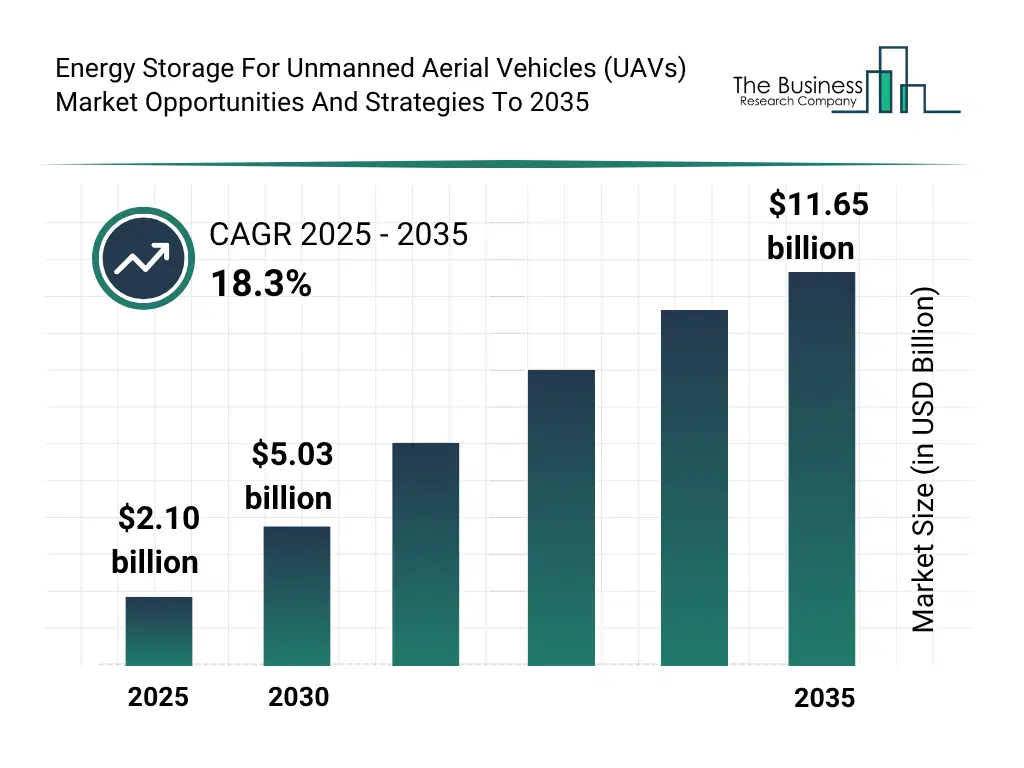
Energy storage for Unmanned Aerial Vehicles (UAVs) Market Size
The global energy storage for unmanned aerial vehicles (UAVs) market reached a value of nearly $2,103.7 million in 2025, having grown at a compound annual growth rate (CAGR) of 20.9% since 2020. The market is expected to grow from $2,103.7 million in 2025 to $5,029.2 million in 2030 at a rate of 19.0%. The market is then expected to grow at a CAGR of 18.3% from 2030 and reach $11,647.4 million in 2035. Growth in the historic period resulted from the rising demand for unmanned delivery services, high demand for security and surveillance applications, increased demand for military drones and growing regulatory support for UAV operations. Factors that negatively affected growth in the historic period were volatility in lithium prices and high cost of advanced energy storage systems. Going forward, the rising demand for commercial drones, rising incorporation of UAVs in precision agriculture, enhanced payload and performance requirements and rise in advancements in battery technologies will drive the growth. Factors that could hinder the growth of the energy storage for unmanned aerial vehicles (UAVs) market in the future include impact of trade war and tariff, limited energy density of batteries and long charging times and downtime.Energy Storage For Unmanned Aerial Vehicles (Uavs) Market Segmentation
The energy storage for unmanned aerial vehicles (UAVs) market is segmented by type, by product, by capacity, by distribution and by application.By Type –
The energy storage for unmanned aerial vehicles (UAVs) market is segmented by type into:
- a) Lithium-Ion Batteries
- b) Lead-Acid Batteries
- c) Nickel-Metal Hydride Batteries
- d) Solid State Batteries
- e) Ultracapacitors
By Product –
The energy storage for unmanned aerial vehicles (UAVs) market is segmented by product into:
- a) Battery
- b) Fuel Cell
By Capacity –
The energy storage for unmanned aerial vehicles (UAVs) market is segmented by capacity into:
- a) 0-10 Kilowatt-Hour
- b) 10-50 Kilowatt-Hour
- c) 50-100 Kilowatt-Hour
- d) 100- 200 Kilowatt-Hour
- e) >200 Kilowatt-Hour
By Distribution –
The energy storage for unmanned aerial vehicles (UAVs) market is segmented by distribution into:
- a) Original Equipment Manufacturers (OEMS)
- b) Aftermarket Sales
- c) Direct Sales
- d) Specialized Integrators
- e) Online Retailers
By Application –
The energy storage for unmanned aerial vehicles (UAVs) market is segmented by application into:
- a) Military And Defense
- b) Commercial Logistics And Delivery
- c) Agriculture And Forestry
- d) Infrastructure Inspection And Monitoring
- e) Entertainment And Media
By Geography - The energy storage for unmanned aerial vehicles (UAVs)market is segmented by geography into:
- • China
- • India
- • Japan
- • Australia
- • Indonesia
- • South Korea
- • USA
- • Canada
- • Brazil
- • France
- • Germany
- • UK
- • Italy
- • Spain
- • Russia
-
o Asia Pacific
o Africa