
Energy Security Market Report 2026
Global Outlook – By Component (Hardware, Software, Services), By Cybersecurity (Physical Security, Cybersecurity Measures, Data Protection, Other Cybersecurities), By Infrastructure (Power Plants, Transmission Lines, Distribution Networks, Storage Facilities, Other Infrastructures), By Source (Fossil Fuels, Renewable Energy, Nuclear Energy, Other Sources), By End-User (Energy And Utility Companies, Government And Defense, Industrial And Commercial, Information Technology (IT) And Telecommunication) – Market Size, Trends, Strategies, and Forecast to 2035
Energy Security Market Overview
• Energy Security market size has reached to $192.16 billion in 2025 • Expected to grow to $301.72 billion in 2030 at a compound annual growth rate (CAGR) of 9.5% • Growth Driver: Rising Global Energy Demand Fueling The Growth Of The Energy Security Market Due To Rapid Industrialization • Market Trend: Advancing Scenario-based Energy Transition Planning To Strengthen Long-term Energy Security And System Resilience • Asia-Pacific was the largest region and fastest growing region.
What Is Covered Under Energy Security Market?
Energy security is the uninterrupted availability of energy sources at affordable and stable prices. It encompasses the protection of energy infrastructure, supply chains, and distribution systems from physical, cyber, and geopolitical risks. It also emphasizes the development of resilient systems capable of withstanding disruptions, ensuring long-term reliability, stability, and sustainable access to energy. The main components of energy security are hardware, software, and services. Hardware solutions are specialized systems designed to protect energy infrastructure, ensure operational continuity, and safeguard critical assets against threats. The different cybersecurity include physical security, cybersecurity measures, data protection, and others. The multiple infrastructures include power plants, transmission lines, distribution networks, storage facilities, and others, and use various energy sources, including fossil fuels, renewable energy, nuclear energy, and others, and they are used by several end users such as energy and utility companies, government and defense, industrial and commercial, and information technology (IT) and telecommunication.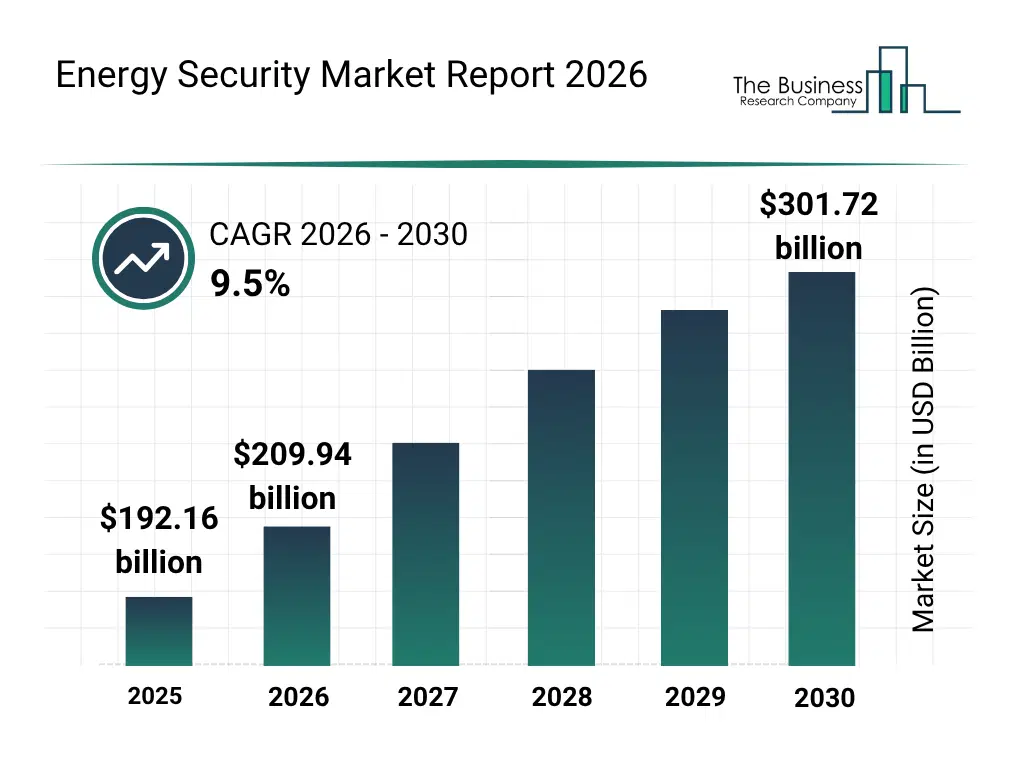
What Is The Energy Security Market Size and Share 2026?
The energy security market size has grown strongly in recent years. It will grow from $192.16 billion in 2025 to $209.94 billion in 2026 at a compound annual growth rate (CAGR) of 9.3%. The growth in the historic period can be attributed to increasing global energy demand, rising geopolitical tensions affecting supply chains, expansion of centralized power infrastructure, growing frequency of grid failures, increasing dependence on fossil fuel imports.What Is The Energy Security Market Growth Forecast?
The energy security market size is expected to see strong growth in the next few years. It will grow to $301.72 billion by 2030 at a compound annual growth rate (CAGR) of 9.5%. The growth in the forecast period can be attributed to accelerating transition to renewable energy systems, rising integration of AI in energy management, increasing investment in grid modernization, growing adoption of distributed energy resources, expansion of cross-border energy interconnections. Major trends in the forecast period include increasing deployment of smart grid resilience systems, rising investment in cyber-physical energy security solutions, growing adoption of predictive risk assessment in energy infrastructure, expansion of decentralized energy storage networks, rising focus on real-time grid monitoring and fault detection.Global Energy Security Market Segmentation
1) By Component: Hardware, Software, Services 2) By Cybersecurity: Physical Security, Cybersecurity Measures, Data Protection, Other Cybersecurities 3) By Infrastructure: Power Plants, Transmission Lines, Distribution Networks, Storage Facilities, Other Infrastructures 4) By Source: Fossil Fuels, Renewable Energy, Nuclear Energy, Other Sources 5) By End-User: Energy And Utility Companies, Government And Defense, Industrial And Commercial, Information Technology (IT) And Telecommunication Subsegments: 1) By Hardware: Smart Grid Equipment, Energy Storage Systems, Power Generation Equipment, Transmission And Distribution Equipment, Monitoring And Surveillance Devices, Control Systems, Backup Power Systems, Physical Security Equipment 2) By Software: Energy Management Software, Grid Management Software, Risk Assessment Software, Cybersecurity Software, Data Analytics Software, Asset Management Software, Incident Response Software, Predictive Maintenance Software 3) By Services: Consulting Services, Integration And Deployment Services, Maintenance And Support Services, Risk Management Services, Security Assessment Services, Training And Education Services, Monitoring Services, Managed Security ServicesWhat Is The Driver Of The Energy Security Market?
The rising global energy demand is expected to propel the growth of the energy security market going forward. Energy is the power derived from natural resources such as fossil fuels, renewables, and nuclear sources, used to generate electricity, fuel transportation, and support industrial, residential, and commercial activities worldwide. The increase in global energy demand is driven by rapid industrialization, as expanding manufacturing activities and large-scale production require substantial energy to operate machinery, power facilities, and sustain continuous operations. Energy security supports the management of rising energy demand by ensuring a stable, reliable, and diversified supply of energy resources to meet growing consumption without disruptions or shortages. For instance, in March 2024, according to the International Renewable Energy Agency (IRENA), a UAE-based non-profit organization, U.S. renewable energy capacity increased from 356,413 megawatts (MW) in 2022 to 387,549 megawatts (MW) in 2023, representing an 8.7% year-on-year increase. Therefore, the rising global energy demand is driving the growth of the energy security industry.Key Players In The Global Energy Security Market
Major companies operating in the energy security market are Siemens AG, Cisco Systems Inc., Johnson Controls International plc, Raytheon Technologies Corporation, Lockheed Martin Corporation, IBM Corporation, General Electric Company, Schneider Electric SE, Northrop Grumman Corporation, ABB Ltd, BAE Systems PLC, Eaton Corporation plc, Thales Group S.A., Emerson Electric Co., Rockwell Automation, Inc., Tapestry Solutions, Inc., Black And Veatch Holdings Company, Tenable Network Security Inc., COPA-DATA GmbH, Nozomi Networks Inc., AlertEnterprise Inc., IOActive LLC, Future Fibre Technologies Pty Ltd, Xage Security Inc.Global Energy Security Market Trends and Insights
Major companies operating in the energy security market are focusing on strategic scenario frameworks such as energy transition pathway analyses to strengthen energy resilience, ensure reliable supply, and support long-term sustainable energy systems. Energy transition pathway analyses are systematic evaluations of scenarios and strategies for shifting energy systems from fossil fuel dependence to low-carbon and renewable sources over time to achieve sustainability and climate goals. For instance, in February 2026, Shell plc, a UK-based energy and petrochemical company, launched its latest Shell Scenarios Sketch titled India’s Energy Transition in a Security-Focused Age. The India-focused analysis outlines three future scenarios, Archipelagos, Surge, and Horizon, examining how the country can meet rapidly rising energy demand while strengthening energy security, affordability, reliability, and decarbonization. The framework highlights the growing role of renewable energy, electrification, low-carbon fuels, natural gas, and carbon capture technologies in building a resilient and secure energy system while supporting long-term competitiveness and climate goals.What Are Latest Mergers And Acquisitions In The Energy Security Market?
In May 2024, Sunoco LP, a US-based energy infrastructure and fuel distribution company, acquired NuStar Energy L.P. for an undisclosed amount. Through this acquisition, Sunoco aims to strengthen its fuel transportation and storage infrastructure, enhance financial stability, and improve operational efficiencies through anticipated expense and commercial synergies. NuStar Energy L.P. is a US-based midstream infrastructure company that functions as a critical link in energy security, primarily focusing on the safe, reliable transportation and storage of liquid fuels.Regional Insights
North America was the largest region in the energy security market in 2025. Asia-Pacific is expected to be the fastest-growing region in the forecast period. The regions covered in this market report are Asia-Pacific, South East Asia, Western Europe, Eastern Europe, North America, South America, Middle East, Africa. The countries covered in this market report are Australia, Brazil, China, France, Germany, India, Indonesia, Japan, Taiwan, Russia, South Korea, UK, USA, Canada, Italy, Spain.What Defines the Energy Security Market?
The energy security market consists of revenues earned by entities by providing services such as risk assessment and analysis, energy infrastructure monitoring, grid security management, cybersecurity services, threat intelligence services, and energy risk advisory services. The market value includes the value of related goods sold by the service provider or included within the service offering. The energy security market also includes sales of backup generators, uninterruptible power supply systems, battery energy storage systems, smart meters, grid monitoring sensors, surveillance cameras, access control systems, perimeter security fencing, transformers, circuit breakers, substations, and microgrid controllers. Values in this market are ‘factory gate’ values, that is the value of goods sold by the manufacturers or creators of the goods, whether to other entities (including downstream manufacturers, wholesalers, distributors and retailers) or directly to end customers. The value of goods in this market includes related services sold by the creators of the goods.How is Market Value Defined and Measured?
The market value is defined as the revenues that enterprises gain from the sale of goods and/or services within the specified market and geography through sales, grants, or donations in terms of the currency (in USD unless otherwise specified). The revenues for a specified geography are consumption values that are revenues generated by organizations in the specified geography within the market, irrespective of where they are produced. It does not include revenues from resales along the supply chain, either further along the supply chain or as part of other products.What Key Data and Analysis Are Included in the Energy Security Market Report 2026?
The energy security market research report is one of a series of new reports from The Business Research Company that provides market statistics, including industry global market size, regional shares, competitors with the market share, detailed market segments, market trends and opportunities, and any further data you may need to thrive in the energy security industry. The market research report delivers a complete perspective of everything you need, with an in-depth analysis of the current and future state of the industry.Energy Security Market Report Forecast Analysis
| Report Attribute | Details |
|---|---|
| Market Size Value In 2026 | $209.94 billion |
| Revenue Forecast In 2035 | $301.72 billion |
| Growth Rate | CAGR of 9.3% from 2026 to 2035 |
| Base Year For Estimation | 2025 |
| Actual Estimates/Historical Data | 2020-2025 |
| Forecast Period | 2026 - 2030 - 2035 |
| Market Representation | Revenue in USD Billion and CAGR from 2026 to 2035 |
| Segments Covered | Component, Cybersecurity, Infrastructure, Source, End-User |
| Regional Scope | Asia-Pacific, Western Europe, Eastern Europe, North America, South America, Middle East, Africa |
| Country Scope | The countries covered in the report are Australia, Brazil, China, France, Germany, India, ... |
| Key Companies Profiled | Siemens AG, Cisco Systems Inc., Johnson Controls International plc, Raytheon Technologies Corporation, Lockheed Martin Corporation, IBM Corporation, General Electric Company, Schneider Electric SE, Northrop Grumman Corporation, ABB Ltd, BAE Systems PLC, Eaton Corporation plc, Thales Group S.A., Emerson Electric Co., Rockwell Automation, Inc., Tapestry Solutions, Inc., Black And Veatch Holdings Company, Tenable Network Security Inc., COPA-DATA GmbH, Nozomi Networks Inc., AlertEnterprise Inc., IOActive LLC, Future Fibre Technologies Pty Ltd, Xage Security Inc. |
| Customization Scope | Request for Customization |
| Pricing And Purchase Options | Explore Purchase Options |