
Contact Us
  Search
The Business Research Company Logo
Electric Bus Global Market Opportunities And Strategies To 2035
Published :May 2026
Pages :361
Format :PDF
Delivery Time :2-3 Business Days
Why 2-3 days? We update the report with the latest data and news before delivery. Let us know if you need us to expedite.
Report Price :$4,490.00

Electric Bus Global Market Opportunities And Strategies To 2035

By Type (Battery Electric Vehicle, Plug-In Hybrid Electric Vehicle, Fuel Cell Electric Vehicle), By Battey Type (Lithium-Nickel-Manganese-Cobalt-Oxide, Lithium-Iron-Phosphate, Other Battery Types), By Vehicle Range (Less Than 200 Miles, Above 200 Miles), By Battery Capacity (Upto 400 Kwh, Above 400 Kwh), By Application (Intercity, Intracity), And By Region, Opportunities And Strategies – Global Forecast To 2035

Electric Bus Market Definition

An electric bus refers to a bus that is powered fully or primarily by electricity instead of conventional fossil fuels such as diesel or petrol. Electric buses are utilized by public transportation agencies, school systems, private shuttle operators and commercial fleet services to transport passengers across various distances and environments, from dense urban areas to intercity corridors. The electric bus market consists of sales, by entities (organizations, sole traders, or partnerships) that are commonly deployed during regular transit schedules, school runs and employee transportation operations. They serve as a sustainable alternative to diesel and gas-powered buses and are often used in response to environmental regulations, cost-saving strategies and public health initiatives.
Research Expert

Book your 30 minutes free consultation with our research experts

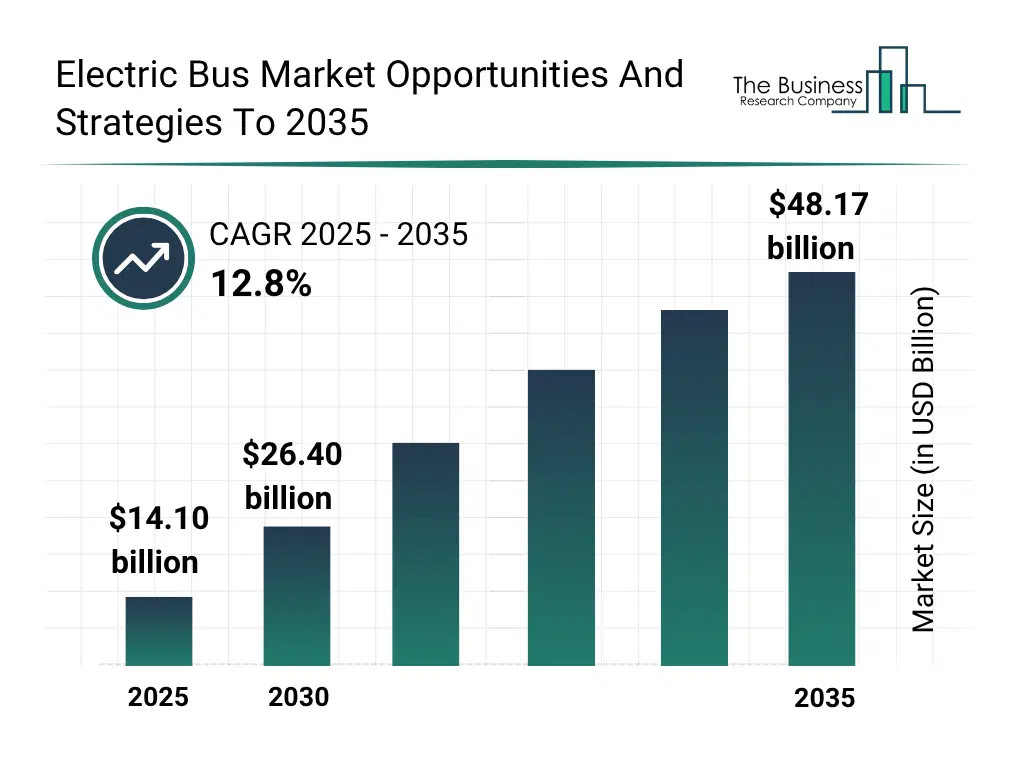
Electric Bus Global Market Opportunities And Strategies To 2035 Market Size and growth rate 2025 to 2030: Graph

Electric Bus Market Size

The global electric bus market reached a value of nearly $14,102.4 million in 2025, having grown at a compound annual growth rate (CAGR) of 4.2% since 2020. The market is expected to grow from $14,102.4 million in 2025 to $26,402.1 million in 2030 at a rate of 13.4%. The market is then expected to grow at a CAGR of 12.8% from 2030 and reach $48,165.8 million in 2035. Growth in the historic period resulted from rise in environmental awareness, rising fuel prices, expansion of smart city initiatives and government-backed electric bus tender programs. Factors that negatively affected growth in the historic period were high initial procurement costs and infrastructure readiness challenges in rural cities. Going forward, expansion of charging infrastructure, rising global public transit spending, stringent zero emission mandates and regulations and corporate and municipal net-zero commitments will drive the growth. Factors that could hinder the growth of the electric bus market in the future include operational and maintenance complexity, limited driving range for high-utilization routes and impact of trade war and tariff.

Electric Bus Market Segmentation

The electric bus market is segmented by type, by battery type, by vehicle range, by battery capacity and by application.

By Type –
The electric bus market is segmented by type into:
    • a) Battery Electric Vehicle
    • b) Plug-In Hybrid Electric Vehicle
    • c) Fuel Cell Electric Vehicle
The electric bus market is segmented by type into battery electric vehicle, plug-in hybrid electric vehicle and fuel cell electric vehicle. The battery electric vehicle market was the largest segment of the electric bus market segmented by type, accounting for 85.4% or $12,045.2 million of the total in 2025. Going forward, the fuel cell electric vehicle segment is expected to be the fastest-growing segment in the electric bus market segmented by type, at a CAGR of 20.7% during 2025-2030.

By Battery Type –
The electric bus market is segmented by battery type into:
    • a) Lithium-Nickel-Manganese-Cobalt-Oxide
    • b) Lithium-Iron-Phosphate
    • c) Other Battery Types
The lithium-iron-phosphate market was the largest segment of the electric bus market segmented by battery type, accounting for 70.3% or $9,918.5 million of the total in 2025. Going forward, the other battery types segment is expected to be the fastest-growing segment in the electric bus market segmented by battery type, at a CAGR of 19.7% during 2025-2030.

By Vehicle Range –
The electric bus market is segmented by vehicle range into:
    • a) Less Than 200 Miles
    • b) Above 200 Miles
The less than 200 miles market was the largest segment of the electric bus market segmented by vehicle range, accounting for 78.8% or $11,111.6 million of the total in 2025. Going forward, the above 200 miles segment is expected to be the fastest-growing segment in the electric bus market segmented by vehicle range, at a CAGR of 17.6% during 2025-2030.

By Battery Capacity –
The electric bus market is segmented by battery capacity into:
  1. a) Upto 400 KWh
  2. b) Above 400 KWh
The upto 400 kWh market was the largest segment of the electric bus market segmented by battery capacity, accounting for 72.2% or $10,184.0 million of the total in 2025. Going forward, the above 400 kWh segment is expected to be the fastest-growing segment in the electric bus market segmented by battery capacity, at a CAGR of 17.7% during 2025-2030.

By Application –
The electric bus market is segmented by application into:
  1. a) Intercity
  2. b) Intracity
The intracity market was the largest segment of the electric bus market segmented by application, accounting for 81.1% or $11,439.8 million of the total in 2025. Going forward, the intracity segment is expected to be the fastest-growing segment in the electric bus market segmented by application, at a CAGR of 14.5% during 2025-2030.

By Geography - The electric bus market is segmented by geography into:
      o Asia Pacific
      • • China
      • • India
      • • Japan
      • • Australia
      • • Indonesia
      • • South Korea
      o North America
      • • USA
      • • Canada
      o South America
      • • Brazil
      o Western Europe
      • • France
      • • Germany
      • • UK
      • • Italy
      • • Spain
      o Eastern Europe
      • • Russia
      o Middle East
      o Africa
Asia-Pacific was the largest region in the electric bus market, accounting for 64.6% or $9,107.1 million of the total in 2025. It was followed by Western Europe, North America and then the other regions. Going forward, the fastest-growing regions in the electric bus market will be Middle East and Africa where growth will be at CAGRs of 26.5% and 23.4% respectively. These will be followed by South America and Eastern Europe where the markets are expected to grow at CAGRs of 23.1% and 20.1% respectively.

Electric Bus Market Drivers

The key drivers of the electric bus market include: Expansion Of Charging Infrastructure Expansion of charging infrastructure is expected to be a key driver of the growth of the electric bus market in the forecast period. As charging availability improves at depots and along transit corridors, fleet operators will gain greater confidence in adopting electric buses without compromising route reliability or service frequency. This improved operational readiness will translate into stronger demand for electric bus models with varied battery capacities and charging compatibility, encouraging manufacturers to expand their product portfolios. While charging infrastructure itself lies outside the vehicle market, its growth directly supports higher electric bus procurement by enabling smoother integration of electric buses into daily transit operations. The expansion of charging infrastructure growth contribution during the forecast period in 2025 is 3.0%.

Electric Bus Market Restraints

The key restraints on the electric bus market include: Operational And Maintenance Complexity Operational and maintenance complexity is restricting the growth of the electric bus market during the forecast period. Electric buses involve high-voltage systems, battery health management and specialized diagnostics that require trained personnel and new maintenance protocols. Fleet operators may face challenges related to staff training, spare parts availability and system integration, which can disrupt operations during the transition phase. These complexities can discourage adoption, particularly among operators with limited technical capacity, thereby slowing the widespread uptake of electric buses. Growth affected by the operational and maintenance complexity during the forecast period in 2025 is -0.5%.

Electric Bus Market Competitive Landscape

Major Competitors are:

  • Zhengzhou Yutong Bus Co. Ltd.
  • BYD Company Limited
  • King Long United Automotive Industry Co. Ltd. (Xiamen King Long Motor Group Co., Ltd.)
  • NFI Group Inc.
  • Volvo Inc.
  • Other Competitors Include:

  • Wrightbus
  • VDL Group
  • Scania AB
  • Foton Motor Group
  • Mercedes (Daimler Buses)
  • BYD Co. Ltd.
  • Dongfeng Motor Corporation
  • Sinotruk Hong Kong Limited
  • King Long United Automotive Industry Co. Ltd.
  • Zhongtong Bus & Holding Company Ltd.
  • Nanjing Golden Dragon Bus (SKYWELL)
  • Higer Bus Company Limited
  • Zhuhai Guangtong Automobile Co. Ltd. (GEMBUS)
  • Shenzhen Wuzhoulong Motors Co. Ltd.
  • Xiamen King Long United Automotive Industry Co. Ltd.
  • Yaxing Motor Coach Co. Ltd.
  • Toyota Group
  • Hino Motors
  • Hyundai Motor Company
  • Woojin Industrial Systems
  • KGM Commercial
  • Zyle Daewoo Bus
  • Tata Motors Limited
  • Ashok Leyland Limited
  • Switch Mobility
  • Olectra Greentech Limited
  • JBM Auto Limited
  • Eicher Motors Limited
  • VinFast
  • FAW Motors
  • Karsan
  • MAN Truck & Bus AG
  • VDL Groep
  • Ebusco
  • Alexander Dennis Limited
  • CAF Group
  • Solaris Bus & Coach S.A.
  • Volvo Group
  • Daimler AG
  • Scania AB
  • SOR Libchavy
  • Škoda Transportation
  • BMC
  • Bozankaya
  • Otokar
  • TEMSA
  • GAZ Group
  • KAMAZ
  • Electroputere Bus
  • Ursus Bus
  • Blue Bird Corporation
  • Edison Motors
  • Nova Bus
  • The Lion Electric Company
  • GreenPower Motor Company Inc.
  • Gillig LLC
  • Proterra Inc.
  • Motiv Power Systems Inc.
  • Thomas Built Buses
  • Eletra
  • Marcopolo
  • Volvo Buses
  • Mercedes-Benz do Brasil
  • ROCTRO
  • Golden Arrow Bus Services
  • Shuttlers
  • Need data on a specific region in this market?

    Opportunities And Recommendations In The Electric Bus Market

    Opportunities – The top opportunities in the electric bus market segmented by type will arise in the battery electric vehicle segment, which will gain $11,095.3 million of global annual sales by 2030. The top opportunities in the electric bus market segmented by battery type will arise in the lithium-iron-phosphate segment, which will gain $11,001.3 million of global annual sales by 2030. The top opportunities in the electric bus market segmented by vehicle range will arise in the less than 200 miles segment, which will gain $8,571.8 million of global annual sales by 2030. The top opportunities in the electric bus market segmented by battery capacity will arise in the upto 400 kWh segment, which will gain $7,361.8 million of global annual sales by 2030. The top opportunities in the electric bus market segmented by application will arise in the intracity segment, which will gain $11,052.0 million of global annual sales by 2030. The electric bus market size will gain the most in China at $3,089.6 million. Recommendations- To take advantage of the opportunities, The Business Research Company recommends the electric bus companies to focus on scaling battery electric bus platforms to meet zero-emission demand, focus on high-capacity modular electric coach chassis for long-range operations, focus on plug-in hybrid platforms as a transitional growth strategy, focus on fuel cell electric buses to address long-range zero-emission demand, focus on corporate employee transport to expand BEV bus deployment, focus on fuel cell electric buses to capture the fastest-growing propulsion segment, focus on emerging battery chemistries to capture the fastest growth, focus on above-200-mile range electric buses to capture high-growth demand, focus on above-400 kWh battery capacity electric buses to accelerate growth, expand in emerging markets, continue to focus on developed markets, focus on localized and institutional distribution expansion, focus on total cost–based and contract-linked pricing, focus on total cost and public value messaging, focus on demonstration-led and stakeholder engagement promotion and focus on intracity electric bus deployment for scalable growth.
    Chat with us