
Contact Us
  Search
The Business Research Company Logo
Drug-Coated Balloons For Coronary Artery Disease Global Market Opportunities And Strategies To 2035
Published :May 2026
Pages :304
Format :PDF
Delivery Time :2-3 Business Days
Why 2-3 days? We update the report with the latest data and news before delivery. Let us know if you need us to expedite.
Report Price :$4,490.00

Drug-Coated Balloons For Coronary Artery Disease Global Market Opportunities And Strategies To 2035

By Drug Type (Paclitaxel-Coated DCBs, Limus-Coated DCBs), By End-User (Hospitals, Cardiac Catheterization Labs, Ambulatory Surgical Centers, Other End-Users), And By Region, Opportunities And Strategies – Global Forecast To 2035

Drug-Coated Balloons For Coronary Artery Disease Market Definition

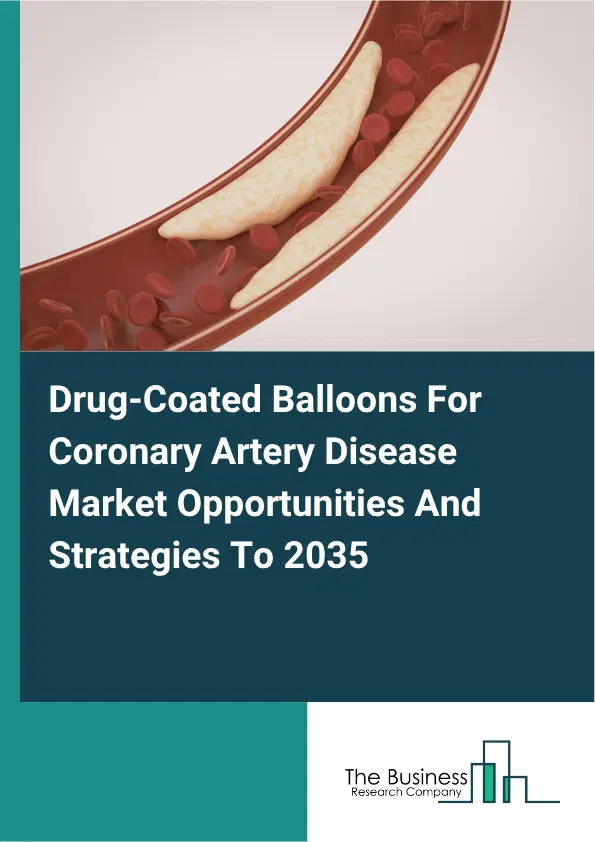
Drug-coated balloons (DCBs) for coronary artery disease (CAD) refer to a category of interventional cardiovascular devices designed to treat narrowed or blocked coronary arteries through percutaneous coronary intervention (PCI). The primary purpose of DCBs in CAD treatment is to restore proper blood flow in diseased coronary arteries while minimizing the need for permanent implants like stents. The drug-coated balloons for coronary artery disease market consists of sales, by entities (organizations, sole traders, or partnerships) that are used by interventional cardiologists and are deployed during PCI procedures commonly performed in hospitals, cardiac catheterization labs and, in some cases, ambulatory surgical centers. They are used at the time of balloon angioplasty, where the device is introduced via catheter, navigated to the lesion, inflated to dilate the artery and concurrently release the drug to prevent re-narrowing.
Research Expert

Book your 30 minutes free consultation with our research experts

Drug-Coated Balloons For Coronary Artery Disease Global Market Opportunities And Strategies To 2035 Market Size and growth rate 2025 to 2030: Graph

Drug-Coated Balloons For Coronary Artery Disease Market Size

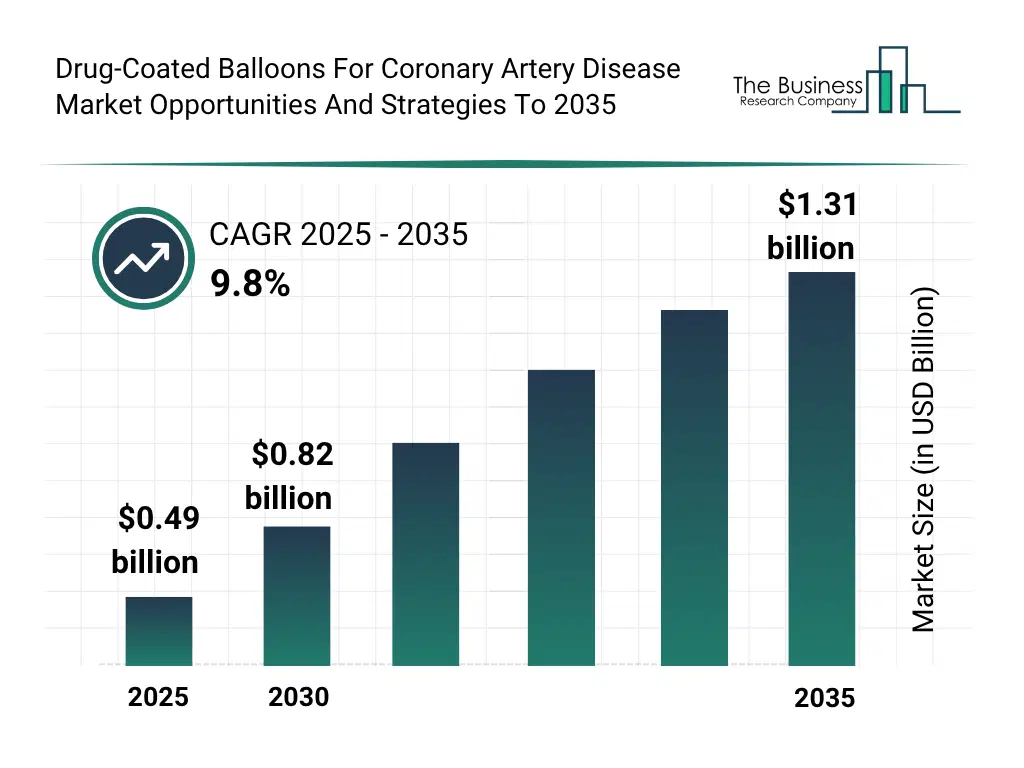
The global drug-coated balloons for coronary artery disease market reached a value of nearly $494.2 million in 2025, having grown at a compound annual growth rate (CAGR) of 14.8% since 2020. The market is expected to grow from $494.2 million in 2025 to $820.7 million in 2030 at a rate of 10.7%. The market is then expected to grow at a CAGR of 9.8% from 2030 and reach $1,311.8 million in 2035. Growth in the historic period resulted from the rising prevalence of coronary artery disease (CAD), higher exposure to smoking and air pollution, growing prevalence of hypertension and dyslipidemia and increasing health-insurance coverage. Factors that negatively affected growth in the historic period were competition from alternative therapies and shortage of skilled professionals. Going forward, growing government funding for cardiovascular programs, increasing burden of diabetes and obesity, increasing rates of sedentary lifestyle and unhealthy diets and growth of private hospital networks will drive the growth. Factors that could hinder the growth of the drug-coated balloons for coronary artery disease market in the future include limited patient awareness of DCB treatment option lack of universal guideline support, and impact of trade war and tariffs.

Drug-Coated Balloons For Coronary Artery Disease Market Segmentation

The drug-coated balloons for coronary artery disease market is segmented by type, by end-user.

By Drug Type –
The drug-coated balloons for coronary artery disease market is segmented by drug type into:
    • a) Paclitaxel-Coated DCBs
    • b) Limus-Coated DCBs
The paclitaxel-coated DCBs market was the largest segment of the drug-coated balloons for coronary artery disease market segmented by drug type, accounting for 96.0% or $474.5 million of the total in 2025. Going forward, the limus-coated DCBs segment is expected to be the fastest growing segment in the drug-coated balloons for coronary artery disease market segmented by drug type, at a CAGR of 12.7% during 2025-2030.

By End-User –
The drug-coated balloons for coronary artery disease market is segmented by end-user into:
    • a) Hospitals
    • b) Cardiac Catheterization Labs
    • c) Ambulatory Surgical Centers
    • d) Other End-Users
The hospitals market was the largest segment of the drug-coated balloons for coronary artery disease market segmented by end user, accounting for 51.1% or $252.8 million of the total in 2025. Going forward, the cardiac catheterization labs segment is expected to be the fastest growing segment in the drug-coated balloons for coronary artery disease market segmented by end user, at a CAGR of 14.1% during 2025-2030.

By Geography - The drug-coated balloons for coronary artery disease market is segmented by geography into:
      o Asia Pacific
      • • China
      • • India
      • • Japan
      • • Australia
      • • Indonesia
      • • South Korea
      o North America
      • • USA
      • • Canada
      o South America
      • • Brazil
      o Western Europe
      • • France
      • • Germany
      • • UK
      • • Italy
      • • Spain
      o Eastern Europe
      • • Russia
      o Middle East
      o Africa
Western Europe was the largest region in the drug-coated balloons for coronary artery disease market, accounting for 55.7% or $275.4 million of the total in 2025. It was followed by Asia Pacific, North America and then the other regions. Going forward, the fastest-growing regions in the drug-coated balloons for coronary artery disease market will be Africa and Middle East where growth will be at CAGRs of 19.1% and 18.4% respectively. These will be followed by Latin America and North America where the markets are expected to grow at CAGRs of 18.0% and 14.6% respectively.

Drug-Coated Balloons For Coronary Artery Disease Market Drivers

The key drivers of the drug-coated balloons for coronary artery disease market include: Increasing Burden Of Diabetes And Obesity During the forecast period, the surge in the increasing burden of diabetes and obesity will propel the growth of the drug-coated balloons for coronary artery disease market. Rising levels of obesity and type 2 diabetes contribute directly to the development of atherosclerosis, endothelial dysfunction and arterial plaque buildup, all of which significantly heighten the risk of coronary artery disease. Individuals with diabetes and obesity experience accelerated vascular damage driven by insulin resistance, elevated blood glucose, chronic inflammation and abnormal lipid metabolism, factors that greatly increase the likelihood of requiring coronary interventions. Moreover, the global shift toward sedentary lifestyles, high-calorie diets and rapid urbanization continues to push obesity and diabetes rates upward across many regions. As countries face growing metabolic health challenges and a larger population enters high-risk cardiovascular categories, the demand for effective, minimally invasive coronary treatment options such as drug-coated balloons rises substantially, thereby driving the growth of the drug-coated balloons for coronary artery disease market. The surge in the increasing burden of diabetes and obesity the forecast period in 2025 is 1.50%.

Drug-Coated Balloons For Coronary Artery Disease Market Restraints

The key restraints on the drug-coated balloons for coronary artery disease market include: Lack Of Universal Guideline Support Lack of universal guideline support is restricting the growth of the drug-coated balloons for coronary artery disease market during the forecast period. The absence of widely accepted, standardized clinical guidelines for the use of drug-coated balloons (DCBs) in coronary interventions limits physician confidence and adoption, particularly in regions where cardiology protocols rely heavily on traditional stenting or bypass procedures. Without clear consensus and guideline backing, cardiologists may hesitate to recommend DCB therapy and payers or insurers may be reluctant to reimburse it, reducing market uptake. Moreover, regulatory bodies and hospital committees often prefer established procedures over newer technologies without guideline endorsement, which slows integration of DCBs into mainstream treatment protocols. As a result, despite clinical potential, the adoption of drug-coated balloons remains constrained in many markets, thereby restraining the growth of the drug-coated balloons for coronary artery disease market. Growth affected by lack of universal guideline support during the forecast period in 2025 is -2.40%.

Drug-Coated Balloons For Coronary Artery Disease Market Competitive Landscape

Major Competitors are:

  • B. Braun Melsungen AG
  • Boston Scientific Corporation
  • BIOTRONIK SE & Co. KG
  • Cordis Corporation (MedAlliance)
  • Meril Life Sciences Pvt. Ltd
  • Other Competitors Include:

  • Acotec Scientific Holdings., Ltd.
  • Medtronic plc
  • Blue Sail Medical
  • OrbusNeich Medical Company Ltd.
  • MicroPort Scientific Corporation
  • Shenqi Medical
  • Sichuan Xingtai Pule
  • Shanghai MicroPort Medical (Group) Co., Ltd.
  • BrosMed
  • Concept Medical
  • Nano Therapeutics Pvt Ltd.
  • Envision Scientific
  • Philips
  • DK Medical (Dissolve)
  • Translumina
  • Minvasys
  • Eurocor GmbH
  • iVascular
  • Abbott Cardiovascular
  • BD (Becton, Dickinson and Company)
  • Concept Medical
  • EUROCOR S.A
  • iVascular
  • Philips (Koninklijke Philips N.V.)
  • Terumo Corporation
  • Concept Medical
  • Need data on a specific region in this market?

    Opportunities And Recommendations In The Drug-Coated Balloons For Coronary Artery Disease Market

    Opportunities – The top opportunities in the drug-coated balloons for coronary artery disease market segmented By Drug Type will arise in the paid service membership segment, which will gain $1,255.0 million of global annual sales by 2030. The top opportunities in the drug-coated balloons for coronary artery disease market segmented by application will arise in the mobile devices segment, which will gain $1,250.1 million of global annual sales by 2030. The top opportunities in the drug-coated balloons for coronary artery disease market segmented by end user will arise in the individual segment, which will gain $1,078.6 million of global annual sales by 2030. The drug-coated balloons for coronary artery disease market size will gain the most in the USA at $508.1 million. Recommendations- To take advantage of the opportunities, The Business Research Company recommends the drug-coated balloons for coronary artery disease companies to focus on sirolimus-based innovation backed by clinical evidence, focus on large-scale comparative evidence to expand clinical adoption, focus on next-generation DCB versatility across lesion types, focus on dual-track DCB portfolios balancing scale and innovation, focus on channel expansion into specialized and outpatient cardiac care, focus on value-based and setting-specific pricing discipline, focus on evidence-led clinical promotion to drive adoption, focus on procedure-focused promotion across care settings, focus on shifting growth toward specialized and outpatient care settings.
    Chat with us