

Directed Energy Weapons Global Market Opportunities And Strategies To 2035
By Product (Lethal Weapons, Non-Lethal Weapons), By Technology (High Energy Laser, High Power Microwave, Electromagnetic Weapons, Sonic Weapons), By End-User (Land, Airborne, Naval), And By Region, Opportunities And Strategies – Global Forecast To 2035
Directed Energy Weapons Market Definition
Directed energy weapons (DEWs) are advanced weapon systems that use focused energy, such as lasers, high-power microwaves, or particle beams, to damage, disable, or destroy targets. Instead of firing physical projectiles, DEWs deliver energy at the speed of light, enabling precise engagement with minimal collateral damage. The primary purpose of DEWs is to provide rapid, precise, and scalable defensive and offensive capabilities, particularly against threats like drones, missiles, rockets, and electronic systems. The directed energy weapons market consists of sales, by entities (organizations, sole traders, or partnerships) that are deployed in various operational domains on land-based vehicles and installations, naval platforms, and airborne systems. They are used in defensive operations to protect troops, installations, or platforms from incoming threats like drones, missiles, and mortars, and in offensive operations to neutralize enemy assets while minimizing collateral damage. DEWs are also employed in crowd control and area denial missions where non-lethal force is desired.
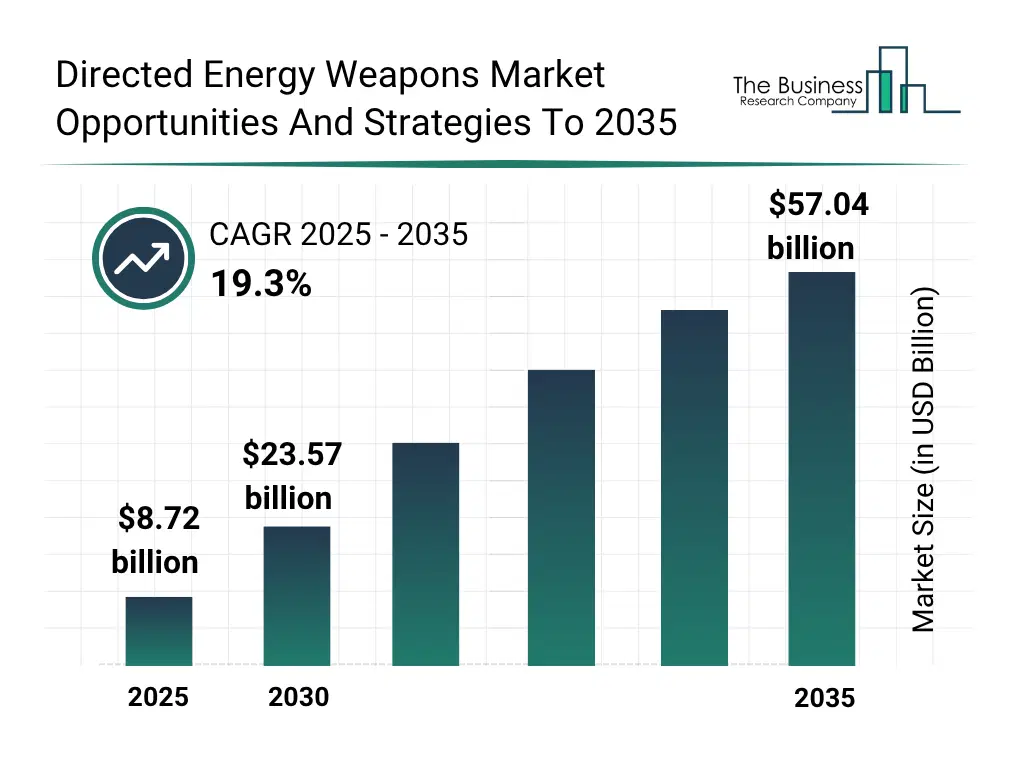
Directed Energy Weapons Market Size
The global directed energy weapons market reached a value of nearly $8,716.4 million in 2025, having grown at a compound annual growth rate (CAGR) of 15.3% since 2020. The market is expected to grow from $8,716.4 million in 2025 to $23,567.8 million in 2030 at a rate of 22.0%. The market is then expected to grow at a CAGR of 19.3% from 2030 and reach $57,042.5 million in 2035. Growth in the historic period resulted from rising government investment on defense expenditure, increasing frequency of drone swarm attacks, increasing adoption of counter-UAS and short-range air-defense (SHORAD) modernization programs and rising threats from hypersonic and advanced missile systems. Factors that negatively affected growth in the historic period were significant power and cooling requirements and high initial development, integration, and deployment costs. Going forward, shift toward asymmetric warfare tactics, rising geopolitical tensions, increasing demand for advanced missile and drone defense and growing focus on national security and border protection will drive the growth. Factor that could hinder the growth of the directed energy weapons market in the future include line-of-sight engagement limitations, budget prioritization challenges and impact of trade war and tariff.Directed Energy Weapons Market Segmentation
The directed energy weapons market is segmented by product, by technology and by end user.By Type –
The directed energy weapons market is segmented by type into:
- a) Lethal Weapons
- b) Non-Lethal Weapons
By Technology –
The directed energy weapons market is segmented by technology into:
- a) High Energy Laser
- b) High Power Microwave
- c) Electromagnetic Weapons
- d) Sonic Weapons
By End User –
The directed energy weapons market is segmented by end user into:
- a) Land
- b) Airborne
- c) Naval
By Geography - The directed energy weapons market is segmented by geography into:
- • China
- • India
- • Japan
- • Australia
- • Indonesia
- • South Korea
- • USA
- • Canada
- • Brazil
- • France
- • Germany
- • UK
- • Italy
- • Spain
- • Russia
-
o Asia Pacific
o Africa