
Digital Twins For Industry 4.0 Market Report 2026
Global Outlook – By Component (Software, Hardware, Services ), By Digital Twin Type (Product Digital Twin, Process Digital Twin, System Digital Twin, Asset Digital Twin, Performance Digital Twin ), By Deployment Mode (Cloud-Based, On-Premises, Hybrid ), By Application (Predictive Maintenance, Product Design And Development, Business And Operational Optimization, Inventory Management And Supply Chain, Virtual Commissioning ), By End-Use Industry (Aerospace And Defense, Automotive And Transportation, Manufacturing, Energy And Utilities, Healthcare And Pharmaceuticals, Oil And Gas ) – Market Size, Trends, Strategies, and Forecast to 2035
Digital Twins For Industry 4.0 Market Overview
• Digital Twins For Industry 4.0 market size has reached to $21.32 billion in 2025 • Expected to grow to $36.61 billion in 2030 at a compound annual growth rate (CAGR) of 11.5% • Growth Driver: Surge In Adoption Of Iot Devices Fueling The Growth Of The Market Due To Expansion Of Real-Time Data Monitoring And Connected Infrastructure • Market Trend: Advancements In AI-Powered Digital Twin Platforms Enhance Industrial Simulation And Operational Efficiency • North America was the largest region in 2025 and Asia-Pacific is the fastest growing region.
What Is Covered Under Digital Twins For Industry 4.0 Market?
Digital twins for Industry 4.0 are digital representations of physical assets, equipment, production systems, or complete industrial operations to replicate and simulate real-world performance. Their primary objective is to track system performance, anticipate potential failures, streamline operations, and support informed decision-making. Digital twins for Industry 4.0, enabling predictive maintenance and process simulation, improve efficiency, minimize downtime, and drive intelligent, data-centric manufacturing within Industry 4.0 ecosystems. The main components of digital twins for Industry 4.0 are software, hardware, and services. Software refers to platforms that enable the creation, simulation, and analysis of virtual models of products, processes, systems, and assets, facilitating real-time monitoring, predictive insights, and operational optimization across industrial environments. They are classified by digital twin type into product digital twin, process digital twin, system digital twin, asset digital twin, and performance digital twin. Deployment is carried out through cloud-based, on-premises, and hybrid modes. They find application in predictive maintenance, product design and development, business and operational optimization, inventory management and supply chain, virtual commissioning, serving end users including aerospace and defense, automotive and transportation, manufacturing, energy and utilities, healthcare and pharmaceuticals, and oil and gas.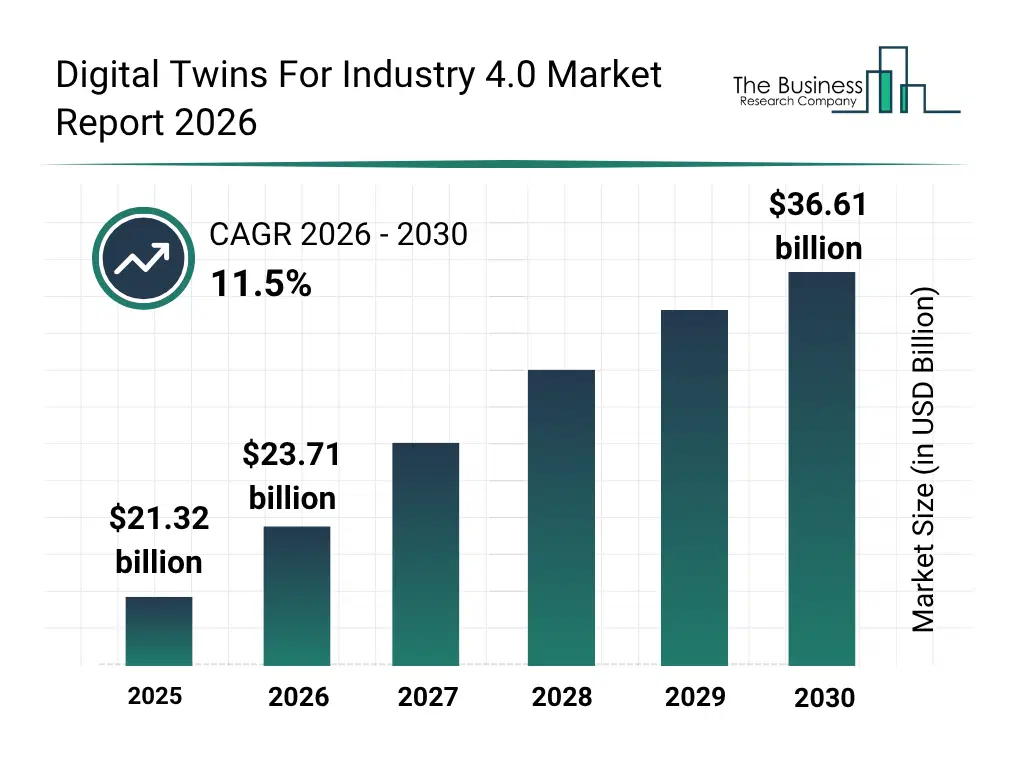
What Is The Digital Twins For Industry 4.0 Market Size and Share 2026?
The digital twins for industry 4.0 market size has grown rapidly in recent years. It will grow from $21.32 billion in 2025 to $23.71 billion in 2026 at a compound annual growth rate (CAGR) of 11.2%. 0 size has grown rapidly in recent years. The growth in the historic period can be attributed to increasing adoption of automation in manufacturing, growing need for operational efficiency, expansion of industrial IoT deployment, rising demand for predictive maintenance, increasing digital transformation in factories.What Is The Digital Twins For Industry 4.0 Market Growth Forecast?
The digital twins for industry 4.0 market size is expected to see rapid growth in the next few years. It will grow to $36.61 billion by 2030 at a compound annual growth rate (CAGR) of 11.5%. 0 market size is expected to see rapid growth in the next few years. The growth in the forecast period can be attributed to growing adoption of AI-driven simulation models, increasing use of cloud-native industrial platforms, rising demand for real-time operational monitoring, expansion of smart factories and connected ecosystems, growing integration of edge computing with industrial systems. Major trends in the forecast period include increasing adoption of real-time digital twin simulation platforms, rising use of predictive maintenance through virtual asset modeling, growing integration of industrial IoT sensors with digital twin systems, expansion of cloud-based digital twin deployment models, rising demand for virtual commissioning in manufacturing operations.Global Digital Twins For Industry 4.0 Market Segmentation
1) By Component: Software, Hardware, Services 2) By Digital Twin Type: Product Digital Twin, Process Digital Twin, System Digital Twin, Asset Digital Twin, Performance Digital Twin 3) By Deployment Mode: Cloud-Based, On-Premises, Hybrid 4) By Application: Predictive Maintenance, Product Design And Development, Business And Operational Optimization, Inventory Management And Supply Chain, Virtual Commissioning 5) By End-Use Industry: Aerospace And Defense, Automotive And Transportation, Manufacturing, Energy And Utilities, Healthcare And Pharmaceuticals, Oil And Gas Subsegments: 1) By Software: Digital Twin Modeling Platforms, Simulation And Scenario Analysis Tools, Data Integration And Interoperability Platforms, Artificial Intelligence And Machine Learning Enabled Analytics, Visualization And Three Dimensional Rendering Software, Application Lifecycle Management Integration Software, Predictive Maintenance Software, Asset Performance Management Software 2) By Hardware: Industrial Internet Of Things Sensors, Smart Actuators And Controllers, Programmable Logic Controllers, Supervisory Control And Data Acquisition Systems, Industrial Robotics Systems, Embedded Systems And Microcontrollers, Edge Computing Devices, Data Acquisition Systems 3) By Services: Consulting And Strategy Development Services, System Integration Services, Deployment And Implementation Services, Customization And Configuration Services, Maintenance And Support Services, Managed Digital Twin Services, Data Analytics And Optimization Services, Training And Education ServicesWhat Is The Driver Of The Digital Twins For Industry 4.0 Market?
The increasing adoption of IoT devices is expected to propel the growth of digital twins for the Industry 4.0 market going forward. IoT devices are physical objects embedded with sensors, software, and connectivity that enable them to collect, exchange, and act on data over the internet. The rise in adoption of IoT devices is driven by real-time data monitoring, as they enable continuous tracking of assets and systems and support faster, data-based decision-making. Digital twins for Industry 4.0 help IoT devices by transforming real-time sensor data into dynamic virtual models that enable predictive insights, performance optimization, and proactive maintenance. For instance, in November 2025, according to the Office of Communications (Ofcom), a UK-based government agency, the number of active IoT devices connected via mobile networks in the UK increased from approximately 24.9 million in 2023 to 26.5 million in 2024. Therefore, the increasing adoption of IoT devices is driving the growth of digital twins for the Industry 4.0 market.Key Players In The Global Digital Twins For Industry 4.0 Market
Major companies operating in the digital twins for industry 4.0 market are Google LLC, Microsoft Corporation, Amazon Web Services Inc., Robert Bosch GmbH, Siemens AG, International Business Machines Corporation, NVIDIA Corporation, Oracle Corporation, Cisco Systems Inc., Schneider Electric SE, Honeywell International Inc., SAP SE, GE Vernova Inc., ABB Ltd, Emerson Electric Co., Rockwell Automation Inc., Dassault Systèmes SE, Autodesk Inc., PTC Inc., Bentley Systems Incorporated, Pepperl+Fuchs SE, Akselos SA.Global Digital Twins For Industry 4.0 Market Trends and Insights
Major companies operating in the digital twins for the Industry 4.0 market are focusing on developing innovative solutions, such as AI-driven digital twin platforms, to improve real-time monitoring, predictive maintenance, and operational efficiency. AI-driven digital twin platforms are advanced software systems that use artificial intelligence to create and analyze virtual replicas of physical assets, processes, or systems for real-time monitoring, simulation, and optimization. For instance, in April 2025, Rockwell Automation, Inc., a US-based provider of industrial automation and control systems, launched Emulate3D Factory Test, an AI-powered digital twin platform showcased at Hannover Messe 2025 that leverages NVIDIA Omniverse APIs to simulate and test complete factory operations virtually before real-world deployment. The solution combines mechanical, electrical, and automation systems into a unified model, enabling synchronized testing, detailed visualization, and workflow validation in a risk-free environment. This platform improves traditional simulation by offering full-factory modeling, automated testing, and advanced analytics, making digital twin technology more practical for complex industrial operations.What Are Latest Mergers And Acquisitions In The Digital Twins For Industry 4.0 Market?
In March 2025, Siemens AG, a Germany-based industrial automation company, acquired Altair Engineering Inc. for approximately USD 10 billion. With this acquisition, Siemens aims to strengthen its leadership in simulation and industrial artificial intelligence (AI) by enhancing its digital twin capabilities, expanding high-performance computing (HPC) and data science offerings, and creating the world’s most complete AI-powered portfolio of industrial software through its Siemens Xcelerator platform. Altair Engineering Inc. is a US-based provider of digital twin technologies and platforms that support Industry 4.0 use cases across design, manufacturing, operation, and lifecycle optimization.Regional Insights
North America was the largest region in the digital twins for Industry 4.0 market in 2025. Asia-Pacific is expected to be the fastest-growing region in the forecast period. The regions covered in this market report are Asia-Pacific, South East Asia, Western Europe, Eastern Europe, North America, South America, Middle East, Africa. The countries covered in this market report are Australia, Brazil, China, France, Germany, India, Indonesia, Japan, Taiwan, Russia, South Korea, UK, USA, Canada, Italy, Spain.What Defines the Digital Twins For Industry 4.0 Market?
The digital twins for the Industry 4.0 market consist of revenues earned by entities by providing services such as simulation and scenario testing, remote asset monitoring and control, product lifecycle management integration, and energy consumption optimization. The market value includes the value of related goods sold by the service provider or included within the service offering. The digital twins for the Industry 4.0 market also include sales of edge computing devices, programmable logic controllers (PLCs), Industrial IoT gateways, and smart industrial cameras. Values in this market are ‘factory gate’ values; that is, the value of goods sold by the manufacturers or creators of the goods, whether to other entities (including downstream manufacturers, wholesalers, distributors, and retailers) or directly to end customers. The value of goods in this market includes related services sold by the creators of the goods.How is Market Value Defined and Measured?
The market value is defined as the revenues that enterprises gain from the sale of goods and/or services within the specified market and geography through sales, grants, or donations in terms of the currency (in USD unless otherwise specified). The revenues for a specified geography are consumption values that are revenues generated by organizations in the specified geography within the market, irrespective of where they are produced. It does not include revenues from resales along the supply chain, either further along the supply chain or as part of other products.What Key Data and Analysis Are Included in the Digital Twins For Industry 4.0 Market Report 2026?
The digital twins for industry 4.0 market research report is one of a series of new reports from The Business Research Company that provides market statistics, including industry global market size, regional shares, competitors with the market share, detailed market segments, market trends and opportunities, and any further data you may need to thrive in the digital twins for industry 4.0 industry. The market research report delivers a complete perspective of everything you need, with an in-depth analysis of the current and future state of the industry.Digital Twins For Industry 4.0 Market Report Forecast Analysis
| Report Attribute | Details |
|---|---|
| Market Size Value In 2026 | $23.71 billion |
| Revenue Forecast In 2035 | $36.61 billion |
| Growth Rate | CAGR of 11.2% from 2026 to 2035 |
| Base Year For Estimation | 2025 |
| Actual Estimates/Historical Data | 2020-2025 |
| Forecast Period | 2026 - 2030 - 2035 |
| Market Representation | Revenue in USD Billion and CAGR from 2026 to 2035 |
| Segments Covered | Component, Digital Twin Type, Deployment Mode, Application, End-Use Industry |
| Regional Scope | Asia-Pacific, Western Europe, Eastern Europe, North America, South America, Middle East, Africa |
| Country Scope | The countries covered in the report are Australia, Brazil, China, France, Germany, India, ... |
| Key Companies Profiled | Google LLC, Microsoft Corporation, Amazon Web Services Inc., Robert Bosch GmbH, Siemens AG, International Business Machines Corporation, NVIDIA Corporation, Oracle Corporation, Cisco Systems Inc., Schneider Electric SE, Honeywell International Inc., SAP SE, GE Vernova Inc., ABB Ltd, Emerson Electric Co., Rockwell Automation Inc., Dassault Systèmes SE, Autodesk Inc., PTC Inc., Bentley Systems Incorporated, Pepperl+Fuchs SE, Akselos SA. |
| Customization Scope | Request for Customization |
| Pricing And Purchase Options | Explore Purchase Options |