

Digital Twin (Excluding Automotive) Global Market Opportunities And Strategies To 2035
By Type (Product Digital Twin, Process Digital Twin, System Digital Twin), By Technology (IoT, IIoT, Blockchain, Artificial Intelligence And Machine Learning, Extended Reality And Other Technology, Big Data Analytics, 5G), By Application (Land Digital Twin Applications (Excluding Automotive), Air Digital Twin Applications, Sea Digital Twin Applications), And By Region, Opportunities And Strategies – Global Forecast To 2035
Digital Twin (Excluding Automotive) Market Definition
Digital twin (excluding automotive) refers to virtual replicas of physical entities, systems, or processes that are used for simulation, analysis, monitoring and optimization across various industries. A digital twin integrates real-time data collected from sensors and connected devices to mirror the current state and behavior of its physical counterpart. These virtual models are employed across the entire lifecycle of a physical asset or system from design and production to operation and maintenance enabling predictive insights, performance optimization and risk reduction. The digital twin market (excluding automotive) market consists of sales by entities (organizations, sole traders and partnerships) of digital twin (excluding automotive) that is used within industries such as aerospace, energy and utilities, manufacturing, construction, maritime, healthcare and urban infrastructure. These users adopt digital twins to improve operational efficiency, conduct predictive maintenance, support decision-making and enhance asset reliability. Digital twins are typically used when physical systems are expensive to prototype, difficult to access, require real-time monitoring, or benefit from continuous performance optimization.
Digital Twin (Excluding Automotive) Market Size
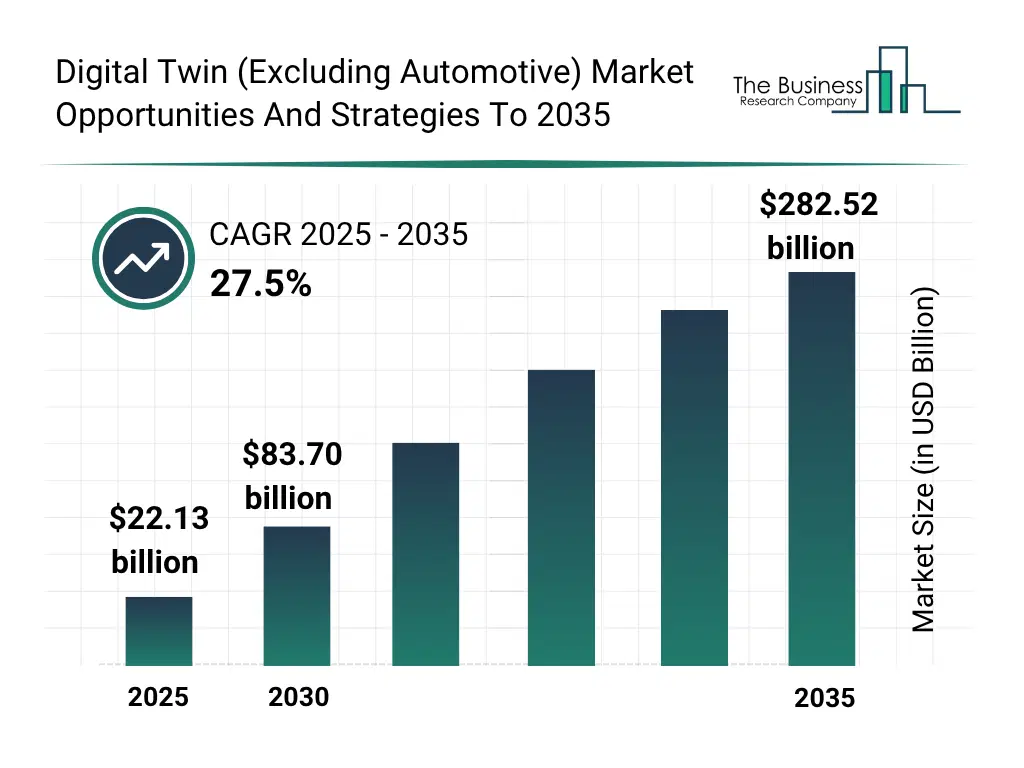
The global digital twin (excluding automotive) market reached a value of nearly $22,126.0 million in 2025, having grown at a compound annual growth rate (CAGR) of 35.0% since 2020. The market is expected to grow from $22,126.0 million in 2025 to $83,704.1 million in 2030 at a rate of 30.5%. The market is then expected to grow at a CAGR of 27.5% from 2030 and reach $282,524.9 million in 2035. Growth in the historic period resulted from the expansion of smart‑city initiatives, expansion of digital transformation strategies, growing environmental compliance and emissions monitoring mandates and increasing adoption in high-value industrial sectors. Factors that negatively affected growth in the historic period were high initial implementation costs and data security and privacy concerns. Going forward, the expansion of connected digital infrastructure, rising investment in renewable energy and smart grids, increased government funding for digital infrastructure and resilience planning and rise of low-code or no-code industrial analytics platforms will drive the growth. Factors that could hinder the growth of the digital twin (excluding automotive) market in the future include shortage of skilled professionals and expertise gaps, regulatory and compliance concerns and impact of trade war and tariffs.Digital Twin (Excluding Automotive) Market Segmentation
The digital twin market (excluding automotive) market is segmented by type, by technology, by application and by geography.By Type –
The digital twin market (excluding automotive) market is segmented by type into:
- a) Product Digital Twin
- b) Process Digital Twin
- c) System Digital Twin
By Technology –
The digital twin market (excluding automotive) market is segmented by technology into:
- a) IoT
- b) IIoT
- c) Blockchain
- d) Artificial Intelligence And Machine Learning
- e) Extended Reality And Other Technology
- f) Big Data Analytics
- g) 5G
By Application –
The digital twin market (excluding automotive) market is segmented by application into:
- a) Land Digital Twin Applications (Excluding Automotive)
- b) Air Digital Twin Applications
- c) Sea Digital Twin Applications
By Geography - The digital twin market (excluding automotive) market is segmented by geography into:
- • China
- • India
- • Japan
- • Australia
- • Indonesia
- • South Korea
- • USA
- • Canada
- • Brazil
- • France
- • Germany
- • UK
- • Italy
- • Spain
- • Russia
-
o Asia Pacific
o Africa