
Deoxyribonucleic Acid (DNA) Damage Repair Enzyme Mixes Market Report 2026
Global Outlook – By Product Type (Deoxyribonucleic Acid (DNA) Repair Enzyme Mixes, Deoxyribonucleic Acid (DNA) Restoration Kits, Base Excision Repair Enzyme Mixes, Oxidative Damage Repair Mixes, Ultraviolet Damage Repair Mixes), By Damage Type (Single Strand Break Repair, Double Strand Break Repair, Oxidative Base Damage Repair, Abasic Site Repair, Deaminated Base Repair), By Distribution Channel (Direct Sales, Distributors, Online Sales, Other Distribution Channels), By End User (Academic And Research Institutes, Pharmaceutical And Biotechnology Companies, Diagnostic Laboratories, Forensic Laboratories, Hospitals And Clinical Research Centers, Other End Users) – Market Size, Trends, Strategies, and Forecast to 2035
Deoxyribonucleic Acid (DNA) Damage Repair Enzyme Mixes Market Overview
• deoxyribonucleic acid (DNA) Damage Repair Enzyme Mixes market size has reached to $0.42 billion in 2025 • Expected to grow to $0.67 billion in 2030 at a compound annual growth rate (CAGR) of 10% • Growth Driver: The Increasing Prevalence Of Genetic Disorders Driving The Growth Of The Market Due To Higher Rates Of Inherited Mutations Across Generations • Market Trend: Advancements In Enzymatic DNA Repair Solutions Enhance Accuracy And Reliability Of Sequencing Workflows • North America was the largest region in 2025 and Asia-Pacific is the fastest growing region.
What Is Covered Under Deoxyribonucleic Acid (DNA) Damage Repair Enzyme Mixes Market?
Deoxyribonucleic acid (DNA) damage repair enzyme mixes are specialized formulations containing a combination of enzymes that detect, excise, and repair various types of damage in DNA molecules, such as breaks, mismatches, or chemically modified bases. These mixes are commonly used in molecular biology and biotechnology applications to restore DNA integrity prior to downstream processes such as polymerase chain reaction, sequencing, or cloning. The main product types of deoxyribonucleic acid (DNA) damage repair enzyme mixes include deoxyribonucleic acid (DNA) repair enzyme mixes, deoxyribonucleic acid (DNA) restoration kits, base excision repair enzyme mixes, oxidative damage repair mixes, and ultraviolet damage repair mixes. Deoxyribonucleic acid (DNA) repair enzyme mixes refer to formulations designed to recognize and enzymatically repair specific DNA damage types, ensuring genomic stability and accurate molecular research outcomes. The damage types include single strand break repair, double strand break repair, oxidative base damage repair, abasic site repair, and deaminated base repair. The distribution channels include direct sales, distributors, online sales, and other distribution channels, and they are used by several end users such as academic and research institutes, pharmaceutical and biotechnology companies, diagnostic laboratories, forensic laboratories, hospitals and clinical research centers, and other end users.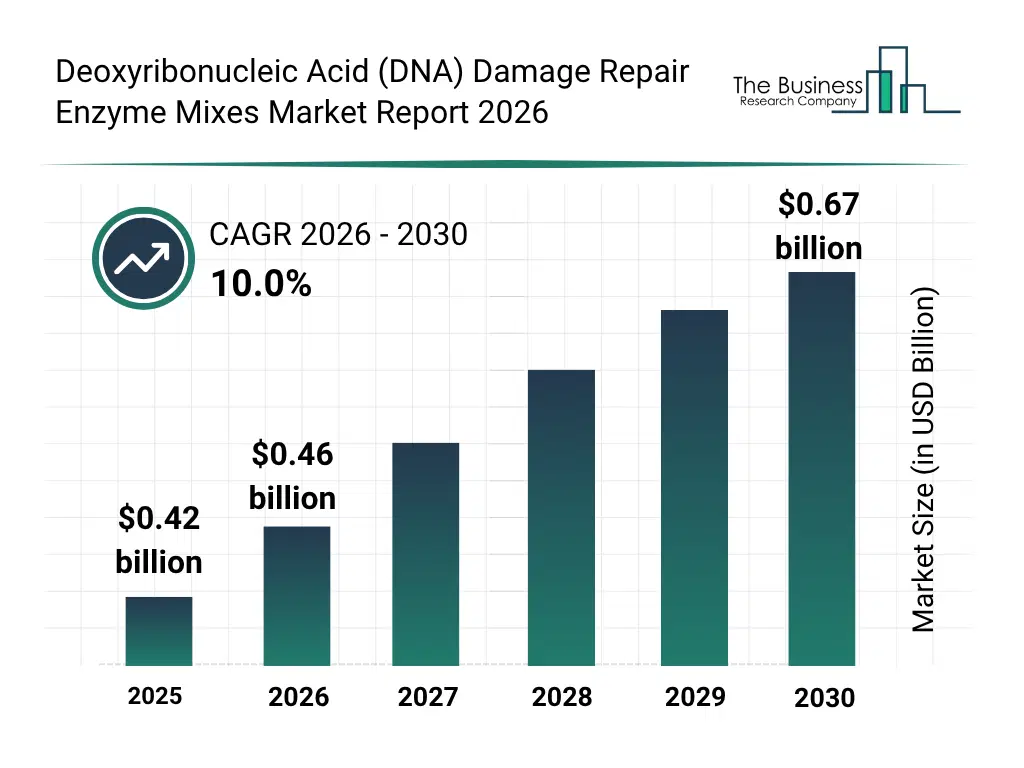
What Is The Deoxyribonucleic Acid (DNA) Damage Repair Enzyme Mixes Market Size and Share 2026?
The deoxyribonucleic acid (DNA) damage repair enzyme mixes market size has grown strongly in recent years. It will grow from $0.42 billion in 2025 to $0.46 billion in 2026 at a compound annual growth rate (CAGR) of 9.8%. The growth in the historic period can be attributed to rising demand for molecular biology research, increasing applications in genomics and sequencing, development of single enzyme repair mixes, growth of biotechnology research institutes, adoption of standard dna repair protocols.What Is The Deoxyribonucleic Acid (DNA) Damage Repair Enzyme Mixes Market Growth Forecast?
The deoxyribonucleic acid (DNA) damage repair enzyme mixes market size is expected to see rapid growth in the next few years. It will grow to $0.67 billion in 2030 at a compound annual growth rate (CAGR) of 10.0%. The growth in the forecast period can be attributed to adoption of automated dna repair platforms, integration with ai-driven genomic analytics, development of broad-spectrum repair mixes, expansion of pharmaceutical r&d, increasing demand for next-generation sequencing restoration kits. Major trends in the forecast period include next-generation dna repair kits, multi-enzyme repair solutions, automated dna damage detection, targeted base excision repair, integration with genomic analysis platforms.Global Deoxyribonucleic Acid (DNA) Damage Repair Enzyme Mixes Market Segmentation
1) By Product Type: Deoxyribonucleic Acid (DNA) Repair Enzyme Mixes, Deoxyribonucleic Acid (DNA) Restoration Kits, Base Excision Repair Enzyme Mixes, Oxidative Damage Repair Mixes, Ultraviolet Damage Repair Mixes 2) By Damage Type: Single Strand Break Repair, Double Strand Break Repair, Oxidative Base Damage Repair, Abasic Site Repair, Deaminated Base Repair 3) By Distribution Channel: Direct Sales, Distributors, Online Sales, Other Distribution Channels 4) By End User: Academic And Research Institutes, Pharmaceutical And Biotechnology Companies, Diagnostic Laboratories, Forensic Laboratories, Hospitals And Clinical Research Centers, Other End Users Subsegments: 1) By Deoxyribonucleic Acid (DNA) Repair Enzyme Mixes: Single Enzyme Repair Mixes, Multi Enzyme Repair Mixes, Broad Spectrum Repair Mixes, Target Specific Repair Mixes 2) By Deoxyribonucleic Acid (DNA) Restoration Kits: Fragmented Deoxyribonucleic Acid Repair Kits, Chemically Modified Deoxyribonucleic Acid Repair Kits, Formalin Fixed Sample Restoration Kits, Next Generation Sequencing Library Restoration Kits 3) By Base Excision Repair Enzyme Mixes: Glycosylase Based Repair Mixes, Endonuclease Based Repair Mixes, Polymerase Assisted Repair Mixes, Ligase Supported Repair Mixes 4) By Oxidative Damage Repair Mixes: Oxidized Base Repair Mixes, Reactive Oxygen Species Damage Repair Mixes, Strand Break Repair Mixes For Oxidative Damage, Comprehensive Oxidative Damage Repair Mixes 5) By Ultraviolet Damage Repair Mixes: Pyrimidine Dimer Repair Mixes, Photoproduct Repair Mixes, Excision Based Ultraviolet Repair Mixes, Comprehensive Ultraviolet Damage Repair MixesWhat Are The Drivers Of The Deoxyribonucleic Acid (DNA) Damage Repair Enzyme Mixes Market?
The increasing prevalence and improved diagnosis of genetic disorders are expected to propel the growth of the deoxyribonucleic acid (DNA) damage repair enzyme mixes market going forward. Genetic disorders are medical conditions caused by abnormalities or mutations in an individual’s genes or chromosomes, which may be inherited or arise spontaneously, including cystic fibrosis, sickle cell anemia, Down syndrome, Huntington’s disease, and hemophilia. The rising number of diagnosed cases is largely attributed to advancements in genetic screening technologies, expanded newborn and carrier testing programs, improved disease awareness, and higher patient survival rates, rather than changes in underlying mutation rates. DNA damage repair enzyme mixes play a critical role in genomic research and diagnostic workflows by improving DNA integrity and reducing sequencing errors during sample preparation and analysis. For instance, in 2023, according to the Cystic Fibrosis Trust Annual Report 2023, a UK-based charity, the number of registered cystic fibrosis patients in the UK increased from 11,148 in 2022 to 11,318 in 2023. Therefore, increasing prevalence of genetic disorders is driving the growth of the deoxyribonucleic acid (DNA) damage repair enzyme mixes industry. The growing demand for personalized medicine is expected to propel the growth of the deoxyribonucleic acid (DNA) damage repair enzyme mixes market going forward. Personalized medicine refers to medical treatments and therapies tailored to individual patients based on their genetic makeup, biomarkers, and specific disease characteristics. The demand for personalized medicine is rising due to advances in genomic technologies and molecular diagnostics, which allow doctors to tailor treatments specifically to a patient’s genetic profile and improve therapeutic outcomes. Deoxyribonucleic acid (DNA) damage repair enzyme mixes help advance personalized medicine by enabling precise detection and correction of individual genetic mutations, allowing tailored therapies based on a patient’s unique genomic profile. For instance, in February 2024, according to the Personalized Medicine Coalition, a US-based non-profit organization, the Food and Drug Administration approved 16 new personalized treatments for rare disease patients in 2023, up from six in 2022, including seven cancer drugs and three for other diseases and conditions. Therefore, the growing demand for personalized medicine is driving the growth of the deoxyribonucleic acid (DNA) damage repair enzyme mixes industry.Key Players In The Global Deoxyribonucleic Acid (DNA) Damage Repair Enzyme Mixes Market
Major companies operating in the deoxyribonucleic acid (DNA) damage repair enzyme mixes market are Thermo Fisher Scientific Inc., Merck KGaA, Agilent Technologies Inc., QIAGEN N.V., GenScript Biotech Corporation, Promega Corporation, Takara Bio Inc., R&D Systems Inc., New England Biolabs Inc., OriGene Technologies Inc., Enzo Life Sciences Inc., ABclonal Biotechnology Co Ltd., Santa Cruz Biotechnology Inc., Oxford Gene Technology Ltd., BioDynami Corporation, Apexbio Technology LLC, Creative Enzymes Inc., AffiGEN Inc., Boster Biological Technology Co Ltd., Avam Life Sciences Pvt. Ltd.Global Deoxyribonucleic Acid (DNA) Damage Repair Enzyme Mixes Market Trends and Insights
Major companies operating in the deoxyribonucleic acid (DNA) damage repair mixes market are focusing on advancing enzymatic formulations for improved DNA repair performance, such as enhanced FFPE DNA repair modules that integrate broader damage correction in preparation workflows for next‑generation sequencing. Enhanced FFPE DNA repair modules refer to enzyme-based formulations designed to more effectively correct common forms of damage in DNA derived from formalin‑fixed, paraffin‑embedded (FFPE) samples while streamlining integration with sequencing library workflows. For instance, in September 2024, New England Biolabs Inc., a United States-based biotechnology company, introduced the NEBNext FFPE DNA Repair v2 Module, which offers higher repair efficiency for cytosine deamination and oxidative lesions, a streamlined workflow requiring no intermediate cleanup, and a convenient buffer system that supports both DNA repair and downstream end‑repair steps in sequencing library preparation.Regional Insights
North America was the largest region in the deoxyribonucleic acid (DNA) damage repair enzyme mixes market in 2025. Asia-Pacific is expected to be the fastest-growing region in the forecast period. The regions covered in this market report are Asia-Pacific, South East Asia, Western Europe, Eastern Europe, North America, South America, Middle East, Africa. The countries covered in this market report are Australia, Brazil, China, France, Germany, India, Indonesia, Japan, Taiwan, Russia, South Korea, UK, USA, Canada, Italy, Spain.What Defines the Deoxyribonucleic Acid (DNA) Damage Repair Enzyme Mixes Market?
The deoxyribonucleic acid (DNA) damage repair enzyme mixes market consists of sales of Endonuclease-based repair formulations, Glycosylase-driven lesion correction mixes, double-strand break repair enzyme cocktails, mismatch repair enzyme systems, and nucleotide excision repair (NER) enzyme mixes. Values in this market are ‘factory gate’ values, that is, the value of goods sold by the manufacturers or creators of the goods, whether to other entities (including downstream manufacturers, wholesalers, distributors, and retailers) or directly to end customers. The value of goods in this market includes related services sold by the creators of the goods.How is Market Value Defined and Measured?
The market value is defined as the revenues that enterprises gain from the sale of goods and/or services within the specified market and geography through sales, grants, or donations in terms of the currency (in USD unless otherwise specified). The revenues for a specified geography are consumption values that are revenues generated by organizations in the specified geography within the market, irrespective of where they are produced. It does not include revenues from resales along the supply chain, either further along the supply chain or as part of other products.What Key Data And Analysis Are Included In The Deoxyribonucleic Acid (DNA) Damage Repair Enzyme Mixes Market Report 2026?
The deoxyribonucleic acid (dna) damage repair enzyme mixes market research report is one of a series of new reports from The Business Research Company that provides market statistics, including industry global market size, regional shares, competitors with the market share, detailed market segments, market trends and opportunities, and any further data you may need to thrive in the deoxyribonucleic acid (dna) damage repair enzyme mixes industry. The market research report delivers a complete perspective of everything you need, with an in-depth analysis of the current and future state of the industry.Deoxyribonucleic Acid (DNA) Damage Repair Enzyme Mixes Market Report Forecast Analysis
| Report Attribute | Details |
|---|---|
| Market Size Value In 2026 | $0.46 billion |
| Revenue Forecast In 2035 | $0.67 billion |
| Growth Rate | CAGR of 9.8% from 2026 to 2035 |
| Base Year For Estimation | 2025 |
| Actual Estimates/Historical Data | 2020-2025 |
| Forecast Period | 2026 - 2030 - 2035 |
| Market Representation | Revenue in USD Billion and CAGR from 2026 to 2035 |
| Segments Covered | Product Type, Damage Type, Distribution Channel, End User |
| Regional Scope | Asia-Pacific, Western Europe, Eastern Europe, North America, South America, Middle East, Africa |
| Country Scope | The countries covered in the report are Australia, Brazil, China, France, Germany, India, Indonesia, Japan, Taiwan, Russia, South Korea, UK, USA, Canada, Italy, Spain. |
| Key Companies Profiled | Thermo Fisher Scientific Inc., Merck KGaA, Agilent Technologies Inc., QIAGEN N.V., GenScript Biotech Corporation, Promega Corporation, Takara Bio Inc., R&D Systems Inc., New England Biolabs Inc., OriGene Technologies Inc., Enzo Life Sciences Inc., ABclonal Biotechnology Co Ltd., Santa Cruz Biotechnology Inc., Oxford Gene Technology Ltd., BioDynami Corporation, Apexbio Technology LLC, Creative Enzymes Inc., AffiGEN Inc., Boster Biological Technology Co Ltd., Avam Life Sciences Pvt. Ltd. |
| Customization Scope | Request for Customization |
| Pricing And Purchase Options | Explore Purchase Options |