
Contact Us
  Search
The Business Research Company Logo
Dark Factories Global Market Opportunities And Strategies To 2035
Published :May 2026
Pages :351
Format :PDF
Delivery Time :2-3 Business Days
Why 2-3 days? We update the report with the latest data and news before delivery. Let us know if you need us to expedite.
Report Price :$4,490.00

Dark Factories Global Market Opportunities And Strategies To 2035

By Type (Industrial Robotics, Additive Manufacturing, Industrial Internet Of Things (IIOT), Automated Guided Vehicles (AGVs)), By Deployment (Greenfield Projects, Brownfield Projects), By End User (Automotive, Pharmaceuticals, Aerospace, Electronics, Other End-Users), And By Region, Opportunities And Strategies – Global Forecast To 2035

Dark Factories Market Definition

Dark factories refer to fully automated manufacturing facilities that operate with minimal or no human intervention on the shop floor. These facilities are designed to function 24/7, utilizing advanced technologies such as industrial robotics, intelligent automation systems, and real-time data analytics to perform a wide range of manufacturing operations autonomously. The dark factories market consists of sales, by entities (organizations, sole traders, or partnerships), of dark factories that used by industries with high-volume production needs or those requiring high levels of precision and efficiency. Users include companies in sectors such as automotive, pharmaceuticals, aerospace, electronics, and other high-tech manufacturing industries. These facilities are used throughout the manufacturing cycle from raw material handling to final product assembly, inspection, and packaging typically in operations where consistency, safety, and scalability are critical.
Research Expert

Book your 30 minutes free consultation with our research experts

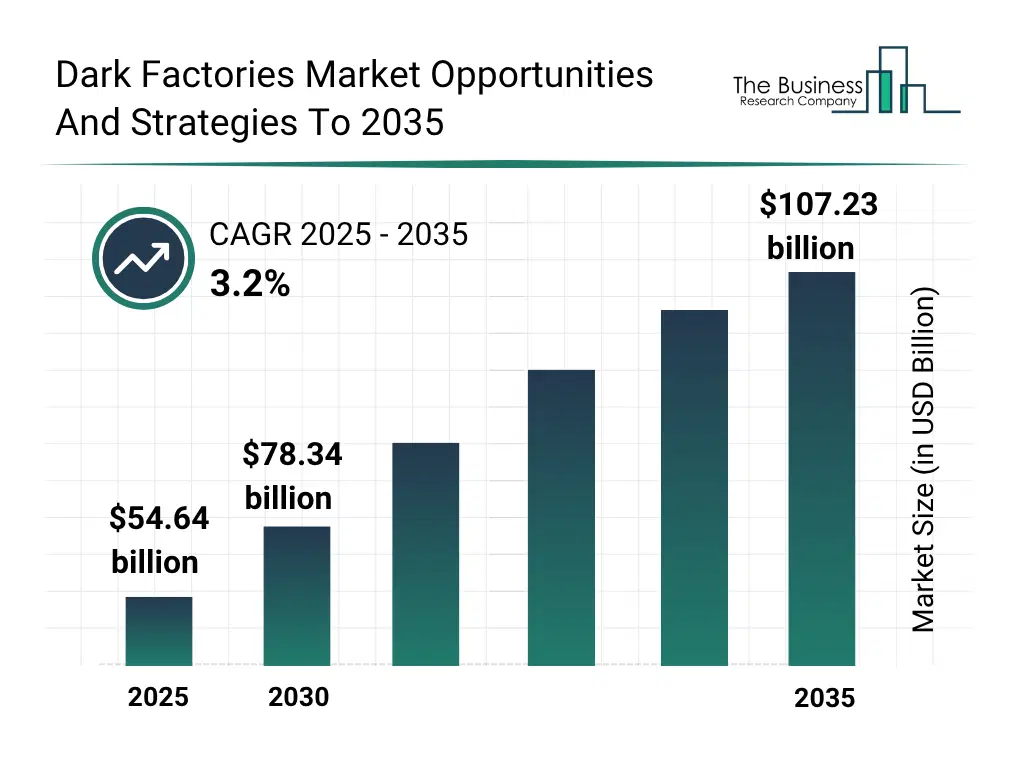
Dark Factories Global Market Opportunities And Strategies To 2035 Market Size and growth rate 2025 to 2030: Graph

Dark Factories Market Size

The global dark factories market reached a value of nearly $54,637.9 million in 2025, having grown at a compound annual growth rate (CAGR) of 3.5% since 2020. The market is expected to grow from $54,637.9 million in 2025 to $78,341.0 million in 2030 at a rate of 7.5%. The market is then expected to grow at a CAGR of 3.2% from 2030 and reach $107,234.0 million in 2035. Growth in the historic period resulted from the rising labor costs, increasing focus on workplace safety, growing adoption of industry 4.0 and smart manufacturing initiatives and rising demand for 24/7 production cycles. Factors that negatively affected growth in the historic period were high switching / vendor lock-in costs, regulatory, safety and compliance constraints. Going forward, the shift toward centralized and remote factory monitoring models, increasing emphasis on sustainable manufacturing promotes, expansion of end-to-end autonomous manufacturing workflows and increasing adoption of industrial robots will drive the growth. Factor that could hinder the growth of the dark factories market in the future include skills shortage for operation & maintenance, impact of trade wars and tariff and very high upfront capital expenditure.

Dark Factories Market Segmentation

The dark factories market is segmented by type, by deployment and end user.

By Type–
The dark factories market is segmented by type into:
    • a) Industrial Robotics
    • b) Additive Manufacturing
    • c) Industrial Internet Of Things (Iiot)
    • d) Automated Guided Vehicles (Agvs)
The industrial robotics market was the largest segment of the dark factories market segmented by type, accounting for 50.5% or $27,592.5 million of the total in 2025. Going forward, the industrial internet of things (IIoT) segment is expected to be the fastest growing segment in the dark factories market segmented by type, at a CAGR of 9.9% during 2025-2030.

By Deployment–
The dark factories market is segmented by deployment into:
    • a) Greenfield Projects
    • b) Brownfield Projects
The greenfield projects market was the largest segment of the dark factories market segmented by deployment, accounting for 52.9% or $28,882.4 million of the total in 2025. Going forward, the greenfield projects segment is expected to be the fastest growing segment in the dark factories market segmented by deployment, at a CAGR of 8.5% during 2025-2030.

By End User–
The dark factories market is segmented by end user into:
    • a) Automotive
    • b) Pharmaceuticals
    • c) Aerospace
    • d) Electronics
    • e) Other End-Uses
The automotive market was the largest segment of the dark factories market segmented by end user, accounting for 38.9% or $21,268.7 million of the total in 2025. Going forward, the pharmaceuticals segment is expected to be the fastest growing segment in the dark factories market segmented by end user, at a CAGR of 9.8% during 2025-2030.

By Geography - The dark factories market is segmented by geography into:
      o Asia Pacific
      • • China
      • • India
      • • Japan
      • • Australia
      • • Indonesia
      • • South Korea
      o North America
      • • USA
      • • Canada
      o South America
      • • Brazil
      o Western Europe
      • • France
      • • Germany
      • • UK
      • • Italy
      • • Spain
      o Eastern Europe
      • • Russia
      o Middle East
      o Africa
Asia Pacific was the largest region in the dark factories market, accounting for 38.1% or $20,833.1 million of the total in 2025. It was followed by North America, Western Europe and then the other regions. Going forward, the fastest-growing regions in the dark factories market will be Asia Pacific and South America where growth will be at CAGRs of 9.0% and 7.8% respectively. These will be followed by Eastern Europe and Middle East where the markets are expected to grow at CAGRs of 6.8% and 6.7% respectively.

Dark Factories Market Drivers

The key drivers of the dark factories market include: Expansion Of End-To-End Autonomous Manufacturing Workflows During the forecast period, the rising use of smart and protective coatings will propel the The expansion of end-to-end autonomous manufacturing workflows is driving demand for dark factories. As manufacturers increasingly adopt fully integrated production processes where machines, robots, and software systems perform all manufacturing steps without human intervention, the adoption of autonomous workflows drives the need for seamless, continuous, and high precision operations. Industry projections indicate that the implementation of autonomous manufacturing systems across sectors is rising steadily year on year, reflecting a broader trend toward fully automated, interconnected production environments. As organizations deploy advanced robotics, real time data processing, and closed loop control systems that span material input to final inspection, dark factories enable optimized throughput, reduced cycle times, and consistent product quality, thereby significantly driving demand for end to end autonomous manufacturing solutions. The expansion of end-to-end autonomous manufacturing workflows growth contribution during the forecast period in 2025 is 2.0%.

Dark Factories Market Restraints

The key restraints on the dark factories market include: Very High Upfront Capital Expenditure During the forecast period, limited standardization and regulatory uncertainty will restrain The very high upfront capital expenditure remains a significant barrier to market expansion. Deploying fully automated manufacturing systems requires substantial initial investments in robotics, AI integration, sensors, and smart factory infrastructure, which create a major financial barrier for many manufacturers. These steep capital requirements can delay or prevent companies from adopting dark factory solutions, especially small and medium-sized enterprises that may have limited access to financing or budget flexibility. Very high upfront capital expenditure also raises the financial risk of moving from conventional production methods to fully automated operations, as manufacturers must ensure that expected efficiency gains outweigh the initial costs. As a result, companies may postpone or scale back the implementation of dark factory solutions due to these significant financial obligations, thereby restricting the growth of the dark factories market. Growth affected by very high upfront capital expenditure during the forecast period in 2025 is -2.5%.

Dark Factories Market Competitive Landscape

Major Competitors are:

  • FANUC Corporation
  • Siemens AG
  • ABB Ltd.
  • Rockwell Automation Inc.
  • Schneider Electric SE.
  • Other Competitors Include:

  • KUKA AG
  • Yaskawa Electric Corp.
  • Omron Corporation
  • Kawasaki Heavy Industries Ltd.
  • Honeywell International Inc.
  • Universal Robots
  • Staubli Robotics
  • Beckhoff Automation
  • SIASUN Robot & Automation
  • Estun Automation
  • EFORT Intelligent Equipment
  • Shanghai STEP
  • Mitsubishi Electric
  • Toshiba Infrastructure Systems & Solutions Co., Ltd.
  • Bosch Rexroth
  • Keyence Corporation
  • Denso Wave
  • Nachi-Fujikoshi Corp
  • HD Hyundai Robotics
  • Keenon Robotics
  • Doosan Robotics
  • Rainbow Robotics
  • Neuromeka
  • Clobot
  • Hanwha Robotics
  • Schaeffler Technologies AG & Co. KG
  • Renishaw plc
  • Locus Robotics
  • CoRobotics Sp. z o.o.
  • KUKA Robotics
  • Siemens Sp. z o.o.
  • Bosch Rexroth Global
  • Dassault Systèmes Poland
  • Amazon.com Inc.
  • Geofabrica Inc.
  • Simplifyber, Inc.
  • Athena 3D Manufacturing
  • Clevertech
  • DeepHawk Inc.
  • Xaba Inc.
  • Basetwo AI
  • Fanuc America Corporation
  • Magna International Inc.
  • ATS Automation Tooling Systems
  • Clearpath Robotics Inc.
  • Hon Hai Precision Industry Co., Ltd. (Foxconn)
  • Medtronic Plc.
  • Ford Motor Company
  • BYD Inc.
  • SCHUNK GmbH
  • Zimmer Group US, Inc.
  • DESTACO (a Dover company)
  • ATI Industrial Automation
  • SAS Automation
  • Applied Robotics, Inc.
  • Robot System Products (RSP)
  • Bastian Solutions
  • Robotiq Inc.
  • Givens Engineering
  • Ingenplast S.A.
  • GMP Srl
  • Shobai Automation
  • HIWIN Mectrol
  • Stäubli
  • Zimmer Group
  • OnRobot
  • PROVEN Robotics
  • Unseen Era
  • Lauritz Knudsen Electrical and Automation (LKEA)
  • JSMAL Automation Ltd.
  • MAFA Co. Ltd.
  • Dangote Group
  • Nigerian Breweries Plc
  • BUA Group
  • Lafarge Africa Plc
  • Elaraby Group
  • Oriental Weavers
  • Alexandria Mineral Oils Company
  • QNB Alahli
  • Raya Holding
  • Sipchem
  • Need data on a specific region in this market?

    Opportunities And Recommendations In The Dark Factories Market

    Opportunities – The top opportunities in the dark factories markets segmented by type will arise in the industrial robotics segment, which will gain $9,876.5 million of global annual sales by 2030. The top opportunities in the dark factories markets segmented by deployment will arise in the greenfield projects segment, which will gain $14,468.7 million of global annual sales by 2030. The top opportunities in the dark factories markets segmented by end user will arise in the automotive segment, which will gain $9,643.1 million of global annual sales by 2030. The dark factories market size will gain the most in China at $5,698.7 million. Recommendations- To take advantage of the opportunities, The Business Research Company recommends the focus on AI-led autonomous manufacturing to stabilize scale and cost efficiency, focus on industrial IoT to enable scalable dark factory operations, focus on greenfield projects to maximize automation returns, expand in emerging markets, continue to focus on developed markets, focus on ecosystem-led channel expansion, focus on outcome-linked pricing discipline, focus on value-led awareness to shape market understanding, focus on proof-driven engagement to accelerate adoption, focus on automotive manufacturing to anchor dark factory growth.
    Chat with us