
Cluster Computing Market Report 2026
Global Outlook – By Component (Hardware, Software, Services), By Deployment Model (On-Premises, Cloud-Based, Hybrid), By Organization Size (Large Enterprises, Small And Medium Enterprises), By Application (Scientific Research, Artificial Intelligence And Machine Learning, Big Data Analytics, Web Services or Online Platforms, Financial Modeling, Other Applications), By End-User (Academic And Research Institutions, Government And Defense, Healthcare And Life Sciences, Manufacturing And Industrial, Banking, Financial Services And Insurance, Retail And Electronic Commerce, Information Technology And Telecommunications) – Market Size, Trends, Strategies, and Forecast to 2035
Cluster Computing Market Overview
• Cluster Computing market size has reached to $58.78 billion in 2025 • Expected to grow to $85.27 billion in 2030 at a compound annual growth rate (CAGR) of 7.8% • Growth Driver: Surge In Demand For High-performance Computing Fueling The Growth Of The Market Due To Rising Need For Faster, Large-scale Computational Solutions • Market Trend: Advanced Gpu Management Boosts Reliability And Efficiency For Mission-critical AI Tasks • North America was the largest region in 2025 and Asia-Pacific is the fastest growing region.
What Is Covered Under Cluster Computing Market?
Cluster computing is a type of computing in which multiple interconnected computers work together as a single system to perform complex tasks. It enables parallel processing, distributing workloads across the connected machines to increase computational speed and efficiency. This approach enhances reliability and scalability, allowing large-scale computations to be completed faster than on a single computer. The main components of cluster computing include hardware, software, and services. Hardware refers to interconnected servers, storage systems, networking equipment, and high-performance computing nodes that work together as a unified system to enhance processing power, scalability, and reliability. These solutions are deployed through on-premises, cloud-based, and hybrid models and are adopted by large enterprises and small and medium enterprises. The various applications involved are scientific research, artificial intelligence and machine learning, big data analytics, web services or online platforms, financial modeling, and other applications and they are utilized by end users including academic and research institutions, government and defense, healthcare and life sciences, manufacturing and industrial, banking, financial services and insurance, retail and electronic commerce, and information technology and telecommunications.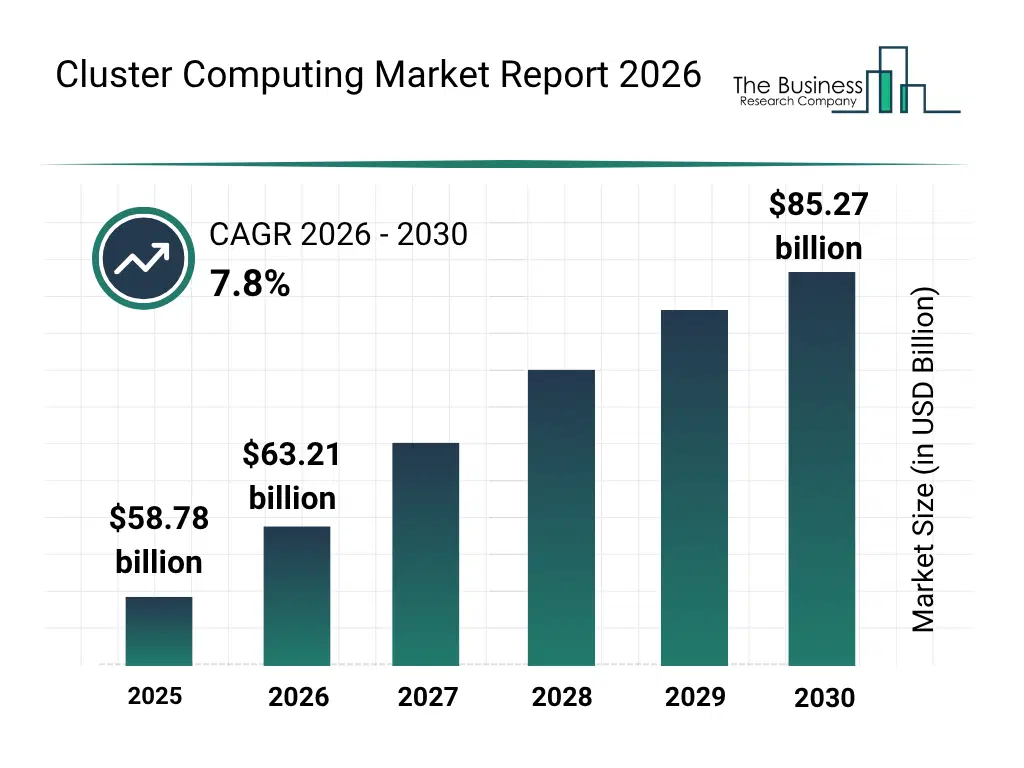
What Is The Cluster Computing Market Size and Share 2026?
The cluster computing market size has grown strongly in recent years. It will grow from $58.78 billion in 2025 to $63.21 billion in 2026 at a compound annual growth rate (CAGR) of 7.5%. The growth in the historic period can be attributed to growing adoption of cluster computing in scientific research, rising demand for big data analytics, increasing need for AI and ML workloads, expansion of academic and research institutions, advancements in CPU and GPU technologies.What Is The Cluster Computing Market Growth Forecast?
The cluster computing market size is expected to see strong growth in the next few years. It will grow to $85.27 billion in 2030 at a compound annual growth rate (CAGR) of 7.8%. The growth in the forecast period can be attributed to increasing deployment in financial modeling applications, rising adoption in healthcare and life sciences, growing demand for managed cluster services, expansion of hybrid and cloud-based cluster solutions, rising focus on energy-efficient high-performance clusters. Major trends in the forecast period include increasing adoption of hybrid cluster deployments, rising demand for high-performance computing hardware, growing integration of cluster management software, expansion of cloud-based cluster services, rising focus on energy-efficient and scalable cluster solutions.Global Cluster Computing Market Segmentation
1) By Component: Hardware, Software, Services 2) By Deployment Model: On-Premises, Cloud-Based, Hybrid 3) By Organization Size: Large Enterprises, Small And Medium Enterprises 4) By Application: Scientific Research, Artificial Intelligence And Machine Learning, Big Data Analytics, Web Services or Online Platforms, Financial Modeling, Other Applications 5) By End-User: Academic And Research Institutions, Government And Defense, Healthcare And Life Sciences, Manufacturing And Industrial, Banking, Financial Services And Insurance, Retail And Electronic Commerce, Information Technology And Telecommunications Subsegments: 1) By Hardware: Central Processing Unit, Graphics Processing Unit, Memory, Storage, Networking Equipment 2) By Software: Cluster Management Software, Job Scheduling Software, Resource Allocation Software, Monitoring And Analytics Software, Security Software 3) By Services: Consulting Services, Deployment Services, Maintenance And Support Services, Training Services, Managed ServicesWhat Is The Driver Of The Cluster Computing Market?
The increasing demand for high-performance computing (HPC) is expected to drive the growth of the cluster computing market over the forecast period. High-performance computing involves the use of advanced computing architectures, including supercomputers and parallel processing systems, to solve complex and computation-intensive problems at very high speeds. The growing reliance on HPC is driven by the rapid increase in data volumes and the complexity of workloads across scientific research, artificial intelligence, climate modeling, financial analytics, and engineering simulations-tasks that conventional computing systems cannot process efficiently. Cluster computing plays a critical role in enabling high-performance computing by connecting multiple computing nodes to operate as a unified system. For instance, in November 2025, according to The Next Platform, a US-based technology media outlet, systems listed in the Top500 supercomputer ranking collectively delivered 22.16 exaflops of computing performance, with accelerated systems accounting for 86.2% of total performance, compared to only 13.8% from CPU-only machines. Therefore, the increasing demand for high-performance computing is driving the growth of cluster computing industry.Key Players In The Global Cluster Computing Market
Major companies operating in the cluster computing market are Huawei Technologies Co. Ltd., Dell Technologies Incorporated, Lenovo Group Limited, International Business Machines Corporation, Intel Corporation, Hewlett Packard Enterprise Company, Fujitsu Limited, NVIDIA Corporation, NEC Corporation, Advanced Micro Devices Inc., Inspur Group Co. Ltd., Super Micro Computer Inc., Iron Systems Incorporated, CoreWeave Inc., Rescale Inc., RunPod Inc., ClusterVision B.V., OpenHPC, ClusterLabs, and ALA Services Limited Liability Company.Global Cluster Computing Market Trends and Insights
Major companies operating in the cluster computing market are focusing on developing advanced solutions, such as high-performance GPU clusters for enterprise AI workloads, to accelerate complex computations, improve scalability, and enhance AI model training efficiency. High-performance GPU clusters refer to interconnected computing nodes equipped with powerful GPUs that provide scalable processing power for tasks like artificial intelligence, machine learning, and large-scale simulations. For instance, in December 2025, Singularity Compute, a Australia -based AI infrastructure company, launched a GPU cluster hosted at a Conapto data center featuring Nvidia L40S, H200, and B200 GPUs. This new solution focuses on offering bare-metal and virtual machine GPU rentals for enterprise AI and artificial superintelligence workloads, which helps organizations accelerate high-performance computing tasks without investing in on-premises hardware. By leveraging modular infrastructure, renewable energy, and advanced GPU management through Cudo Compute solutions, the cluster enables efficient, scalable, and reliable operations for AI researchers and enterprises. It is engineered to support demanding environments, including large-scale AI model training, AGI research, and enterprise AI applications, ensuring consistent, high-performance, and sustainable computing for mission-critical projects and advanced analytics initiatives.What Are Latest Mergers And Acquisitions In The Cluster Computing Market?
In December 2025, Nvidia Corporation, a US-based technology company specializing in graphics processing units (GPUs) and high-performance computing platforms, acquired SchedMD Limited Liability Company for an undisclosed amount. Through this acquisition, Nvidia aims to strengthen its artificial intelligence and high-performance computing ecosystem by integrating Simple Linux Utility for Resource Management (Slurm), a leading workload manager and scheduler for supercomputers and large-scale graphics processing unit’s clusters by enabling more efficient orchestration of high-performance computing and artificial intelligence workloads. SchedMD Limited Liability Company is a US-based company specializing in developing and supporting Slurm, an open-source workload manager widely used in supercomputing, artificial intelligence training clusters and distributed computing environments.Regional Insights
North America was the largest region in the cluster computing market in 2025. Asia-Pacific is expected to be the fastest-growing region in the forecast period. The regions covered in this market report are Asia-Pacific, South East Asia, Western Europe, Eastern Europe, North America, South America, Middle East, Africa. The countries covered in this market report are Australia, Brazil, China, France, Germany, India, Indonesia, Japan, Taiwan, Russia, South Korea, UK, USA, Canada, Italy, Spain.What Defines the Cluster Computing Market?
The cluster computing market consists of revenues earned by entities by providing services such as system integration, consulting, maintenance and support, cloud deployment, software development, training and certification. The market value includes the value of related goods sold by the service provider or included within the service offering. The cluster computing market includes sales of high-performance computing (HPC) nodes, GPU cards, rack enclosures, and cooling systems. Values in this market are ‘factory gate’ values, that is, the value of goods sold by the manufacturers or creators of the goods, whether to other entities (including downstream manufacturers, wholesalers, distributors, and retailers) or directly to end customers. The value of goods in this market includes related services sold by the creators of the goods.How is Market Value Defined and Measured?
The market value is defined as the revenues that enterprises gain from the sale of goods and/or services within the specified market and geography through sales, grants, or donations in terms of the currency (in USD unless otherwise specified). The revenues for a specified geography are consumption values that are revenues generated by organizations in the specified geography within the market, irrespective of where they are produced. It does not include revenues from resales along the supply chain, either further along the supply chain or as part of other products.What Key Data And Analysis Are Included In The Cluster Computing Market Report 2026?
The cluster computing market research report is one of a series of new reports from The Business Research Company that provides market statistics, including industry global market size, regional shares, competitors with the market share, detailed market segments, market trends and opportunities, and any further data you may need to thrive in the cluster computing industry. The market research report delivers a complete perspective of everything you need, with an in-depth analysis of the current and future state of the industry.Cluster Computing Market Report Forecast Analysis
| Report Attribute | Details |
|---|---|
| Market Size Value In 2026 | $63.21 billion |
| Revenue Forecast In 2035 | $85.27 billion |
| Growth Rate | CAGR of 7.5% from 2026 to 2035 |
| Base Year For Estimation | 2025 |
| Actual Estimates/Historical Data | 2020-2025 |
| Forecast Period | 2026 - 2030 - 2035 |
| Market Representation | Revenue in USD Billion and CAGR from 2026 to 2035 |
| Segments Covered | Component, Deployment Model, Organization Size, Application, End-User |
| Regional Scope | Asia-Pacific, Western Europe, Eastern Europe, North America, South America, Middle East, Africa |
| Country Scope | The countries covered in the report are Australia, Brazil, China, France, Germany, India, Indonesia, Japan, Taiwan, Russia, South Korea, UK, USA, Canada, Italy, Spain. |
| Key Companies Profiled | Huawei Technologies Co. Ltd., Dell Technologies Incorporated, Lenovo Group Limited, International Business Machines Corporation, Intel Corporation, Hewlett Packard Enterprise Company, Fujitsu Limited, NVIDIA Corporation, NEC Corporation, Advanced Micro Devices Inc., Inspur Group Co. Ltd., Super Micro Computer Inc., Iron Systems Incorporated, CoreWeave Inc., Rescale Inc., RunPod Inc., ClusterVision B.V., OpenHPC, ClusterLabs, and ALA Services Limited Liability Company. |
| Customization Scope | Request for Customization |
| Pricing And Purchase Options | Explore Purchase Options |