
Broadcast And Media Technology Global Market Opportunities And Strategies To 2035
By Type (Web Content Management, Variable Capacitors, Editorial And Print Workflow, Media/Digital Asset Management, Revenue Management, Ad And Data Management, User Management), By Hosting Model (Integrated, Standalone), By End-Users (Broadcasters, Distributors, OTT, IPTV, Other End-User Types), And By Region, Opportunities And Strategies – Global Forecast To 2035
Broadcast And Media Technology Market Definition
Broadcast and media technology refers to the comprehensive set of digital tools and platforms used to manage the end-to-end lifecycle of media content, including creation, management, distribution, monetization, and audience engagement. This market plays a pivotal role in enabling television broadcasters, radio stations, over-the-top (OTT) streaming services, internet protocol television (IPTV) providers, and content distributors to efficiently handle complex workflows related to media production and dissemination. The broadcast and media technology market consists of sales, by entities (organizations, sole traders, or partnerships) that is used by broadcasters and media companies of all sizes to deliver content to viewers across traditional and digital platforms and is utilized in both live and on-demand scenarios, including news broadcasting, entertainment programming, sports, advertising, and digital publishing.
Broadcast And Media Technology Market Size
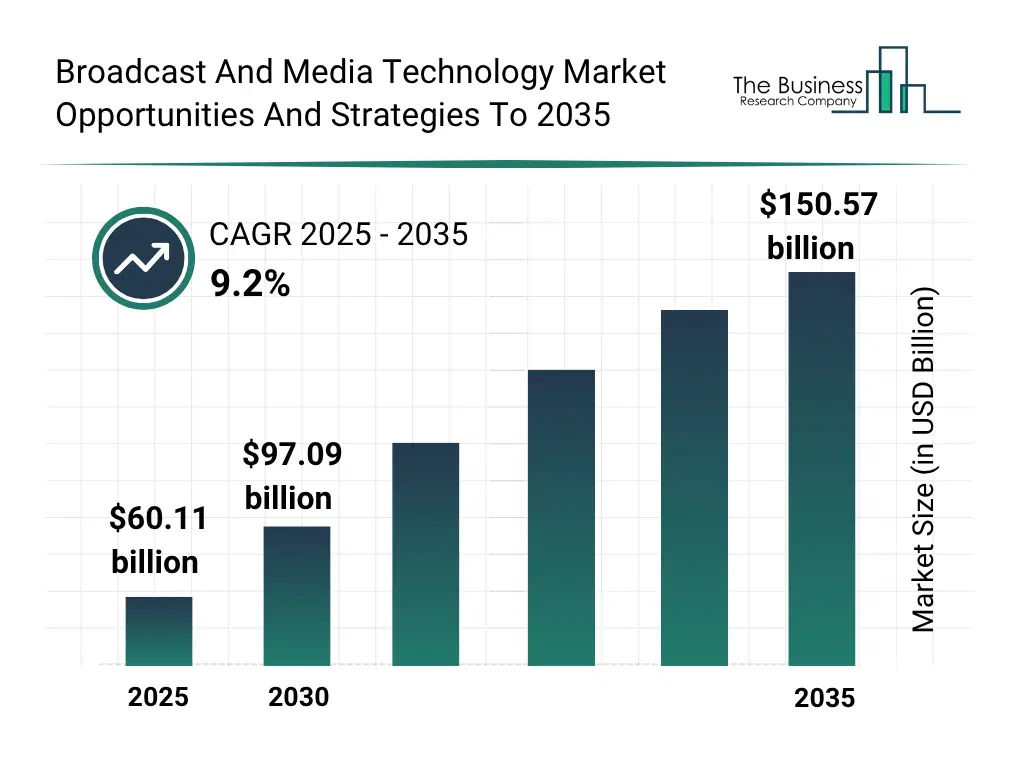
The global broadcast and media technology market reached a value of nearly $60,105.0 million in 2025, having grown at a compound annual growth rate (CAGR) of 11.6% since 2020. The market is expected to grow from $60,105.0 million in 2025 to $97,088.7 million in 2030 at a rate of 10.1%. The market is then expected to grow at a CAGR of 9.2% from 2030 and reach $150,573.0 million in 2035. Growth in the historic period resulted from the rising internet and smartphones penetration, rising demand for media and entertainment industry, surge in on-demand content penetration and rising demand for live sports and event broadcasting. Factors that negatively affected growth in the historic period were rising piracy and unauthorized content distribution and increasing operational costs for content acquisition. Going forward, the expansion of OTT platforms, expansion of content delivery networks (CDNs), growth of IP-based and software-defined broadcasting infrastructure and growth of digital advertising will drive the growth. Factors that could hinder the growth of the broadcast and media technology market in the future include impact of trade war and tariff, rising regulatory scrutiny on media ownership and rising churn rates.Broadcast And Media Technology Market Segmentation
The broadcast and media technology market is segmented by solution type, by hosting model type and by end user type.By Solution Type –
The broadcast and media technology market is segmented by solution type into:
- a) Web Content Management
- b) Content Storage Solutions
- c) Editorial And Print Workflow
- d) Media/Digital Asset Management
- e) Revenue Management
- f) Ad And Data Management
- g) User Management
By Hosting Model –
The broadcast and media technology market is segmented by hosting model into:
- a) Integrated
- b) Standalone
By End-Users Type –
The broadcast and media technology market is segmented by end-user type into:
- a) Broadcasters
- b) Distributors
- c) OTT
- d) IPTV
By Geography - The broadcast and media technology market is segmented by geography into:
- • China
- • India
- • Japan
- • Australia
- • Indonesia
- • South Korea
- • USA
- • Canada
- • Brazil
- • France
- • Germany
- • UK
- • Italy
- • Spain
- • Russia
-
o Asia Pacific
o Africa