
Bioinductive Implant Market Report 2026
Global Outlook – By Type (Biodegradable, Non-Biodegradable, Other Types), By Material Type (Biological Grafts, Synthetic Resorbable Polymers, Hybrid Bio Synthetic Implants, Recombinant Protein Based Materials), By Technology (Electrospinning, 3D Printing, Other Technologies), By Application (Orthopedic, Cardiovascular, Dental, Other Applications), By End-User (Hospitals, Clinics, Ambulatory Surgical Centres, Other End-Users) – Market Size, Trends, Strategies, and Forecast to 2035
Bioinductive Implant Market Overview
• Bioinductive Implant market size has reached to $1.94 billion in 2025 • Expected to grow to $3.2 billion in 2030 at a compound annual growth rate (CAGR) of 10.6% • Growth Driver: The Rise In Musculoskeletal Disorders Driving The Growth Of The Market Due To Increasing Prevalence From Obesity And Poor Nutrition • Market Trend: Innovative Collagen-Based Scaffold Enhances Tendon Healing And Reduces Re-Tear Rates • North America was the largest region in 2025 and Asia-Pacific is the fastest growing region.
What Is Covered Under Bioinductive Implant Market?
A bioinductive implant is a medical device designed to stimulate the body’s natural healing processes by promoting tissue regeneration and repair at the implant site. It typically works by inducing cellular growth and extracellular matrix formation, enhancing recovery without relying solely on mechanical support. The main types of bioinductive implant include biodegradable, non-biodegradable, and other types. Biodegradable implants refer to devices designed to support tissue regeneration and gradually dissolve in the body, eliminating the need for removal. These implants are available in biological grafts, synthetic resorbable polymers, hybrid bio synthetic implants, and recombinant protein based materials and are manufactured using electrospinning, 3D printing, and other technologies. The key applications of orthopedic, cardiovascular, dental, and other applications, while the end-use includes hospitals, clinics, ambulatory surgical centres, and other end-users.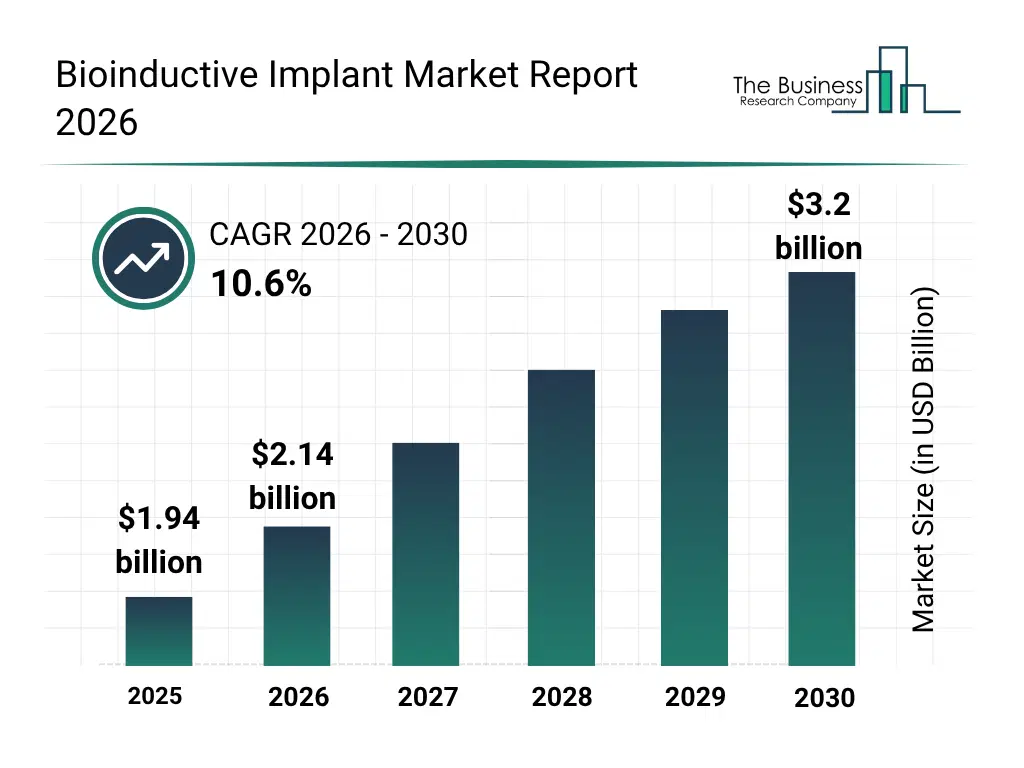
What Is The Bioinductive Implant Market Size and Share 2026?
The bioinductive implant market size has grown rapidly in recent years. It will grow from $1.94 billion in 2025 to $2.14 billion in 2026 at a compound annual growth rate (CAGR) of 10.3%. The growth in the historic period can be attributed to increasing prevalence of orthopedic and cardiovascular disorders, growing adoption of implantable medical devices, rising investments in biomedical research, development of synthetic resorbable polymers, expansion of hospital and clinical infrastructure.What Is The Bioinductive Implant Market Growth Forecast?
The bioinductive implant market size is expected to see rapid growth in the next few years. It will grow to $3.2 billion in 2030 at a compound annual growth rate (CAGR) of 10.6%. The growth in the forecast period can be attributed to growing demand for patient-specific implants, increasing adoption of bioabsorbable composite materials, rising use of nanofiber and multilayered scaffold implants, expansion of dental and orthopedic surgeries, increasing focus on regenerative medicine and tissue engineering. Major trends in the forecast period include increasing adoption of biodegradable implants, rising demand for 3d printed and customized implants, growing integration of growth factor embedded technologies, expansion of electrospinning and nanofiber structured implants, rising focus on orthopedic and dental applications.Global Bioinductive Implant Market Segmentation
1) By Type: Biodegradable, Non-Biodegradable, Other Types 2) By Material Type: Biological Grafts, Synthetic Resorbable Polymers, Hybrid Bio Synthetic Implants, Recombinant Protein Based Materials 3) By Technology: Electrospinning, 3D Printing, Other Technologies 4) By Application: Orthopedic, Cardiovascular, Dental, Other Applications 5) By End-User: Hospitals, Clinics, Ambulatory Surgical Centres, Other End-Users Subsegments: 1) By Biodegradable: Natural Polymer Based Implants, Collagen Based Implants, Gelatin Based Implants, Polylactic Acid Based Implants, Polyglycolic Acid Based Implants, Polycaprolactone Based Implants, Chitosan Based Implants, Bioabsorbable Composite Implants 2) By Non-Biodegradable: Silicone Based Implants, Polyethylene Based Implants, Polyurethane Based Implants, Titanium Reinforced Implants, Stainless Steel Reinforced Implants, Permanent Composite Implants, Ceramic Based Implants 3) By Other Types: Partially Degradable Implants, Smart Responsive Implants, Drug Eluting Implants, Growth Factor Embedded Implants, Nanofiber Structured Implants, Multi Layered Scaffold Implants, Customized Patient Specific ImplantsWhat Are The Drivers Of The Bioinductive Implant Market?
The growing prevalence of musculoskeletal disorders (MSK) is expected to propel the growth of the bioinductive implant market. Musculoskeletal disorders comprise a broad group of conditions affecting muscles, bones, joints, tendons, and ligaments, often resulting in pain, reduced mobility, and functional impairment. The increasing incidence of these disorders is driven by factors such as rising obesity rates, poor nutrition, and sedentary lifestyles, all of which place greater mechanical stress on joints and weaken musculoskeletal structures over time. Bioinductive implants support healing by stimulating natural tissue regeneration, enhancing tendon and ligament repair, and promoting durable recovery while reducing re-injury risk. For instance, in January 2024, the Office for Health Improvement and Disparities, a UK-based government department, reported that the proportion of individuals aged 16 and over living with a long-term musculoskeletal condition increased from 17.6% in 2022 to 18.4% in 2023. Therefore, a growing prevalence of musculoskeletal disorders (MSK) is driving the growth of the bioinductive implant industry. The rising incidence of sports-related injuries is expected to propel the growth of the bioinductive implant market going forward. Sports-related injuries refer to physical harm or damage to the body’s muscles, bones, joints, ligaments, or tendons that occur during athletic activities or exercise. The rising incidence of sports-related injuries is due to more people engaging in high-intensity sports, which place greater stress on muscles, joints, and ligaments. Bioinductive implants aid in the healing of sports-related injuries by supporting tissue regeneration and enhancing recovery in damaged tendons and ligaments. For instance, in October 2024, according to Inside World Football, a UK-based web-based news-driven service, sport injuries reached a total of 4,123 during the 2023-24 season, marking a 4% increase compared to 2022-23. Therefore, a rising incidence of sports-related injuries is driving the growth of the bioinductive implant industry.Key Players In The Global Bioinductive Implant Market
Major companies operating in the bioinductive implant market are Baxter International Inc, Zimmer Biomet Holdings Inc., Smith Nephew plc, Arthrex Inc., CONMED Corporation, Footprint International Holdco Inc, MiMedx Group Inc., LifeNet Health Inc., Anika Therapeutics Inc., ZimVie Inc, Danimer Scientific Inc, Smurfit Kappa Group, NatureWorks LLC, Mondi Group, Novamont S.p.A, Tissue Regenix Group plc, Stora Enso Oyj, Collagen Matrix Inc., Polymateria Ltd, BioSphere Plastic LLC.Global Bioinductive Implant Market Trends and Insights
Major companies operating in the bioinductive implant market are increasingly focused on developing innovative solutions, such as collagen-based and resorbable implants, to promote tendon regeneration and improve surgical outcomes in rotator cuff repair. Collagen-based and resorbable implants are medical devices composed of natural or engineered collagen materials that provide temporary structural support, stimulate tissue repair, and gradually resorb within the body as healing progresses. For instance, in July 2023, Smith & Nephew plc, a UK-based medical technology company, launched the REGENETEN Bioinductive Implant, a collagen-based scaffold designed to augment rotator cuff repair by biologically supporting tendon healing beyond conventional sutured repair techniques. The implant is delivered arthroscopically through a minimally invasive incision and is approximately the size of a postage stamp. It provides a biocompatible framework that leverages the body’s intrinsic healing processes to induce new tendon-like tissue formation, is fully resorbed over time, and has been associated with reduced re-tear rates and improved functional outcomes compared with traditional repair methods alone.Regional Insights
North America was the largest region in the bioinductive implant market in 2025. Asia-Pacific is expected to be the fastest-growing region in the forecast period. The regions covered in this market report are Asia-Pacific, South East Asia, Western Europe, Eastern Europe, North America, South America, Middle East, Africa. The countries covered in this market report are Australia, Brazil, China, France, Germany, India, Indonesia, Japan, Taiwan, Russia, South Korea, UK, USA, Canada, Italy, Spain.What Defines the Bioinductive Implant Market?
The bioinductive implant market consists of sales of collagen bioinductive patches, synthetic bioinductive scaffolds, bioactive-coated repair adjuncts, 3D bioinductive scaffolds, and anatomy-specific patch variants. Values in this market are ‘factory gate’ values, that is, the value of goods sold by the manufacturers or creators of the goods, whether to other entities (including downstream manufacturers, wholesalers, distributors, and retailers) or directly to end customers. The value of goods in this market includes related services sold by the creators of the goods.How is Market Value Defined and Measured?
The market value is defined as the revenues that enterprises gain from the sale of goods and/or services within the specified market and geography through sales, grants, or donations in terms of the currency (in USD unless otherwise specified). The revenues for a specified geography are consumption values that are revenues generated by organizations in the specified geography within the market, irrespective of where they are produced. It does not include revenues from resales along the supply chain, either further along the supply chain or as part of other products.What Key Data And Analysis Are Included In The Bioinductive Implant Market Report 2026?
The bioinductive implant market research report is one of a series of new reports from The Business Research Company that provides market statistics, including industry global market size, regional shares, competitors with the market share, detailed market segments, market trends and opportunities, and any further data you may need to thrive in the bioinductive implant industry. The market research report delivers a complete perspective of everything you need, with an in-depth analysis of the current and future state of the industry.Bioinductive Implant Market Report Forecast Analysis
| Report Attribute | Details |
|---|---|
| Market Size Value In 2026 | $2.14 billion |
| Revenue Forecast In 2035 | $3.2 billion |
| Growth Rate | CAGR of 10.3% from 2026 to 2035 |
| Base Year For Estimation | 2025 |
| Actual Estimates/Historical Data | 2020-2025 |
| Forecast Period | 2026 - 2030 - 2035 |
| Market Representation | Revenue in USD Billion and CAGR from 2026 to 2035 |
| Segments Covered | Type, Material Type, Technology, Application, End-User |
| Regional Scope | Asia-Pacific, Western Europe, Eastern Europe, North America, South America, Middle East, Africa |
| Country Scope | The countries covered in the report are Australia, Brazil, China, France, Germany, India, Indonesia, Japan, Taiwan, Russia, South Korea, UK, USA, Canada, Italy, Spain. |
| Key Companies Profiled | Baxter International Inc, Zimmer Biomet Holdings Inc., Smith Nephew plc, Arthrex Inc., CONMED Corporation, Footprint International Holdco Inc, MiMedx Group Inc., LifeNet Health Inc., Anika Therapeutics Inc., ZimVie Inc, Danimer Scientific Inc, Smurfit Kappa Group, NatureWorks LLC, Mondi Group, Novamont S.p.A, Tissue Regenix Group plc, Stora Enso Oyj, Collagen Matrix Inc., Polymateria Ltd, BioSphere Plastic LLC. |
| Customization Scope | Request for Customization |
| Pricing And Purchase Options | Explore Purchase Options |