
Bio-Based Resins Market Report 2026
Global Outlook – By Type (Biobased Epoxy Resins, Biobased Acrylic Resins, Biobased Polyester Resins, Biobased Polyurethane Resins, Biobased Phenolic Resins), By Raw Material (Plant-Based Oils, Starch, Cellulose, Lignin, Sugars), By Technology (Chemical Synthesis, Microbial Fermentation, Bio-Polymerization), By Form (Liquid, Powder, Pellet), By End-Use Industry (Consumer Goods, Industrial, Healthcare, Food And Beverage, Agriculture, Automotive, Electronics) – Market Size, Trends, Strategies, and Forecast to 2035
Bio-Based Resins Market Overview
• Bio-Based Resins market size has reached to $12.48 billion in 2025 • Expected to grow to $22.34 billion in 2030 at a compound annual growth rate (CAGR) of 12.4% • Growth Driver: The Rise In Demand For Sustainable And Eco-Friendly Products Driving The Growth Of The Market Due To Increasing Environmental Awareness And Preference For Renewable Materials • Market Trend: Innovative Eco-Friendly Dispersions Drive Sustainable Textile And Coatings Solutions • North America was the largest region in 2025 and Asia-Pacific is the fastest growing region.
What Is Covered Under Bio-Based Resins Market?
Bio-based resins are polymers derived from renewable biological sources such as plants, algae, or microorganisms, rather than from traditional petroleum-based feedstocks. They are used in manufacturing materials such as plastics, adhesives, and coatings, offering a more sustainable and environmentally friendly alternative. The main types of bio-based resins include biobased epoxy resins, biobased acrylic resins, biobased polyester resins, biobased polyurethane resins, and biobased phenolic resins. Biobased epoxy resins are derived from renewable raw materials and are used for coatings, adhesives, and composite applications requiring high strength and chemical resistance. They are produced using raw materials such as plant-based oils, starch, cellulose, lignin, and sugars and are manufactured utilizing technologies such as chemical synthesis, microbial fermentation, and bio-polymerization. They are available in liquid, powder, and pellet forms and are utilized across end-use industries including consumer goods, industrial, healthcare, food and beverage, agriculture, automotive, and electronics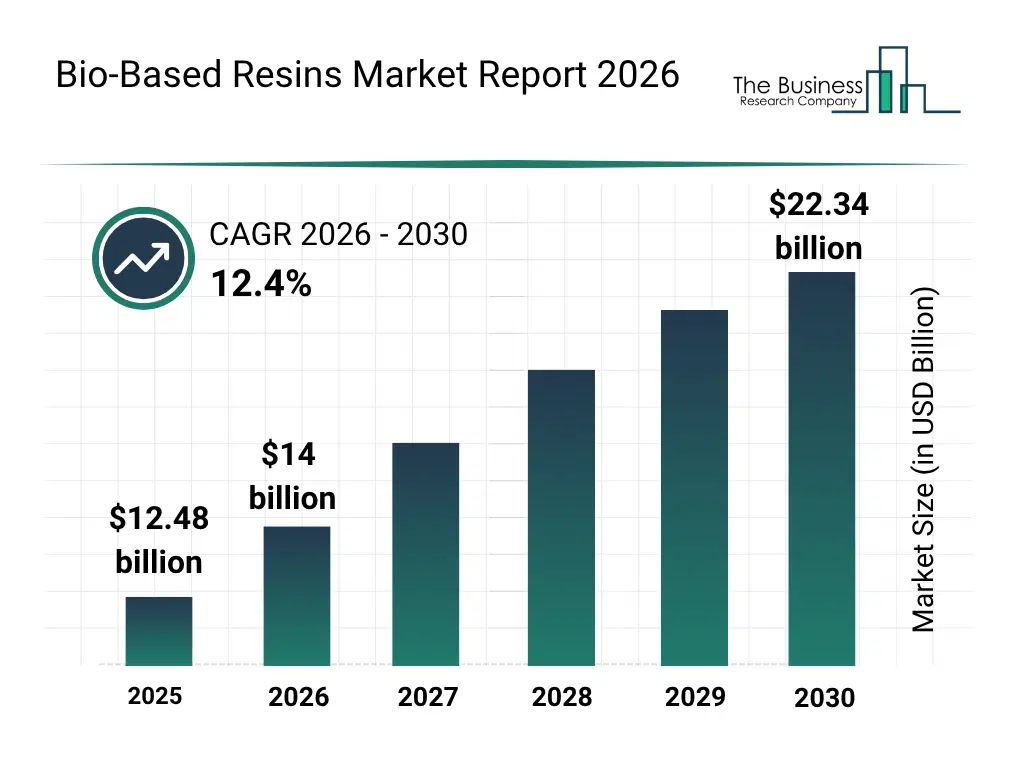
What Is The Bio-Based Resins Market Size and Share 2026?
The bio-based resins market size has grown rapidly in recent years. It will grow from $12.48 billion in 2025 to $14 billion in 2026 at a compound annual growth rate (CAGR) of 12.2%. The growth in the historic period can be attributed to increasing environmental awareness, rising petroleum prices, adoption of plant-based raw materials, growing demand in consumer goods, technological advances in resin synthesis.What Is The Bio-Based Resins Market Growth Forecast?
The bio-based resins market size is expected to see rapid growth in the next few years. It will grow to $22.34 billion in 2030 at a compound annual growth rate (CAGR) of 12.4%. The growth in the forecast period can be attributed to increasing demand from automotive and electronics industries, growth of sustainable packaging solutions, rising adoption of bio-polymerization technologies, expansion in healthcare and food & beverage sectors, government incentives for renewable materials. Major trends in the forecast period include increasing adoption of plant-based epoxy and polyurethane resins, rising demand for microbial fermentation technologies, growing use of bio-polymerization methods, expansion of liquid and pellet form biobased resins, rising focus on automotive and electronics applications.Global Bio-Based Resins Market Segmentation
1) By Type: Biobased Epoxy Resins, Biobased Acrylic Resins, Biobased Polyester Resins, Biobased Polyurethane Resins, Biobased Phenolic Resins 2) By Raw Material: Plant-Based Oils, Starch, Cellulose, Lignin, Sugars 3) By Technology: Chemical Synthesis, Microbial Fermentation, Bio-Polymerization 4) By Form: Liquid, Powder, Pellet 5) By End-Use Industry: Consumer Goods, Industrial, Healthcare, Food And Beverage, Agriculture, Automotive, Electronics Subsegments: 1) By Biobased Epoxy Resins: Plant-Based Epoxy Resins, Lignin-Based Epoxy Resins, Soybean Oil-Based Epoxy Resins 2) By Biobased Acrylic Resins: Water-Based Acrylic Resins, Bio-Derived Acrylic Emulsions, Renewable Acrylic Copolymers 3) By Biobased Polyester Resins: Aliphatic Biobased Polyester Resins, Aromatic Biobased Polyester Resins, Unsaturated Biobased Polyester Resins 4) By Biobased Polyurethane Resins: Biobased Polyol-Based Polyurethane Resins, Castor Oil-Based Polyurethane Resins, Soy-Based Polyurethane Resins 5) By Biobased Phenolic Resins: Lignin-Based Phenolic Resins, Tannin-Based Phenolic Resins, Cardanol-Based Phenolic ResinsWhat Is The Driver Of The Bio-Based Resins Market?
The increasing demand for sustainable and eco-friendly products is expected to propel the growth of the bio-based resins market. Sustainable and eco-friendly products are designed to minimize environmental impact through the use of renewable resources and reduced reliance on fossil-based materials. This growing demand is driven by rising environmental awareness, as consumers increasingly prefer products that reduce pollution, conserve resources, and support a greener lifestyle. In response to these shifting preferences, manufacturers are adopting bio-based resins as alternatives to petroleum-based materials to improve sustainability profiles, meet regulatory requirements, and enhance brand positioning. Bio-based resins help lower carbon emissions and environmental impact by utilizing renewable feedstocks. For instance, in April 2024, according to the National Association of Convenience Stores, a US-based trade association representing the convenience and fuel retailing industry, the percentage of consumers concerned about the environmental impact of their purchases increased from 66% in 2022 to 68% in 2023 and further to 80% in 2024. Therefore, the increasing demand for sustainable and eco-friendly products is driving the growth of the bio-based resins industry.Key Players In The Global Bio-Based Resins Market
Major companies operating in the bio-based resins market are BASF SE, Mitsubishi Chemical Group Corporation, Toray Industries Inc., Kaneka Corporation, Evonik Industries AG, Covestro AG, Braskem S.A., DuPont de Nemours Inc., DSM-Firmenich AG, UPM-Kymmene Corporation, Arkema S.A., Eastman Chemical Company, Danimer Scientific Inc., Corbion N.V., Gelita AG, NatureWorks LLC, Avantium N.V., Novamont S.p.A., Futerro S.A, Bluepha Co. Ltd., TotalEnergies Corbion B.V., Synthos S.A, Green Dot Bioplastics Inc, and Entropy Resins Inc.Global Bio-Based Resins Market Trends and Insights
Major companies operating in the bio-based resins market are focusing on developing innovative solutions such as, bio-based waterborne dispersions, to enhance sustainability and reduce the carbon footprint of coatings, adhesives, and textile applications. Bio-based waterborne dispersions are eco-friendly polymer particles dispersed in water, made partly or fully from renewable resources, and used in coatings, adhesives, and textiles. For instance, in January 2025, Arkema S.A., a France based specialty materials company, launched its ENCOR bio based waterborne dispersions, an innovative product range incorporating up to 30% bio based content and delivering up to 40% carbon footprint reduction compared with conventional textile resins, supporting sustainable textile production and helping manufacturers achieve lower lifecycle emissions. These dispersions are formaldehyde and APEO free, compliant with Oeko Tex Eco Passport standards, and designed to enhance end of life management with improved durability and color fastness, making them suitable for a wide range of performance textile applications while aligning with growing industry demand for eco friendly materials.What Are Latest Mergers And Acquisitions In The Bio-Based Resins Market?
In June 2025, Teknor Apex Company Inc., a US-based materials science and manufacturing company, acquired Danimer Scientific for an undisclosed amount. With this acquisition, Teknor Apex aims to expand and diversify its sustainable materials portfolio by integrating advanced biopolymer technologies, strengthening its position in eco friendly alternatives to traditional plastics, and enabling acceleration of research and development and market reach. Danimer Scientific Inc. is a US-based bioplastics technology company that provides developers and manufacturers of 100% bio-based and biodegradable resins.Regional Insights
North America was the largest region in the bio-based resins market in 2025. Asia-Pacific is expected to be the fastest-growing region in the forecast period. The regions covered in this market report are Asia-Pacific, South East Asia, Western Europe, Eastern Europe, North America, South America, Middle East, Africa. The countries covered in this market report are Australia, Brazil, China, France, Germany, India, Indonesia, Japan, Taiwan, Russia, South Korea, UK, USA, Canada, Italy, Spain.What Defines the Bio-Based Resins Market?
The bio-based resins market consists of sales of bio-based vinyl ester resins, bio-based melamine-formaldehyde resins, bio-based alkyd resins, bio-based polyamide resins, and bio-based urea-formaldehyde resins. Values in this market are ‘factory gate’ values, that is, the value of goods sold by the manufacturers or creators of the goods, whether to other entities (including downstream manufacturers, wholesalers, distributors, and retailers) or directly to end customers. The value of goods in this market includes related services sold by the creators of the goods.How is Market Value Defined and Measured?
The market value is defined as the revenues that enterprises gain from the sale of goods and/or services within the specified market and geography through sales, grants, or donations in terms of the currency (in USD unless otherwise specified). The revenues for a specified geography are consumption values that are revenues generated by organizations in the specified geography within the market, irrespective of where they are produced. It does not include revenues from resales along the supply chain, either further along the supply chain or as part of other products.What Key Data And Analysis Are Included In The Bio-Based Resins Market Report 2026?
The bio-based resins market research report is one of a series of new reports from The Business Research Company that provides market statistics, including industry global market size, regional shares, competitors with the market share, detailed market segments, market trends and opportunities, and any further data you may need to thrive in the bio-based resins industry. The market research report delivers a complete perspective of everything you need, with an in-depth analysis of the current and future state of the industry.Bio-Based Resins Market Report Forecast Analysis
| Report Attribute | Details |
|---|---|
| Market Size Value In 2026 | $14 billion |
| Revenue Forecast In 2035 | $22.34 billion |
| Growth Rate | CAGR of 12.2% from 2026 to 2035 |
| Base Year For Estimation | 2025 |
| Actual Estimates/Historical Data | 2020-2025 |
| Forecast Period | 2026 - 2030 - 2035 |
| Market Representation | Revenue in USD Billion and CAGR from 2026 to 2035 |
| Segments Covered | Type, Raw Material, Technology, Form, End-Use Industry |
| Regional Scope | Asia-Pacific, Western Europe, Eastern Europe, North America, South America, Middle East, Africa |
| Country Scope | The countries covered in the report are Australia, Brazil, China, France, Germany, India, Indonesia, Japan, Taiwan, Russia, South Korea, UK, USA, Canada, Italy, Spain. |
| Key Companies Profiled | BASF SE, Mitsubishi Chemical Group Corporation, Toray Industries Inc., Kaneka Corporation, Evonik Industries AG, Covestro AG, Braskem S.A., DuPont de Nemours Inc., DSM-Firmenich AG, UPM-Kymmene Corporation, Arkema S.A., Eastman Chemical Company, Danimer Scientific Inc., Corbion N.V., Gelita AG, NatureWorks LLC, Avantium N.V., Novamont S.p.A., Futerro S.A, Bluepha Co. Ltd., TotalEnergies Corbion B.V., Synthos S.A, Green Dot Bioplastics Inc, and Entropy Resins Inc. |
| Customization Scope | Request for Customization |
| Pricing And Purchase Options | Explore Purchase Options |