
Beekeeping Transport Truck Market Report 2026
Global Outlook – By Truck Type (Flatbed Trucks, Box Trucks, Refrigerated Trucks, Custom Beekeeping Trucks, Other Truck Types), By Payload Capacity (Light Duty, Medium Duty, Heavy Duty), By Distribution Channel (Direct Sales, Dealerships, Online Sales, Other Distribution Channels), By Application (Commercial Beekeeping, Hobbyist Beekeeping, Pollination Services, Other Applications), By End-User (Beekeepers, Apiary Service Providers, Agricultural Enterprises, Other End Users) – Market Size, Trends, Strategies, and Forecast to 2035
Beekeeping Transport Truck Market Overview
• Beekeeping Transport Truck market size has reached to $0.85 billion in 2025 • Expected to grow to $1.16 billion in 2030 at a compound annual growth rate (CAGR) of 6.5% • Growth Driver: Rising Demand For Commercial Honey Production Is Driving The Growth Of The Market Due To Increasing Need For Efficient Hive Transportation And Nectar Source Migration • North America was the largest region in 2025 and Asia-Pacific is the fastest growing region.
What Is Covered Under Beekeeping Transport Truck Market?
A beekeeping transport truck is a specially designed vehicle used to move large numbers of beehives safely between locations in commercial beekeeping operations. These trucks are generally fitted with hive racks, proper ventilation, and secure loading systems to protect both the bees and equipment during transportation. A beekeeping transport truck facilitates migratory beekeeping, enabling beekeepers to relocate colonies to crop fields for pollination and to areas with seasonal nectar sources to enhance honey production. The main truck types of beekeeping transport trucks include flatbed trucks, box trucks, refrigerated trucks, custom beekeeping trucks, and others. Flatbed trucks refer to vehicles with open, flat cargo areas used for safely transporting beekeeping equipment and hives. These trucks are available in different payload capacities, including light-duty, medium-duty, and heavy-duty options, and are distributed through channels such as direct sales, dealerships, online sales, and others. Their applications include commercial beekeeping, hobbyist beekeeping, pollination services, and others, and they are used by end users such as beekeepers, apiary service providers, agricultural enterprises, and others.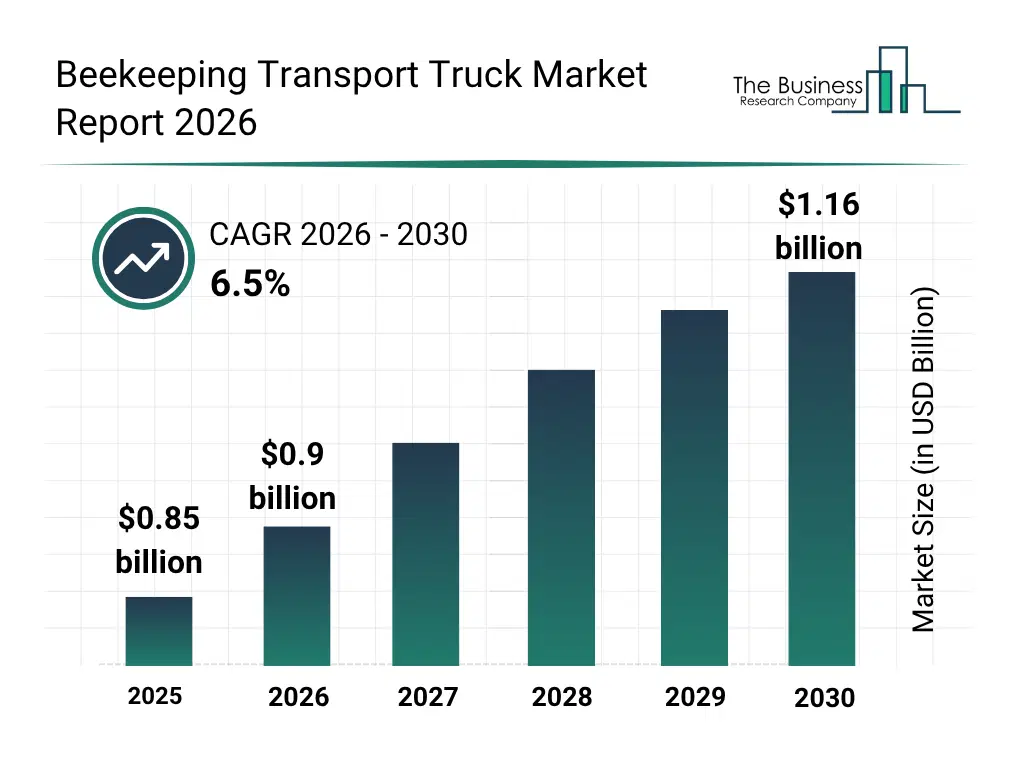
What Is The Beekeeping Transport Truck Market Size and Share 2026?
The beekeeping transport truck market size has grown strongly in recent years. It will grow from $0.85 billion in 2025 to $0.9 billion in 2026 at a compound annual growth rate (CAGR) of 6.3%. The growth in the historic period can be attributed to increasing demand for commercial honey production, growth of migratory beekeeping practices, rising need for crop pollination services, expansion of agricultural acreage requiring pollination, adoption of basic hive transport vehicles.What Is The Beekeeping Transport Truck Market Growth Forecast?
The beekeeping transport truck market size is expected to see strong growth in the next few years. It will grow to $1.16 billion by 2030 at a compound annual growth rate (CAGR) of 6.5%. The growth in the forecast period can be attributed to growing demand for managed pollination services, increasing adoption of electric and low-emission transport trucks, rising focus on bee colony health monitoring during transport, expansion of precision agriculture requiring pollination logistics, development of smart climate-controlled beekeeping transport systems. Major trends in the forecast period include increasing adoption of climate-controlled beekeeping transport trucks, rising demand for ventilated hive transport systems for colony safety, growing use of hydraulic loading and unloading mechanisms, expansion of pollination service-driven migratory beekeeping operations, increasing integration of modular hive rack configurations for transport efficiency.Global Beekeeping Transport Truck Market Segmentation
1) By Truck Type: Flatbed Trucks, Box Trucks, Refrigerated Trucks, Custom Beekeeping Trucks, Other Truck Types 2) By Payload Capacity: Light Duty, Medium Duty, Heavy Duty 3) By Distribution Channel: Direct Sales, Dealerships, Online Sales, Other Distribution Channels 4) By Application: Commercial Beekeeping, Hobbyist Beekeeping, Pollination Services, Other Applications 5) By End-User: Beekeepers, Apiary Service Providers, Agricultural Enterprises, Other End Users Subsegments: 1) By Flatbed Trucks: Standard Flatbed Trucks, Drop Side Flatbed Trucks, Stake Body Flatbed Trucks, Aluminum Flatbed Trucks, Steel Flatbed Trucks 2) By Box Trucks: Dry Freight Box Trucks, Insulated Box Trucks, Ventilated Box Trucks, Liftgate Equipped Box Trucks, Curtain Side Box Trucks 3) By Refrigerated Trucks: Single Temperature Refrigerated Trucks, Multi Temperature Refrigerated Trucks, Chiller Equipped Refrigerated Trucks, Freezer Equipped Refrigerated Trucks, Hybrid Cooling Refrigerated Trucks 4) By Custom Beekeeping Trucks: Hydraulic Loader Equipped Beekeeping Trucks, Integrated Hive Rack Beekeeping Trucks, Climate Controlled Beekeeping Trucks, Multi Tier Hive Carrier Trucks, Side Loading Beekeeping Trucks 5) By Other Truck Types: Tilt Bed Trucks, Low Bed Transport Trucks, All Terrain Beekeeping Trucks, Electric Powered Transport Trucks, Hybrid Powered Transport TrucksWhat Are The Drivers Of The Beekeeping Transport Truck Market?
The increasing demand for commercial honey production is expected to propel the growth of the beekeeping transport truck market going forward. Commercial honey production refers to the large-scale cultivation and harvesting of honey by managed bee colonies for sale in domestic and international markets. Demand for honey production is increasing as consumers shift toward natural sweeteners instead of processed sugars, driven by growing health and wellness trends. Beekeeping transport trucks support commercial honey production by allowing beekeepers to efficiently move hives to areas with abundant nectar sources and nearby processing facilities, reducing transit time and preserving honey quality. For instance, in June 2025, according to the U.S. Department of Agriculture, a US-based government department, total U.S. honey production increased from 125.3 million pounds in 2022 to 139.5 million pounds. Therefore, an increasing demand for commercial honey production is driving the growth of the beekeeping transport truck industry. The rising pollination demand from agriculture is expected to propel the growth of the beekeeping transport truck market going forward. Pollination demand from agriculture refers to the increasing need for managed bee colonies to fertilize crops, driven by the expansion of pollinator-dependent food production. The pollination demand is rising primarily due to the rapid growth in specialty crop cultivation, such as almonds, berries, and fruits, which rely almost entirely on insect pollination for successful yields, prompting farmers to lease bee colonies at a growing scale. As more farmland is dedicated to pollinator-dependent crops, the need to transport bee colonies across regions intensifies, directly increasing demand for specialized beekeeping transport trucks. For instance, in March 2024, according to the U.S. Department of Agriculture (USDA), a UD-based government department responsible for producing official agricultural statistics, pollination income in the United States rose to $255 million in 2023, up 6 percent from $241 million in 2022. Therefore, rising pollination demand from agriculture is driving the growth of the beekeeping transport truck industry. The rising beeswax export demand is expected to propel the growth of the beekeeping transport truck market going forward. Beeswax export is the global trade of beeswax derived from honeybee hives for use in industries such as cosmetics, pharmaceuticals, food processing, and candle production. The beeswax export demand is primarily rising due to the rapid expansion of the natural and organic personal care industry, where beeswax serves as a key ingredient, prompting manufacturers across the globe to source larger volumes of beeswax from producing regions. Beekeeping transport trucks support beeswax export by enabling the efficient transport of bee colonies and harvested wax from apiaries to processing and export facilities, ensuring product quality and timely trade. For instance, in March 2024, according to the NSW Government, an Australia-based state government department, New South Wales beeswax exports reached $14.3 million in 2023–24, representing a 27% year-on-year increase. Therefore, rising beeswax export demand is driving the growth of the beekeeping transport truck industry.Key Players In The Global Beekeeping Transport Truck Market
Major companies operating in the beekeeping transport truck market are FAW Group Corporation, BeeWise Technologies Ltd., MaxiTRANS Industries Limited, ŁYSOŃ, Nova Trailer, Midland Pty Ltd, Bee Trailers, Miller Honey Farms Inc., Abelo Ltd., POLDINGROUP Sp. z o.o., LINYI GAMA MACHINERY CO. LTD., ANEL d.o.o., Shandong Tianhong Industrial Co. Ltd., Humbaur GmbH, Shanghai Vift Machinery Co. Ltd., Maanshan Jieling International Trade Co. Ltd., Shandong Yunyong International Co. Ltd., Xuzhou Bonovo Machinery & Equipment Co. Ltd., Henan Multi-Sweet Beekeeping Technology Co. Ltd., Qingdao Haiju Industrial Co. Ltd.Regional Insights
North America was the largest region in the beekeeping transport truck market in 2025. Asia-Pacific is expected to be the fastest-growing region in the forecast period. The regions covered in this market report are Asia-Pacific, South East Asia, Western Europe, Eastern Europe, North America, South America, Middle East, Africa. The countries covered in this market report are Australia, Brazil, China, France, Germany, India, Indonesia, Japan, Taiwan, Russia, South Korea, UK, USA, Canada, Italy, Spain.What Defines the Beekeeping Transport Truck Market?
The beekeeping transport truck market consists of sales of hive pallet transport systems, hydraulic hive loading platforms, ventilated hive carrier modules, bee colony securing frames. Values in this market are ‘factory gate’ values, that is, the value of goods sold by the manufacturers or creators of the goods, whether to other entities (including downstream manufacturers, wholesalers, distributors, and retailers) or directly to end customers. The value of goods in this market includes related services sold by the creators of the goods.How is Market Value Defined and Measured?
The market value is defined as the revenues that enterprises gain from the sale of goods and/or services within the specified market and geography through sales, grants, or donations in terms of the currency (in USD unless otherwise specified). The revenues for a specified geography are consumption values that are revenues generated by organizations in the specified geography within the market, irrespective of where they are produced. It does not include revenues from resales along the supply chain, either further along the supply chain or as part of other products.What Key Data and Analysis Are Included in the Beekeeping Transport Truck Market Report 2026?
The beekeeping transport truck market research report is one of a series of new reports from The Business Research Company that provides market statistics, including industry global market size, regional shares, competitors with the market share, detailed market segments, market trends and opportunities, and any further data you may need to thrive in the beekeeping transport truck industry. The market research report delivers a complete perspective of everything you need, with an in-depth analysis of the current and future state of the industry.Beekeeping Transport Truck Market Report Forecast Analysis
| Report Attribute | Details |
|---|---|
| Market Size Value In 2026 | $0.9 billion |
| Revenue Forecast In 2035 | $1.16 billion |
| Growth Rate | CAGR of 6.3% from 2026 to 2035 |
| Base Year For Estimation | 2025 |
| Actual Estimates/Historical Data | 2020-2025 |
| Forecast Period | 2026 - 2030 - 2035 |
| Market Representation | Revenue in USD Billion and CAGR from 2026 to 2035 |
| Segments Covered | Truck Type, Payload Capacity, Distribution Channel, Application, End-User |
| Regional Scope | Asia-Pacific, Western Europe, Eastern Europe, North America, South America, Middle East, Africa |
| Country Scope | The countries covered in the report are Australia, Brazil, China, France, Germany, India, ... |
| Key Companies Profiled | FAW Group Corporation, BeeWise Technologies Ltd., MaxiTRANS Industries Limited, ŁYSOŃ, Nova Trailer, Midland Pty Ltd, Bee Trailers, Miller Honey Farms Inc., Abelo Ltd., POLDINGROUP Sp. z o.o., LINYI GAMA MACHINERY CO. LTD., ANEL d.o.o., Shandong Tianhong Industrial Co. Ltd., Humbaur GmbH, Shanghai Vift Machinery Co. Ltd., Maanshan Jieling International Trade Co. Ltd., Shandong Yunyong International Co. Ltd., Xuzhou Bonovo Machinery & Equipment Co. Ltd., Henan Multi-Sweet Beekeeping Technology Co. Ltd., Qingdao Haiju Industrial Co. Ltd. |
| Customization Scope | Request for Customization |
| Pricing And Purchase Options | Explore Purchase Options |